A vessel calling at Shanghai or Tianjin carries 50+ statutory certificates that must be valid, endorsed, and available on demand. One expired certificate or missed survey endorsement triggers detention by China MSA, which enforces Tokyo MOU standards with additional Chinese requirements and 100% inspection rates for high-risk vessels. With six SOLAS amendments effective January 1, 2026 and China's revised Maritime Code granting electronic records legal parity from May 2026, fleet operators can sign up for Marine Inspection's certificate management platform to automate expiry monitoring, survey scheduling, and PSC readiness across the entire fleet.
50+
Certificates Per Vessel
Statutory, class & operational documents required onboard
6
New SOLAS Amendments
Major changes effective 1 January 2026
15%
China MSA Detention Rate
Immediate operational halt for non-compliance
May 2026
Revised Maritime Code
E-records gain legal parity with paper
SOLAS Amendments Effective January 1, 2026
IMO Resolution MSC.532(107) and related instruments introduce six changes affecting certificates, surveys, and onboard equipment. Each has different timelines for newbuildings versus existing ships, and China MSA enforces the earliest applicable deadline.
PFOS Ban in Firefighting Foams
SOLAS II-2/10.11
Prohibits PFOS above 10 mg/kg. Existing ships comply by first survey after 1 Jan 2026. Affects CSSE/CSSC endorsement.
Lifting Appliances Safety
SOLAS II-1/3-13
Mandatory standards for all onboard lifting appliances. Load testing required by first renewal survey. PMS integration per MSC.1/Circ.1663.
SOLAS V/19.2.12
Containerships and bulk carriers 3,000 GT+ built after 1 Jan 2026 must record roll motion. Reflected in Safety Equipment Certificate.
Vehicle Carrier Fire Safety
SOLAS II-2/20
Enhanced fire detection and suppression for vehicle carriers. New builds from 1 Jan 2026; existing ships partial compliance by 1 Jan 2028.
Cargo Ship Fire Detection
SOLAS II-2/7.5.5
Fire detection extended to control stations and accommodation on cargo ships built after 1 Jan 2026.
SOLAS XIV
Now covers fishing vessels 24m+, pleasure yachts 300 GT+, and cargo ships 300-500 GT in polar waters.
Statutory Certificate Matrix: Survey Cycles & Validity
Missing a single endorsement causes a certificate to cease regardless of the expiry date printed on it. Operators managing multi-vessel certificate portfolios can schedule a compliance dashboard walkthrough to see how automated tracking calculates actual compliance windows rather than simple expiry monitoring.
Key Statutory Certificates
| Certificate | Convention | Validity | Survey Cycle |
| Cargo Ship Safety Construction |
SOLAS I/12 |
5 years |
Annual + Intermediate (2nd-3rd yr) + Renewal |
| Cargo Ship Safety Equipment |
SOLAS I/12 |
5 years |
Annual + Periodical (2nd-3rd yr) + Renewal |
| Cargo Ship Safety Radio |
SOLAS I/12 |
5 years |
Annual + Periodical (2nd-3rd yr) + Renewal |
| Safety Management (SMC) |
ISM / SOLAS IX |
5 years |
Intermediate verification (2nd-3rd yr) |
| Ship Security (ISSC) |
ISPS / SOLAS XI-2 |
5 years |
Intermediate verification (2nd-3rd yr) |
| International Load Line |
LL Conv. 1966 |
5 years |
Annual |
| Oil Pollution Prevention (IOPP) |
MARPOL I |
5 years |
Annual + Intermediate + Renewal |
| Air Pollution Prevention (IAPP) |
MARPOL VI |
5 years |
Annual + Intermediate + Renewal |
| Energy Efficiency (IEE) |
MARPOL VI |
No expiry |
Initial survey only |
| Tonnage Certificate |
Tonnage 1969 |
No expiry |
Re-measurement if structural changes |
Key Statutory Certificates
Cargo Ship Safety Construction
SOLAS I/12 — 5 yrs — Annual + Intermediate + Renewal
Cargo Ship Safety Equipment
SOLAS I/12 — 5 yrs — Annual + Periodical + Renewal
Cargo Ship Safety Radio
SOLAS I/12 — 5 yrs — Annual + Periodical + Renewal
Safety Management (SMC)
ISM / SOLAS IX — 5 yrs — Intermediate (2nd-3rd yr)
Ship Security (ISSC)
ISPS / SOLAS XI-2 — 5 yrs — Intermediate (2nd-3rd yr)
International Load Line
LL Conv. 1966 — 5 yrs — Annual
Oil Pollution Prevention (IOPP)
MARPOL I — 5 yrs — Annual + Intermediate + Renewal
Air Pollution Prevention (IAPP)
MARPOL VI — 5 yrs — Annual + Intermediate + Renewal
Energy Efficiency (IEE)
MARPOL VI — No expiry — Initial only
Tonnage Certificate
Tonnage 1969 — No expiry — Re-measurement if changes
China-Specific Compliance Beyond IMO Standards
China MSA adds requirements beyond IMO conventions that are a frequent source of PSC deficiencies. Operators calling at Chinese ports can sign up for Marine Inspection's free trial to access the regulatory database mapping these China-specific requirements to actionable checklist items.
01
Revised Maritime Code (May 1, 2026)
16 chapters, 310 articles. E-records gain legal parity (Articles 82-86). Raises carrier liability, adds oil pollution damage chapter.
02
MSA Safety Management Certification
Maritime Traffic Safety Law requires Chinese-flagged vessels to hold MSA-issued compliance certificates separate from ISM DOC/SMC.
03
CCS Classification Rules (Jan 2026)
New Sea-Going Steel Ships rules (RCN No.3) effective 1 Jan 2026. CCS surveys 36,000+ ships (210M GT) with digital-first workflows.
04
Electronic Seafarer Certificates
MSA Jan 2026 notice accepts electronic STCW certification for unlimited navigation areas alongside paper documents.
05
Bilingual Docs & Flag Display
Chinese translations required for cargo manifests, crew lists, and DG declarations. MSA actively penalises flag display violations.
06
EU ETS for China-EU Routes
70% CO2 allowance surrender from 2026 (up from 40%). CH4 and N2O included for the first time.
Automate Certificate Tracking Across Your Fleet
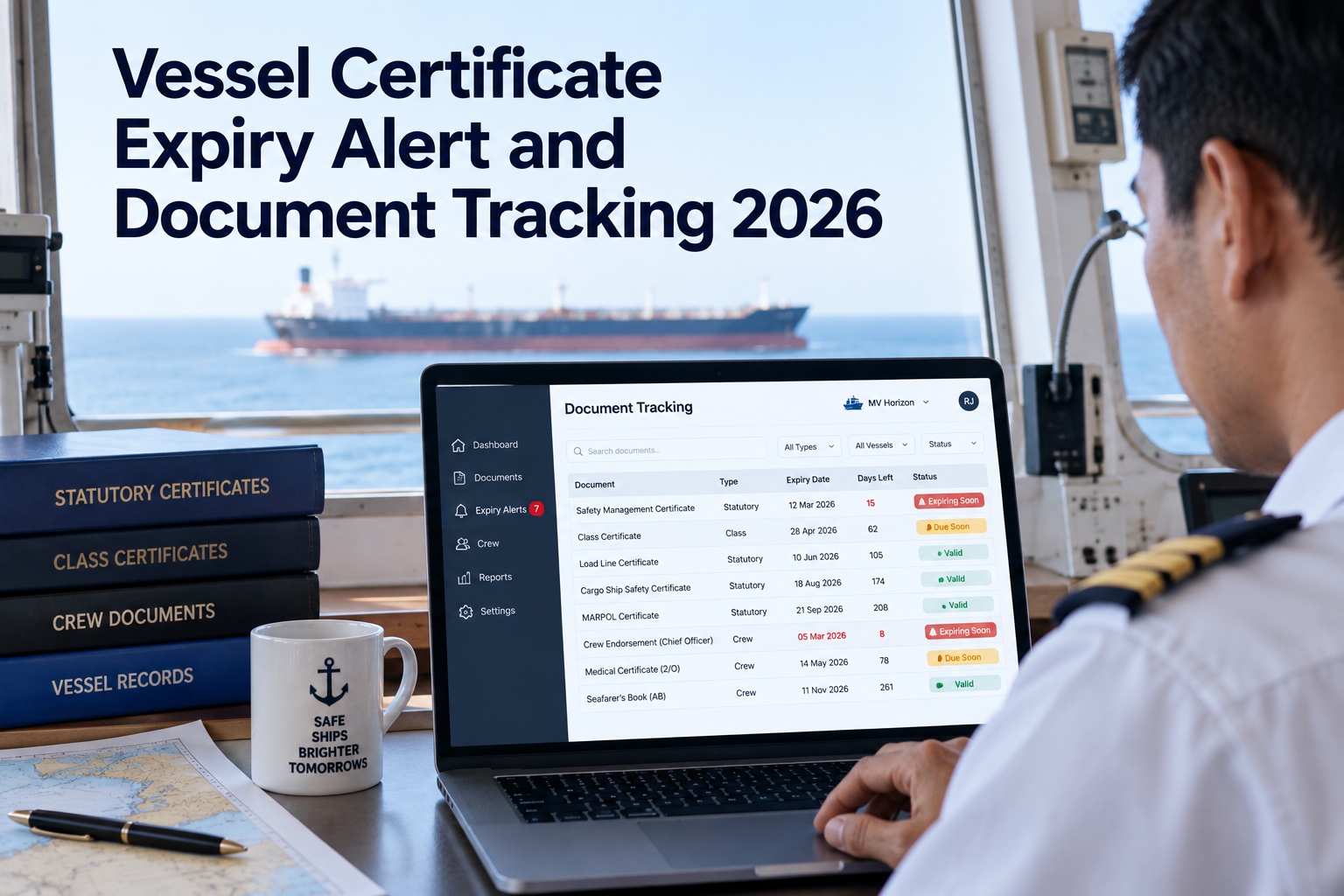
Marine Inspection tracks every statutory certificate, calculates compliance windows including endorsement deadlines, and generates automated alerts at 90, 60, and 30 days before expiry for continuous PSC readiness.
Expert Review: Certificate Compliance Strategy
Certificate failures in China stem from three root causes. First, tracking systems monitor expiry dates but miss survey endorsement windows. A CSSC ceases if annual endorsement isn't completed within three months of the anniversary, creating ten compliance deadlines per cycle. Operators who schedule a demo of survey-window-based compliance tracking eliminate this category entirely.
Second, six SOLAS amendments create one-time compliance actions sequenced against each vessel's survey schedule. The PFOS ban applies at "first survey" after January 2026, meaning deadlines vary by vessel. For a 20-ship fleet, this one amendment produces 20 different deadlines.
Third, China MSA adds requirements not in standard international checklists: mandatory SMS certification, bilingual documentation, and national flag display rules are all active enforcement items resulting in penalties.
Digital Compliance: Essential Platform Capabilities
For fleets managing 50+ documents per vessel across 10-50 ships, manual tracking creates inevitable gaps. These capabilities distinguish maritime-grade platforms from generic systems — sign up to deploy Marine Inspection fleet-wide and eliminate certificate-related detentions.
Survey Window Modelling
Calculates actual compliance windows based on anniversary dates and endorsement margins. Alerts when planning must begin, not when certificates lapse.
Amendment Impact Mapping
Identifies affected vessels by type, GT, and survey schedule. Generates vessel-specific action plans with calculated deadlines.
PSC Readiness Scoring
Continuous assessment based on certificate validity, deficiencies, and crew certification scored against China MSA targeting criteria.
Multi-Flag Portfolio Management
Handles vessels across flag states with varying requirements and recognised organisations in a unified dashboard.
Build a Detention-Proof Compliance System
Marine Inspection tracks every certificate, maps SOLAS amendment impacts to individual vessels, and maintains continuous PSC readiness scoring built for China's regulatory environment.
Frequently Asked Questions
What are the major SOLAS amendments effective January 1, 2026?
Six amendments under IMO Resolution MSC.532(107) and MSC.550(108): PFOS ban in firefighting foams (SOLAS II-2/10.11), lifting appliance standards (SOLAS II-1/3-13), electronic inclinometer for containerships/bulk carriers 3,000 GT+ (SOLAS V/19.2.12), vehicle carrier fire safety (SOLAS II-2/20), extended cargo ship fire detection (SOLAS II-2/7.5.5), and expanded Polar Code. Each has different timelines for new versus existing ships.
How does China MSA enforce SOLAS compliance differently?
China MSA (11 regional branches, 70+ offices) follows Tokyo MOU standards plus Chinese-specific requirements: 100% inspection for high-risk vessels, mandatory Chinese-language translations, separate SMS certification under the Maritime Traffic Safety Law, national flag display enforcement, and Beidou navigation compatibility. Detentions are recorded in the Tokyo MOU database, affecting future targeting across Asia-Pacific.
What happens if a certificate endorsement is missed?
The certificate ceases to be valid regardless of the expiry date. SOLAS annual surveys must be completed within three months before or after each anniversary. SMC and ISSC require intermediate verification between the second and third anniversary. Operating with a ceased certificate is a detainable deficiency. Extensions for vessels not in port are limited to completing the voyage, not exceeding three months.
How does China's revised Maritime Code affect certificate management?
Effective May 1, 2026, Articles 82-86 grant legal parity to electronic transport records that are complete, retrievable, issuer-identifiable, and holder-verifiable. The code unifies domestic/international carriage rules, raises liability limits, and adds oil pollution damage provisions. Digital systems must meet these four statutory conditions.
What is the cost of PSC detention versus compliance software?
A single detention in China averages $2-5M total (off-hire, repairs, penalties, reputation damage via Tokyo MOU records). Maritime compliance platforms cost $50,000-150,000 annually per vessel. Even preventing one deficiency that delays operations pays for annual costs, with most operators achieving ROI within the first month.