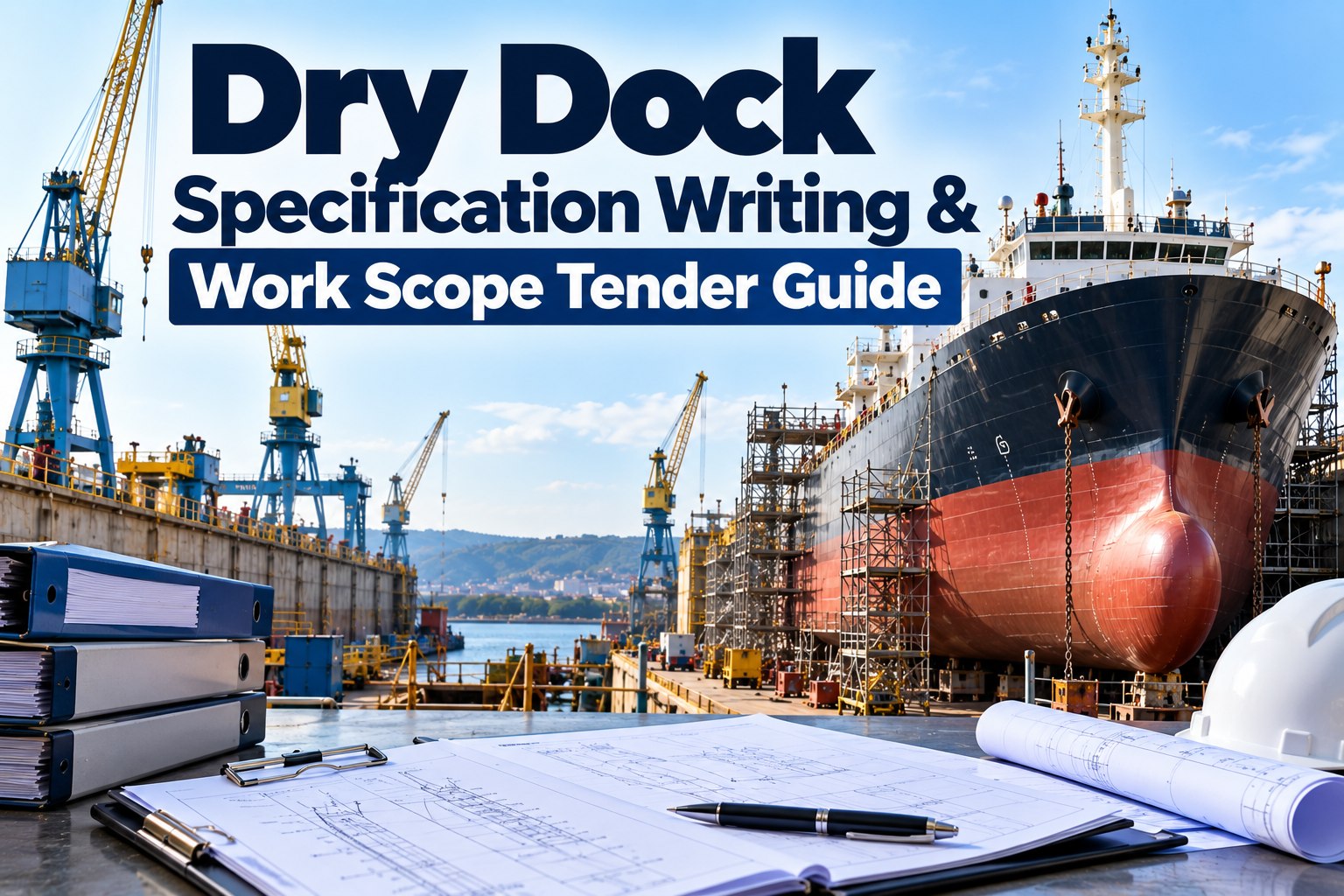
A dry dock specification is the document that decides whether yard quotes can be compared at all. When the work list is vague, each yard prices its own reading of it, the cheapest bid is often the one that left something out, and the gap turns up as variation orders once the ship is in dock. For a Technical Superintendent, writing the specification line by line is the cheapest cost control available. This guide shows how to structure it, how to write each line, what goes into the yard quotation package and how to compare bids.
- Write the specification 4 to 6 months before docking, after a superintendent ship visit, and send it to yards as a numbered, line-by-line package.
- Every line needs location, dimensions, material, quantity, test and a pricing basis. Add photographs wherever condition is in doubt.
- Ask yards to price every line, and compare dock days, unit rates and exclusions as well as the total.
- Agree how unforeseen work is priced and approved in writing before docking.
- Send the full yard package 30 to 60 days before arrival, per Marine Inspection's guide.
Why a Vague Dry Dock Specification Starts the Overrun
Marine Inspection's dry docking guide describes the specification as the stage where the technical superintendent develops a detailed work specification with a clear scope per item, covering steel renewal plans, coating specifications, machinery work scope and spare parts with delivery schedules, all aligned with class survey requirements. A ship management article makes the same point from the cost side: the better the specification is prepared, the more transparent the yard's quotation will be and the fewer disputes follow.
The reverse is expensive. Our dry dock cost breakdown guide notes that scope gaps found after the contract typically cost 2 to 3 times the pre-tender rate, according to Marine Inspection's guide. Every item missing from the tender is priced at the yard's mid-dock rate, not the competitive tender rate.
Three ways a weak specification costs money
- Non-comparable bids. Yards price different scopes, so the lowest bid is a guess about which lines were assumed.
- Variation orders. Work that was needed but not written is added in dock at premium rates and with extra days.
- Disputes. Without dimensions, photos and acceptance criteria, both sides argue about what was agreed.
Anatomy of a Dry Dock Specification
There is no single mandatory layout, and yards and ship managers use their own templates. The nine-section structure below is our suggested way to organise a specification so each department's work is complete and each section has an owner. Adjust it to your company's format.
| Section | What goes in | Common gap |
|---|---|---|
| General and yard services | Dock hire, docking plan, shore power, water, cranes, gangway, waste, fire watch | Services priced per day with no stated limit |
| Hull and docking | Cleaning, blasting, coating areas and system, anodes, marks, blocking | Coating area given as a total, not by zone |
| Steel and structural | Renewal locations, plate sizes, gauging plan, crop-and-renew rates | Unit rates missing for unforeseen steel |
| Tanks | Cleaning, inspection, coating repair, tests | Gas-free and access arrangements left out |
| Machinery and propulsion | Main engine, auxiliaries, shaft, propeller, rudder, thrusters | Overhaul scope given as 'inspect and repair as found' |
| Piping, valves and sea chests | Renewals, overhauls, hydro tests, overboard valves | No pipe size, length or test requirement |
| Electrical and automation | Motors, switchboards, alarm and sensor work | Spares and calibration responsibility unclear |
| Safety and statutory | Class survey items, lifesaving, fire fighting, load line, ballast water system | Survey witness times not stated |
| Owner supplies and logistics | Spares, deliveries, crew, superintendent, attendance | Delivery dates and customs paperwork not agreed |
How to Write a Specification Line That a Yard Can Price
Each job in the specification is a numbered line. A line that a yard can price without a question contains the same set of fields every time. Use this set as a template for every item.
Weak lines and specified lines
| Weak line | Specified line | Why it matters |
|---|---|---|
| Renew pipe in engine room | Renew galvanised black steel pipe DN250, L=2000 mm, two 45 degree bends, one penetration, ER Deck 2 SB, Fr. 24. Photo attached. | The second line comes from a ship management example. It tells the yard what to price. |
| Clean and paint tanks | Blast SA 2.5 and recoat ballast tank 4P, 380 m2 bottom and lower sides, two coats of the specified system, DFT stated, hold point before final coat. | Our own example. Area, standard and hold point are stated. |
| Overhaul pump as required | Overhaul cargo pump 2 per maker's manual, replace listed parts, test on the pier, owner supplies the kit, yard supplies labour. | Our own example. Responsibility and test are stated. |
The ship management article also stresses crew involvement, because the crew know the condition of the ship best, and attaching photographs to remove ambiguity that leads to cost disputes.
Where the Scope Comes From
A specification built from memory misses things. Marine Inspection's guide says the technical superintendent should make a ship visit to identify all repairs before the specification is finalised. Pull the list from several sources, and record where each item came from.
- Class and statutory items. Survey requirements due in this dock, always in the specification.
- Condition survey and gauging. Thickness readings, coating condition and tank inspections.
- Crew input. Defects and issues the ship staff have noted over the last cycle.
- Planned maintenance data. Running hours, overdue jobs and equipment trends.
- Previous dock lessons. What was missed or underestimated last time.
- Outstanding observations. Open inspection and audit findings that need dock access to close.
Mark each item must-do, deferrable or opportunistic
Once items are collected, label them so the tender can be priced in layers. Class and safety work is must-do. Condition-based work that can wait to the next window is deferrable. Optional improvements need a business case. Our dry dock planning timeline guide covers this three-way split and the scope freeze that follows it.
Unit Rates and Pricing Basis for Unforeseen Work
However good the specification, steel and pipe findings will appear once tanks are opened and paint is blasted. The tender is the moment to price them, when yards are competing, not in dock. Ask each yard for unit rates for steel renewal per tonne, pipe per metre, coating per square metre and labour per hour, and agree how extra work is approved.
A ship management article advises asking how unforeseen works will be priced and approved, and whether there is an escalation clause, and settling this in writing early rather than on the spot in dock.
The Yard Quotation Package: What to Send
Marine Inspection's guide says yards receive a yard quotation package in Refman or BASSnet format, so that competing quotations can be compared in a standard way. Whatever template you use, the package should contain the following.
- The full specification, with a numbered line for every job
- Docking plan, general arrangement and tank capacity plans
- Condition survey reports and thickness gauging results
- Photographs linked to the line they support
- Class survey status and the survey items due in dock
- Required dock and repair-berth days, and the target dates
- Terms: payment, penalties for delay, warranty and insurance
- The pricing format the yard must return, including unit rates and day rates
Ask yards to return prices against your line numbers, not in their own layout. A Hellenic Shipping News article about a tender portal vendor describes the cost of the opposite: quotations that arrive in different formats, with missing details, manual entry into comparison matrices and price revisions scattered across email threads.
Comparing Yard Quotes: Beyond the Total
Marine Inspection's guide recommends line-by-line price analysis for apples-to-apples comparison, then cost negotiation per line item, rather than lump-sum bids. It also advises negotiating realistic repair days, split into dock days and repair-berth days. Before comparing totals, normalise each bid with the checks below.
| Check | Question to ask | Why it matters |
|---|---|---|
| Same scope | Does every yard price every line, with no 'by others' or exclusions? | Priced differently, not priced less |
| Dock and berth days | Are dock days and repair-berth days quoted separately and realistically? | Cheap quote with longer days costs more in off-hire |
| Unit rates | Are steel, pipe, coating and labour rates quoted for unforeseen work? | Mid-dock scope gaps can cost 2 to 3 times the pre-tender rate |
| Services and extras | Which items are daily charges, and which are capped? | Services can swing the total |
| Exclusions and assumptions | What does the quote assume about access, weather and owner supplies? | Hidden assumptions become variations |
| Payment and penalties | What are the payment stages, delay terms and warranty? | Commercial risk sits outside the price |
| Yard record | What is the yard's record on similar ships and on variation orders? | Track record predicts behaviour in dock |
Our dry dock cost breakdown guide explains why days matter: an extra day of off-hire can equal several percent of a direct budget, so a yard that quotes fewer days at a higher price may still be cheaper overall.
Contract Basis and Written Approvals
A ship management article calls the general contract the most critical document and says it should define the total timeframe, the budget and the terms and penalties for delays or underperformance. Marine Inspection's guide points to the BIMCO REPAIRCON contract basis. BIMCO describes REPAIRCON 2018 as a framework agreement that should be the first choice for major ship repair projects. We could not confirm from BIMCO's current catalogue page whether a newer edition exists, so check the current edition and take legal advice before using it.
The same article says verbal agreements must be followed up in writing. Build that rule into the project: every approved change should have a date, a price, a time impact and a named approver.
Common Dry Dock Specification Mistakes
Systems for Specification Development and Tender
Specifications grow through dozens of revisions, and yards need the latest version with its photographs. Marine Inspection supports specification development with version control, distribution of the yard documentation package, daily progress tracking and real-time cost monitoring, as described in its own dry docking guide. Dated photos linked to each finding, and observations turned into tasks with owners, deadlines and evidence, help each line start with proof of condition and finish with proof of completion.