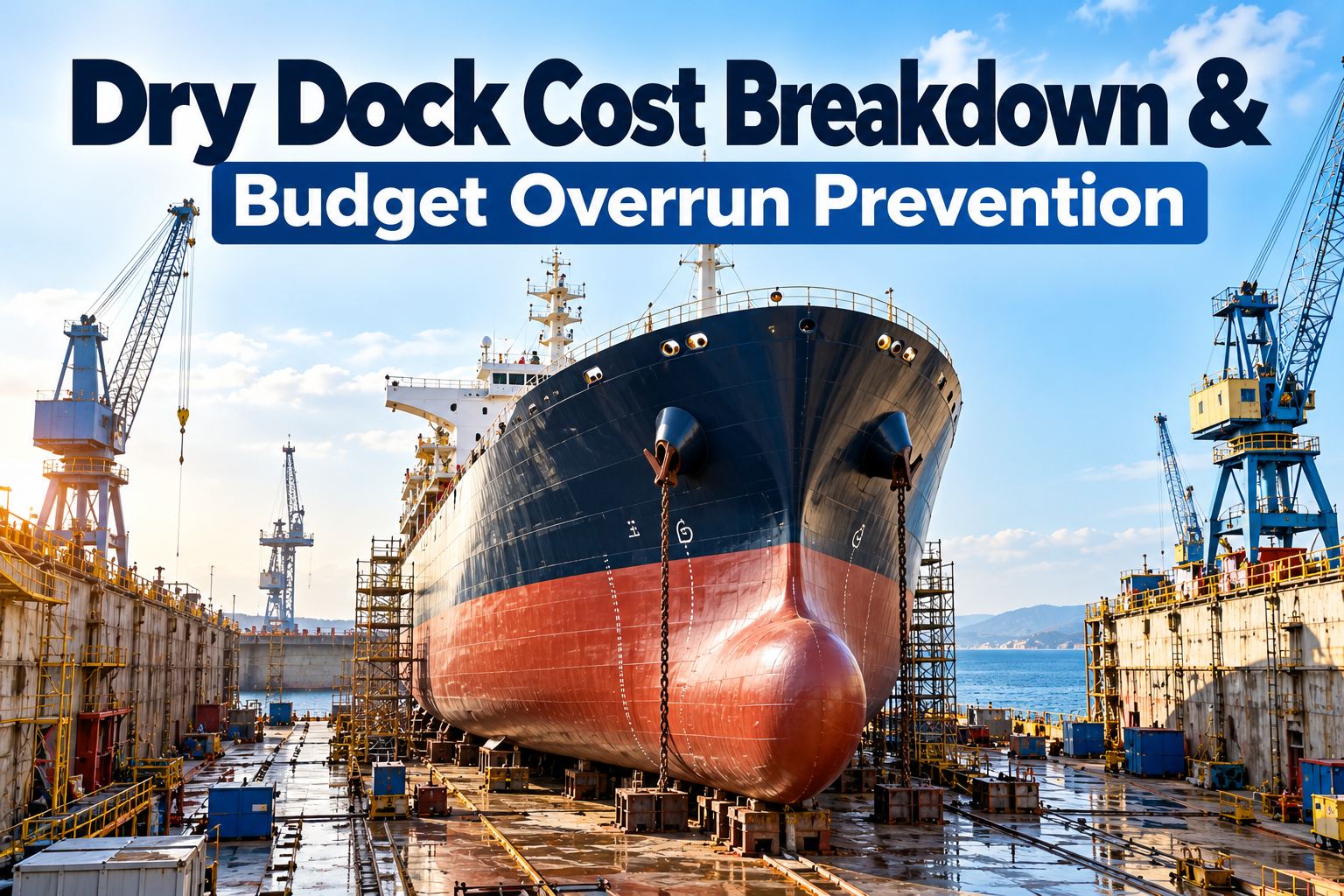
A dry dock cost breakdown starts with one uncomfortable fact: the yard quote is only part of what a docking costs, and it is rarely the part that overruns. For a Fleet Manager approving a project of $500,000 to $3 million or more, the real question is where money goes, where it leaks, and how much reserve to hold. This guide splits the cost into buckets, shows the seven leaks that push budgets up, and sets out contingency and control methods you can apply to the next dock.
- Budget six yard and owner cost buckets, and track off-hire as a separate commercial cost.
- Most overrun comes from seven leaks: late scope, discovery items, extra days, mid-dock rates, mandatory retrofits, material prices and soft costs.
- Marine Inspection's guide recommends 10 to 15% contingency. Use it for discoveries and control scope growth with a freeze date.
- One extra day of off-hire can equal several percent of the direct budget, so price every variation in days as well as dollars.
- Reported overrun figures differ by source, from 10 to 15% to 15 to 25%. We found no independent public statistic.
Dry Dock Cost Breakdown: Where the Money Goes
Direct dry dock cost runs from $500,000 to more than $3 million in Marine Inspection's dry docking guide, depending on vessel size and scope. Inside that figure, a ship repair cost tool published by Ship Universe groups spending into six buckets, which is a practical way to build and review a budget line by line.
| Cost bucket | What it covers | What drives it | Variable to watch |
|---|---|---|---|
| Yard daily charges | Dock hire, mobilisation, services | Fixed by yard tariff and days in dock | Dock days |
| Hull cleaning and coating | Blasting, surface preparation, paint system | Area, coating spec, weather | Area and paint spec |
| Steel renewal | Plate and structural repairs | Wastage found at inspection | Gauging results |
| Machinery and propulsion | Engine, shaft, rudder, valves, pumps | Overhaul scope and spares | Running hours and condition |
| Class, survey and statutory | Surveys, tank tests, certificates | Dictated by the survey window | Class items due |
| Owner supplies and logistics | Spares, crew, superintendent, travel | Lead times and freight | Long-lead items |
Marine Inspection's guide also gives upper-end ranges by work stream: hull and structure $100,000 to $800,000 or more, machinery systems $80,000 to $500,000 or more, underwater components $50,000 to $300,000, tank inspections $40,000 to $200,000, and safety equipment and statutory work $30,000 to $150,000. Hull and structure is the widest range because it holds steel renewal, the least predictable item. Our dry dock planning timeline guide shows when each of these decisions has to be made.
Yard Cash vs Commercial Cost
Ship Universe's calculator makes a distinction worth copying: lost contribution per day is a commercial opportunity cost, not yard cash. Keep the two apart in your budget. Yard cash is what the yard and suppliers invoice. Commercial cost is what the ship does not earn while it sits in dock.
Why the split matters
- Different owners. The Technical Superintendent controls most yard cash. The commercial team owns the off-hire assumption.
- Different levers. Yard cash is reduced through scope and tender discipline. Commercial cost is reduced by fewer days.
- Different exposure. Marine Inspection's guide puts off-hire beyond the planned duration at $20,000 to $50,000 per day. Another guide quotes $20,000 to $100,000 depending on ship type. A balancia article uses a container ship at $30,000 a day, so a five-day extension costs $150,000 in lost income before any repair bill.
A useful habit is to state every variation order in two numbers: the repair cost and the days it adds. The second number often decides whether the work is approved.
Seven Dry Dock Cost Leaks and How to Seal Them
Reading the sources together, overruns come from a short list of causes rather than from random bad luck. Each one has a point where it can be caught earlier.
The sources disagree on the typical overrun: 15 to 25% in one guide and 10 to 15% in another. The point is not which is right. It is that both are large enough to justify the controls below.
Dry Dock Contingency: How Much to Hold and What It Is For
Marine Inspection's guide recommends 10 to 15% contingency in the budget approval. That is a sound starting point, but the number matters less than what the reserve is allowed to pay for. If it covers scope that should have been frozen, it will be gone before the first tank is opened.
A risk-tiered approach
We suggest setting the reserve by how likely the ship is to produce discovery items. The tiers below are our own, anchored to the 10 to 15% baseline. The higher tier goes above it because older ships with open scope can exceed it, so adjust the figures to your own history.
| Risk tier | Typical profile | Contingency | Most likely call on it |
|---|---|---|---|
| Lower risk | Younger ship, recent thickness gauging, clean tank history, scope frozen | About 10% | Mostly small discoveries and days |
| Typical | Mid-life ship, some coating breakdown, normal class items | About 12% | Steel and coating area growth |
| Higher risk | Older ship, known corrosion, no recent gauging, open scope | 15% or more, with steel held separately | Steel renewal and extra days |
Five Controls That Prevent Dry Dock Budget Overrun
Marine Inspection's guide lists the controls that reduce typical overruns. We have grouped them into five actions, and added a vendor-sourced scope trio.
- Specification first. A comprehensive pre-dock specification closes the gaps that cost 2 to 3 times more in dock.
- Line-by-line tender analysis. Compare yards on every item, not the total, and check variation order rates.
- Real-time cost tracking. Compare spend with the Gantt plan daily so the forecast moves before the invoice does.
- Change order control. Require evidence for every variation, with a price, a time impact and a named approver.
- A contract framework. The guide points to the BIMCO RepairCon framework for dispute resolution.
Scope freeze, single owner, decision matrix
An iShipPlus article, from a software vendor, recommends three structural fixes: freeze work scope four weeks before arrival and treat later additions as change orders, name one accountable owner for parts as critical path, and give on-site representatives a decision matrix with approval authority and response times. The article claims owners who do all three routinely finish within 3% of budget. We could not verify that figure independently, but the logic is consistent with the leaks above.
Variation Order Approval Ladder
Slow decisions cost days, and uncontrolled decisions cost money. An approval ladder fixes both by saying who can approve what, and how fast. The thresholds below are our illustrative template. Set yours against the size of your own budgets.
| Approver | Variation size | What is required |
|---|---|---|
| Dock superintendent | Up to 0.5% of approved budget | Same-day approval, recorded with photos and price |
| Technical Superintendent | 0.5% to 2% | Written variation order with time impact |
| Fleet Manager | 2% to 5% | Business case: cost, days, risk of deferral |
| Fleet Manager and finance or owner | Above 5% | Reforecast and re-approval of the project budget |
Worked Example: A Contingency Tested by Three Findings
This example is our own and uses assumed figures. Take a $1,000,000 direct budget with 12% contingency, and an assumed off-hire of $35,000 per day. In dock the team finds a tank steel repair, needs three extra days, and meets a late regulatory item.
| Line | Amount |
|---|---|
| Approved direct budget | $1,000,000 |
| Contingency at 12% | $120,000 |
| Authorised total | $1,120,000 |
| Steel finding in tank | $60,000 |
| Three extra dock days at $35,000 off-hire | $105,000 |
| Late regulatory item | $20,000 |
| Total unplanned | $185,000 |
| Position against authorised total | $65,000 over |
| Position against base budget | 18.5% over |
Two lessons come out of it. First, the extra days cost more than the steel, so schedule discipline protects more money than a tough steel rate. Second, one extra day at $35,000 is 3.5% of the direct budget, which means a few days can consume a large part of the reserve before the repair bill is counted.
After the Dock: Benchmark Cost and Feed the Next Budget
Shipnet's article on dry docking challenges recommends tracking line-item costs and benchmarking performance across similar vessels. That only works if each project records the same lines. At close-out, reconcile final cost against budget by bucket, list every variation with its cause, and record what the original specification missed.
What to carry into the next dock
- Steel quantity found against steel quantity budgeted, by tank.
- Extra days by cause: weather, parts, scope or yard performance.
- Variation orders by size and by who approved them.
- Rates actually paid compared with the tender.
- Defects raised on the post-dock list, with owners and deadlines.
These records improve contingency sizing for the next ship in the same class, and they give you evidence for tender negotiations. Our guide to dry dock preparation in China and the equivalent guide for South Korea show how regional differences in yard practice can affect these lines.
Common Dry Dock Budgeting Mistakes
Systems for Dry Dock Cost Control
Cost control in dock depends on seeing the forecast daily and on keeping evidence behind every variation. Marine Inspection supports specification development with version control, distribution of the yard document package, daily progress tracking with Gantt charts, real-time cost monitoring, dated photos linked to findings and digitisation of the post-dock defect list, as described in its own dry docking guide. Finding records with owners, deadlines and evidence make variation orders easier to approve and to audit later.