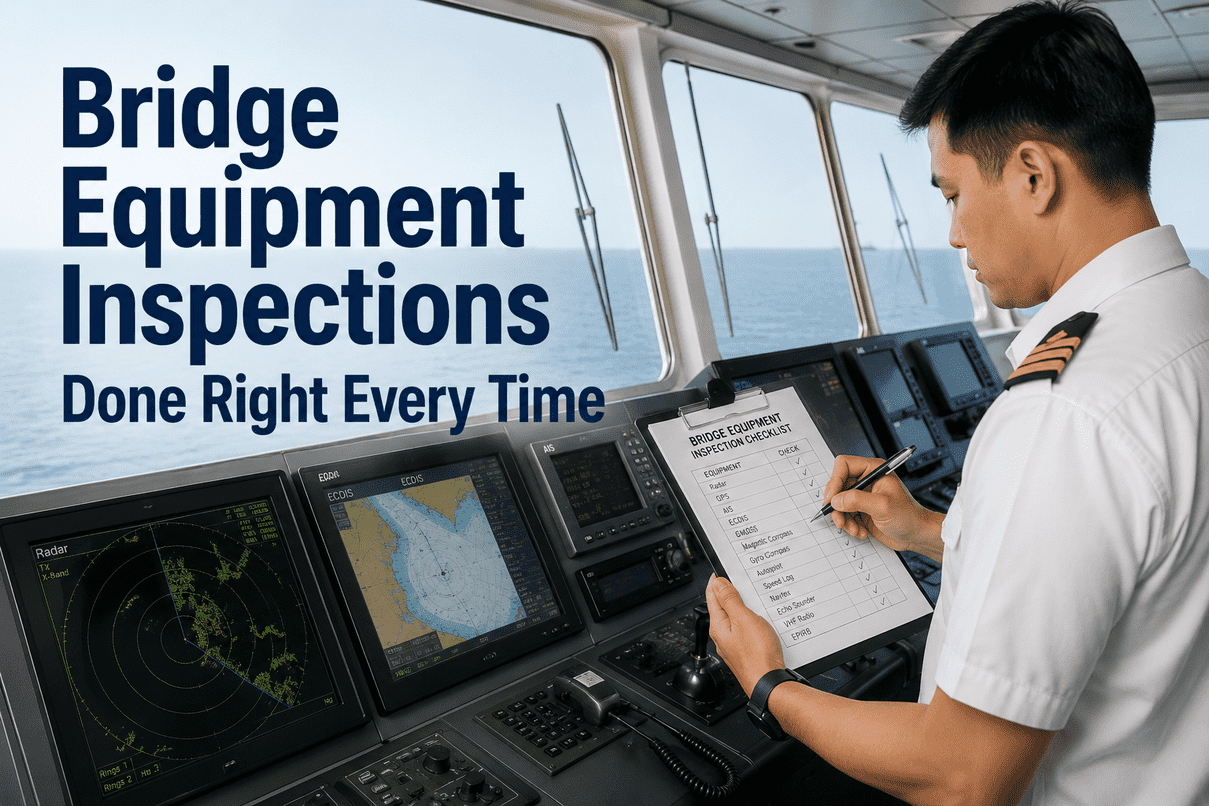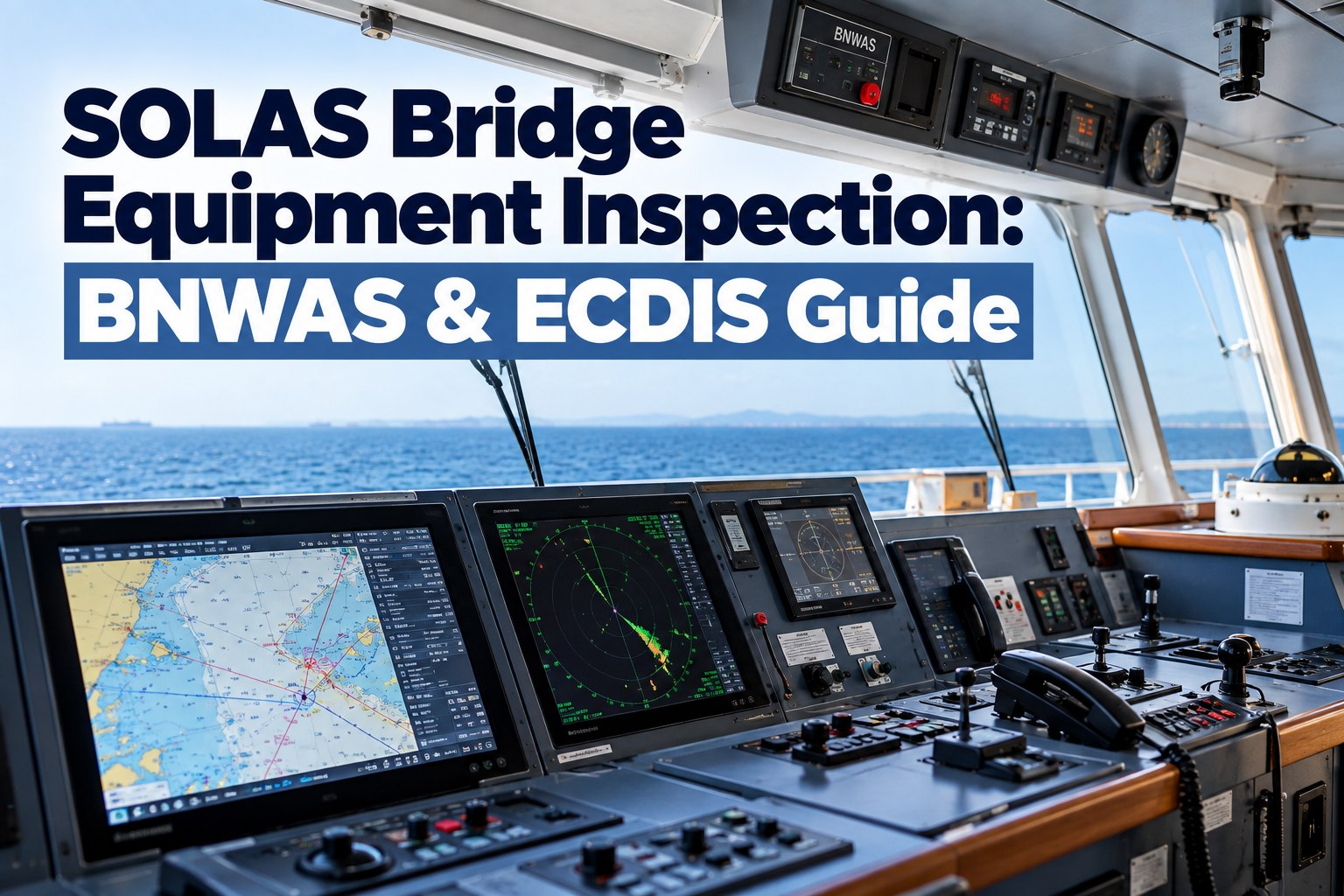
A bridge inspection is not really an inspection of equipment. Every unit on a modern bridge is type-approved, fitted by a class-approved installer and surveyed at intervals by somebody else, so the hardware is rarely the problem. What gets written up is the layer on top of the hardware: a BNWAS switched to manual off and left there, an ECDIS whose safety contour has been sitting at 30 metres since the last voyage, a VDR with no annual performance test certificate, a radar with a performance monitor nobody has used. The equipment works. The settings and the records are what fail. This guide goes bridge unit by bridge unit — what the performance standard requires the equipment to do, which settings an inspector will look at, what the test routine is, and what record each item is supposed to leave behind.
The boxes pass. The settings behind them are what an inspector opens, and they change every watch.
A working bridge carries a dozen separately certified systems. An inspection visits most of them in under an hour, and it does it by asking for settings and records rather than by testing the boxes.
SOLAS bridge equipment inspection: what is actually examined
SOLAS chapter V sets carriage requirements in regulations 18 and 19 and, in regulation 16, requires that the equipment is maintained in efficient working order. That combination is what an inspector works from: the equipment must be there, it must work, and there must be evidence that somebody has been keeping it that way. In practice a bridge visit splits into three questions asked of every unit.
Is it there and does it work?
Is it set up correctly for this voyage?
Where is the record?
The useful consequence is that most of a bridge inspection can be prepared for without touching a single piece of equipment — by working through the settings and the folder. Keeping those per-unit checks and certificates against the vessel rather than in a drawer is what turns a bridge visit into a short conversation.
BNWAS inspection: the escalation sequence and the mode switch
The bridge navigational watch alarm system is the most consequential single item on a bridge inspection, because a BNWAS that is switched off or wrongly configured is evidence about how the ship keeps watch, not just about a box. It is also easy to test, which is why inspectors do.
The BNWAS escalation sequence under MSC.128(75)
Four things get checked, and all four are quick. The dormant period must be set within the 3 to 12 minute range and should suit the ship rather than sitting at the maximum by default. The reset must work from the wheelhouse — a push button, a motion detector, or both — and a motion detector must not be positioned so that it resets from normal chartroom movement by somebody who is not keeping a lookout. The escalation must actually reach the master and the back-up officer, which means testing the cabin sounders rather than assuming them. And the mode setting must be protected: a key switch, a password, or installation in the master’s cabin, under the master’s authority.
The finding inspectors are looking for
ECDIS checks: safety depth, safety contour and the settings that get written up
ECDIS settings are the single richest source of bridge findings, because they are voyage-specific, they are changed by watchkeepers, and a wrong value produces a display that looks entirely normal. Two numbers do most of the work.
Safety depth bolds every sounding equal to or shallower than the value. Safety contour draws the line the ship must not cross and is what the anti-grounding alarm works from.
Safety depth is draft plus under-keel clearance, and its job is display: every sounding at or above that depth is shown in bold, so the watchkeeper reads danger directly off the chart. Safety contour is the boundary between safe and unsafe water and is what triggers the alarm when the ship crosses it. It must be equal to or greater than the safety depth, and it can only take a value the ENC actually carries — 5, 10, 20 metres and so on — so the system will round up to the next available contour. An inspector who finds safety contour below safety depth, or both left at default, has a finding that needs no further investigation.
Open ocean
Coastal waters
Pilotage and harbour
Two failure modes sit either side of these numbers. Settings left too tight produce constant alarms, watchkeepers stop reading them, and the system becomes noise. Settings left too loose produce a silent bridge with nothing to warn about a hazard. Both are visible in the alarm history, which is where an experienced inspector looks rather than at the settings page — and both are worth recording in the passage plan so the intended values for each leg are written down before the watch starts. The same discipline underpins the wider chapter V navigation safety inspection.
ECDIS chart and software currency: the other half of an ECDIS check
The settings are one half. The other is whether the system is current, and there are three separate things that expire.
ENC cells and permits
Presentation library and software
Backup arrangement
Radar inspection and performance monitoring
Radar rarely fails an inspection outright. What is asked is whether anybody knows how well it is performing, and the answer is supposed to come from the performance monitor rather than from an opinion about the picture.
Check the performance monitor at a known setting and record the result, so a degrading magnetron shows as a trend rather than as a surprise in fog. Confirm both radars are set to the correct heading input and that the heading marker aligns. Check the anti-clutter controls are not wound permanently up — sea clutter left at maximum on a clear day will still be there when the weather closes in. And confirm the radar is recording to the VDR, because the VDR check downstream will look for the radar image and finding it missing is a VDR deficiency that originates on the radar.
VDR test requirements and the annual performance test
The voyage data recorder carries a specific, dated obligation that ships get caught by: under SOLAS regulation V/18.8 it must be subjected to an annual performance test, carried out by an approved testing or servicing facility, with a certificate of compliance issued and retained on board. The guidance for that test is MSC.1/Circ.1222/Rev.1, and for float-free capsules approved under the current standard it also takes in an examination of the release and the beacon.
Fixed capsule
Float-free capsule
Long-term recording medium
What the VDR records is as much part of the check as how long it keeps it: date and time, position, speed over ground, heading, bridge and communications audio, radar imagery from both bands, ECDIS image data, engine and rudder orders and responses, hull opening and watertight and fire door status, wind data and AIS. If any of those channels has been unplugged, failed or never connected after a refit, the VDR is not recording what it is certified to record, and the annual test is the mechanism that is supposed to find it.
Compasses, AIS and the rest of the bridge equipment inspection
The remaining items are individually small and collectively produce a good share of the findings, largely because each one belongs to a different routine.
Gyro compass
Magnetic compass
AIS
Echo sounder and speed log
GMDSS
EPIRB and SART
Bridge equipment inspection intervals and the records each one leaves
The grid below is the useful form of all of this: what is checked, how often, and the record that proves it. The record column is the one that closes inspections, because a check with no output is indistinguishable from a check that never happened.
| Equipment | Check | Interval | Record it leaves |
|---|---|---|---|
| BNWAS | Dormant period, reset, escalation to master and public spaces, mode protection | Before departure and periodically at sea | Bridge log entry with the mode in use and the dormant period set |
| ECDIS | Safety depth and contour, alarm and cross-track limits, sensor inputs | Every passage plan and at each leg change | Settings recorded in the passage plan; alarm history retained |
| ENC and software | Cell permits, weekly corrections applied, presentation library version | Weekly, and before each voyage | Chart correction record and maker’s software version record |
| Radar | Performance monitor, heading marker alignment, VDR feed | Before departure and weekly at sea | Performance monitor reading logged so the trend is visible |
| VDR | Annual performance test by an approved facility; saved-data test | Annually, plus periodic data saves | Certificate of compliance retained on board |
| Gyro compass | Error by azimuth or transit, error applied to courses steered | Once a watch where practicable | Compass error book or deck log entry |
| Magnetic compass | Deviation checked against the card; adjustment when required | Regularly at sea; adjusted per company and flag policy | Current deviation card and adjustment record |
| AIS | Static data correct; voyage data current for this passage | Each voyage and on any change of draft or destination | Bridge log entry; static data verified against certificates |
| GMDSS | Daily, weekly and monthly tests; battery condition and reserve source | Daily, weekly, monthly | Radio log with the tests and battery readings entered |
| EPIRB and SART | Battery and release dates, registration, float-free mounting | Monthly inspection; annual shore-based maintenance | Shore-based maintenance certificate and monthly check record |
Company and flag requirements sit above this list, and some flags set tighter intervals than SOLAS. The record column is the part worth standardising across a fleet, because it is what makes one ship’s bridge auditable against another’s.
Bridge equipment inspection failures that turn into detentions
Safety of navigation accounted for 8.0 per cent of all deficiencies recorded in the Paris MoU region in 2025, across 16,474 inspections and 51,797 deficiencies, with the overall detention rate rising to 4.18 per cent. Navigation findings are not the largest category, but they are disproportionately represented at the serious end, because several of them go to whether the ship can safely be navigated at all.
BNWAS off or unprotected
Charts not corrected for the voyage
ECDIS with default safety settings
No VDR annual test certificate
Equipment fitted but not feeding the VDR
Records that do not match practice
Did bridge equipment requirements change in 2026?
Not for equipment already fitted. The chapter V carriage requirements, the BNWAS performance standard and the VDR obligations described here are unchanged, and there is no new bridge equipment that existing ships must retrofit under the amendments that entered into force on 1 January 2026.
There is one bridge-adjacent addition, and it applies to new ships only: electronic inclinometers become a requirement for ships constructed on or after 1 January 2026, rather than something to be fitted to the existing fleet. If your ship was in service before that date, the 2026 package asks nothing of your bridge — the work in it sits elsewhere, principally in the new lifting appliance requirements, which do reach ships already in service.
Bridge equipment inspection: frequently asked questions
What is the BNWAS dormant period and what should it be set to?
Who is allowed to change the BNWAS mode?
How is ECDIS safety depth different from safety contour?
How often must a VDR be tested?
How long must a VDR retain its data?
What ECDIS backup arrangement is acceptable?
What bridge records does port state control ask for?
Did SOLAS add bridge equipment for 2026?
Related guides on this site: pre-departure steering gear tests.