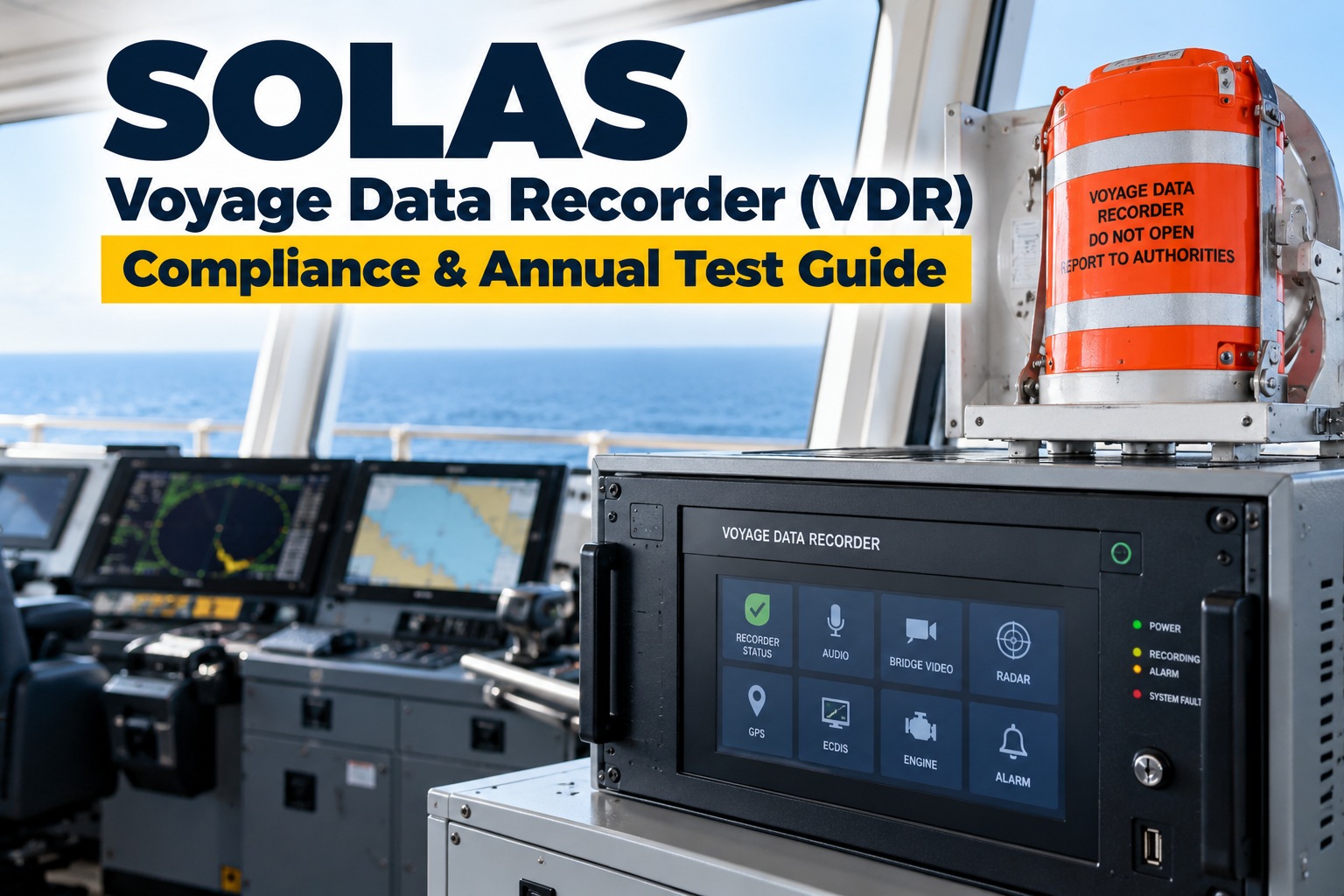
After a collision, grounding or fire, the voyage data recorder is often the only neutral witness aboard. For a Master, the annual performance test is the proof that the witness will still speak: that it records the right inputs, survives the casualty, can run on reserve power and can be recovered. This guide explains which VDR rules apply, what the recorder must capture and how long it keeps it, how the annual performance test works step by step, and what to check so that the evidence is usable when it matters.
Which VDR Rules and Standards Apply to Your Ship
Full VDR, simplified VDR and optional recorders: how the type depends on ship and build date
SOLAS Chapter V Regulation 20 sets the carriage requirement. A summary from a VDR manufacturer says a full VDR is required on passenger ships and on cargo ships of 3,000 gross tonnage and over built on or after 1 July 2002, and a simplified VDR on older cargo ships of 3,000 gross tonnage and over. Because that summary comes from a vendor, confirm the carriage rule in the SOLAS text and with your flag state.
| Ship or installation | Type or standard | Where we found it |
|---|---|---|
| Passenger ships and cargo ships of 3,000 GT and over built on or after 1 July 2002 | Full VDR | Danelec summary of SOLAS V/20 |
| Cargo ships of 3,000 GT and over built before 1 July 2002 | Simplified VDR (S-VDR), standard MSC.163(78) | Danelec summary, MSC.1/Circ.1222/Rev.1 |
| VDR installed before 1 July 2014 | A.861(20) as amended by MSC.214(81) | IMO Resolution MSC.333(90), paragraph 2 |
| VDR installed on or after 1 July 2014 | MSC.333(90) | IMO Resolution MSC.333(90), paragraph 2 |
| Ships not required to carry a VDR | Optional L-VDR | Danelec summary |
Why the installation date decides which performance standard your recorder was built to
MSC.333(90) says the revised standard applies to VDRs installed on or after 1 July 2014, while earlier installations follow A.861(20) as amended by MSC.214(81). That matters for the Master because the annual test checks the data items required at original commissioning, so two ships with different installation dates can be tested against different lists.
What the VDR Must Record: Twenty Data Items From the Bridge and the Ship
How twenty required inputs flow into three recording media
The diagram follows the data path in MSC.333(90): inputs from bridge equipment and ship systems enter the data acquisition unit, which writes to a fixed capsule, a float-free capsule and a long-term medium. If any input is missing or silent, the casualty record has a hole in it.
Which groups of inputs make up the twenty items, and where each interface lives on board
Navigation is the largest group, with seven items, followed by safety status, structure and environment, and records. The interfaces you can check onboard sit behind the group names: GNSS, log, gyro, radar, ECDIS and AIS feeds for navigation; microphones and VHF for audio; steering and engine order interfaces; alarm and door indication panels; and wind and acceleration sensors where they are fitted.
How Long the Data Survives: Capsules, Retention and Reserve Power
Retention periods for the fixed capsule, the float-free capsule and the long-term medium
MSC.333(90) sets minimum retention on each medium. The fixed and float-free media keep at least 48 hours, and the long-term medium keeps at least 30 days or 720 hours. The fixed medium must retain data for at least two years after recording ends, and the float-free medium for at least six months.
| Medium or function | Minimum duration | Kept after recording ends | Note |
|---|---|---|---|
| Fixed recording medium (capsule) | At least 48 hours | At least 2 years | Fire, shock, penetration and deep-sea pressure resistant, with underwater location aid |
| Float-free recording medium (capsule) | At least 48 hours | At least 6 months | Must float free after sinking, with grappling and recovery features |
| Long-term recording medium | At least 30 days or 720 hours | Not stated in the extract | Holds the longer record |
| Bridge audio on reserve power | 2 hours, then stops automatically | Not applicable | Dedicated reserve source on loss of ship's main supply |
| Float-free locating signals | At least 48 hours within a period of at least 168 hours | Not applicable | Helps recovery after a casualty |
What happens on a blackout: the two-hour reserve power rule
On loss of the ship's main supply, the VDR must record bridge audio from a dedicated reserve source for two hours and then stop automatically. That is why the annual test removes external power and checks both that the alarm activates and that the recorder runs for at least 1 hour 55 minutes and stops recording no later than 2 hours 5 minutes. Our emergency generator and black-start test guide explains the blackout test that the engine room runs on the same ship.
The Annual Performance Test Step by Step
Who carries out the test, when it is due and how long the report takes
MSC.1/Circ.1222/Rev.1 says the annual test is performed by the manufacturer or a person the manufacturer authorises. For cargo ships it may be done within three months either side of the due date, with a maximum interval of 18 months, subject to SOLAS I/14 extensions. The report must be issued within 45 days. If results are satisfactory, an Annual Performance Test Certificate is issued, valid until the next annual revalidation provided the equipment is properly maintained.
Eight checks the testing engineer must complete, and the pass condition for each
Float-Free Capsule and Acoustic Beacon: What the Master Should See Checked
Expiry dates and release arrangements that decide whether the capsule can be recovered
The test checks the beacon and the reserve power battery dates, the beacon function and the float-free arrangements. For capsules approved under MSC.333(90), the examination follows MSC.1/Circ.1040/Rev.1. A fixed capsule must also be highly visible in colour, marked with retro-reflective material and fitted with an underwater location aid.
| Item | What is checked | Evidence to keep |
|---|---|---|
| Acoustic beacon (underwater locating aid) | Functional test and battery expiry date | Test result and date in the report |
| Reserve power source | Battery expiry and 2-hour behaviour | Time recorded when the alarm and the stop occur |
| Float-free capsule release | Release mechanism and other datable items in date | Expiry dates, examination note |
| Float-free capsule examination | For MSC.333(90) capsules, the examination follows MSC.1/Circ.1040/Rev.1 | Examination report |
| Fixed capsule markings | Highly visible colour, retro-reflective marking and underwater location aid, per MSC.333(90) | Visual check and photo |
| Fastenings and cabling | Security of fixings, junction boxes and cable seals (our suggestion) | Photo and maintenance note |
Sensor Inputs: Why a Silent Feed Ruins Casualty Evidence
How the manufacturer checks each interface for operation and recording during the test
The test report has a section for the interfaces checked for operation and recording, each marked yes, no or not applicable. A second section records changes or repairs to sensors, and the engineer checks the maintenance records and that any defects were rectified. The table below pairs each input with what to confirm. The typical faults come from a servicing vendor's page and are not from the regulation.
| Input | Source | What to confirm | Typical fault |
|---|---|---|---|
| Position, speed and heading | GNSS, speed log, heading | Data present throughout the 12-hour log | Lost sensor data or serial rate mismatch (vendor-reported) |
| Bridge and VHF audio | Bridge microphones, VHF | Audio clear and continuous on all channels | Microphone degradation (vendor-reported) |
| Radar and ECDIS | Radar, ECDIS display capture | Frames recorded without gaps | Frame capture out of sync (vendor-reported) |
| Rudder and engine orders | Steering and engine order interfaces | Orders and responses logged together | Interface mismatch after refits |
| Alarms and hull openings | Alarm system and door status | Alarms and door status logged | Replaced panel not reconnected |
| Environment and structure | Wind, acceleration, rolling, where fitted | Values logged where equipment is fitted | Sensor replaced without VDR update |
What to do after a sensor is replaced, a bridge system is refitted or software is changed
A refit can break a feed silently. After any sensor replacement or bridge system change, ask for the VDR interface to be rechecked and the maintenance record updated, and keep the entry for the next annual test. The test report asks for it, and a casualty investigation will too.
The Master's Part Before, During and After the Test
Before the test: dates, records and access for the testing engineer
Confirm the due date and window, gather the maintenance records, make sure the previous certificate and report are available, and arrange access to the bridge, the capsule locations and the reserve power supply. If the beacon or battery dates are close to expiry, order replacements before the engineer arrives.
After the test: certificate on board and findings turned into tasks
A vendor summary says the certificate of compliance, with its date and applicable standards, must be kept on board. Record any observations from the report as tasks with an owner and deadline, and diarise the next window.
After an incident: protect the recording before it is overwritten
VDRs record continuously, and the media hold a minimum retention period, so older data can be overwritten by newer recordings. Agree with the manufacturer and your company, in advance, how the data is saved after an incident and who is notified. Follow flag state and investigating authority instructions. This is our suggestion, and the exact steps depend on your recorder model.
Mistakes That Make a VDR Test Pass on Paper and Fail in a Casualty
Six gaps that leave the recorder compliant on the certificate but thin on evidence
Systems That Keep VDR Test Dates, Expiries and Findings in One Place
How certificate, battery and beacon dates, test reports and tasks stay connected
A VDR test depends on dates that are easy to lose: the test window, the battery and beacon expiries, the certificate and the follow-up from the report. Marine Inspection supports certificate and equipment tracking, a dated photo repository and observations turned into tasks with owners, deadlines and evidence, as described in its dry docking guide for project work. For a Master, that means every test window and expiry is visible, and every finding has an owner.