Every chief engineer has lost the same argument. The overhaul is proposed, the budget is tight, the unit is still running, and the job slides one more voyage. What makes the argument so hard to win is that the two options are not measured the same way: a planned job has one visible number attached to it, and a breakdown has a dozen numbers spread across four departments, most of which never appear in the technical budget at all. The repair invoice is the smallest of them.
The repair is the cheapest part of a breakdown
Why the comparison is never made honestly
The reason deferral keeps winning is structural rather than technical. A planned job is a single cost, in one budget, owned by one department, known months in advance. A breakdown is a set of costs that mostly land somewhere else: hire on the commercial side, deviation and bunkers in operations, a claim with the insurer, and a compliance consequence that has no budget line anywhere.
From inside the technical department, deferring looks like a saving, because the saving is immediate and visible while the cost is delayed and someone else’s. That is an accounting artefact, not an engineering judgement, and it is worth naming out loud when the overhaul is being argued about.
What a breakdown actually costs, line by line
The breakdown below is the structure rather than the arithmetic — the amounts depend on the vessel, the trade and the hire rate. The useful column is the last one, because it explains why the comparison feels so lopsided when it is made in a budget meeting.
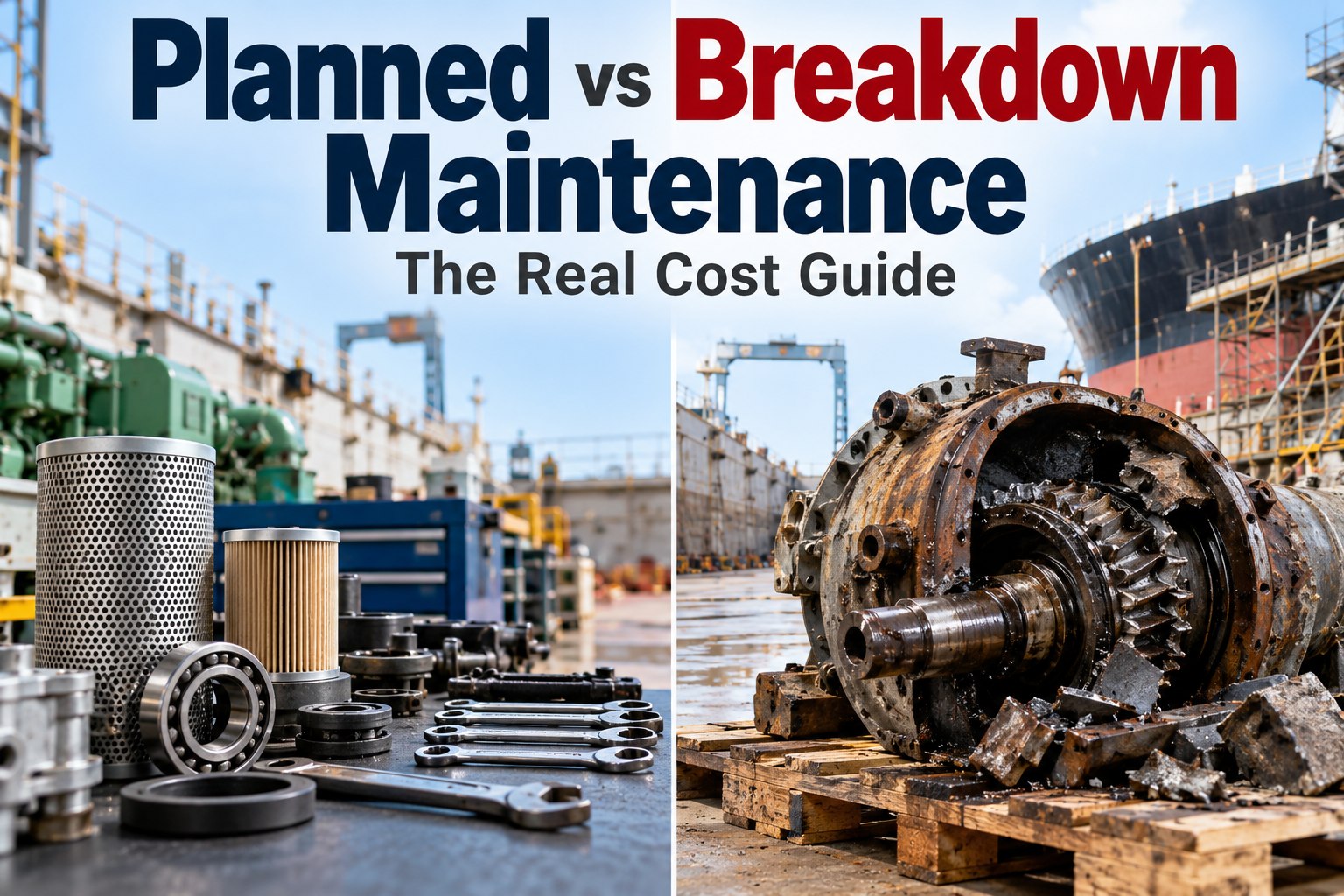
| Cost line | Planned job | Run to failure | Shows in the technical budget? |
|---|---|---|---|
| Parts | Ordered on a normal lead time, at list price, shipped by sea | Expedited, air freighted, sometimes bought at whatever the one available supplier asks | Yes — both |
| Labour | Ship’s staff, in hand, during a planned window | Riding crew or maker’s service engineer, mobilised at short notice with flights and standby time | Yes — both |
| Consequential damage | None — the component is opened before it takes anything with it | The failure runs into neighbouring components, which is what turns a part into a claim | Partly — the rest sits with the insurer |
| Earning days lost | None, or absorbed in a scheduled window | However long the repair takes, at the vessel’s daily hire | No — commercial |
| Deviation and port costs | None | Deviation, berth or anchorage, agency, bunkers burnt waiting | No — operations |
| Compliance consequence | None, and the record supports you | Findings at the next inspection, a worse risk profile, more inspections for years | No — nowhere |
| Timing | Chosen — a convoy, a ballast leg, a yard period | Chosen by the machinery, which tends to pick the worst moment | Not a cost, but it drives every line above |
What the claims record says about the difference
Hull and machinery claims data puts a number on the consequential-damage line, which is the one most often left out of the argument. Across a study of more than a thousand claims, main engine damage averaged over half a million US dollars per claim and accounted for close to 35% of machinery claim costs — the most expensive category there is.
Two things in that data matter for the argument on board. The first is that the costliest failures are the ones that spread — a lubrication problem becomes a crankshaft because nothing interrupted it. The second is that the leading cause is not wear, not age and not design, but maintenance carried out incorrectly or not at all. Both say the same thing: the money is lost in the gap between when a condition became known and when somebody acted on it. Our guide to main engine overhaul scheduling covers how those intervals are set in the first place.
A deferral stops being a technical decision the moment it is recorded
This is the part that is specific to ships, and it is the reason a deferral on a vessel is not the same as a deferral in a factory. Once a job is overdue, the maintenance record has to say something about it, and there are only three possibilities.
It is recorded, with a reason and an approval
It is recorded, with nothing behind it
It is signed off as done
Option C is where a budget decision turns into an ISM finding, and it happens quietly, usually with nobody intending it, because the pressure to keep the record clean and the pressure to defer the job arrive from the same direction at the same time.
Where deferred maintenance shows up in port state control
The Paris MoU recorded 51,797 deficiencies across 16,474 inspections in 2025, with 4,744 of them at detention level and 688 ships held — a detention rate of 4.18%, up from 4.03% the year before. Safety-management findings accounted for 4.5% of all deficiencies.
The categories at the top of that list are worth reading as an engineer rather than as a compliance officer. Fire safety led at 16.8% and structural and electrical items under SOLAS II-1 followed at 11.6%. Neither of those is a design problem. Fire doors alone made up 3.1% of all deficiencies — a maintained item that decays slowly, is never urgent, and is exactly the kind of job that gets deferred because nothing happens the day you defer it. Which findings cross the line into holding the ship is set out in our guide to the deficiencies behind detentions.
The trap: a reactive fleet cannot afford to become a planned one
There is a second cost in the reactive column that never reaches a budget at all, and chief engineers feel it long before anyone ashore sees it. Breakdown work is carried out by the same people who would otherwise be doing the planned work. Every unplanned repair consumes hours that were allocated to preventing the next one, which means a department that falls behind does not simply stay behind — it accelerates.
This is why the condition of a vessel tends to change in steps rather than gradually. A fleet is either comfortably ahead of its list or it is being driven by it, and the transition between the two is quick. It also explains a pattern familiar to anyone who has taken over a vessel in poor condition: the overdue list is not the problem to be solved, it is the symptom of a labour deficit that has to be paid down before the routines can hold.
Getting out is more expensive than staying out, which is the real argument for the planned side. It takes a yard period, riding crew or additional manning to clear a backlog, and all of that is spent reaching the position a maintained vessel never left. The operational detail of running the routines themselves is covered in our guide to planned maintenance systems on ships.
Not everything should be on a planned routine
The honest version of this argument has to admit that running a component to failure is sometimes the right answer. A planned regime applied to everything on board wastes labour on items where failure costs almost nothing, and it buries the jobs that matter in a list nobody can finish. The question is not planned against reactive as a philosophy — it is which strategy each item deserves.
The two boxes that cause trouble are the bottom left and the top right. Items that genuinely belong in run-to-failure are often kept on a routine out of habit, consuming hours that the top right badly needs. And items in the top right are the ones that get deferred, because they are expensive and the failure is not today. Moving effort from one to the other costs nothing and is the single most useful thing a technical department can do with its own list. You can see in a short demo how that list is sorted and tracked.
Making the case in a budget meeting
How Marine Inspection supports the planned side
Nothing above is an argument that a system prevents failures. It is an argument that the costs are invisible until somebody puts them in one place, and that a deferral becomes dangerous at the point where it stops being recorded properly. Both are record problems.