Most downtime calculations start with daily hire multiplied by days lost, and that formula is wrong in both directions for reasons that are contractual rather than arithmetical. The first thing to establish is which type of off-hire clause you are working under, because the same eighteen-hour breakdown produces two entirely different numbers. Period clauses are calculated by taking the time from the off-hire event to the point at which the event ceases, regardless of whether any time was actually lost — the simplest form, and generally regarded as charterer-friendly. Net loss of time clauses are more common and less straightforward: hire ceases only for the time actually lost because of the event, which requires a calculation rather than a stopwatch. The classic example is NYPE 1946 Clause 15, where the operative words are that payment of hire ceases for the time thereby lost. Those four words determine your figure. And whichever clause applies, the cost does not stop at lost hire — the charterparty commonly provides that additional bunkers consumed and expenses incurred while the vessel is off-hire fall on the owner, so the ship continues costing money while earning nothing. Start a free trial of Marine Inspection and hold the evidence the calculation actually rests on.
The same eighteen-hour breakdown, two different answers
Period clause
Time is counted from the off-hire event to the point at which that event ceases, regardless of whether any time was actually lost to the voyage. The simplest form to apply and generally perceived as favouring the charterer.
Eighteen hours off-hire, whether or not the voyage was delayed by eighteen hours
Net loss of time clause
Hire ceases only for the time actually lost because of the event, which requires the lost period to be identified and connected to the event. More common, less straightforward, and generally more favourable to the owner.
Could be eighteen hours, could be four, could be none if the voyage lost nothing
Four Things That Have to Be Established
Under a net loss of time clause the charterer carries the burden, and each element is an evidential question rather than a factual one. That makes your records the determinant of the number rather than merely its documentation. Book a Marine Inspection demo and see what contemporaneous evidence looks like across all four.
01
That an off-hire event occurred
Established by the record of what happened and when. The traditional clause lists deficiency or default of officers or crew, deficiency of stores, fire, breakdown of or damage to hull, machinery or equipment, grounding, detention by arrest, detention by average accidents, drydocking for examination or bottom painting, and other similar causes.
02
That it falls within the clause
A question of construction against the specific wording, and the reason the same event can resolve differently under different forms. Broad wording such as any other cause whatsoever behaves differently from a narrower list, and heavily amended rider clauses change the position again.
03
That it prevented the full working of the vessel
This is the phrase that decides many disputes. A ship delayed by an external obstruction, a political event, a river closure or port congestion may remain on hire if the ship itself remains fully efficient and the clause is not broad enough to catch it. Conversely a partial impairment in cargo gear or power generation can be enough.
04
That time was actually lost, and how much
Required where the clause is a net loss of time clause. The period lost has to be identified and connected to the event, which is a causation question resolved on evidence — and it is where most of the money in a disputed claim actually sits.
Published guidance is direct about the consequence: off-hire claims are evidence-driven, and both parties should collect documents from the moment an incident occurs. Without clear evidence, a charterer may struggle to prove off-hire and an owner may struggle to resist an unjustified deduction. Good record keeping is described as essential, which is an unusually blunt statement to find in commercial guidance and reflects how frequently these turn on what was written down at the time.
The Cost Stack: Four Layers, Not One
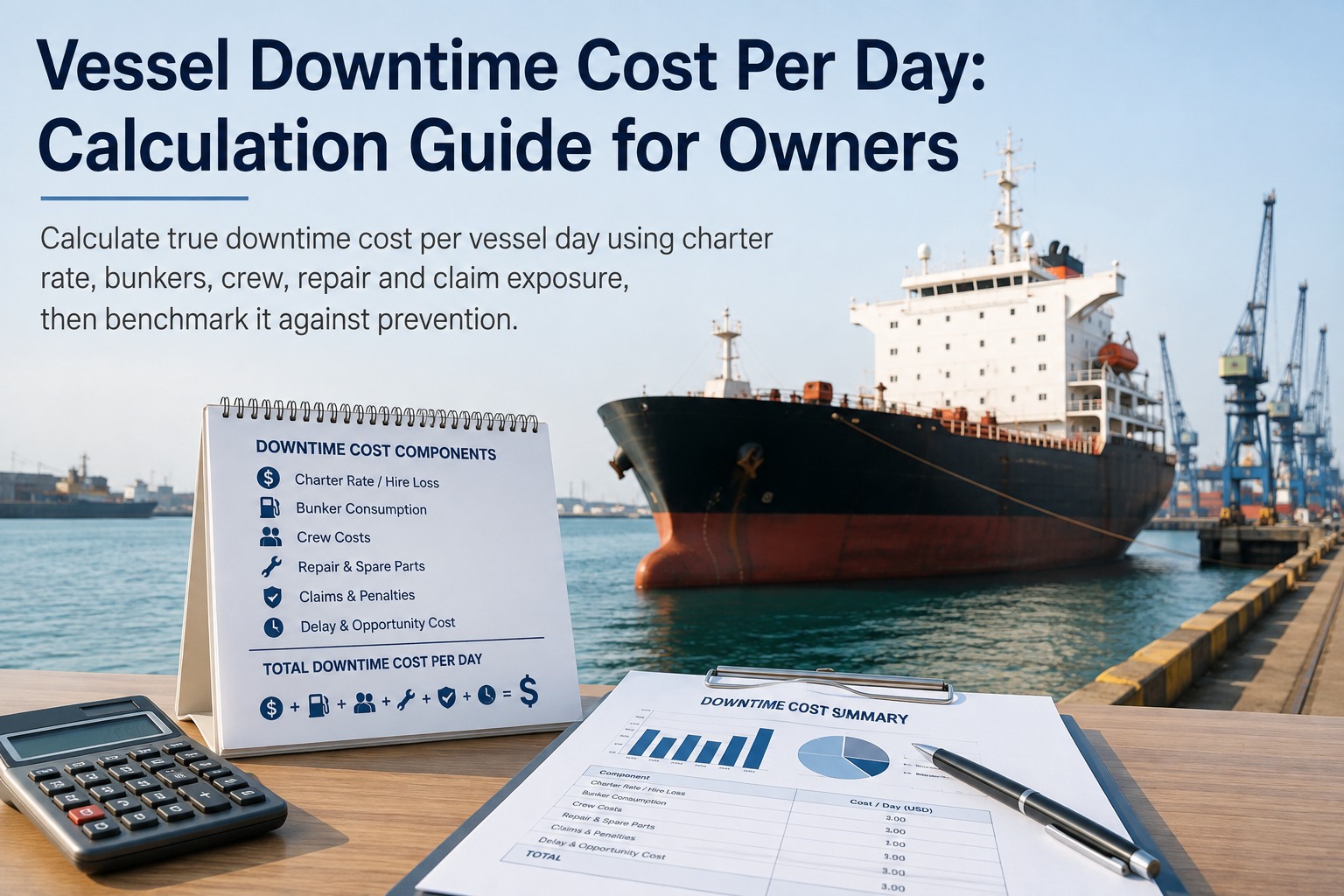
Lost hire is the headline and roughly half the picture. The remainder continues accruing while the vessel earns nothing. Sign up for Marine Inspection and capture the supporting evidence for each layer as it happens.
Layer 1
Hire not earned
The daily rate for the period the clause puts the vessel off-hire. Published figures put an average around twenty-five thousand dollars a day for a standard Panamax container ship, though this is entirely specific to vessel type, market and the charter in force. Strictly this is not a deduction from hire but no hire for the relevant period, though it usually appears as a deduction from the sum due.
Layer 2
Bunkers, on the owner
The charterparty commonly provides that when the vessel is off-hire, the additional bunkers consumed and the expenses incurred are for the owner's account. So fuel burned during a breakdown, a repair, a deviation or a wait becomes an owner cost at the precise moment the revenue stops.
Layer 3
Running costs, which never pause
Crew wages, provisions, insurance, management fees and stores continue at the same rate whether the vessel is working or not. These do not appear in an off-hire calculation because they are not deducted from anything — they simply carry on being spent against no revenue, which is why the daily cost of downtime exceeds the daily hire rate.
Layer 4
Consequences
Repair cost, expedited parts and technicians, additional port and agency fees, and the ripple effects — missed transit slots, disrupted schedules and downstream commercial consequences. Published commentary notes that in 2026 the stakes have risen further as insurance and repair costs continue to climb.
The layer people forget
Bunkers and expenses during off-hire are commonly for the owner's account
Which means a downtime day is not neutral — it is negative. The revenue stops, the running costs continue at full rate, and the fuel burned during the delay moves onto your side of the ledger. Any calculation using daily hire alone understates the position by whatever your daily operating cost happens to be, plus whatever was consumed getting the vessel working again.
Not All Downtime Is Off-Hire
The distinction matters commercially in both directions, and it is a common source of disputed deductions. Schedule a walkthrough and hold the evidence that supports your side of the argument.
Delay without impairment
A ship delayed by an external obstruction, a political event, a river closure or port congestion may remain fully on hire where the ship itself remains fully efficient and the clause is not broad enough to reach that cause. Time lost is not the same thing as off-hire.
Caused by the charterer's own orders
In one reported case, marine growth that fouled a propeller as a result of a period spent waiting to load was treated as a natural consequence of the charterer's orders and therefore not an off-hire event. An off-hire event also cannot arise from the charterer's own breach of the charterparty.
Impairment without full stoppage
Working the other way, a partial breakdown can trigger the clause where it prevents the vessel performing the service immediately required. Under the full working order standard, even a minor impairment in cargo gear or power generation can lead to a pro-rata deduction in hire.
Deviation, and how far it runs
Where a ship deviates for repairs, the charterparty should specify whether hire stops only during the repairs themselves or also during the deviation and the return to an equivalent position. That drafting point can multiply the off-hire period several times over, and it is worth knowing your own position before an incident rather than during one.
The Method
A defensible downtime figure follows a sequence, and the first two steps are documentary rather than numerical. Start a free trial and build the evidence base steps three and four depend on.
Step 1
Read the clause and identify its type
Period clause or net loss of time clause. Check whether there is a threshold below which the clause does not bite, whether consequential delay is included, how bunkers are treated, whether drydocking is covered, whether crew issues are covered, and whether broad wording such as any other cause whatsoever appears.
Step 2
Establish the event and the impairment
What failed, when, and what it prevented the vessel from doing. This is where contemporaneous records decide the outcome — engine logs, alarm history, the defect record, the time the fault was first observed rather than when the work order was raised.
Step 3
Calculate the period the clause produces
Under a period clause, event start to event end. Under a net loss of time clause, the time actually lost to the voyage as a result — which may be less than the elapsed period, and with deviation and return may be considerably more.
Step 4
Add the layers the clause does not cover
Additional bunkers and expenses falling to the owner, running costs continuing through the period, repair and mobilisation cost, additional port and agency fees, and any downstream commercial consequence you can evidence.
Step 5
Divide by the days to get your own figure
Which produces a per-day downtime cost specific to your vessel, your charter and your operating cost base — and which will be a materially larger number than the daily hire rate you started with. That is the figure to use in any prevention comparison, not the hire rate alone.
Steps two and three are decided by what was recorded at the time, not by what is reconstructed afterwards.
Which is the entire practical link between a maintenance record and a commercial outcome.
The Evidence That Decides the Number
Both sides of an off-hire dispute are arguing from documents, and the documents were made or not made months earlier. Book a walkthrough and check whether each of these currently exists on your vessels.
Table 1: What an Off-Hire Position Rests On
Using the Figure Against Prevention
Once you have a per-day number specific to your own operation, the comparison becomes straightforward and considerably more defensible than an industry average. Start a free trial and build the comparison from your own off-hire log.
Table 2: Turning Downtime Days Into a Prevention Case
IMPORTANT: THIS IS NOT LEGAL ADVICE
Off-hire is governed entirely by the wording of your charterparty and the law applicable to it. This page describes general principles drawn from published commentary on standard forms; the same event can produce different outcomes under NYPE 1946, NYPE 1993, BALTIME, Shelltime or a heavily amended rider clause, and nothing here should be applied to an actual claim without advice from your P and I club, your legal advisers or both. Nobody should rely on this page in a dispute. The financial figures are illustrative. The Panamax daily hire figure cited comes from published 2026 commentary and varies enormously by vessel type, market conditions and the specific charter in force — use your own charterparty rate. Where the burden sits and what must be proved depends on the clause. The four-element structure described reflects general commentary on net loss of time clauses and does not apply uniformly. Record-keeping advice is the one thing that transfers cleanly. Published commercial guidance is consistent that off-hire claims are evidence-driven and that documents should be collected from the moment an incident occurs, whichever side of the argument you are on.
Frequently Asked Questions
Why can I not just multiply daily hire by days lost?
Because two separate things break that formula. First, the period itself is determined by the clause type rather than by the calendar: a period clause runs from the off-hire event until the event ceases regardless of whether time was actually lost, while a net loss of time clause suspends hire only for the time actually lost as a result — and the classic net loss of time wording in NYPE 1946 Clause 15 turns on the words for the time thereby lost. Second, lost hire is only one layer. Additional bunkers and expenses during off-hire commonly fall to the owner, running costs continue at full rate, and repair and consequential costs sit outside the hire calculation entirely.
What is the difference between the two clause types?
Period clauses are the simpler form and are calculated by taking the time from the off-hire event to the point at which that event ceases, regardless of whether any time was actually lost — generally perceived as charterer-friendly. Net loss of time clauses are more common and less straightforward, requiring a calculation of the time actually lost in the voyage as a result of the event, and are generally more favourable to the owner. Under the second type the charterer must connect the event to a measurable loss of time, which means an eighteen-hour breakdown does not automatically produce eighteen hours off-hire.
Is every delay an off-hire event?
No, and the distinction runs both ways. A ship delayed by an external obstruction, a political event, a river closure or port congestion may remain fully on hire where the ship itself remains fully efficient and the clause is not broad enough to catch that cause — the phrase preventing the full working of the ship is central. In one reported case, propeller fouling arising from a period waiting to load at the charterer's orders was treated as a natural consequence of those orders rather than an off-hire event, and an off-hire event cannot arise from the charterer's own breach. Conversely, a partial impairment in cargo gear or power generation can be enough to trigger a pro-rata deduction.
Who pays for bunkers during off-hire?
Commonly the owner. Charterparties frequently provide that when the vessel is off-hire, the additional bunkers consumed and the expenses incurred are for the owner's account. That is why a downtime day is negative rather than merely neutral: the revenue stops, the running cost base continues unchanged, and fuel burned during the breakdown, the repair, any deviation and the return moves onto your side of the ledger at the same moment. Any per-day downtime figure built from the hire rate alone therefore understates the position by at least your daily operating cost plus consumption during the period.
What determines whether a claim succeeds?
Evidence, principally, and evidence created at the time rather than assembled afterwards. Under a net loss of time clause the charterer must generally show that an off-hire event occurred, that it falls within the clause, that it prevented or impaired the required operation of the ship, and that time was lost. Published commercial guidance states that off-hire claims are evidence-driven and that both parties should collect documents from the moment an incident occurs, noting that without clear evidence a charterer may struggle to prove off-hire and an owner may struggle to resist an unjustified deduction. The strongest material is contemporaneous — engine and alarm logs, the defect record, and the time the fault was first observed rather than when a work order was raised.
What about repairs requiring a deviation?
That is a drafting question with potentially large financial consequences, and it is worth establishing your position before an incident rather than during one. Where a ship deviates for repairs, the charterparty should specify whether hire stops only during the repairs themselves or also during the deviation and the return to an equivalent position. The difference can multiply the off-hire period several times over, since a diversion to a repair port and the passage back may substantially exceed the repair itself. This is one of several points — alongside thresholds, treatment of bunkers, whether drydocking is covered and whether crew issues are included — that ought to be checked in the clause rather than assumed.
Hire not earned
+
Bunkers on owner
+
Running costs
+
Repair and consequences
Your Number, Not the Hire Rate
Read the clause first, because the period it produces is a contractual question rather than an arithmetical one. Then add the three layers the clause does not cover, divide by the days, and you have a per-day downtime cost specific to your vessel and your charter — materially larger than the hire rate, and the only figure worth comparing prevention against. Underneath all of it sits the same requirement: contemporaneous records of what failed, when it was first observed, what was impaired and how long each stage of the repair took, because that is what both sides will be arguing from.