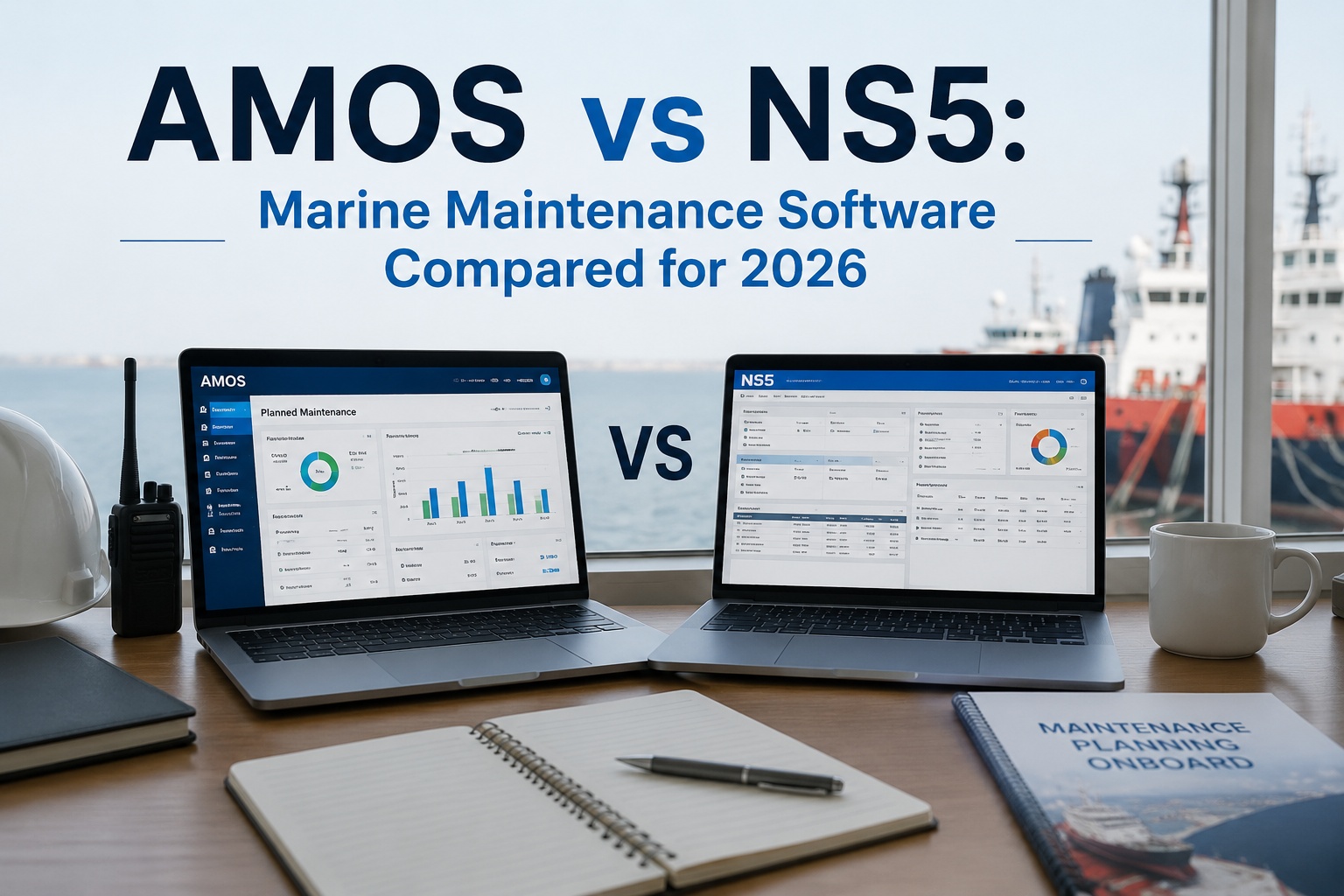
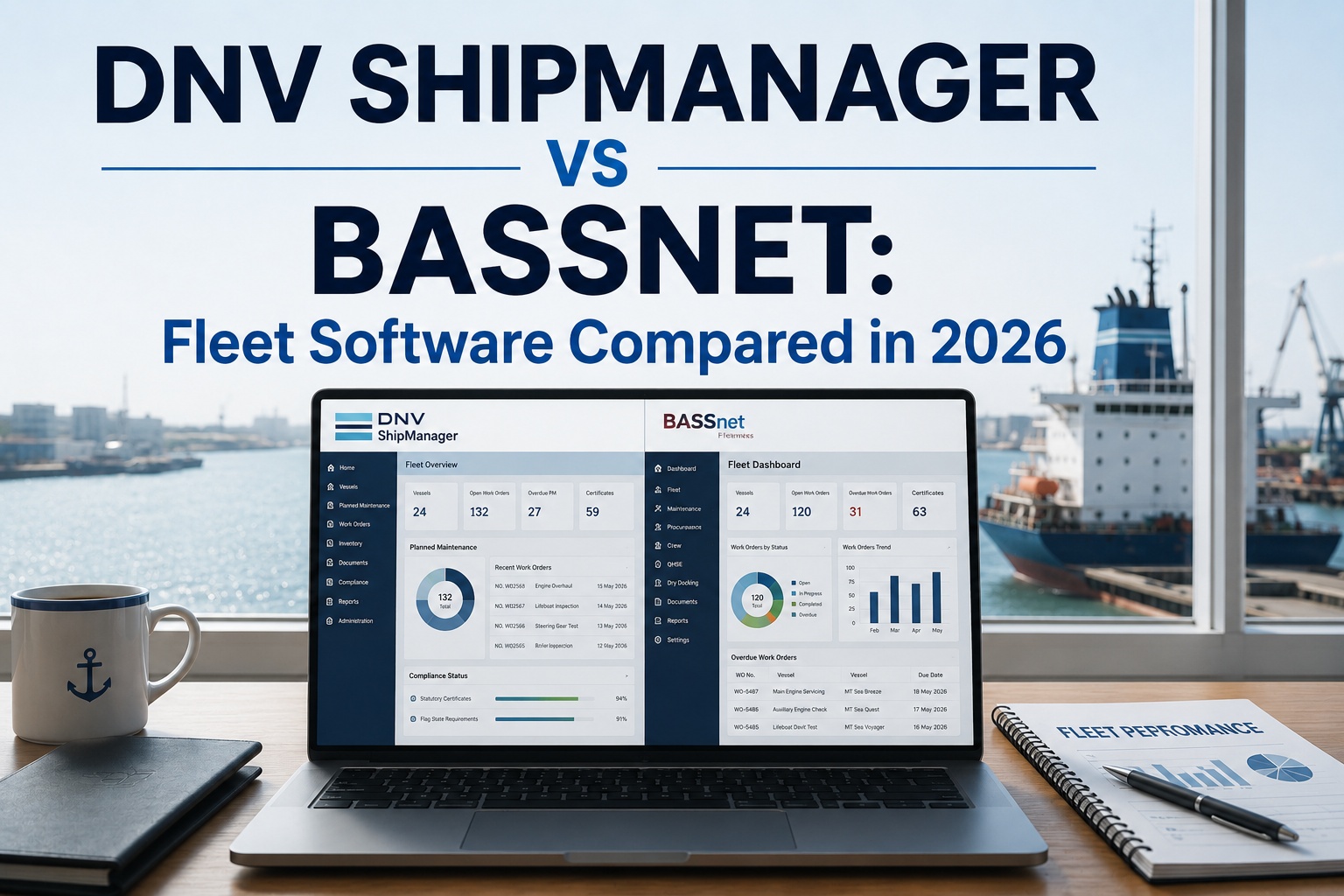
AMOS and NS are the two deepest technical management systems in commercial shipping, they have been competing for the same superintendents since the 1980s, and most head-to-head comparisons published about them are useless because they compare a 2011 product against a 2025 one. Both platforms have changed fundamentally in the last two years. SpecTec launched AMOS-X in September 2025 from Manchester, integrating maintenance, inventory and procurement into a single system, and now offers three tiers — Gateway, Horizon and Enterprise — on one architecture so a growing fleet moves up without migrating. ABS Nautical Systems retired the NS5 name in favour of NS Enterprise, added NS Core for the workboat sector, and launched browser-based NS-Web in 2024, removing the on-premise server requirement under SOC 2 Type I, SOC 2 Type II and ISO 27001 certification. Independent reviewers agree on one thing about both: immense specialised technical depth, and a steep learning curve to reach it. This comparison runs them against each other honestly, round by round, and then against the third option that neither vendor will raise in your evaluation. Start a free trial of Marine Inspection and put all three on the table at once.
Head to Head: The Two Incumbents
AMOS
SpecTec, Manchester
OriginAMOS-D, 1984, the first PMS built for ships
CurrentAMOS-X, launched September 2025
StructureGateway, Horizon and Enterprise tiers on one architecture
OwnerVolaris, part of Constellation Software
NS Enterprise
ABS Nautical Systems
OriginNautical Systems, mid-1980s
CurrentNS-Web, launched 2024; NS5 name retired
StructureNS Enterprise and NS Core, modular by function
OwnerABS Wavesight, affiliated with ABS class
Both are premium, full-featured enterprise investments with deep technical specialisation. Neither is the cheapest or fastest route to a working maintenance system, and that gap is where the third option lives.
Two Lineages, Running in Parallel
Reading the two histories side by side explains most of the differences in the products today, including why one sells in tiers and the other sells in modules. Book a Marine Inspection demo for a live reference point while you read them.
AMOS Lineage
1984
AMOS-D ships on DOS as the first purpose-built planned maintenance system for vessels, establishing the category.
1990s to 2010s
Maintenance, inventory, procurement, dry dock, HSQE and crewing modules mature across a reported 3,000-plus vessels and 300-plus customers.
Recent
Three tiers introduced on a single architecture, so a fleet moves from Gateway to Horizon to Enterprise by reconfiguration rather than replacement.
Sept 2025
AMOS-X launches, integrating maintenance, inventory and procurement into one system on customer infrastructure, cloud or hybrid, with 25 percent of annual operating profit committed to development.
NS Lineage
Mid-1980s
Nautical Systems begins developing for the maritime sector, building the client-server module structure that shaped the product for decades.
2011
NS5 Enterprise arrives as a ground-up redesign with fleet dashboards and KPI drill-down across maintenance, supply chain, safety and personnel.
2015 to 2018
NS Core launched for workboats, the NS5 name retired in favour of NS Enterprise, then NS Insight analytics and offline mobile apps added alongside EU MRV, Subchapter M and IMO DCS coverage.
2024
NS-Web launches at the 24th annual user conference, moving modules to the browser and removing the on-premise server, under SOC 2 Type I, SOC 2 Type II and ISO 27001.
Round by Round
Six rounds on the capabilities that decide real evaluations. Each carries a verdict and a note on where a modern cloud platform sits on the same line, because a two-way comparison hides the option that most often wins. Sign up for Marine Inspection and score the third column yourself.
Planned Maintenance Depth
Both carry four decades of accumulated marine job logic, counter and calendar scheduling, component hierarchies and survey-relevant tagging. Independent reviewers describe both as offering immense specialised technical depth. Neither will be found short here by any realistic fleet.
Cloud platformNarrower job-card complexity, but equal on interval and running-hour triggering, and stronger on defect-to-work-order speed.
Inventory and Procurement Integration
AMOS-X was built specifically around unifying maintenance, inventory and procurement into one system, and SpecTec's own material centres on the failure it targets: a job scheduled, a work order raised, the part not aboard, sourcing taking days. Procure-to-pay with supplier and budget control is a core product rather than a connected module.
Cloud platformStock levels and reorder tied to consumption at the point of use; heavy sourcing handled by integration to a procurement platform.
Functional Breadth
NS Enterprise reaches wider: maintenance, purchasing, HSQE, crew administration, voyage, vessel performance monitoring, drydock, hull inspection, document and drawings control, eLogs and a workboat application for Subchapter M. Breadth is a benefit where you operate it and a cost where you do not.
Cloud platformDeliberately narrow — maintenance, inspection, defect management, spares and compliance evidence, with nothing else priced in.
Class Relationship
ABS affiliation is a real asset for ABS-classed tonnage, with newbuild programmes that have bundled maintenance and repair modules into classed deliveries. For mixed-class fleets the advantage thins, and some owners prefer their maintenance evidence not to sit with a survey authority.
Cloud platformClass-neutral by design, with identical terms across every society in the fleet.
Growth Path Without Migration
Three tiers on a single architecture means a fleet scaling from ten vessels to sixty reconfigures rather than replaces, which removes a migration event that competitors typically charge for. Independent analysis also places AMOS in the mid-market modular tier with more transparent per-vessel pricing than the enterprise suites.
Cloud platformNo tiers at all; published per-vessel pricing with the same product regardless of fleet size.
Time to a Productive Crew
This is the round both incumbents lose. Reviewers cite a steep learning curve and extensive user training as the primary drawback of each, and depth is the direct cause. A platform an engineer cannot use without training produces records reconstructed after the watch rather than captured at the machine, and every downstream report inherits that.
Cloud platformA new joiner completes a first job with no classroom training, which is the whole design premise rather than a feature.
Three-Way Capability Table
The same lines assessed across all three options, with the test that settles each one in a demo. Schedule a walkthrough and run the tests on your own vessel data rather than a vendor sandbox.
Table 1: AMOS, NS Enterprise and Modern Cloud PMS Compared
2026 EVALUATION REALITY
The regulatory floor is identical for all three. ISM Code Element 10 requires every company holding a Document of Compliance to run a documented maintenance system, and SOLAS Chapter IX makes ISM mandatory for SOLAS-certified ships, so passenger ships, cargo ships of 500 GT and above and mobile offshore drilling units are in scope whichever platform they run. IACS formalised PMS requirements in 2001, and Bureau Veritas, DNV, Lloyd's Register and ABS approve owners' systems and conduct the initial survey. Outcome figures on both sides are vendor-reported. SpecTec reports AMOS-X delivering a 15 percent reduction in downtime and associated costs, a 30 percent gain in crew efficiency, savings up to 30,000 US dollars per vessel per year and audit preparation time halved. These come from the vendor's own customer base rather than independent audit, so ask for a named reference of comparable fleet size and verify directly. Pricing estimates circulating for this tier are aggregator guesses, not rate cards — treat any number you have not received in writing as a placeholder.
The Third Column
Neither Vendor Will Put This Option on Your Shortlist
Equipment registers, interval and running-hour triggers, defect-to-work-order closure, spares consumed at the point of use, certificate windows and class survey dates — deployed in weeks at published per-vessel pricing, class-neutral, with every core workflow native to the device your engineers already carry.
Rollout Time and Cost, Three Ways
This is where the two incumbents separate from each other and where both separate from the third option. Independent tiering places NS among the enterprise suites and AMOS in the mid-market modular band, and the practical consequences run right through the project plan. Start a free trial to see per-vessel pricing applied to your fleet without a custom-quote cycle.
Table 2: Rollout, Commercial Terms and Cost Exposure
Three Destinations, Not Two
Most fleets running this comparison are at a decision point on both sides at once, since AMOS-X and NS-Web are both live migration questions. That makes this the cheapest moment to consider all three destinations rather than two. Book a walkthrough and pressure-test whichever one describes you.
Destination 1
Consolidate on AMOS
Choose this if inventory and procurement failures are your real cost — parts not aboard when the job starts, sourcing delays, budget control by spreadsheet. AMOS-X was built around exactly that failure, the tier structure means growth does not trigger a migration, and independent tiering suggests more pricing transparency than the enterprise band.
VerifyOffline scope for your crews, and current security certifications in writing.
Destination 2
Consolidate on NS Enterprise
Choose this if your tonnage is predominantly ABS-classed and you genuinely operate the breadth — HSQE, crewing, voyage, drydock, hull inspection and document control alongside maintenance. The class relationship is worth real money at that profile, and NS-Web resolves the architecture question with strong certification behind it.
VerifyModule-by-module web coverage today, and what non-ABS tonnage costs you.
Destination 3
Leave the Suite Question Behind
Choose this if you would open two modules out of eight, if your engineers work around the system today, or if you need a compliance problem solved in weeks rather than quarters. Round 6 is the one both incumbents lose, and it is the round that determines whether your maintenance record is evidence or a reconstruction.
VerifyThat you genuinely do not need the breadth, by counting the modules you open in a month.
Frequently Asked Questions
Is AMOS or NS5 better for planned maintenance?
On pure planned maintenance depth they are close enough that the answer will not come from a feature comparison. Both carry four decades of marine job logic, and independent reviewers describe both as offering immense specialised technical depth for technical management. The separation comes from adjacent capability and fit. AMOS is stronger where inventory and procurement failures drive your cost, since AMOS-X was built specifically to unify those three functions. NS Enterprise is stronger where you need functional breadth across HSQE, crewing, voyage, drydock and document control, and where your fleet is ABS-classed. Choose on adjacency and class mix, not on the PMS core.
Is NS5 still a current product?
The NS5 name was retired. ABS Nautical Systems rebranded the suite to NS Enterprise to describe the software regardless of version, added NS Core in 2015 as a streamlined edition for the workboat sector, and launched browser-based NS-Web in 2024 at the 24th annual user conference, removing the on-premise server requirement under SOC 2 Type I, SOC 2 Type II and ISO 27001 certification. Operators still saying NS5 are usually describing an older deployment rather than the current platform, which is the first thing to establish before scoping any comparison or migration.
What is AMOS-X and does it replace older AMOS versions?
AMOS-X is SpecTec's next-generation platform, launched from Manchester in September 2025, integrating maintenance, inventory and procurement into a single system running on customer infrastructure, in the cloud or hybrid. SpecTec reports outcomes including a 15 percent reduction in downtime and associated costs, a 30 percent improvement in crew efficiency, savings of up to 30,000 US dollars per vessel per year and audit preparation time halved, drawn from its own customer base rather than independent audit. The suite is offered in Gateway, Horizon and Enterprise tiers on one architecture, so tier changes are reconfiguration rather than migration. Confirm what moving from your specific current version involves.
Which is cheaper, AMOS or NS?
Neither publishes pricing, so any figure circulating online is an aggregator estimate rather than a rate card. What independent tiering does suggest is a structural difference: NS is generally grouped with the enterprise suites, where custom quotation, multi-year contracts, six to fifteen month implementations and professional services adding twenty to thirty percent in year one are the pattern. AMOS is generally grouped with mid-market modular platforms, where per-vessel pricing is more transparent, implementation runs three to six months and module-based licensing allows gradual adoption. Ask both for year-one and year-three totals in writing including services, and compare those rather than licence lines.
Should we consider a cloud platform instead of either?
Yes, and this is the moment to do it, because both vendors have live migration questions on the table so the cost of staying and the cost of looking are briefly equal. The honest test is module count and crew behaviour. If you genuinely operate maintenance, inventory, procurement, HSQE, crewing and drydock through one system, a suite earns its cost and you should choose between the two on class mix and adjacency. If you would open two modules out of eight, or if engineers record work on paper and enter it later, a focused cloud platform deploys in six to twelve weeks at published pricing and fixes the workflow that is actually failing.
Run All Three in One Week
Hand a second engineer a login with no training and time four tasks: find a component by its shipboard name, close a job offline with photo evidence, raise a defect through to a parts requirement, and produce one component's full history unaided. Marine Inspection is built so that test passes on day one — and it is the test neither suite comparison will run for you.