A typical commercial vessel operates between 80 and 200 electric motors. They power everything from cooling water pumps and engine room ventilation fans to steering gear, cargo cranes, air compressors, and fire-fighting systems. Individually, most of these motors are not complex machines — they are induction motors with bearings, windings, and a cooling system. Collectively, they are the vessel's nervous system, and when they fail, critical systems go down. Industry data shows that bearing failures cause roughly 50-60% of electric motor failures, with winding insulation breakdown accounting for another 30-40%. Both failure modes produce detectable warning signs — vibration changes, temperature rises, insulation resistance decline — weeks or months before catastrophic failure. The problem aboard most vessels is not that these faults are undetectable. The problem is that no one is systematically tracking motor condition data, scheduling inspections by running hours, or trending performance over time. Marine Inspection provides the planned maintenance and inspection platform that makes systematic motor management practical for ship operators. Fleet managers ready to bring structure to their motor maintenance can create a free account and start building motor maintenance workflows today.
50-60%
Of Motor Failures Caused by Bearing Degradation
30-40%
Of Motor Failures From Winding Insulation Breakdown
60%
Of Maritime Incidents From Machinery Failure (2024)
80-200
Electric Motors Operating on a Typical Commercial Vessel
Where Motors Operate: Shipboard Systems at Risk
Not every motor on a vessel carries the same operational consequence if it fails. A cargo hold ventilation fan motor failing in port is an inconvenience. A steering gear motor failing during channel transit is an emergency. Effective motor maintenance starts by identifying which motors exist on the vessel, what system they serve, and what happens when they stop working. Marine Inspection allows operators to create a complete motor inventory organized by system, criticality, and maintenance schedule — giving chief engineers and shore management a clear picture of the motor population they are responsible for.
Critical Shipboard Motor Applications
Cooling water (SW/FW), lube oil, fuel transfer, bilge, ballast, fire, cargo, boiler feed
Typical count: 25-60 motors per vessel
Failure impact: Loss of cooling causes engine shutdown. Loss of fire pump compromises safety systems. Bilge pump failure creates flooding risk.
High Criticality
Engine room ventilation, accommodation HVAC, cargo hold ventilation, boiler forced draft, purifier room exhaust
Typical count: 15-40 motors per vessel
Failure impact: Engine room ventilation loss restricts engine power. HVAC failure affects crew habitability. Cargo ventilation loss risks condensation damage.
High Criticality
Steering gear hydraulic pump motors, bow thruster, stern thruster, azimuth thruster drives
Typical count: 2-6 motors per vessel
Failure impact: Steering gear failure is a SOLAS emergency. Thruster failure compromises docking and maneuvering. Blackout of steering leads to grounding or collision risk.
Safety Critical
Main air compressors, emergency air compressor, refrigeration compressor, AC compressor
Typical count: 4-10 motors per vessel
Failure impact: Starting air compressor failure prevents main engine restart. Refrigeration compressor failure affects cargo on reefer vessels. AC failure impacts crew welfare.
High Criticality
Cargo cranes (hoist, luff, slew), mooring winches, windlass, capstans, hatch cover motors
Typical count: 10-30 motors per vessel
Failure impact: Crane motor failure halts cargo operations. Windlass failure compromises anchoring. A single crane can use 10 motors for full-range movement.
Medium-High Criticality
Fuel oil purifiers, lube oil purifiers, oily water separator, sludge separator
Typical count: 4-8 motors per vessel
Failure impact: Fuel purifier failure forces operation on unpurified fuel, risking engine damage. Lube oil purifier failure accelerates engine wear. OWS failure creates MARPOL compliance risk.
High Criticality
How Motors Fail: The Four Failure Modes That Monitoring Catches
Electric motor failures follow predictable patterns. The four dominant failure modes — bearing degradation, insulation breakdown, rotor faults, and external/environmental factors — each produce specific warning signatures that structured monitoring can detect weeks or months before failure. The challenge on vessels is not the complexity of detection but the absence of systematic tracking. Most ships rely on the watch engineer noticing unusual noise or heat during rounds. Marine Inspection converts that subjective awareness into documented, trending, actionable data. Operators exploring how to build this tracking into their existing maintenance program can schedule a platform demonstration configured for rotating equipment.
Motor Failure Mode Breakdown
50-60%
Bearing Failures
Inadequate lubrication, contamination, misalignment, overloading, shaft currents from VFDs, improper installation
Warning Signals
Increasing vibration amplitude at bearing frequencies
Rising bearing temperature
Audible noise changes (ultrasonic detectable early)
Grease discoloration or metallic particles
30-40%
Winding Insulation
Thermal aging, moisture ingress, salt contamination, voltage surges, overloading, vibration-induced mechanical wear on windings
Warning Signals
Declining insulation resistance (megger) readings
Falling polarization index over successive tests
Elevated winding temperature at same load
Current imbalance between phases
5-10%
Rotor Faults
Broken rotor bars, end-ring cracks, rotor eccentricity from bearing wear, thermal fatigue from frequent starts
Warning Signals
Sidebands around line frequency in current spectrum
Pulsating motor current at slip frequency
Speed fluctuations under load
Increased vibration at rotational speed
~10%
External Factors
Temperature extremes, salt spray corrosion, flooding, power quality issues, improper mechanical loading, physical damage
Warning Signals
Visible corrosion on frame, terminal box, or fan cover
Voltage and frequency deviations at supply
Abnormal current draw versus rated nameplate
Physical damage visible during inspections
Track Every Motor, Every Failure Mode, Fleet-Wide
Marine Inspection lets you build a complete motor inventory, schedule inspections by criticality, log condition data from each check, and trend parameters over time. When a bearing starts degrading or insulation begins declining, the data tells you — not the sound of a motor seizing at 2 AM.
Four Monitoring Techniques for Shipboard Motors
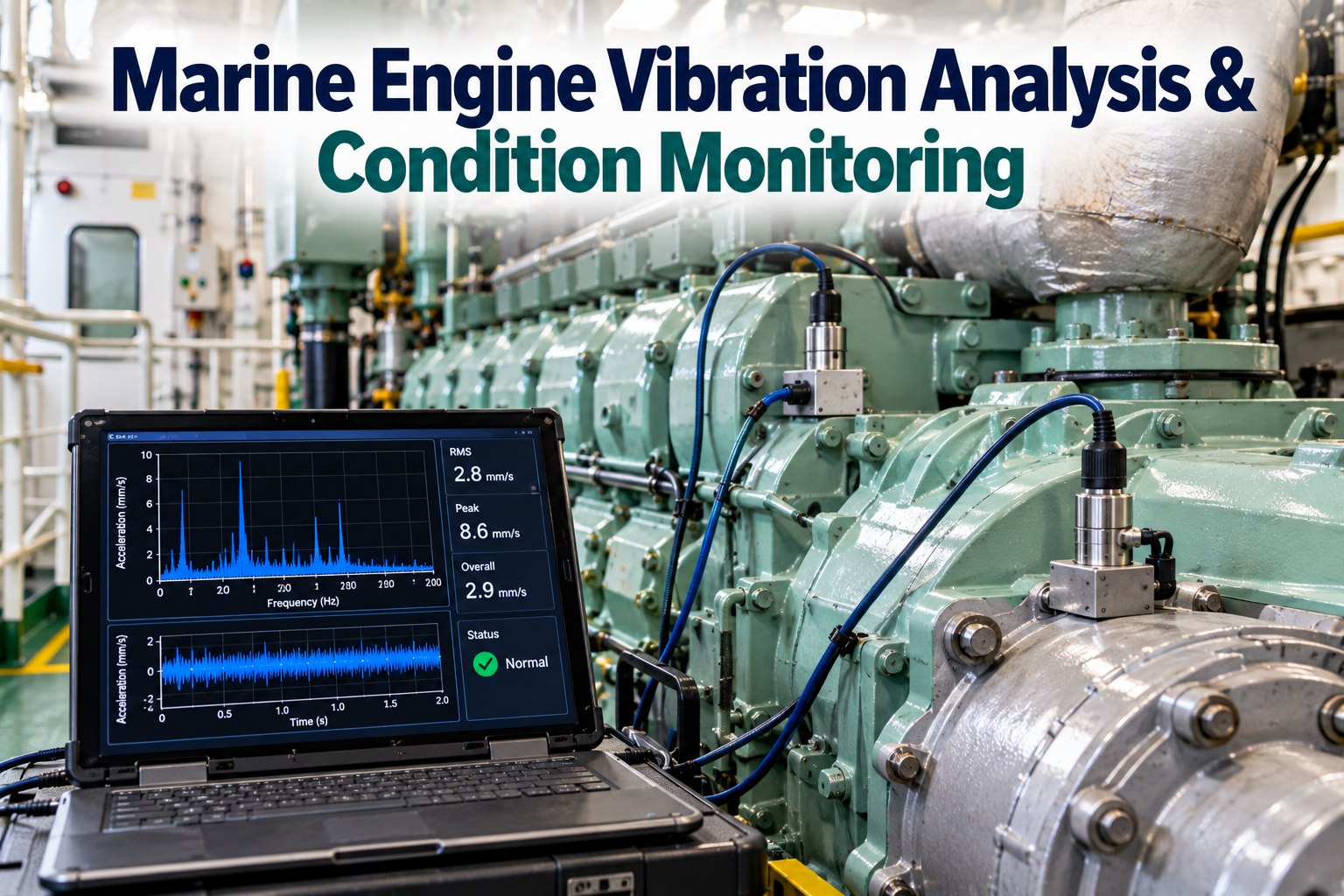
No single monitoring technique catches every motor failure mode. Vibration analysis detects bearing and mechanical faults. Insulation testing detects winding degradation. Temperature monitoring detects thermal stress. Current analysis detects rotor and electrical faults. The most effective ship operators use a combination, matched to motor criticality — comprehensive monitoring for safety-critical steering gear and fire pump motors, basic inspections for non-critical accommodation fan motors. Marine Inspection supports logging data from all four techniques, creating a single maintenance record per motor that trends mechanical, electrical, and thermal condition together.
Monitoring Techniques Matched to Failure Modes
| Technique |
What It Detects |
When to Apply |
Typical Interval |
| Vibration Analysis |
Bearing wear, misalignment, imbalance, looseness, coupling faults, foundation problems |
All motors above 5 kW; priority on pumps, compressors, fans, cranes |
Monthly for critical motors, quarterly for standard, baseline after installation or overhaul |
| Insulation Testing |
Winding insulation degradation, moisture ingress, contamination, aging, phase-to-ground faults developing |
All motors during planned shutdowns; priority on high-voltage and safety-critical motors |
Every 6-12 months (IR and PI test); after any flooding, prolonged layup, or suspected contamination |
| Temperature Monitoring |
Bearing overheating, winding thermal stress, cooling system degradation, overloading, ventilation blockage |
All motors during watch rounds; continuous monitoring on safety-critical and large motors |
Per watch (manual), continuous (where sensors installed), infrared scan quarterly |
| Current Analysis |
Broken rotor bars, air gap eccentricity, phase imbalance, power supply quality issues, mechanical load changes |
Large motors above 50 kW; motors with frequent starts; motors driving variable loads |
Annually for baseline, ad-hoc when vibration or performance anomalies detected |
Motor Maintenance Schedule by Running Hours and Criticality
The right maintenance interval depends on the motor's criticality, operating environment, and duty cycle. A fire pump motor that runs intermittently needs different attention than an engine room ventilation fan running 24/7. Marine Inspection handles this complexity by allowing operators to define separate maintenance schedules per motor, with triggers based on running hours, calendar intervals, or condition thresholds. Operators working with a fleet of vessels can sign up and configure motor-specific maintenance schedules across their entire fleet from a single dashboard.
Motor Maintenance Framework by Criticality Level
Safety Critical
Steering gear, fire pump, emergency generator cooling, lifeboat davit
Daily
Visual inspection, listen for abnormal noise, check operating temperature
Monthly
Vibration reading, bearing temperature log, current draw check, visual inspection of connections
6 Months
Insulation resistance test, alignment check, lubrication per maker's schedule, terminal tightness
Annually
Full condition assessment, polarization index, bearing replacement evaluation, IR thermography scan
High Criticality
Cooling water pumps, engine room fans, fuel/lube oil purifiers, cargo cranes, air compressors
Weekly
Visual/audible check, operating temperature verification, current draw spot check
Quarterly
Vibration measurement, bearing temperature trending, lubrication check/top-up
Annually
Insulation resistance and polarization index, alignment verification, coupling inspection
Per Maker
Bearing replacement, winding cleaning, full motor overhaul per manufacturer's running-hour intervals
Standard Criticality
Accommodation fans, galley exhaust, sewage treatment, freshwater generator, workshop equipment
Monthly
Visual inspection, listen for noise, check motor frame temperature by hand
6 Months
Lubrication per schedule, check belt tension (where applicable), clean cooling air paths
Annually
Insulation resistance test, visual inspection of windings and connections, general clean
Per Maker
Bearing replacement at manufacturer's recommended intervals or upon condition indication
Expert Review: Why Shipboard Motor Maintenance Matters Now
DNV's Maritime Safety Trends 2014-2024 report documented that machinery damage or failure caused 60% of all maritime incidents in 2024 — up from 38% a decade earlier. Machinery failures increased 20% year-over-year in 2024, with vessels over 25 years old involved in 41% of all incidents. The Allianz Safety and Shipping Review 2025 recorded 1,860 machinery damage incidents globally, with fire and explosion events reaching 250 — the highest in a decade, and with 20% year-over-year growth. Engine room fires, many of which originate from electrical equipment failures including motors, accounted for the majority of marine equipment insurance claims.
The ageing global fleet makes motor maintenance increasingly urgent. More than half the global fleet is now over 15 years old. At that age, motor bearings, winding insulation, and cooling systems have degraded significantly from their commissioned state. The average age of a vessel involved in a total loss over the past decade is 29 years. On these vessels, motors installed at build may have 100,000+ running hours. Without systematic condition tracking, degradation goes unnoticed until failure — and on a vessel with 80-200 motors, the probability of at least one motor failing in any given voyage is substantial.
CM Technologies noted at Nor-Shipping 2025 that advanced diagnostics and monitoring solutions for marine machinery should be considered essential safety tools, not optional upgrades. Maersk reported a 20% reduction in engine-related downtime through systematic monitoring including auxiliary machinery. The technology is available. What most operators lack is the maintenance management structure to apply it consistently. Marine Inspection provides that structure — a platform where every motor has a maintenance record, every inspection generates documented results, and every developing fault is tracked from detection through resolution. Operators ready to bring this discipline to their motor maintenance can book a platform walkthrough with our team.
Give Every Shipboard Motor the Maintenance Attention It Needs
Marine Inspection provides motor inventory management, criticality-based maintenance scheduling, condition data logging, insulation resistance trending, and fleet-wide visibility — so developing motor faults are caught and corrected before they take critical systems offline.
Frequently Asked Questions
Can the platform manage maintenance for 80-200 motors across a single vessel?
Yes. Each motor is added as a separate equipment item with its own maintenance schedule, condition history, and criticality classification. Motors can be organized by system (pumps, fans, cranes, compressors), by location (engine room, deck, accommodation), or by criticality level. The vessel dashboard shows maintenance status, overdue tasks, and open deficiencies for the entire motor population at a glance — exactly the fleet-wide visibility that makes managing 100+ motors practical rather than overwhelming.
Does the platform support logging vibration measurements and insulation resistance test results?
Yes. Condition monitoring data — vibration readings, insulation resistance values, polarization index results, bearing temperatures, current draw measurements — can all be logged against each motor's maintenance record. Over time, this creates a trending history that shows whether a motor's condition is stable, gradually declining, or approaching intervention thresholds. This is the difference between knowing a motor's insulation resistance today and knowing whether it has been declining steadily over the past 12 months.
How does criticality-based scheduling work for different motor types?
Each motor is assigned a criticality level — safety critical, high, or standard — which determines its maintenance frequency and monitoring depth. Safety-critical motors (steering gear, fire pumps) get daily checks and monthly vibration readings. High-criticality motors (cooling water pumps, engine room fans) get weekly checks and quarterly monitoring. Standard motors (accommodation fans, workshop equipment) get monthly checks and annual testing. The platform enforces these schedules automatically and flags overdue tasks by criticality level, ensuring the most important motors always get attention first.
Can shore management monitor motor condition across a fleet of vessels?
Yes. The fleet dashboard gives technical superintendents, fleet managers, and DPAs real-time visibility into motor maintenance compliance, open deficiencies, and overdue tasks across every vessel in the fleet. When a chief engineer logs a declining insulation resistance reading on a safety-critical motor, shore management sees it immediately — enabling coordinated decisions about spare parts, specialist support, or drydock planning without waiting for monthly reports or email updates.
How quickly can an operator set up motor maintenance tracking on the platform?
Signup is instant and free. Adding motors as equipment items takes minutes per motor — enter the motor's location, nameplate data, criticality level, and applicable maintenance tasks. For a vessel with 100 motors, the initial setup typically takes a few days of engineering department effort. Once configured, the system runs maintenance schedules automatically, tracks completion, and builds condition history from every inspection. Most operators have their critical motors fully configured within the first week.