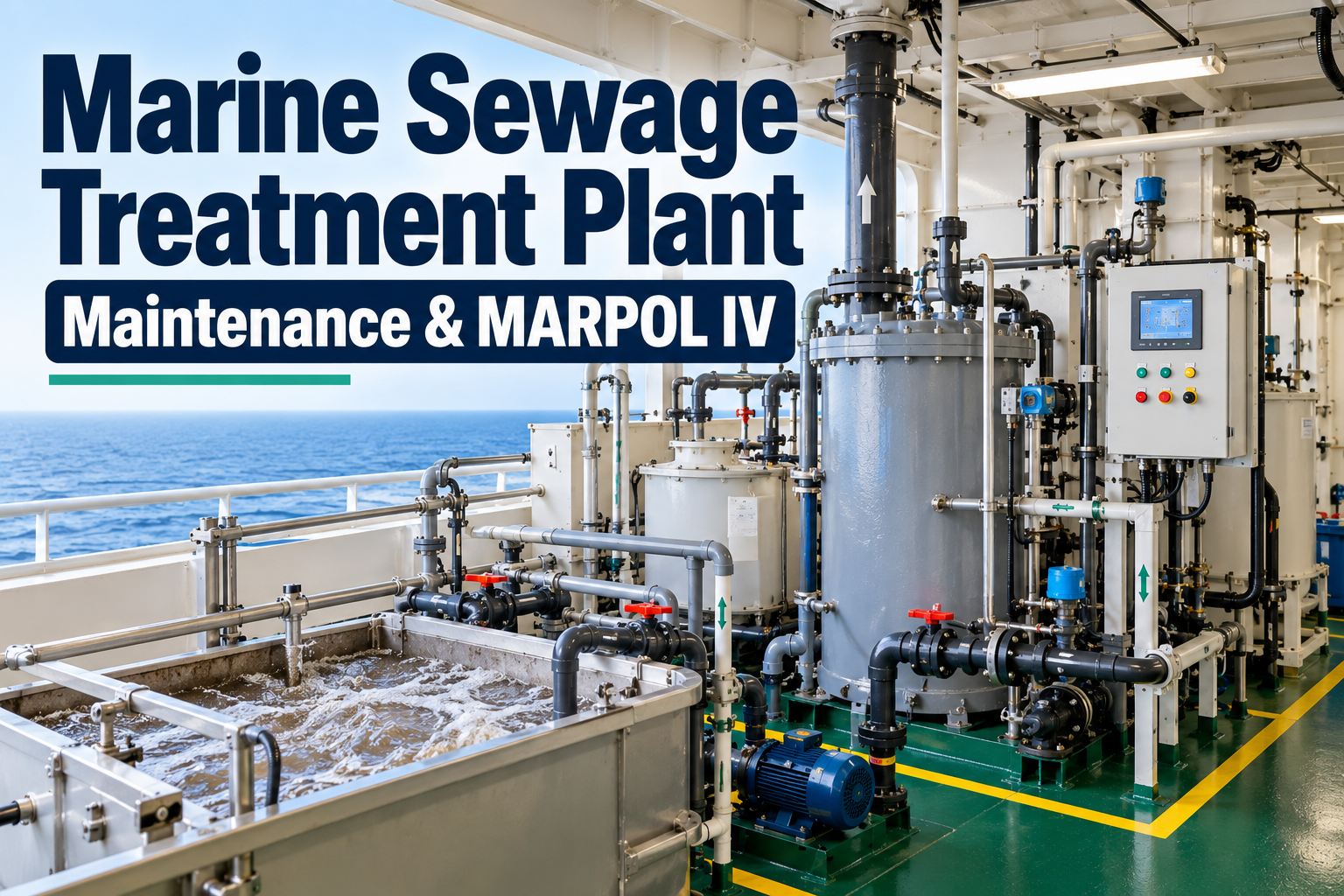
Marine Sewage Treatment Plant Maintenance & MARPOL IV
A sewage treatment plant is the only machine in the engine room that runs on living organisms, and that single fact explains almost every problem crews have with it. You cannot fix a biological plant by tightening something. If the aerobic bacteria in the aeration chamber have been killed by cabin disinfectant, starved by a ship in lay-up, or drowned by a blower that stopped three days ago, the plant will keep pumping — it will simply be pumping raw sewage past a sampling point while the log book says otherwise. MARPOL Annex IV sets who must carry a plant, where sewage may go overboard, and through IMO resolution MEPC.227(64) exactly how clean the effluent must be. This guide covers the applicability and certificate rules, the discharge distances, the effluent standard in numbers, how aerobic, chemical and membrane plants differ in practice, what keeps the biology alive, a maintenance schedule that holds up at a Port State Control inspection, and the troubleshooting engineers actually need. Start a free trial of Marine Inspection to log plant readings, chlorine dosing and discharge positions against the certificate.
MARPOL Annex IV — resolution MEPC.227(64)
Three chambers, one colony of bacteria, and a discharge you have to defend
Sewage entering the plant has to be aerated, settled and disinfected before it reaches the overboard valve. Every fault engineers report traces back to one of those three stages losing its conditions.
Annex IV applies to ships of 400 gross tonnage and above, and to ships under 400 GT certified to carry more than 15 persons, on international voyages. Those ships must have one of three arrangements on board, and the arrangement you have decides where you are allowed to discharge.
Option A
Approved sewage treatment plant
Type-approved to the effluent standard in force when it was fitted. Gives the widest discharge freedom because the effluent itself is certified clean — but only while the plant is actually working to that standard.
Option B
Comminuting and disinfecting system
Approved system that macerates and disinfects, with a holding tank for sewage produced inside restricted waters. Discharge permitted further from land than untreated sewage, but not at any distance.
Option C
Holding tank only
Capacity sized for the ship’s trade and complement, with a standard discharge connection for pumping ashore. Everything goes to a reception facility or overboard beyond 12 NM under the conditions below.
The certificate and survey trail
ISPP CertificateInternational Sewage Pollution Prevention Certificate, issued after initial survey. Maximum validity five years.
Renewal surveyBefore the certificate expires, confirming plant, piping, discharge connection and arrangements still match the certificate.
Additional surveyAfter any repair, renewal or modification of the plant or associated piping. Swapping a plant for a different model without one invalidates the certificate.
Standard connectionShore discharge flange to the dimensions in Annex IV, accessible and with a gasket and bolts available on board.
Where you may discharge, and at what speed
This is the part most often got wrong, because crews remember one distance and apply it to everything. The distance depends on how the sewage was treated, not on how urgent the tank level is. See how a position-aware checklist blocks the wrong discharge before the valve is opened.
Discharge permission by distance from nearest land
The Baltic is the exception that catches passenger ships
The Baltic Sea is a Special Area under Annex IV for passenger ships, with a nutrient-removal requirement on top of the ordinary effluent standard: total nitrogen reduced to 20 Qi/Qe mg/l or by at least 70 per cent, and total phosphorus to 1.0 Qi/Qe mg/l or by at least 80 per cent. An ordinary aerobic plant that passes everywhere else will not pass there. If the ship carries passengers and trades Baltic, confirm the plant’s approval covers the Special Area standard before the voyage, not at the berth.
The effluent standard your plant has to hit
Resolution MEPC.227(64) sets the numbers a plant is tested against, and testing runs for a minimum of ten days after steady-state conditions are reached — a deliberately long window, because a biological plant can be made to look good for an afternoon. Several limits carry a Qi/Qe dilution correction, which compares the flush and test water used against the design flow, so a plant cannot pass by diluting its way there.
MEPC.227(64) effluent limits — each row has its own scale
Two of those limits pull against each other and catch crews out. Coliform count comes down with disinfectant; residual disinfectant in the effluent must stay below 0.5 mg/l. Chasing a bad coliform result by winding up the chlorine dose fixes one number and fails another — and the extra chlorine carries back into the aeration chamber and kills the bacteria doing the real work.
How the three plant types behave in service
Most ships carry one of three arrangements. They fail in completely different ways, so the maintenance effort belongs in different places.
Type
How it works
Where it fails
Watch weekly
Biological / aerobic (extended aeration)
Aerobic bacteria break down organics in an aerated chamber; solids settle and are returned; effluent is disinfected before discharge
Bacteria killed by cabin chemicals, blower stoppage, long lay-up or hot water ingress. Recovery takes days, not hours
Vacuum collection to a treatment unit; small pipe bores and low flush volume reduce water use significantly
Vacuum leaks at toilet valves, blocked small-bore lines, vacuum pump seals. Loss of vacuum stops the whole system
Vacuum level and pump cut-in frequency, leak checks at suspect toilets
Chemical / physical
Dosing and flocculation with solids separation; no living culture to protect
Chemical stock run-out, dosing pump failure, sludge accumulation, higher consumable cost and sludge volume
Chemical stock and dose rate, dosing pump delivery, sludge tank level
Membrane bioreactor (MBR)
Biological stage followed by membrane filtration, giving very low solids and the nutrient performance needed in Special Areas
Membrane fouling and irreversible blinding if cleaning intervals are missed; membranes are an expensive consumable
Transmembrane pressure and permeate flow, cleaning-in-place interval
What keeps the biology alive
On a biological plant, these six habits decide whether the effluent ever meets the standard. None of them are maintenance tasks in the usual sense — they are operating discipline.
Keep the air on
Aerobic bacteria die without oxygen. A blower tripped overnight and left until the morning round can cost several days of recovery. Blower failure should be an alarm the watchkeeper sees, not something discovered at the next settling test.
Control what goes down the drains
Bleach, strong cabin disinfectant, paint solvent, galley degreaser and oil all kill the culture. Brief the catering and deck departments and use only the cleaning products the plant maker permits — in the quantity they permit.
Run the settling test weekly
Draw a sample, let it settle in a measuring cylinder and read the solids. A common maker guideline is to de-sludge when settled solids exceed around 200 mg/l. Record the number every week so you can see a trend rather than a single bad reading.
Watch the air lift return
Most plants return settled sludge to the aeration chamber with an air lift, often visible through a clear section of tubing. No visible flow means the settling chamber is filling and the culture is shrinking, long before the effluent looks wrong.
Dose disinfectant to the plate, not by feel
Follow the maker’s dose. Typical contact-tank chlorination sits around 1 to 5 ppm, but the number that matters at the sample point is residual below 0.5 mg/l. Over-dosing kills the culture upstream and fails the residual limit downstream.
Restart deliberately after lay-up
After a docking or a long idle period the culture is gone. Seed the plant with a bacterial culture, run aeration with low loading for several days and do not expect compliant effluent on day one. Plan the restart before you need the plant, not after.
A sewage plant is judged on its record, not its condition
Weekly settling results, chlorine dosing, blower hours, discharge positions and shore-disposal receipts — captured on a phone at the plant with photo evidence and filed against the ISPP Certificate, so the trend is there when an inspector asks for it.
Intervals below are a practical baseline consistent with common maker recommendations. The plant’s own manual always takes precedence, particularly for membrane cleaning and for units approved to the Special Area standard.
Interval
Task
What good looks like
Daily
Check blower running and air distribution, plant pressure, alarm panel clear, discharge pump cycling normally
Even bubbling across the aeration chamber, no alarms standing, pump cutting in and out on level
Daily
Check disinfectant stock and dosing, observe effluent appearance at the sight glass
Effluent clear to faintly turbid with no odour of raw sewage; dosing unit not run dry
Weekly
Settling test on an aeration chamber sample; de-sludge if solids exceed the maker’s figure
Result written down every week; brown floc that settles cleanly, not black or greasy
Weekly
Confirm air lift return flow; clear the air lift if sluggish
Visible continuous return to the aeration chamber
Weekly
Add bacterial culture where the maker specifies it, particularly after any chemical ingress
Dosing recorded with quantity and reason
Monthly
Test level switches and float controls for the discharge and transfer pumps
Each switch proven individually; no float held up by rag or scale
Monthly
Clean strainers and screens, check comminutor or macerator cutters, check non-return valves
Free movement, no rag build-up, cutters not blunted or jammed
Monthly
Blower service: air filter, belt tension or coupling, oil level, relief valve
Filter clean, no leaks, relief valve lifts at the set pressure
Quarterly
Back-flush with seawater where the maker permits; inspect and clean diffusers
Diffusers delivering evenly again; no dead zones in the aeration chamber
Quarterly
UV lamp and quartz sleeve check or renewal on units using UV disinfection
Lamp within its rated hours, sleeve clean, lamp hours logged
Six-monthly
Vacuum system: leak test toilets and valves, service vacuum pump, check collecting vessel
Vacuum holding without frequent pump cut-ins; no persistent leaking toilet
Annual
Empty, ventilate, gas-test and internally inspect the plant; check coatings, welds, baffles and anodes
Enclosed-space entry permit completed; coating intact, no wastage at the waterline
Annual
Verify ISPP Certificate, standard discharge connection, gasket and bolts, and overboard valve sealing arrangement
Certificate valid, connection accessible and complete, valve arrangement matching the certificate
Before anyone opens the plant
Sewage tanks and treatment plants generate hydrogen sulphide, methane and ammonia, and are oxygen-deficient. Hydrogen sulphide deadens the sense of smell at exactly the concentrations that kill, so “it smells fine” is not a test. Treat every entry as enclosed-space entry: isolate and lock off the plant, drain and flush, ventilate continuously, gas-test for oxygen, hydrogen sulphide and flammable gas, work under a permit with a standby person and rescue equipment ready. Handle hypochlorite and other disinfectants with the correct PPE and never mix chemicals in the dosing tank.
Troubleshooting matrix
Work down the causes in order. On a biological plant, ask what changed three to five days ago — the culture reacts slowly, so today’s bad effluent usually reflects last week’s event.
Symptom
Likely causes, in order
What to do
Effluent dark, cloudy, smells of raw sewage
Culture killed by chemicals; blower stopped; hydraulic overload; sludge not returned
Restore aeration, stop the chemical source, reduce loading, de-sludge and re-seed with culture. Expect several days to recover.
Heavy foaming in the aeration chamber
Detergent ingress from laundry or galley; young culture after re-seeding; over-aeration
Trace and stop the detergent source, reduce air to the maker’s setting, allow the culture to mature before judging.
Sludge floating instead of settling
Denitrification in the settling chamber; excessive sludge age; air lift not returning
Increase sludge return or de-sludge, check the air lift is clear, review aeration period against the manual.
Black sludge, rotten-egg odour
Anaerobic conditions from prolonged air loss or a blocked diffuser
Restore full aeration, clean or renew diffusers, de-sludge the anaerobic material, re-seed.
High coliform result at the sample point
Disinfectant run out or dosing pump failed; contact time too short; short-circuiting across the chamber
Check stock and dosing pump delivery first, then contact time and baffles. Do not simply raise the dose.
Residual chlorine above the limit
Over-dosing to mask a poor biological stage; dosing pump set too high; dechlorination step failed
Return the dose to the maker’s figure and fix the biological stage instead. Verify the residual at the sample point after adjusting.
Isolate cabins in sections to find the leak, clear the blockage, service the pump, re-brief on what must not be flushed.
Blower tripping or overheating
Blocked air filter; belt slipping; relief valve lifting on back pressure from fouled diffusers
Clean the filter, retension or renew the belt, clean the diffusers. Repeated relief lifting means the diffusers are the real fault.
Membrane flux falling, pressure rising
Fouling; cleaning interval missed; excess solids carried to the membrane stage
Run the cleaning-in-place procedure from the manual, correct the upstream solids, record transmembrane pressure each week.
What a PSC officer will look at
ISPP Certificate and survey record
Valid, and describing the plant actually installed. A replaced or modified unit needs an additional survey; a certificate naming a superseded model is a deficiency in itself.
Operating and maintenance records
Weekly settling results, blower and pump maintenance, disinfectant dosing, UV lamp hours. A file that starts three weeks before the inspection tells its own story.
Discharge entries with position
Where and when sewage went overboard, with speed, and which treatment applied. Annex IV has no dedicated record book, so flag and company requirements plus the deck log carry this — keep it consistent and complete.
Reception facility receipts
For every shore discharge. Tank capacity, complement and voyage pattern should roughly reconcile with what was landed and what was discharged at sea.
Overboard valve arrangement
Correctly marked, and any holding-tank bypass secured and sealed in accordance with the certificate. An unsealed bypass is one of the fastest ways to a detainable finding.
Crew knowledge
The duty engineer being able to state the discharge distances for the ship’s arrangement, and the plant’s alarm response, without reading it off a plate.
Frequently asked questions
Q1
How far from land can treated sewage be discharged?
Effluent from an approved sewage treatment plant meeting the standard may be discharged at any distance. Comminuted and disinfected sewage from an approved system requires more than 3 NM from the nearest land, and untreated sewage more than 12 NM. For the last two, the ship must be en route at not less than 4 knots and discharging at a moderate rate approved by the Administration — never in a single dump.
Q2
Which ships does MARPOL Annex IV apply to?
Ships of 400 GT and above, and ships under 400 GT certified to carry more than 15 persons, engaged on international voyages. Those ships must carry an approved treatment plant, an approved comminuting and disinfecting system with a holding tank, or a holding tank sized for the trade, and must hold a valid ISPP Certificate.
Q3
What are the MEPC.227(64) effluent limits?
Thermotolerant coliform not more than 100 per 100 ml, total suspended solids 35 mg/l, BOD5 25 mg/l, COD 125 mg/l, pH between 6 and 8.5, and residual disinfectant below 0.5 mg/l where chlorine is used. Several of those carry a Qi/Qe dilution correction. Type testing runs for at least ten days after steady-state conditions are reached.
Q4
Why does the plant smell of rotten eggs?
Hydrogen sulphide from anaerobic conditions — the aerobic bacteria have lost their oxygen supply, usually because a blower stopped or the diffusers are fouled. Restore full aeration, clean the diffusers, remove the anaerobic sludge and re-seed. Treat the gas itself as a serious hazard: it deadens the sense of smell at dangerous concentrations.
Q5
What kills the bacteria in a sewage treatment plant?
Bleach and strong cabin disinfectants, galley degreasers, paint solvents, oil, and over-chlorination inside the plant itself. Loss of aeration for more than a few hours does the same by starving the culture of oxygen. Recovery after any of these takes days and usually needs re-seeding with a bacterial culture.
Q6
Can sewage be discharged in port?
No. Port, harbour and coastal state rules are stricter than Annex IV and generally require discharge to a reception facility, and in any case the en-route and speed conditions cannot be met alongside. Land it ashore and keep the receipt.
Q7
What is different about the Baltic Sea?
It is a Special Area under Annex IV for passenger ships, adding a nutrient-removal standard: total nitrogen to 20 Qi/Qe mg/l or at least a 70 per cent reduction, and total phosphorus to 1.0 Qi/Qe mg/l or at least an 80 per cent reduction. Standard aerobic plants do not achieve this; passenger ships trading there generally need a plant approved to that standard or must land sewage ashore.
Q8
How do you restart a plant after dry-dock?
Assume the culture is dead. Fill, start aeration, seed with a bacterial culture and run at low loading for several days before expecting compliant effluent, checking settling and effluent appearance daily. Plan the seeding and the timing before the ship needs the plant — a fresh culture cannot be hurried.
Keep the sewage plant’s evidence as clean as its effluent
Marine Inspection puts the weekly settling test, dosing record, blower and pump maintenance and discharge positions on one phone at the plant — with due-date alerts for UV lamps, diffuser cleaning, membrane cleaning and ISPP survey windows across the whole fleet.