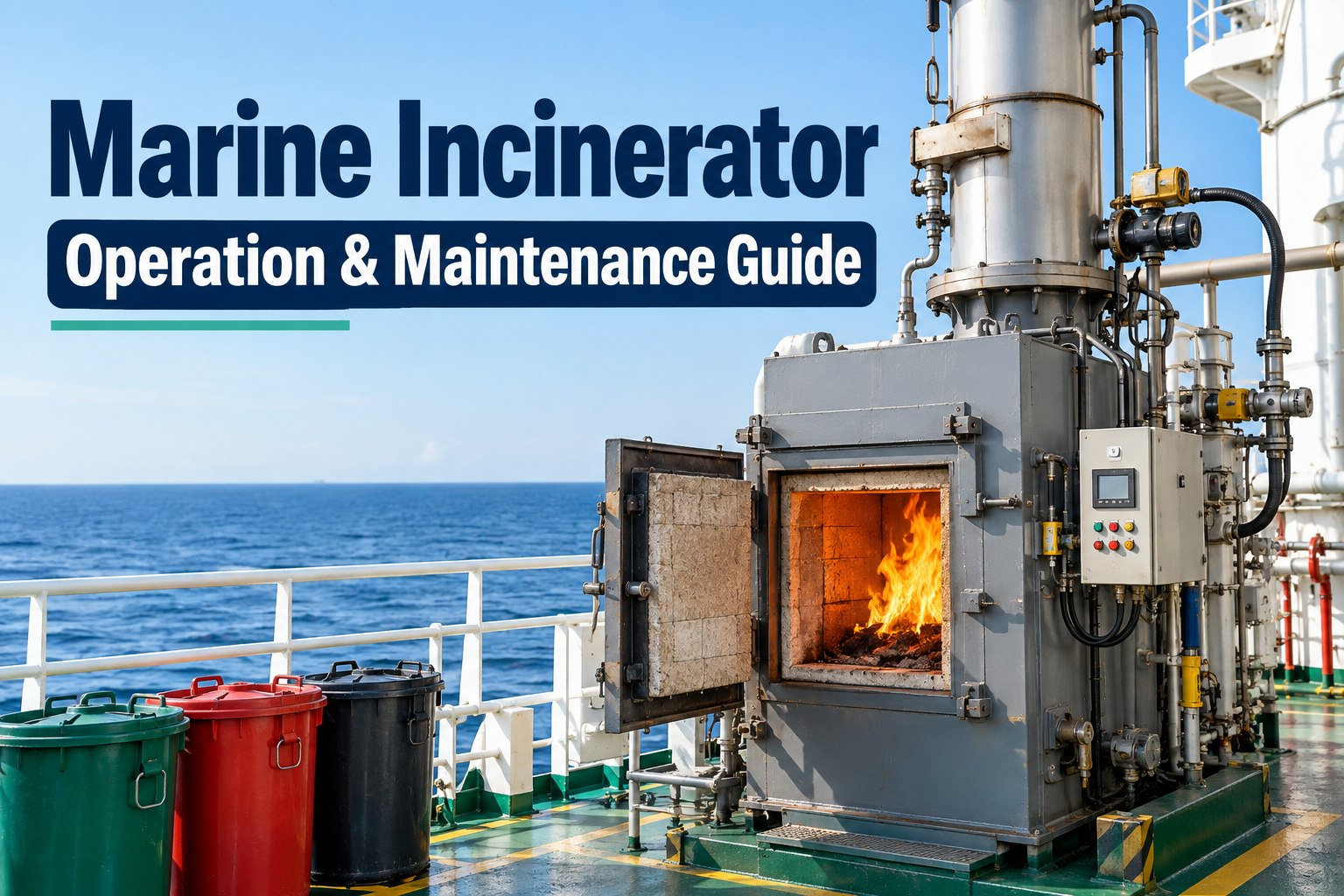
A shipboard incinerator is the only piece of machinery on board whose whole purpose is to destroy something, and it is judged almost entirely on temperature. MARPOL Annex VI, Regulation 16 and IMO resolution MEPC.244(66) set a narrow flue gas window — 850 to 1,200 °C — plus limits on oxygen, carbon monoxide, soot and unburned residue in the ash. Run below the window and you make dioxins and smoke; run above it and you destroy the refractory lining that makes the unit certifiable in the first place. Between those two failures sit the practical problems every engineer knows: sludge that will not burn, a burner that keeps locking out, a refractory arch that cracks after two months, and a Garbage Record Book that does not match what the ash pan says happened. This guide covers the operating limits in the regulation, what you may and may not feed the unit, a correct burn cycle from prepurge to postpurge, refractory care, a maintenance schedule that survives a Port State Control inspection, and the troubleshooting most crews need at 0200 with a full sludge tank. Start a free trial of Marine Inspection to log burn cycles, temperatures and ash disposal against the certificate.
MARPOL Annex VI — Regulation 16
The whole job is keeping flue gas inside one temperature window
Every other incinerator parameter — oxygen, carbon monoxide, soot, ash burnout — follows from whether the combustion chamber holds the window during the feeding phase.
Below 850 °CIncomplete combustion, smoke, dioxin formation. Feeding must stop.
850 – 1,200 °CThe compliant operating window. Flue gas outlet, measured during combustion.
Above 1,200 °CRefractory spalling, slag fusion, burner and crown damage.
Incinerators installed on or after 1 January 2000 must hold an IMO type approval certificate, and the operating manual that comes with it is a controlled document — a PSC officer is entitled to ask for it and to compare what it says with what your logbook records. These are the figures behind that comparison.
850 – 1,200 °C
Flue gas outlet temperature
Measured during combustion, not during preheat or cooling down. Continuous-feed units must not accept waste when the chamber is below 850 °C.
600 °C in 5 min
Batch-loaded units
No preheat requirement, but the combustion chamber must reach 600 °C within five minutes of start-up. Most makers preheat to around 650 °C before the first charge anyway.
6 – 12 %
Oxygen in the combustion chamber
Below 6 % you starve the flame and make CO; above 12 % you are cooling the chamber with excess air and dropping out of the window.
200 mg/MJ
Carbon monoxide in flue gas
Maximum average. CO is the single most useful indicator that combustion has gone incomplete — it rises before smoke becomes visible.
Bacharach 3
Soot number / Ringelmann 1
Roughly 20 % opacity. Higher readings are accepted only briefly during start-up, not as a steady-state condition.
10 % max
Unburned components in ash
By weight. Ash that still looks like recognisable garbage is evidence the cycle was cut short or the chamber never held temperature.
Purge timings sit alongside those limits and are the part crews most often shorten. Before ignition the chamber must be purged with at least four air changes and never less than 15 seconds; the same prepurge applies between restarts after any flame failure; and after the fuel valve closes the postpurge must run for not less than 15 seconds. Defeating a purge to save a few minutes on a night watch is how furnace explosions happen. See how a digital checklist enforces purge and temperature steps before the burner will be signed off as started.
What you may burn, and what will end a career
The prohibited list is short, absolute and heavily inspected. There is no dispensation for a full sludge tank, a long port stay or an unavailable reception facility.
Prohibited on board — never incinerate
Annex I, II and III cargo residues, and any packing materials contaminated by them
Polychlorinated biphenyls (PCBs)
Garbage containing more than traces of heavy metals
Sewage sludge and sludge oil not generated on board the ship
Exhaust gas cleaning system (scrubber) residues
Polyvinyl chloride (PVC) — except in incinerators holding IMO type approval
Permitted, with conditions
Sludge oil generated on board, from purifier and bilge operations
Sewage sludge generated on board — but never in ports, harbours or estuaries
Oily rags, filters and used absorbent material from machinery spaces
Galley and domestic waste, dried and drained before charging
Cardboard, paper and non-contaminated packaging from ship’s stores
Waste oils and used lubricating oil produced by the ship’s own machinery
Medical waste in units approved for it, where the flag administration permits
The port restriction catches more ships than the prohibited list
Sewage sludge and sludge oil must not be incinerated in ports, harbours or estuaries, and many coastal states and individual port authorities ban all incineration alongside. Local rules are stricter than MARPOL in the Baltic, several EU ports, California, Singapore and much of the Gulf. Record the ship’s position at the start and end of every burn — a start time with no position is an argument you will lose.
What a correct burn cycle looks like
Plotted against time, a good cycle has a recognisable shape: a short purge at ambient, a steep preheat, a long plateau inside the window while waste is fed, then a controlled burn-down and postpurge. Cycles that fail inspection almost always show the plateau dipping below 850 °C because waste was charged faster than the chamber could recover.
Combustion chamber temperature through one batch cycle
Indicative profile for a batch-loaded unit burning galley waste and sludge oil. Actual plateau depends on calorific value of the charge and on how much water the sludge still carries.
1
Check before you light anything. Ash pan emptied and refitted, door interlocks proving, flue damper free, sludge service tank heated and settled, forced draught fan clear. A cold start on a half-full ash pan is the most common cause of a blocked grate.
2
Prepurge. At least four air changes of the combustion chamber and uptake, never less than 15 seconds. Confirm the fan is actually delivering — a proving switch that has been strapped out is a finding and a hazard.
3
Ignition and preheat. Light the diesel burner and bring the chamber to about 650 °C before any charging. On continuous-feed units the interlock at 850 °C does this for you; on batch units the operator is the interlock.
4
First charge. Load solid waste in small quantities, dry and drained. Wet or bagged waste smothers the flame, drops chamber temperature and sends the CO reading straight up.
5
Hold the plateau. Watch flue gas outlet and oxygen together. If temperature falls toward 850 °C, stop feeding and let the burner recover; do not chase it with more air, which cools the chamber further.
6
Introduce sludge oil gradually. Sludge with high water content will quench the flame. Settle and drain the service tank first, keep it at the maker’s recommended temperature, and feed at a rate the chamber can absorb without dipping.
7
Burn down. Stop charging well before you intend to shut down and let the contents burn out inside the window. This is what gets unburned components in the ash under 10 % by weight.
8
Postpurge and cool. Not less than 15 seconds after the fuel valve closes, then let the unit cool naturally. Opening the door on a hot chamber thermally shocks the refractory and is the single biggest cause of premature lining failure.
Every burn cycle is a record, not just a job
Start and stop times, position, what was burned, peak and minimum flue gas temperature, and who operated the unit. Marine Inspection captures it on a phone at the machine, with photo evidence of the ash pan and the temperature display, and files it against the Garbage Record Book and Oil Record Book entries.
Refractory is the expensive consumable in an incinerator, and almost all of its damage is self-inflicted through thermal cycling. A lining treated well lasts years; one shocked by cold-water hosing or door-opening on a hot chamber cracks in weeks.
Commissioning and after any repair
New or patched refractory must be dried out on the maker’s curing schedule — typically a slow ramp over several hours with a soak before reaching working temperature. Free moisture turned to steam inside the lining blows the face off it. Record the curing profile; class and PSC both ask for it after a lining renewal.
Heating and cooling rates
Keep to the manual’s permitted rate of rise and fall. Never quench a hot chamber, never hose it out, never open the charging door to speed cooling. Most linings that fail early failed for this reason alone.
Inspect cold, and map what you find
At every cold inspection, check the crown, the burner quarl, the door frame and the grate area for cracking, spalling, slag build-up and missing anchors. Photograph the same four viewpoints each time so deterioration is comparable rather than remembered.
Hairline cracks are normal — movement is not
Fine crazing from thermal cycling is expected. What matters is a crack that has opened, a section that has moved, or hot spots showing on the casing. Casing temperature above the maker’s limit means the lining behind it has gone, whatever it looks like from inside.
Slag and clinker
Running above 1,200 °C fuses ash into clinker that bonds to the lining and takes refractory with it when chipped off. Burning plastics and high-calorific waste without controlling the feed rate is the usual cause.
Keep the spares that match
Castable, plastic refractory and anchors have shelf lives and specific grades. A patch made with whatever was in the store is a patch that fails first and, if it changes the chamber geometry, calls the type approval into question.
Maintenance schedule that keeps the unit certifiable
Intervals below are a practical baseline in line with common maker recommendations; the type approval manual for your specific unit always takes precedence. Log every item — an inspector looks for a pattern of completion, not a single tidy entry.
Interval
Task
What good looks like
Every cycle
Record start/stop, position, waste type, peak and minimum flue gas temperature
Entry signed, position logged, temperatures inside 850 – 1,200 °C for the feeding phase
Every cycle
Empty and inspect ash pan before next start; check ash burnout
Ash grey and friable, no recognisable material, under 10 % unburned by weight
Daily in use
Check burner flame through sight glass, photocell lens, flue gas opacity
Stable flame, clean lens, soot not exceeding Bacharach 3 in steady running
Weekly
Clean photocell/flame eye, check door seals and interlocks, drain sludge tank water
Interlocks stop the burner when tested; seal rope intact; free water drained off
Monthly
Clean or renew burner nozzle and electrodes, check ignition transformer, test fan proving switch
Correct spark gap, clean atomiser, fan proving switch trips the sequence as designed
Monthly
Inspect flue and uptake for soot build-up; check spark arrester where fitted
Uptake clear, no soot bed capable of supporting an uptake fire
No open cracks, no movement, slag removed carefully without damaging the face
Quarterly
Calibrate or verify flue gas temperature sensor against a reference instrument
Reading within the maker’s tolerance; calibration recorded with date and instrument used
Quarterly
Function-test all safety trips: low temperature, high temperature, flame failure, door open
Each trip proven individually and logged; no strapped-out or bypassed device
Six-monthly
Overhaul sludge pump and heater, clean strainers, check sludge tank heating coil
Sludge delivered at design temperature and viscosity, strainers clean
Annual
Full internal inspection, refractory measurement, casing temperature survey, insulation checks
Lining thickness within limits, casing temperature under maker’s figure, findings written up
Annual
Verify type approval certificate, operating manual and training records are on board and current
Certificate matches the installed unit; manual is the controlled version; operators named and trained
The records a PSC officer will ask to see
Incinerator findings are rarely about the machine. They are about a gap between what the machine did and what the books say it did. Digitising these entries removes the two failures inspectors look for first: missing signatures and dates that do not line up.
Garbage Record Book
Every incineration of garbage recorded with date, time, ship’s position, categories burned and estimated amount. Entries signed by the officer in charge and the pages countersigned by the Master. Retained on board for two years from the last entry.
Oil Record Book Part I
Sludge and waste oil burned in the incinerator is a disposal method and must be entered under the relevant code with quantity and time started and stopped. Sludge tank quantities in the book should be reconcilable with actual soundings.
Type approval certificate and manual
Required for units installed on or after 1 January 2000. The certificate must correspond to the unit actually fitted, and the operating manual it references must be on board and available to the watchkeepers, not locked in the office.
Maintenance and test records
Refractory inspections with photographs, safety trip tests, temperature sensor calibration and burner overhauls. Photographs dated to the inspection, not to the day someone assembled the file.
Operator training
Named personnel trained on this unit, with the training recorded. Regulation 16 expects operators to be trained and able to follow the manufacturer’s instructions — a crew change with no handover is where that trail usually breaks.
Reception facility receipts
For everything you could not or must not burn. A ship with a sludge production rate that never matches its disposal record invites a much longer conversation than the incinerator itself.
What inspectors actually find
Burning in port. Sewage sludge or sludge oil incinerated alongside, or in an estuary, often recorded honestly in the book by a crew that did not know the restriction.
Temperature never logged. A burn cycle recorded with times but no flue gas temperature, which makes it impossible to show the unit was operated within the window.
Ash with recognisable waste in it. Plastic fragments, whole cans and unburned food in the ash pan — direct evidence the cycle was ended early or the chamber never reached temperature.
Strapped-out interlocks. Door switches taped, fan proving bridged, low-temperature interlock disabled so the unit can be fed faster. Treated as a serious deficiency.
Sludge quantities that do not reconcile. Oil Record Book entries that cannot be squared with tank soundings and running hours of the purifiers.
Missing or mismatched type approval. A certificate for a different model, or a unit replaced without the paperwork following it.
Soot fire damage in the uptake. Evidence of a previous uptake fire with no report, no repair record and no change to the cleaning interval.
Operating manual not on board. Or present only as an uncontrolled photocopy that does not match the installed unit.
Troubleshooting matrix
The faults below cover most incinerator call-outs. Work down the causes in order — on this machine the cheap cause is usually the real one.
Symptom
Likely causes, in order
What to do
Burner will not light
Empty or cold service tank; clogged nozzle; fouled photocell; weak ignition spark; fan proving switch not made
Check fuel supply and temperature first, then clean nozzle and flame eye, then set electrode gap. Never bypass the proving switch to force a start.
Repeated flame failure lockout
Water in sludge; wrong sludge temperature/viscosity; dirty photocell; air register maladjusted
Settle and drain the sludge tank, confirm heater output, clean the flame eye, reset air to the manual’s setting.
Cannot reach 850 °C
Wet or bagged waste; overcharging; excess air too high; refractory damaged; burner underfiring
Stop charging and let the burner recover. Dry and drain waste, reduce charge size, trim excess air down toward 6 – 12 % oxygen.
Temperature runs above 1,200 °C
High-calorific charge such as plastics or oily rags in quantity; feed rate too high; air control fault
Reduce feed rate, mix high-calorific waste with lower-value material, check the temperature control loop and damper actuator.
Stop the unit, inspect cold, repair before further use. A hot spot is a structural and fire risk, not a cosmetic one.
Uptake fire
Soot bed in flue from prolonged incomplete combustion; spark arrester blocked
Shut down, close air, boundary cool. Afterwards investigate the combustion problem that laid the soot bed and shorten the cleaning interval.
Frequently asked questions
What temperature must a marine incinerator operate at?
Flue gas outlet temperature must stay between 850 and 1,200 °C during combustion. Continuous-feed units must not accept waste below 850 °C. Batch-loaded units have no preheat requirement but the combustion chamber must reach 600 °C within five minutes of start-up, and in practice most are preheated to around 650 °C before the first charge.
Can sewage sludge be incinerated on board?
Yes, if it was generated on board that ship — but never in ports, harbours or estuaries. Sewage sludge and sludge oil from another ship or from shore must not be incinerated at all. Many port authorities also ban incineration alongside regardless of what is being burned, so check local rules before lighting up.
Is PVC allowed in a shipboard incinerator?
Only in incinerators that hold an IMO type approval certificate. Outside that, PVC is on the prohibited list because burning it produces hydrogen chloride and dioxins. The same applies to refined petroleum products containing halogen compounds.
How much unburned material is allowed in the ash?
A maximum of 10 % by weight of unburned components. Practically, ash should be grey and friable with nothing recognisable in it. Plastic fragments or whole food waste in the ash pan tell an inspector the cycle was cut short or the chamber never held the operating window.
What prepurge is required before ignition?
At least four air changes of the combustion chamber and uptake, and never less than 15 seconds. The same prepurge applies before any restart after a flame failure, and the postpurge after the fuel valve closes must run for not less than 15 seconds.
Which incinerators need a type approval certificate?
Units installed on or after 1 January 2000 must hold an IMO type approval certificate issued under MARPOL Annex VI, Regulation 16, with the associated operating manual on board. The certificate must correspond to the unit actually fitted — a certificate for a superseded model is a deficiency.
Why does refractory fail so quickly on some ships?
Almost always thermal shock: opening the charging door on a hot chamber, hosing it out to cool it down, or ignoring the permitted heating and cooling rates. Running above 1,200 °C adds slag that bonds to the face and pulls lining away when it is chipped off. A lining that is cycled gently and inspected cold every quarter lasts several times longer.
What record entries does an incinerator generate?
Garbage incineration goes in the Garbage Record Book with date, time, position, categories and estimated amount; sludge and waste oil burned goes in Oil Record Book Part I under the relevant disposal code with quantities and start/stop times. Both need the officer’s signature and the Master’s countersignature, and the ship’s position must be recorded for every burn.
Turn every burn cycle into evidence you can produce on demand
Marine Inspection puts the incinerator checklist, temperature log, refractory photographs and record book entries on one phone at the machine — with due-date alerts for trip testing, sensor calibration and cold refractory inspections across the whole fleet.