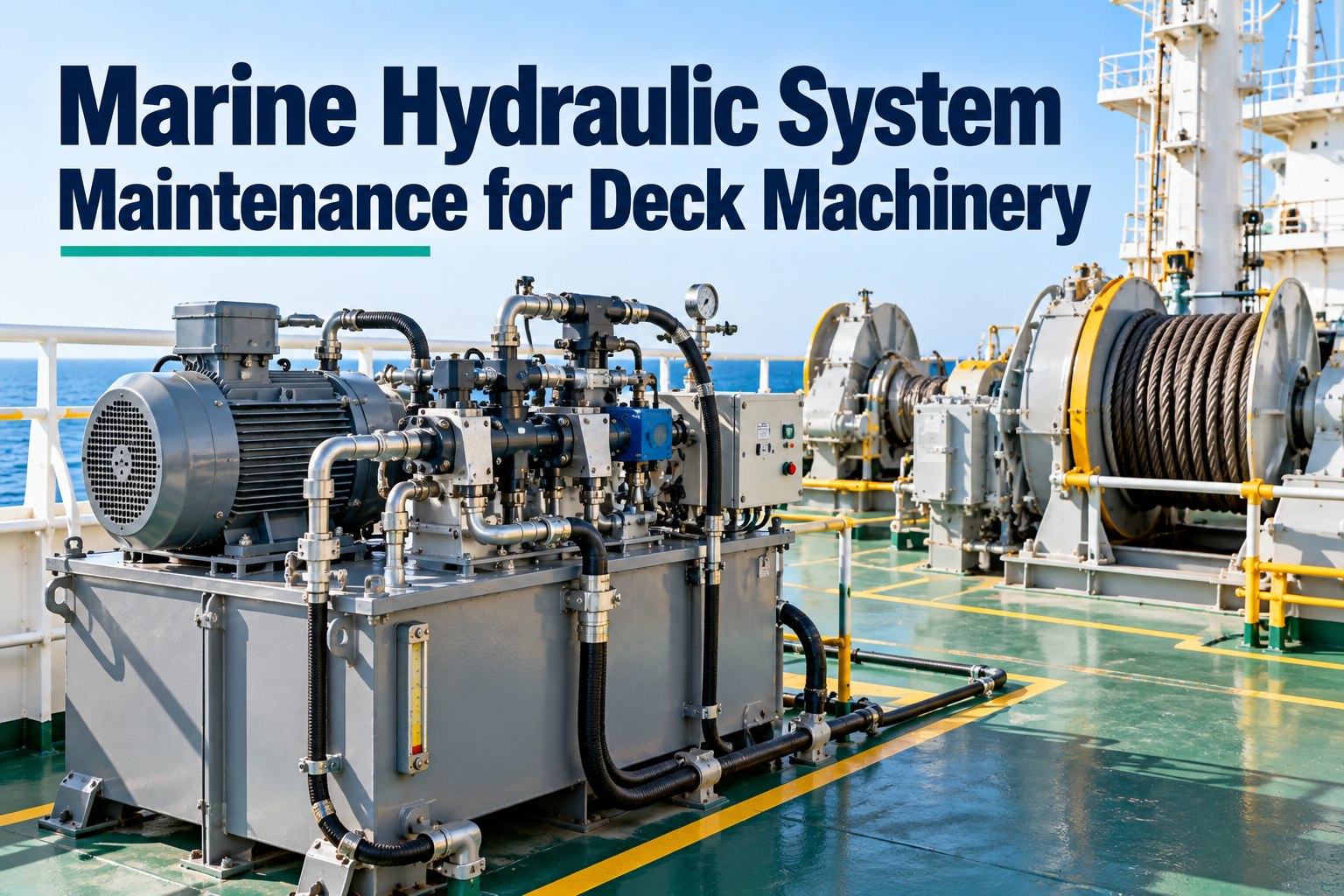
Marine Hydraulic System Maintenance for Deck Machinery
Deck hydraulics fail for one reason far more often than any other, and it is not wear. It is dirt. The oil in a mooring winch circuit is a machine component in its own right — it transmits the power, lubricates the pump, cools the system and carries away heat — and the particles suspended in it are what destroy the close clearances inside pumps and valves. The frustrating part is that contamination is invisible: oil that looks perfectly clean in a sample bottle can carry thousands of particles per millilitre at the size that matters. That is why hydraulic maintenance on deck machinery is built around a number almost nobody on board can quote from memory, the ISO 4406 cleanliness code, and why the ships that have fewest crane and winch breakdowns are the ones that treat filtration, breathers and sampling as primary maintenance rather than housekeeping. This guide covers the code and what it actually means, target cleanliness by component, filtration and reservoir practice, hose inspection and the injuries hoses cause, accumulator safety, the quirks of winches, cranes, hatch covers and windlasses, leak control, and a maintenance and troubleshooting set for the whole deck. Start a free trial of Marine Inspection to hold oil results, hose records and deck machinery inspections in one place.
Fluid cleanliness — ISO 4406
The most important number in deck hydraulics is one nobody can see
An ISO 4406 code is three numbers, one for each particle size that matters. Read left to right they describe how much abrasive is circulating through your pumps and valves right now.
Reading a code — example 18 / 16 / 13
18
particles ≥ 4 µm
1,300 – 2,500 per ml
/
16
particles ≥ 6 µm
320 – 640 per ml
/
13
particles ≥ 14 µm
40 – 80 per ml
Every step up the scale doubles the particle count. A system drifting from 18/16/13 to 20/18/15 is carrying four times the abrasive it was designed for — with no visible change in the oil.
The scale is logarithmic, which is easy to say and easy to underestimate. Each code number represents roughly twice the particles of the one below it, so the difference between a system at code 16 and one at code 20 is not twenty-five per cent worse — it is sixteen times the particle count.
Each code step is one doubling — particles per millilitre at the ≥ 4 µm channel
How clean does each component need the oil?
Cleanliness targets are set by the most sensitive component in the circuit, not by the average. One proportional valve in a crane control block sets the standard for the whole system, however tolerant the rest of it is. See how a target code is recorded per machine so the sample result is judged against the right figure rather than a fleet average.
Typical target cleanliness by component — the ≥ 4 µm code
A single sensitive component sets the target for the circuit it sits in. If a crane has proportional control, the whole crane circuit is a code 16 system regardless of what the pump would tolerate.
Filtration, breathers and the reservoir
Filters do not make oil clean on their own. They remove what is already circulating; keeping dirt out in the first place is cheaper and more effective, and most of it enters through three routes — the breather, top-ups, and work on the system. Log filter changes and differential pressure readings against each power pack and the pattern of ingress becomes obvious.
The breather is the main door
Every time a cylinder extends and retracts, the reservoir breathes. On deck that means drawing in salt-laden, humid air with whatever the wind is carrying. A plain wire-mesh breather stops nothing useful; a filter or desiccant breather matched to the reservoir is one of the cheapest reliability upgrades available.
Top-ups are a contamination event
New oil out of a drum is routinely dirtier than the system it is going into. Filter on filling, keep a dedicated clean transfer unit, keep drums sealed and horizontal under cover, and never top up with a funnel and a rag on an open deck.
Change filters on indication, not on the calendar
Differential pressure indicators exist for a reason. A filter changed early wastes money, a filter left past bypass is doing nothing at all — and once the element is in bypass the system is running unfiltered while the gauge still looks familiar.
Watch for water
Water enters through breathers, seals and deck washing, and does damage out of all proportion to its quantity — corrosion, reduced film strength, additive depletion and accelerated oxidation. Cloudy or hazy oil is free water already; clear oil can still hold dissolved water.
Sample properly or do not bother
Take samples from the same point, from a live line under flow rather than the bottom of a settled tank, with a clean bottle and after flushing the sampling valve. A badly taken sample produces a number that is worse than none, because someone will act on it.
Temperature is part of cleanliness
Hot oil thins, oxidises and forms varnish that coats valve spools and makes them stick. Coolers, sea water flow and reservoir level all belong in the same conversation as filters, because a system running hot degrades its own oil faster than the filter can protect it.
Deck machinery records that actually get kept
Oil sample results and cleanliness codes, filter changes, hose fitment dates, brake tests and crane inspections — captured on deck at the machine with photo evidence, and trended across every winch and crane in the fleet.
Hose assemblies are the only part of the system with a definite ageing clock, and on deck they live outdoors in ultraviolet light, salt and movement. Industry practice under ISO/TS 17165-2 puts a shelf life of up to seven years on bulk rubber hose — extendable to ten under proper storage — and a maximum of two years for an assembled hose in store before it should be visually inspected and proof tested again. Service life in use is set by the application, not by a universal number, which is exactly why inspection matters.
Replace the assembly — do not repair it — on any of these
Cover cracked, cut or abraded through to the reinforcement
Reinforcement wire visible, frayed or rusted anywhere
Blister, bulge or soft spot in the cover or tube
Kinked, crushed or flattened section
Leak at the fitting, or the hose pulling out of the ferrule
Corroded, cracked, damaged or slipping end fitting
Cover stiff, hard, charred or heat-damaged
Hose twisted in service, or rubbing against structure
Bend radius tighter than the maker’s minimum
Any assembly of unknown age, origin or pressure rating
Fluid injection injury — the hazard crews consistently underestimate
Hydraulic fluid escaping a pinhole at working pressure is an invisible jet that will penetrate skin without the person necessarily feeling more than a sting. The wound looks trivial and the damage underneath is not: injected fluid destroys tissue and the injury is a surgical emergency, treated within hours, not a first-aid box matter. Never search for a leak with a hand — use a piece of card or cardboard held at a distance, with the machine depressurised wherever the fault can be found that way. Anyone struck by a hydraulic jet goes to medical attention immediately and tells the doctor it was a high-pressure injection injury, even if they feel fine. The same applies to whipping hoses: a ruptured pressure line under load moves faster than anyone can react, so nobody stands in line with a hose run while a system is being pressurised.
Accumulators store energy after the pump stops
An accumulator holds enough energy to move machinery with every pump shut down and every isolating valve closed. It is the reason hatch covers and crane booms have come down on people during maintenance, and the reason no hydraulic work starts until stored energy has been discharged.
Discharge before any work
Isolate, then relieve pressure through the dump valve and confirm zero on the gauge — a gauge reading zero on the wrong side of a closed valve proves nothing. Block or support anything that could move under gravity.
Nitrogen only, never air
Charging a bladder or piston accumulator with compressed air creates an explosion hazard with the oil present. Use nitrogen, the correct charging rig, and the pre-charge pressure on the maker’s plate.
Check the pre-charge on a schedule
Pre-charge falls slowly over time. A low charge shows up as pressure pulsation, sluggish response and hammering in the pipework long before anyone connects it to the accumulator.
Treat it as a pressure vessel
External corrosion, mounting security and the certificate all matter. A corroded accumulator shell on an exposed deck is a pressure vessel defect, not a painting job.
What each piece of deck machinery does to its hydraulics
Mooring winches
Duty is short, heavy and repetitive, with shock loading every time a line comes tight. Watch the brake as carefully as the hydraulics: holding capacity, band condition and linkage adjustment are what stop a line running away, and rendering behaviour is a safety characteristic rather than a maintenance detail. Hydraulic symptoms to watch are slow hauling under load and a motor that creeps when the control is in neutral.
Deck cranes
The most valve-dense circuits on board, usually with proportional control, so they set the cleanliness target for their own system. Slew bearings, luffing cylinders and long hose runs through moving joints mean hose inspection here is not optional. Jerky luffing, drift on a held load and slew that hunts are all classic control-valve contamination symptoms.
Hatch covers
Low duty cycle, long idle periods, and cylinders that sit exposed with rods extended for weeks. Rod corrosion and pitting cut seals on the next stroke, which is why covers are the commonest source of deck oil leaks. Cleats, seals and drainage matter as much as the cylinders, because a leaking cover is a cargo claim as well as a hydraulic fault.
Windlass
Used rarely, then asked for full load in poor conditions, and located where it gets the most sea water. The failures found on arrival are usually the ones that developed while it sat unused — seized controls, water in the oil, stuck brake bands. Operating it briefly before arrival is worth more than any inspection carried out alongside.
Leak control is compliance, not tidiness
A hydraulic leak on deck is three problems at once: a reliability problem, a slip hazard, and a pollution risk with a clear path over the side. Port State Control officers walking the deck notice oil on plating and drip trays before they notice anything else about the machinery.
Fix the cause, not the drip. A tray and a rag under a leaking gland is a finding waiting to be written, and it hides the rate at which the leak is worsening.
Scuppers and save-alls. Deck scuppers plugged where required, save-alls intact and drained to a proper tank rather than to the deck.
Keep an oil-spill kit where the hydraulics are. Absorbent at the crane base is worth ten times the same material in a store three decks down.
Know whether your equipment needs an environmentally acceptable lubricant. Ships trading US waters must use EALs at oil-to-sea interfaces; whether a given deck item counts depends on the equipment and the arrangement, so confirm it rather than assuming.
Record consumption. Hydraulic oil topped up without a corresponding known cause is oil that went somewhere. Trending consumption per machine finds slow leaks long before anyone sees them.
Pressure-test after any repair. And check again once the system has been through a full thermal cycle, because joints that seal cold do not always seal hot.
Maintenance schedule
A practical baseline for deck hydraulic systems. Equipment manuals and class requirements for lifting appliances take precedence, particularly for crane load testing and thorough examination.
Interval
Task
What good looks like
Daily in use
Walk the deck: oil on plating, drips at glands and fittings, hose condition at moving joints
Dry deck, no fresh oil anywhere, nothing chafing
Daily in use
Check reservoir level and oil temperature; look for foam or cloudiness in the sight glass
Level in band, temperature stable, oil bright and clear
Weekly
Read filter differential pressure indicators on every power pack
All in the green; none sitting at or past the bypass point
Weekly
Grease slew rings, sheaves and pins; operate hatch cover and windlass circuits briefly
Machinery exercised rather than left to seize between uses
Monthly
Inspect cylinder rods for pitting and corrosion, especially covers left extended
Rods clean and protected; any pitting addressed before it cuts a seal
Monthly
Check breathers and desiccant elements; renew saturated desiccant
Element within its colour range, housing sound, no open breather ports
Quarterly
Oil sample from each system for ISO 4406 cleanliness and water content
Code at or better than target; trend flat or improving; result filed against the machine
Quarterly
Full hose survey against the replacement criteria; record fitment dates
Every assembly identified with a date; nothing in service of unknown age
Quarterly
Check accumulator pre-charge against the plate; inspect shell and mountings
Pre-charge within tolerance, nitrogen only, mountings sound
Six-monthly
Verify relief and safety valve settings; test emergency stops and limit switches
Settings match the drawing, every stop and limit proven individually
Six-monthly
Mooring winch brake holding capacity test and band inspection
Tested to the ship’s specified figure, result recorded, linings within limits
Annual
Flush and renew oil where analysis indicates; clean the reservoir internally
Reservoir free of sludge and water; new oil filtered into the system, not poured in
Annual / per class
Crane thorough examination and load test; review lifting appliance certification
Certificates current, register complete, defects from the examination closed out
Troubleshooting matrix
Symptom
Likely causes, in order
What to do
Slow or weak operation under load
Relief valve set low or worn; pump wear; internal leakage past cylinder seals; low oil level
Check level and relief setting first, then measure cylinder drift with the control in neutral before condemning the pump.
Jerky or hunting movement
Air in the system; contamination sticking valve spools; low accumulator pre-charge
Bleed the circuit, check the cleanliness code, verify pre-charge. Jerkiness with a bad ISO code is contamination until proved otherwise.
Never leave a load suspended while investigating. Isolate and test the holding valve separately from the cylinder.
Oil overheating
Cooler fouled or sea water flow lost; relief valve passing continuously; low reservoir level; wrong viscosity
Clean the cooler and prove flow, then look for a relief valve dumping full flow to tank.
Cloudy or milky oil
Water ingress through breather, seals or deck washing
Sample and test. Find the water path before changing oil, or the new charge goes the same way.
Foaming in the reservoir
Air drawn in at a suction joint; low level; wrong oil; return line above oil level
Check suction connections and level first. Foaming oil will not transmit power and damages the pump quickly.
Pump noisy, whining or knocking
Cavitation from a restricted suction; aeration; contamination damage; low level
Clear the suction strainer and check for a partly closed suction valve. A cavitating pump destroys itself fast.
Filter indicator in bypass repeatedly
System genuinely dirty; wrong element; cold-start indication only; ingress source not fixed
Change the element and sample. A repeat within weeks means dirt is still entering — find the door it is coming through.
Valve spool sticking
Varnish from overheated oil; silt contamination; distortion from over-tightened mounting
Sample for cleanliness and check the temperature trend. Cleaning a spool without fixing the oil buys a few weeks.
Repeated hose failures at one point
Chafing against structure; bend radius too tight; hose twisted on fitting; wrong specification
Fix the routing, not just the hose. A hose that failed once in a position will fail again in the same position.
Frequently asked questions
What does an ISO 4406 code such as 18/16/13 mean?
Three particle counts per millilitre, for particles of 4 µm and larger, 6 µm and larger, and 14 µm and larger. Code 18 is 1,300 to 2,500 per ml, code 16 is 320 to 640, code 13 is 40 to 80. Each step up the scale is roughly double the particles of the step below.
What cleanliness should deck machinery hydraulics run at?
It depends on the most sensitive component in the circuit. Widely used supplier guidance puts servo valves near code 15, proportional valves near 16, variable piston pumps near 17, fixed piston and vane pumps near 18, and gear pumps, directional valves and cylinders in the 19 to 20 region. The equipment maker’s own figure always governs.
How often should hydraulic hoses be replaced?
There is no universal service life — ISO/TS 17165-2 leaves it to the application and expects inspection to drive replacement. It does set storage limits: up to seven years for bulk rubber hose, extendable to ten under proper storage, and a maximum of two years for an assembled hose in store before it is visually inspected and proof tested again. On deck, record the fitment date of every assembly and replace on condition.
How do you find a hydraulic leak safely?
Never with a hand. Depressurise where you can, and where you cannot, pass a piece of card or cardboard at a distance to locate the jet. Escaping fluid at working pressure penetrates skin and causes an injection injury that needs surgical treatment within hours, however small the wound looks.
Why is water in hydraulic oil such a problem?
It corrodes components, reduces the oil film that separates moving surfaces, strips additives and accelerates oxidation, and it promotes varnish that makes valve spools stick. Cloudy or milky oil means free water is already present; clear oil can still carry dissolved water, which is why it gets tested rather than judged by eye.
Why do hatch cover cylinders leak more than anything else?
Because they sit still, outdoors, often with rods extended, for weeks at a time. The exposed rod pits and corrodes, and the next stroke drags that damaged surface straight through the seal. Keeping rods retracted where the design allows, and protected where it does not, prevents most of it.
Is new oil clean enough to put straight into a system?
Usually not. New oil from a drum is frequently dirtier than the target code for the system it is going into. Filter it in through a dedicated transfer unit rather than pouring it, and keep drums sealed and under cover so the contamination does not start in the store.
What do inspectors look at on deck hydraulics?
Oil on the deck and in save-alls, hose condition at cranes and hatch covers, the state of drip trays and scuppers, guards and emergency stops, lifting appliance certification and the register of examinations, and whether mooring winch brake tests have been carried out and recorded.
Put the cleanliness code where the deck crew can act on it
Sample results, filter changes, hose fitment dates, brake tests and crane examinations in one place — captured at the machine, with due-date alerts for sampling, hose surveys and load tests across every vessel.