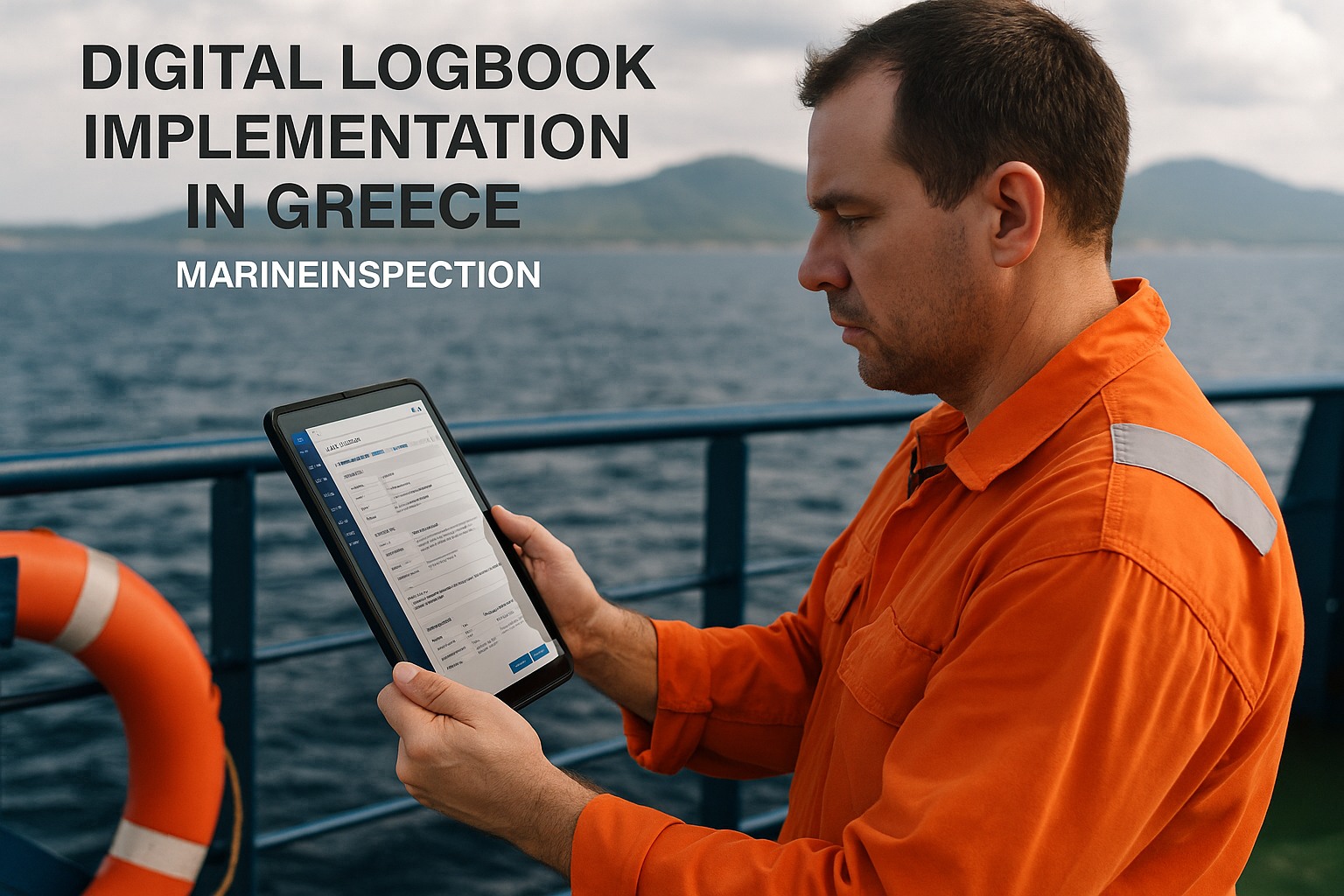
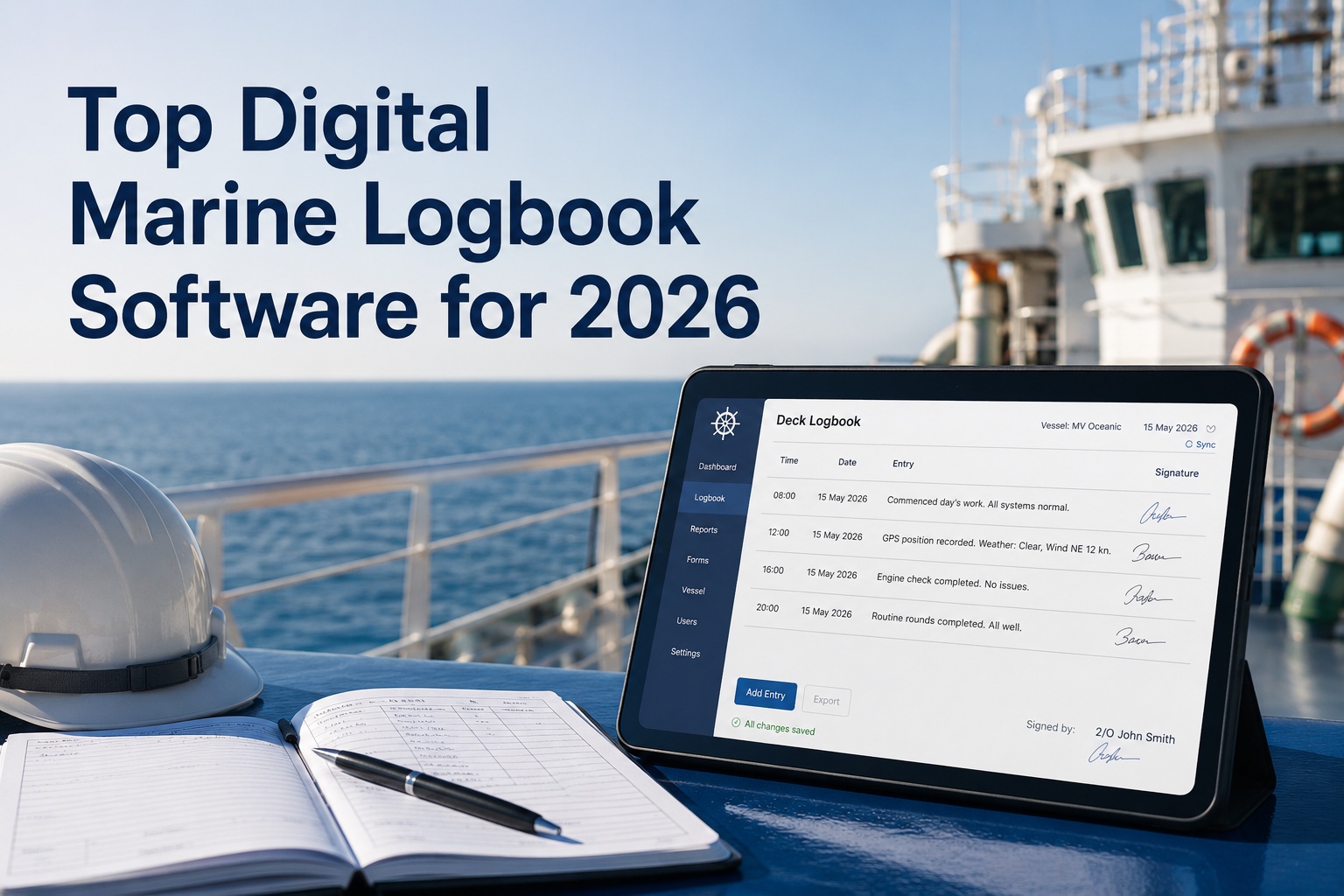
Digital Logbook Implementation in Greece: Greek Shipping Compliance & IMO Guide 2026
Greece controls the world's largest merchant fleet — 5,691 vessels representing 20% of global deadweight tonnage and 61% of the European Union's fleet. The Greek shipping industry employs approximately 160,000 people directly and indirectly, with vessels calling at 176 countries in 2024 alone. For Greek shipowners and ship management companies operating from Piraeus, Athens, London, and Singapore, the shift from paper-based logbooks and inspection records to digital systems is not a future consideration — it is an operational necessity driven by IMO regulatory acceptance of electronic record books, increasing PSC scrutiny of documentation quality, and the practical impossibility of managing compliance across hundreds of vessels through paper processes. Marine Inspection provides the digital vessel inspection and maintenance platform that Greek shipping companies need to structure their compliance documentation, maintenance scheduling, and inspection records into a single system accessible from both ship and shore. Operators managing Greek-owned or Greek-flagged vessels can create a free account and begin digitizing their vessel inspection and maintenance records immediately.
Greek Shipping: The Scale of the Compliance Challenge
5,691
Greek-Owned Vessels — World's Largest Merchant Fleet
20%
Of Global Deadweight Tonnage Controlled by Greek Shipowners
61%
Of the EU Fleet Capacity Under Greek Ownership
176
Countries Visited by Greek Vessels in 2024
The Regulatory Framework: Why Digital Records Are Now Standard
The IMO has progressively expanded acceptance of electronic record books across its major conventions. MARPOL amendments adopted through Resolution MEPC.312(74) in 2019 — effective October 2020 — allow approved electronic record books as alternatives to hard-copy records across Annexes I, II, V, and VI. Resolution MEPC.372(80) in 2023 extended this to ballast water management records, with electronic BWM record books permitted from October 2025. SOLAS Chapter V Regulation 28, guided by IMO Resolution A.916(22), accepts electronic recording of navigational activities. For Greek shipowners managing fleets that trade globally, these regulatory changes mean that digital inspection and maintenance records are no longer supplementary — they are accepted as primary documentation during PSC inspections, ISM audits, and classification society surveys.
IMO Electronic Record Book Regulatory Timeline
2019
MEPC.312(74)
Guidelines for electronic record books under MARPOL adopted. Allows ERBs for Oil Record Books (Parts I and II), Cargo Record Books, Garbage Record Books, and Ozone-Depleting Substances Record Books.
In Force Since Oct 2020
2023
MEPC.372(80)
Guidelines for electronic record books under BWM Convention adopted. Extends digital record acceptance to Ballast Water Record Books with flag administration approval required.
ERBs Permitted From Oct 2025
Ongoing
SOLAS V/Reg 28
IMO Resolution A.916(22) accepts "handwritten, electronic, or mechanical" recording of navigational activities. Electronic bridge logbooks require flag administration acceptance and SMS integration.
Accepted With Flag Approval
2025
STCW Amendments
MSC.107 amendments allow seafarers to hold electronic certificates meeting minimum information requirements per MSC.1/Circ.1665. Entered into force January 2025.
In Force Since Jan 2025
What Digital Vessel Inspection Actually Replaces — and Improves
The shift to digital inspection and maintenance records is not simply moving paper forms onto a screen. It fundamentally changes how compliance documentation is created, verified, and accessed. For Greek ship management companies overseeing dozens or hundreds of vessels, the operational difference between paper-based and digital inspection systems determines whether the shore office operates on current data or on information that is already weeks old by the time it arrives. Companies managing fleets across multiple flags and trading areas can see how Marine Inspection structures vessel inspection records for multi-vessel operations.
Paper Records vs. Digital Vessel Inspection
Paper-Based Records
Completion Verification
Shore office discovers incomplete records weeks or months later when logbooks are collected during port calls
Maintenance Scheduling
Running-hour tasks tracked manually, overdue items identified only during superintendent visits or audits
PSC Inspection Readiness
Records must be physically located, sorted, and presented. Missing pages or entries discovered during inspection
Fleet Oversight
Technical superintendents rely on monthly emails and phone calls. No real-time visibility into compliance status
ISM Audit Trail
Non-conformity closeout tracked in separate files. Corrective action verification requires physical document review
Digital Vessel Inspection (Marine Inspection)
Completion Verification
Shore office sees task completion in real time. Overdue items flagged automatically with responsible person and due date
Maintenance Scheduling
Running-hour and calendar-based tasks tracked automatically. Alerts generated before due dates, escalation for overdue items
PSC Inspection Readiness
All inspection records, maintenance history, and compliance documentation accessible digitally within seconds
Fleet Oversight
Fleet dashboard shows every vessel's compliance status. Filter by overdue tasks, equipment type, or vessel
ISM Audit Trail
Every non-conformity tracked from identification through corrective action to verified closure with full history
Digitize Your Fleet's Inspection and Maintenance Records
Marine Inspection replaces paper-based inspection logs, maintenance checklists, and compliance tracking with a structured digital platform built for multi-vessel operations — giving Greek ship management companies real-time fleet visibility.
Implementation Roadmap for Greek Shipping Companies
Implementing digital vessel inspection across a fleet requires a structured approach — particularly for Greek companies managing vessels under multiple flags, trading globally, and subject to inspections by Paris MOU, Tokyo MOU, USCG, and AMSA authorities. Marine Inspection is designed to support this transition progressively, starting with the highest-value compliance areas and expanding as crew familiarity grows. Technical superintendents overseeing fleet digitalization can sign up and begin configuring their first vessel within hours.
Fleet Digitalization: Six-Step Implementation
1
Set Up Vessel Profiles
Register each vessel with its equipment inventory, classification details, and flag state. Assign shore management access levels.
Day 1 — 1-2 hours per vessel
2
Configure Safety-Critical Maintenance
Set up recurring inspection schedules for fire safety equipment, lifesaving appliances, emergency systems, and navigation equipment — the top PSC deficiency areas.
Week 1 — Focus on highest-risk equipment
3
Add Machinery Maintenance Schedules
Configure running-hour-based maintenance for main engine, generators, purifiers, pumps, and other machinery. Link tasks to maker's instructions and class requirements.
Week 2-3 — Build complete PMS digitally
4
Establish Certificate and Document Tracking
Enter all statutory and class certificate expiry dates. Set advance alerts for renewals and survey windows. Track DOC, SMC, ISPS, MLC, IAPP, and class certificates.
Week 2 — Parallel to machinery setup
5
Train Crew and Establish Digital Workflows
Familiarize officers with digital task completion, condition reporting, and near-miss logging. Integrate platform procedures into the vessel's SMS documentation.
Week 3-4 — Per ISM Code familiarization requirements
6
Activate Fleet-Wide Shore Monitoring
Shore superintendents and DPAs access fleet dashboard showing compliance status across all vessels. Identify overdue items fleet-wide and intervene proactively.
Month 2+ — Full operational visibility
What Greek Shipowners and Managers Actually Gain
The business case for digital vessel inspection extends beyond regulatory compliance. For Greek shipping companies operating on competitive charter markets where reputation, vessel condition, and PSC performance directly influence commercial viability, digital maintenance and inspection records provide measurable advantages.
PSC Performance
Current, complete, and accessible documentation eliminates the most common PSC deficiency triggers — missing records, expired items, and incomplete maintenance evidence. Paris MOU detention rates rose to 4.03% in 2024; prepared vessels avoid this.
Charter Readiness
Charterers and vetting organizations increasingly require digital maintenance evidence. RIGHTSHIP, SIRE, and CDI inspections favor vessels with structured, verifiable maintenance histories over paper records.
Superintendent Efficiency
Technical superintendents managing 6-12 vessels each get real-time visibility into every vessel's maintenance status without waiting for port calls, emails, or phone reports. Problems identified before they become findings.
ISM Audit Confidence
Every maintenance action, non-conformity, corrective action, and near-miss creates a documented audit trail. Internal and external auditors see evidence of a functioning SMS, not just documentation of one.
Class Survey Preparation
Condition monitoring data, maintenance completion records, and running-hour histories available for class surveyors. Reduces survey duration and minimizes conditions of class imposed for missing documentation.
Multi-Vessel Standardization
Consistent maintenance standards across the fleet regardless of crew changes, vessel age, or trading area. New vessels configured with the same templates, ensuring uniform compliance from day one.
The Union of Greek Shipowners' 2024-2025 Annual Report confirmed that the Greek-owned fleet has grown by more than 42% since 2015, with the number of vessels on order increasing more than five times in the past five years. This expansion, combined with the fleet's global trading pattern across 176 countries, creates an extraordinary compliance management challenge. Every Greek-owned vessel is subject to PSC inspections under multiple MOU regimes, ISM audits, classification society surveys, and commercial vetting inspections — each requiring current, accurate, verifiable maintenance and inspection records.
The IMO's progressive acceptance of electronic record books — MARPOL ERBs since October 2020 (Resolution MEPC.312(74)), BWM Convention ERBs from October 2025 (Resolution MEPC.372(80)), electronic seafarer certificates from January 2025 (STCW amendments MSC.107), and SOLAS V/Reg 28 acceptance of electronic navigational recording — establishes that digital documentation is no longer an alternative approach but the direction the entire industry is moving. For Greek ship management companies headquartered in Piraeus and Athens managing global fleets, digital vessel inspection and maintenance platforms like Marine Inspection provide the infrastructure to meet these requirements systematically rather than reactively. Companies ready to begin their fleet's digital transition can schedule a demonstration to see how the platform structures vessel inspection records.
The Digital Platform Greek Shipping Companies Need
Marine Inspection brings vessel inspections, maintenance scheduling, compliance tracking, and fleet oversight into one digital platform — designed for the scale, complexity, and global trading patterns of Greek-owned fleets.
Is Marine Inspection an IMO-approved electronic record book?
Marine Inspection is a digital vessel inspection and maintenance management platform — it structures and digitizes your maintenance records, inspection checklists, compliance tracking, and fleet oversight. For statutory record books that require specific flag administration type-approval under MEPC.312(74) (such as Oil Record Books or Cargo Record Books), the vessel must carry the flag-approved system. Marine Inspection complements these by managing everything around them: planned maintenance, safety equipment inspections, non-conformity tracking, drill records, and shore oversight.
Can the platform support Greek-owned vessels under multiple flag states?
Yes. Each vessel is configured with its own flag state, classification society, and specific regulatory requirements. A Greek company managing vessels under Greek, Liberian, Marshall Islands, and Panamanian flags can maintain standardized maintenance programs while accommodating flag-specific requirements. Fleet dashboards consolidate compliance visibility across all flags.
How does the platform help with PSC inspection preparation?
When all maintenance tasks are current, certificates tracked, and inspection records complete, the vessel is inspection-ready by default. There is no separate "PSC preparation" scramble. Shore management can see overdue items across the fleet and address gaps before port calls in high-inspection jurisdictions like Paris MOU, USCG, or AMSA ports.
Can shore-based superintendents in Piraeus monitor vessels in real time?
Yes. The fleet dashboard gives shore management — technical superintendents, DPAs, fleet managers — real-time visibility into every vessel's compliance status. Filter by vessel, equipment type, or task status. Overdue items, approaching due dates, and completed tasks are all visible without waiting for emails or port call reports.
How quickly can a fleet of 10-20 vessels be set up?
Signup is free and instant. A single vessel takes a few hours to configure with equipment, maintenance schedules, and certificates. For a fleet of 10-20 vessels using standardized templates, the shore team can typically have all vessels configured within two to three weeks — with the most critical safety equipment and certificates live within the first few days.