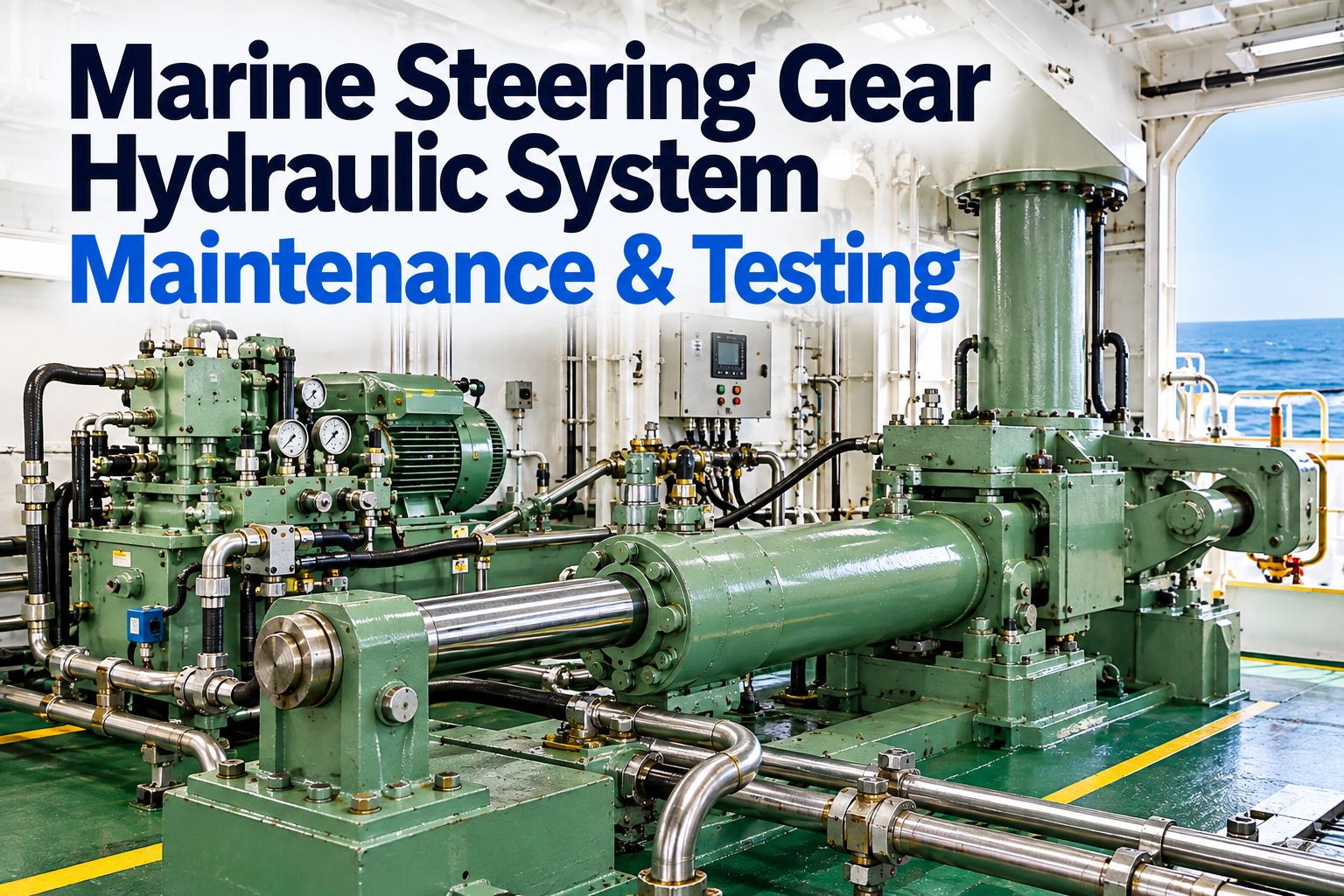
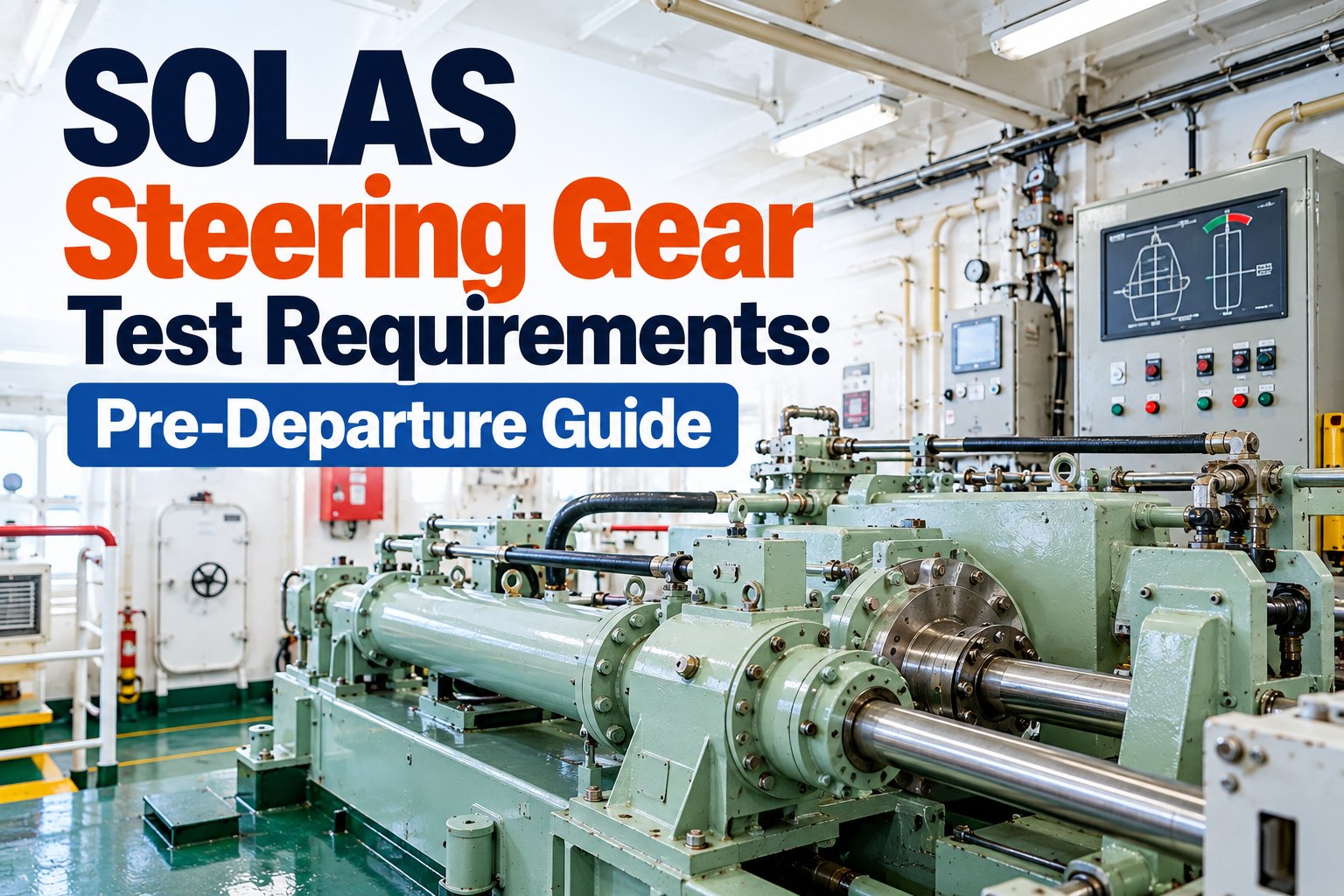
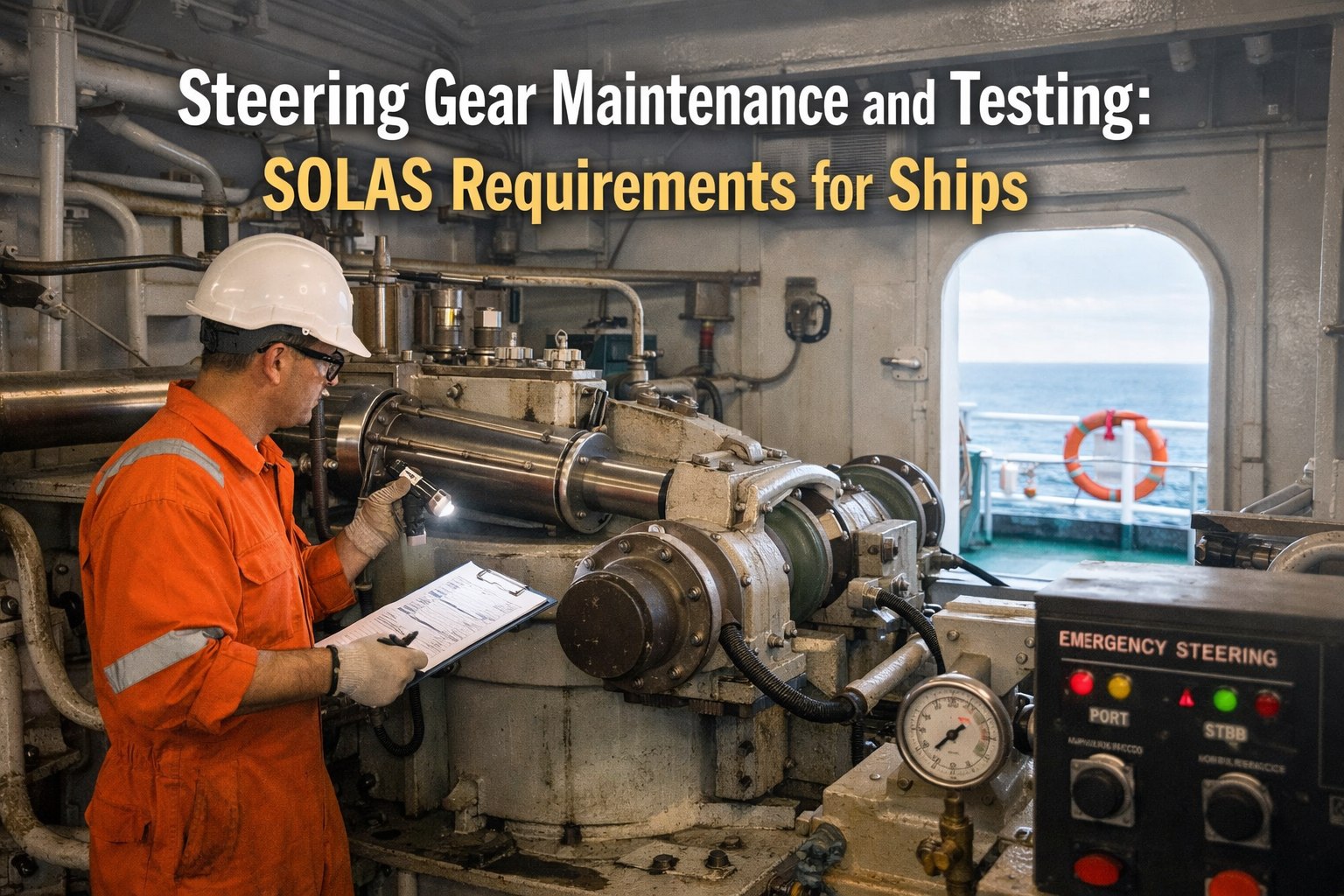
Steering gear is the only machinery on board with a statutory stopwatch attached to it. SOLAS does not simply require it to work, it requires the rudder to move a defined number of degrees in a defined number of seconds, it requires the system to be tested within twelve hours of every departure, and it requires the crew to practise steering the ship from the steering gear compartment four times a year. Port State Control officers know this, which is why steering gear paperwork and a live demonstration are among the first things asked for. Behind all of that sits a hydraulic system that fails in slow, unglamorous ways: a ram seal weeping a little more each month, oil that has quietly picked up water, a relief valve nobody has lifted in years, a filter changed late, a limit switch out of adjustment. This guide covers the performance the rules demand, the pre-departure test and the quarterly drill, and the hydraulic maintenance that keeps the system able to pass both. Follow the maker's manual and the ship's procedures for every figure specific to your installation. To keep test records, oil top-up quantities and seal findings with the equipment, try Marine Inspection free.
Steering gear
Tested within 12 hours. Drilled every three months. Recorded every time.
The tests are quick. The hydraulic maintenance that lets the system pass them is the part that gets deferred, and it is what a rising oil top-up quantity is telling you.
The date of the checks, and the date and details of emergency steering drills, have to be recorded.
What the rules require the gear to do
The performance standards sit in SOLAS Chapter II-1, Regulations 29 and 30. The testing and drill requirements sit in Chapter V, Regulation 26. Between them they define both the machine and the routine.
35° to 30° in 28 secondsMain steering gear, at the deepest seagoing draught and maximum ahead service speed, must put the rudder from 35° on one side to 30° on the other in not more than 28 seconds.
15° to 15° in 60 secondsAuxiliary steering gear must put the rudder from 15° on one side to 15° on the other in not more than 60 seconds, at half the maximum ahead service speed or 7 knots, whichever is greater.
IndependenceMain and auxiliary arrangements must be such that a failure of one does not put the other out of action.
45 seconds to regain steeringOn tankers, chemical tankers and gas carriers of 10,000 gross tonnage and above, and other ships of 70,000 gross tonnage and above, steering capability has to be regained within 45 seconds after loss of one power actuating system.
Design pressure marginPiping and components subject to internal hydraulic pressure are designed to at least 1.25 times the maximum working pressure expected in service.
Instructions postedSimple operating instructions with a block diagram of the changeover procedures must be permanently displayed on the bridge and in the steering compartment.
The two timing requirements, drawn to scale
The pre-departure test
Within twelve hours before departure the steering gear must be checked and tested by the crew. In practice most ships do it shortly before letting go, and testing earlier in the window does not help if the gear then sits unused. Where a ship is regularly engaged on short voyages, the flag state may waive the pre-departure requirement provided the checks are carried out at least weekly.
1Main steering gear, run and observed through its full movement
2Auxiliary steering gear, where fitted as a separate system
3Remote steering gear control systems, including each mode
4Every steering position on the navigation bridge
5Emergency power supply to the steering gear
6Rudder angle indicators, compared with the actual rudder position
7Remote steering gear control system power failure alarms
8Power unit failure alarms and automatic isolating arrangements
9Visual inspection of the gear, linkages and connections
10Communications between the bridge and the steering compartment
Two people, one useful testAn engineer in the steering flat watching the rudder move while the bridge works the wheel is the only way to prove the angle indicators agree and the linkages are sound. A test done entirely from the bridge proves the control system, not the gear.
The quarterly emergency steering drill
Emergency steering drills have to take place at least once every three months so the crew can practise steering from the steering gear compartment. The drill has three required elements, and the date and details are recorded.
Direct control in the compartmentSteering the ship from within the steering gear compartment, using local control, with the crew who would actually do it.
Communication with the bridgeThe full procedure: helm orders passed, repeated back and acted on, using the fitted means of communication and the backup.
Alternative power suppliesWhere applicable, operating the gear on the alternative or emergency supply, including changeover.
Make the drill realisticUse the rudder angle indicator in the compartment, time the changeover, and rotate which crew members take the helm orders. A drill where the same two officers do it every quarter proves very little on the night it matters.
Hydraulic maintenance: where the system actually degrades
The statutory tests prove function on the day. The hydraulic system is what decides whether it still functions in six months. These are the items that repay attention.
Oil condition and level
Level in the tanks and header, with the normal mark known
Water content and cleanliness by sample, not by appearance
Correct grade only, and the same grade in the replenishing tank
Breather and filler filtration, which is how dirt usually gets in
Rams, seals and glands
Weeping at the gland is the first sign, before a measurable leak
Rod surface condition, scoring and corrosion pitting
Seal renewal on the maker's interval, not after failure
Drip trays kept clean so a new leak is visible immediately
Pumps and motors
Noise, vibration and temperature against the normal
Both pumps run and proved on the same schedule, not just the duty one
Coupling alignment and mounting bolts
Starter, overloads and auto changeover tested
Valves and piping
Relief valve settings and function, on the maker's interval
Isolating and bypass valves in the correct position and labelled
Flexible hoses for age, cracking and chafing
Pipe supports and clamps, which fail before the pipe does
Mechanical parts
Tiller and rudder stock keys, nuts and locking arrangements
Rudder stops and their clearances
Limit switches and their adjustment against the actual angle
Greasing points, bearings and pins on the planned schedule
Compartment condition
Bilge dry, with the bilge alarm working
Lighting, including emergency lighting
Instructions and block diagram posted and legible
Communications equipment and spare parts stowed and accessible
Oil top-up quantity: the leak nobody reported
Hydraulic oil does not evaporate. Every litre added went somewhere: past a ram seal, through a gland, out of a pipe joint, or into the bilge. Trending the top-up quantity is the cheapest leak detector on the ship, and it turns an invisible problem into a planned seal renewal instead of an emergency in a channel.
Alarms, indication and failure detection
The alarms are part of the statutory arrangement, not an extra. Test them as such and record what each one did.
Alarm or indicationWhat it protects againstHow to prove it
Power unit failureLosing a pump without the bridge knowingTrip the unit and confirm the bridge audible and visual indication
Control system power failureLoss of remote control while steering looks normalRemove the control supply under controlled conditions and confirm the alarm and fallback
Low oil level in a tankA leak running the system dryLower the level or use the test facility, and confirm before returning to normal
Automatic isolating arrangementOne system's fault disabling the otherDemonstrate the isolation as the maker specifies, ideally during the quarterly drill
Rudder angle indicatorsSteering to a reading that no longer matches the rudderCompare bridge, wing and compartment indicators with the actual rudder position
Hydraulic lock or overloadDamage to the gear at the stopsCheck limit switch adjustment and stop clearances at the planned interval
Rudder, stock and carrier
The steering gear moves the rudder, but the rudder and its bearings carry the loads. These checks usually happen at drydocking and are worth planning for well in advance.
Rudder dropMeasured by jumping bar or equivalent at drydocking, and compared with previous figures. A rising value means carrier or neck bearing wear.
Pintle and bearing clearancesTaken as the maker and class require, with the method and reference point recorded so figures compare year to year.
Rudder stock and couplingCoupling bolts, keys and locking arrangements, and any sign of movement at the tiller.
Rudder plating and weldsCracks, indents and corrosion, plus the drain plug and internal pressure test where required.
Rudder stopsClearances against the drawing, and evidence of contact marks that suggest the rudder has been driven onto them.
Anodes and coatingsCondition recorded at each docking, since corrosion at the stock and pintles is expensive to correct.
Findings that come up in inspections
No record of the pre-departure test, or a record that predates the twelve-hour window
Emergency steering drill overdue, or recorded without the three required elements
Instructions and block diagram missing, illegible or not matching the installation
Rudder angle indicator in the steering compartment not agreeing with the bridge
Oil leaks with the drip trays full, and no record of top-up quantities
Communications between bridge and steering flat not working or not tested
Alarms inhibited or not demonstrable on request
Steering compartment used for stores, with access to the gear obstructed
Pre-departure tests and drills recorded as you do themCapture the test, the times observed, the oil added and the photographs at the gear, offline, and hand the inspector a complete record instead of a folder.
Noisy pumpSuction condition, oil level, aeration, couplingAir in the system, low level, misalignment, pump wear
Angle indicators disagreeTransmitter, linkage, calibrationFeedback linkage worn or shifted, transmitter out of calibration
Overheating oilCooling, relief valve, continuous pump runningRelief valve passing, cooler fouled, gear working against a fault
Fails to change overIsolating valves, control supply, interlocksValve in the wrong position, control power lost, interlock fault
Records to keep
Pre-departure testsDate and time, items tested, times observed and who carried them out
Emergency steering drillsDate, the three elements covered, who took part and what was learned
Hydraulic maintenanceOil samples and top-up quantities, filter changes, seal renewals, relief valve settings
Survey and dockingRudder drop and clearance measurements, class attendance and any conditions
Frequently asked questions
When exactly must steering gear be tested?
Within twelve hours before departure, by the ship's crew. Ships regularly engaged on short voyages may have that waived by the flag state provided the checks and tests are carried out at least once a week.
What timing must the main steering gear achieve?
From 35° on one side to 30° on the other in not more than 28 seconds, at the deepest seagoing draught and maximum ahead service speed.
Do we have to test auxiliary steering gear separately?
Only where a separate auxiliary system is fitted. Ships with two or more identical power units have redundant main steering rather than an auxiliary arrangement, which is why the regulation says "where applicable".
How often are emergency steering drills required?
At least once every three months, including direct control from the steering gear compartment, the communication procedure with the bridge and, where applicable, the operation of alternative power supplies.
What is the 45-second requirement?
On tankers, chemical tankers and gas carriers of 10,000 gross tonnage and above, and other ships of 70,000 gross tonnage and above, steering capability must be regained within 45 seconds after the loss of one power actuating system.
Never be the ship without the steering gear record
Marine Inspection records pre-departure tests, quarterly drills, oil quantities and seal work at the gear, offline, links them to the equipment and the date, and produces the file an inspector asks for.