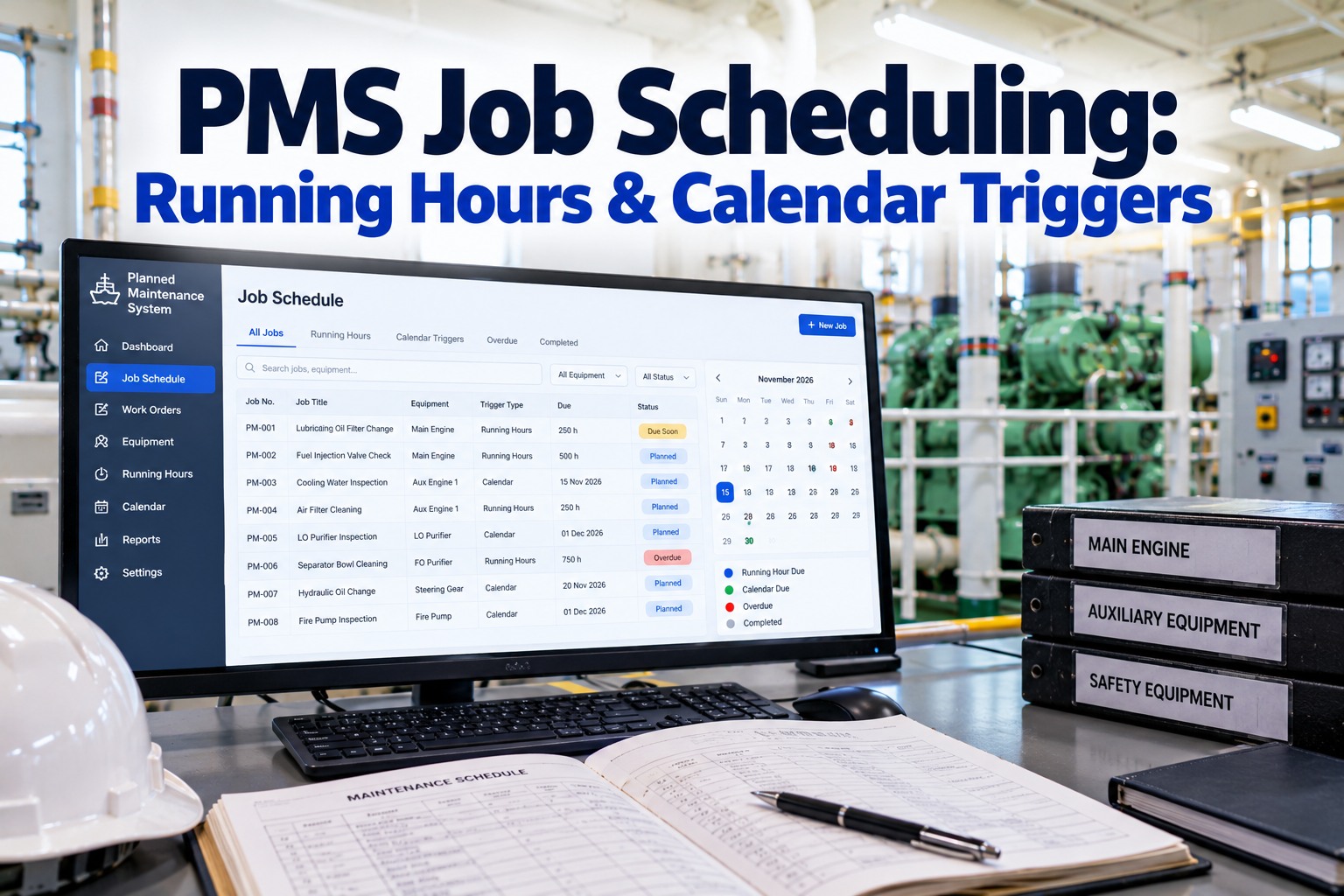
A planned maintenance system is only as good as its schedule. If the triggers are wrong, jobs come due when nobody can do them, the backlog grows, and the PMS turns into a list of overdue red lines that an auditor reads in seconds. Good PMS job scheduling sets each job on the right trigger, keeps running hours honest, puts the important work first and keeps postponements under control. This guide is for chief engineers who want a schedule the crew can actually keep. Book a demo to see running-hour and calendar scheduling in Marine Inspection.
PMS job scheduling: running hours, calendar triggers and a backlog you can defend
comes first
Example: generator overhaul due on hours before the calendar date.
PMS job scheduling triggers: running hours, calendar or condition
Every PMS job needs a trigger that matches how the equipment actually wears. Navatom’s PMS guide lists three types.
Running hours
Fits: engines, compressors, purifiers, pumps, anything that wears with use.
Risk: only as accurate as the counter readings.
Calendar
Fits: statutory and class items, safety equipment, things that age even when idle.
Risk: over-maintains equipment that rarely runs.
Condition
Fits: critical machinery with a monitoring method that sees the fault early.
Risk: only works if readings are taken and trended.
IACS UR Z20 lets running-hour intervals for class PMS items follow the maker’s recommendations, even where they are longer than continuous machinery survey intervals. Most other items may not exceed those intervals. For the wider rules, see our planned maintenance system guide.
Running-hour and calendar triggers together: whichever comes first
Many jobs carry both triggers, such as 8,000 hours or 12 months, whichever comes first. The same job then falls due at very different times on two identical machines.
Illustrative. DG1 hits its hours at month 9; DG3 hits its calendar limit with only 2,100 hours run. Both are due, for different reasons.
Generator schedules show this most clearly. Our auxiliary engine and generator maintenance guide covers the typical intervals.
Running hours: keeping PMS counters honest
A running-hour schedule is only as good as the readings feeding it. Missed, guessed or mistyped readings move every job on that machine without anyone noticing.
Let the counters schedule the jobs
Enter running hours once a week and every linked job recalculates its due date, with impossible readings flagged before they move the schedule.
PMS job prioritisation: what gets done first
There are always more jobs than hands. A fixed priority order stops the urgent-looking job pushing aside the important one.
Safety, statutory and class
Lifesaving and fire equipment, class PMS items, anything a surveyor or PSC officer will check.
Critical equipment
Equipment your ISM system marks as critical: steering, propulsion, power generation.
Wear-driven jobs
Running-hour overhauls and condition-triggered work that stops a breakdown later.
Routine and housekeeping
Cleaning, minor checks and jobs that can safely move a week.
PMS backlog control: overdue, postponed and deferred jobs
Some backlog is normal. A backlog that only ever grows is the warning. Track it every month and put every postponement through the same approval route.
Overdue jobs at month end (illustrative)
A yard delay pushed June and July over target; a planned catch-up brought it back.
Postponement route
Keeping PMS job scheduling credible at audit
Auditors and inspectors read a schedule fast. Tokyo MOU data, cited by Maritime Mutual, shows ISM-related deficiencies as the most frequent cause of PSC detentions, with 731 such cases from 2015 to 2017. One Isle of Man PSC notice lists, as a detention reason, a ship whose ISM maintenance and defect reporting system was not effectively carried out on board.
Class annual audit
UR Z20: performance and maintenance records, breakdowns, actions on out-of-tolerance readings, and whether overhaul intervals were kept.
Port State Control
A defect found on deck leads to the PMS: was the job planned, done and recorded, or overdue?
Vetting and internal audit
Chronic overdue jobs, postponements without approval and running hours that do not add up.
For how leading operators set up their schemes, see our ship PMS IMO and global best practices guide.
How Marine Inspection handles PMS job scheduling
Marine Inspection works out each job’s due date from its trigger, whichever comes first. Running hours recalculate the schedule as soon as they are entered, and the chief engineer gets a weekly plan the crew can actually finish. The week below is illustrative.
PMS job scheduling: frequently asked questions
Should PMS jobs run on running hours or calendar?
How often should running hours be entered?
What is a reasonable PMS backlog?
Can a PMS job be postponed?
What do auditors check in the PMS schedule?
A schedule the crew can keep, and an auditor can trust
Right trigger for every job, honest running hours and a backlog that stays under control, all in one PMS.