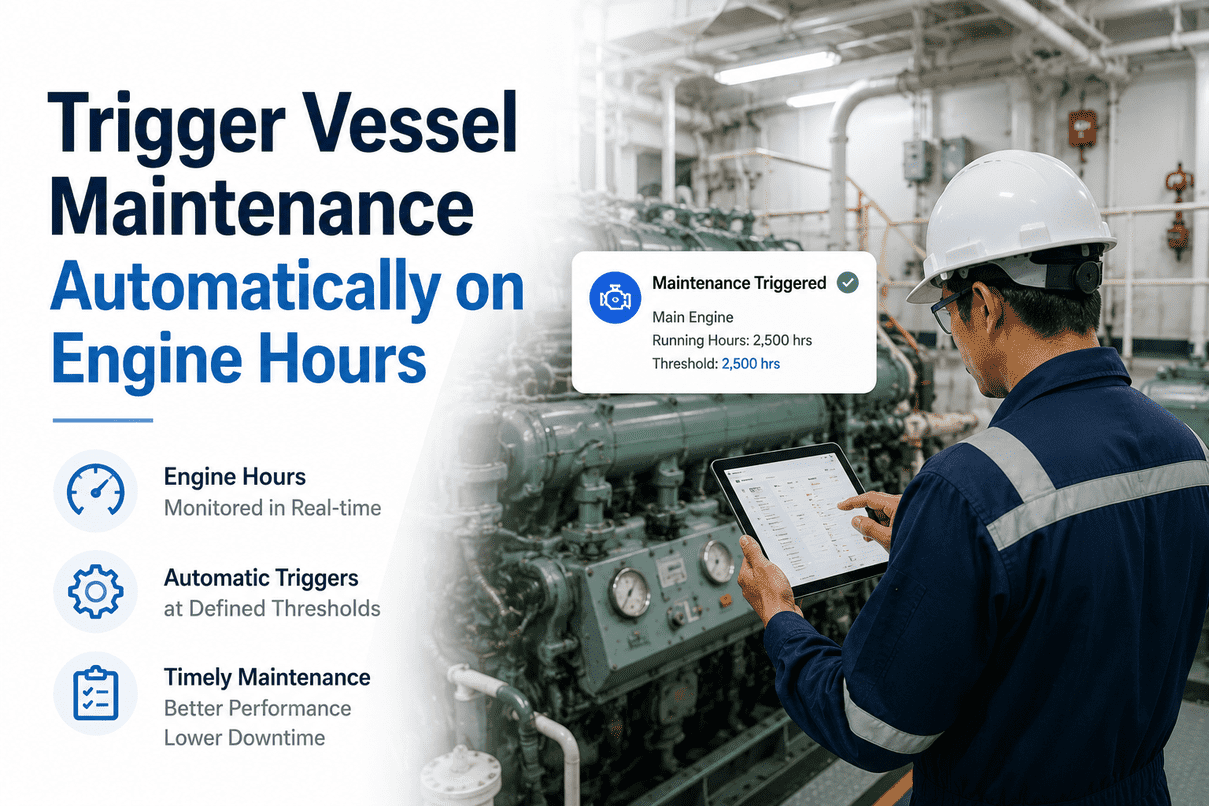
A marine diesel engine does not wear out by the calendar — it wears out by the hour. A main engine pushing through a long laden voyage accumulates wear at a completely different rate from an auxiliary that idles in port, which is why every manufacturer maintenance manual is written around running hours, not dates: 250-hour filter cleans, 1,000-hour injector checks, 2,000-hour overhauls, 4,000-hour half-decarbonisation, 8,000-hour full decarbonisation, and 16,000-hour major overhauls. The problem is that on most vessels those hour counters live in a logbook and the maintenance plan lives in a spreadsheet, so the two only meet when someone remembers to reconcile them. Miss the moment and you either over-service a healthy engine and waste labor, or under-service a hard-worked one and risk a failure mid-voyage. Engine-hour-based triggering closes that gap: the system watches the running hours on every engine and fires the right maintenance job automatically the instant a threshold is crossed. This page explains how that works, which intervals matter, and why it keeps both main and auxiliary engines at peak condition. To see it run on your own machinery, book a Marine Inspection demo.
How an Engine-Hour Trigger Works
Hours accrue
Running hours are tracked for every engine and rotating asset, logged by crew or fed from machinery counters.
Threshold hit
The counter crosses a set interval — say 8,000 hours on the main engine — and the rule fires.
Work order spawns
A job is generated automatically, pre-filled with the task, procedure, and required spares — no manual entry.
Done & reset
The engineer completes and signs off; the counter resets and the next interval starts ticking.
The Marine Engine Running-Hour Interval Ladder
Marine diesel maintenance is structured around a well-established ladder of running-hour intervals, each with its own scope of work. A trigger-based system holds every rung of this ladder for every engine at once — something no logbook-and-spreadsheet method can do reliably across a fleet.
250 h
Routine service. Clean filters, service the turbocharger air filter, drain water and sediment from fuel/water separators.
1,000 h
Inspection & adjustment. Crankcase inspection, fuel injector testing, crankshaft deflection checks, valve clearance adjustment.
2,000 h
Component overhaul. Injector overhaul, liner inspection, crankshaft alignment verification, opening-pressure adjustment.
4,000 h
Half-decarbonisation. Cylinder heads removed, overhauled and decarbonised, valves lapped, liner and piston crown inspected.
8,000 h
Full decarbonisation. Piston withdrawal, ring changes, turbocharger overhaul and bearing renewal — a major planned stop.
16,000 h
Major overhaul. Liner renewal, bearing inspection, connecting-rod bolt renewal. Modern electronically controlled engines may extend these intervals.
Intervals shift with engine type, load, and fuel quality, and the manufacturer's manual always governs — light-load running, for example, fouls exhaust spaces faster and can shorten cleaning intervals. A good system lets you tune each threshold per engine rather than forcing one blanket schedule.
Why a Date-Only Schedule Quietly Costs You
Blanket time-based scheduling treats every engine the same, which means it is wrong for almost all of them. The result is a hidden double penalty that shows up on the maintenance budget and in the breakdown log alike.
Over-servicing
A lightly used auxiliary serviced on the calendar gets opened up before it needs it — burning labor hours and spares on a healthy machine and introducing fresh assembly risk every time.
Under-servicing
A hard-worked main engine on the same calendar runs past its real wear point, raising the odds of a failure mid-voyage — with charter penalties and emergency port calls attached.
Manual reconciliation
When hours sit in a logbook and the plan sits in a spreadsheet, someone has to match them by hand. Entries made from memory after the fact are exactly where intervals get missed.
Tying the trigger to actual hours instead of dates is what eliminates both premature service and missed intervals — the single change that lets a fleet stop over-maintaining one engine while under-maintaining the next.
See Hour-Based Triggers Fire Live
Marine Inspection tracks running hours automatically for main engines, auxiliaries, generators, pumps, and propulsion, and spawns the right job the moment a threshold is crossed. Book a 30-minute demo and we will set up a running-hour trigger on a vessel like yours.
Main Engine vs Auxiliary: Same Logic, Different Clocks
The power of hour-based triggering is that each engine runs on its own clock. The main engine and the auxiliaries may share interval scopes, but they hit them at completely different times depending on how the vessel trades — and the system tracks each independently.
Main Propulsion Engine
Accumulates hours fast on laden passages
Decarbonisation and overhaul intervals dominate planning
Major stops are coordinated with voyage and dry-dock windows
A missed interval here is the highest-consequence failure
Auxiliary Engines & Generators
Run in rotation — hours spread unevenly across units
Each generator needs its own independent counter
Easy to over-service the idle unit, under-service the lead
Per-asset triggers keep every unit on its true schedule
What Automatic Hour Triggering Delivers
Moving from manual reconciliation to system-driven triggers changes the day-to-day reality in the engine room and the numbers on the maintenance ledger.
Right Service at the Right Time
Each engine is serviced on its actual wear, eliminating the waste of premature service and the risk of a missed interval.
No Missed Overhauls
The 8,000 and 16,000-hour major jobs fire automatically and escalate if overdue, so a critical overhaul never slips off the radar.
Per-Engine Accuracy
Every main engine, auxiliary, and generator carries its own counter, so the lead and standby units stay on separate, correct clocks.
Spares Ready in Advance
Because the upcoming interval is visible, the parts for a decarbonisation can be aboard before the threshold is reached.
Audit-Ready Evidence
Running-hour-driven, digitally documented maintenance produces the compliance trail class surveyors and PSC inspectors expect.
No Manual Reconciliation
Hours and the maintenance plan live in one place, removing the after-the-fact matching where intervals get lost.
Setting Up Hour Triggers — A Quick Reference
Whatever platform you use, a sound hour-trigger setup comes down to a few configuration choices. Use this as a checklist when you evaluate or roll one out.
Engine-Hour Trigger Configuration Checklist
Frequently Asked Questions
What is engine-hour-based maintenance?
It is maintenance scheduled on actual running hours rather than calendar dates. When an engine's hour counter crosses a defined threshold — for example 8,000 hours — the system automatically generates the corresponding maintenance job. This ties servicing to real wear, which is how marine engine manufacturers structure their maintenance manuals.
What are the standard marine engine maintenance intervals?
Marine diesel maintenance follows a running-hour ladder: roughly 250-hour routine service, 1,000-hour inspections, 2,000-hour overhauls, 4,000-hour half-decarbonisation, 8,000-hour full decarbonisation, and 16,000-hour major overhaul. Modern electronically controlled engines may have extended intervals, and the manufacturer's specific manual always takes precedence.
Why is hour-based better than calendar-based for engines?
A date-only schedule treats a hard-working main engine and a rarely used auxiliary identically, so it over-services the light unit and under-services the heavy one. Hour-based triggers fire at the correct point for each engine's actual usage, eliminating both wasted premature service and dangerous missed intervals.
Should I use hours or a calendar limit?
The strongest setup is hybrid: the job fires on the running-hour threshold or a calendar limit, whichever comes first. Hours drive servicing for engines under real load, while the calendar backstop catches low-use units that would otherwise go too long between services.
How are running hours tracked?
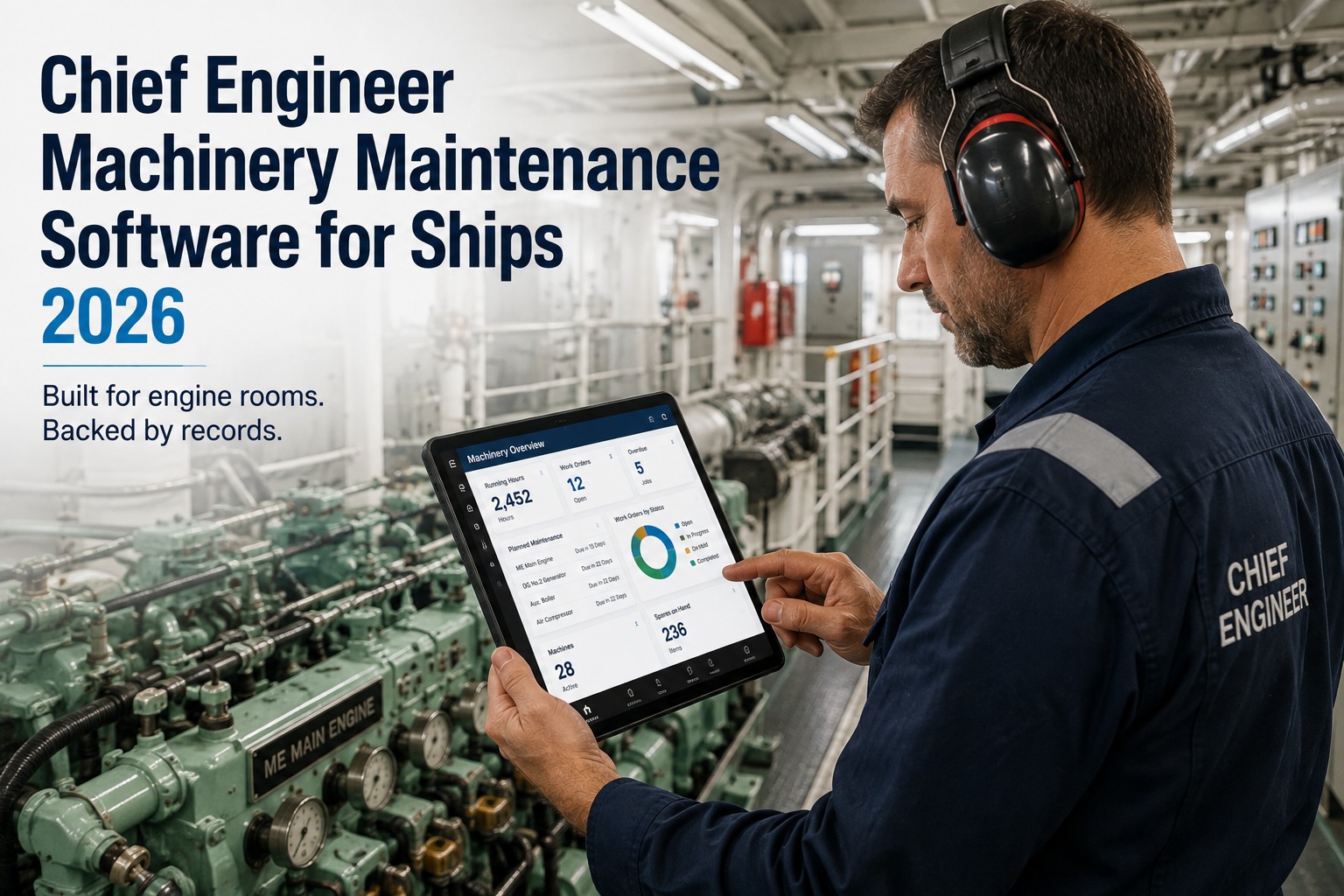
Hours can be logged by the crew during watch rounds or fed automatically from machinery counters, then held against each asset in the maintenance system. Automated tracking removes the after-the-fact, from-memory entries that cause missed intervals, and keeps every engine's counter current.
Does each generator need its own counter?
Yes. Auxiliary generators run in rotation, so they accumulate hours unevenly. Without a separate counter per unit, it is easy to over-service the standby and under-service the lead. Per-asset triggering keeps each generator on its own correct schedule.
Put Your Engines on Auto-Pilot Maintenance
Track running hours on every engine, fire the right job the instant a threshold is crossed, and keep main and auxiliary engines at peak condition — all in one purpose-built maritime platform. Book a tailored walkthrough or start a free trial and load your engine register today.