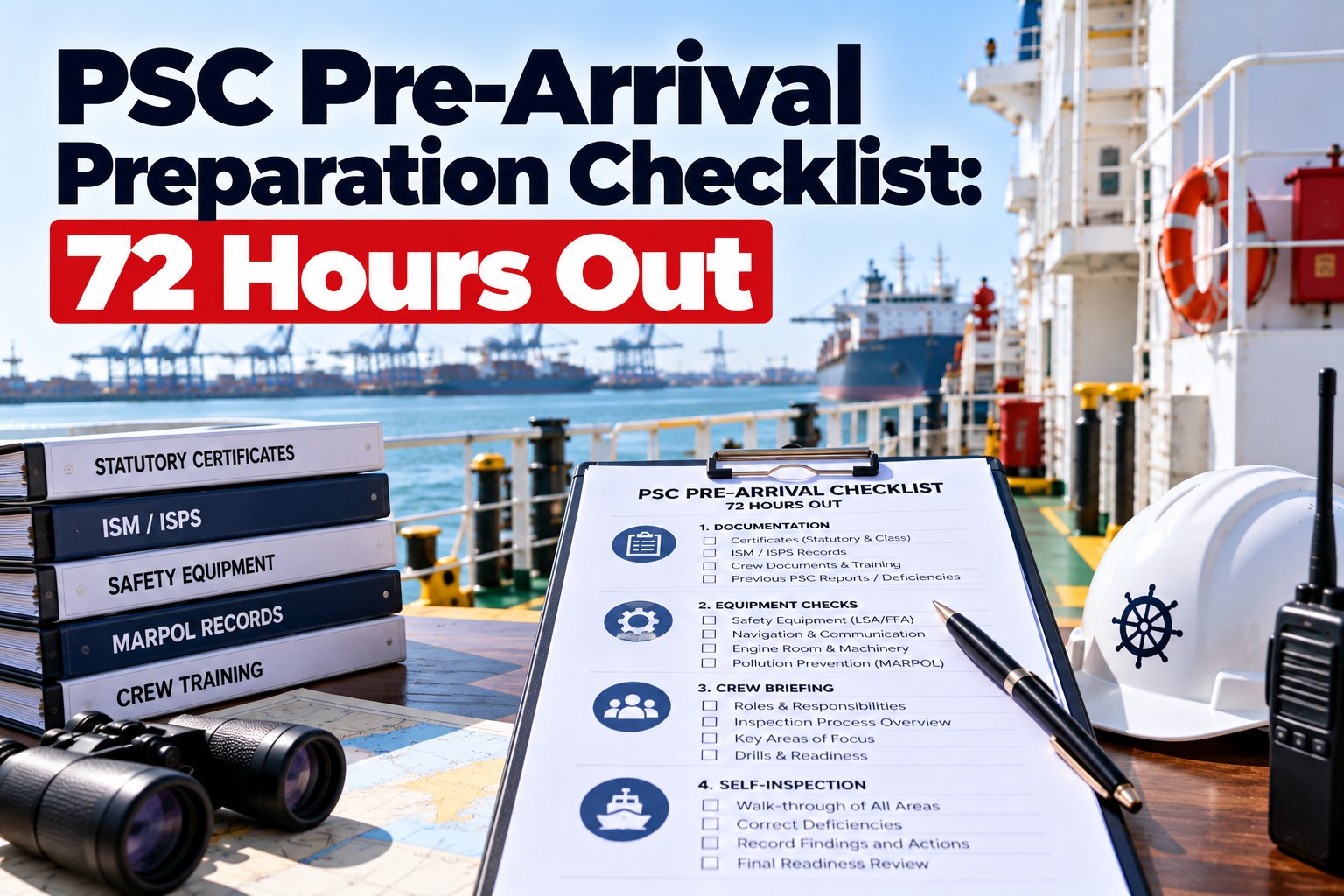
PSC Pre-Arrival Preparation Checklist: 72 Hours Out
Every ship has a pre-arrival checklist and most of them say roughly the same things. What separates the ships where that actually happens from the ships where it is signed on the way in is whether each line has a name against it. This guide takes the familiar 72-hour routine and assigns it to four owners working in parallel, including the one ashore that is most often forgotten. The item-by-item list itself is set out in our PSC inspection checklist.
MasterChief OfficerChief EngineerOffice
Four tracks, running at the same time, each with an owner
A checklist with no owner per line behaves in a familiar way, and all three failure modes are familiar to anybody who has arrived at a port with a list that was completed but not done.
The visible items crowd out the invisible
Fire equipment is tangible and gets checked. Whether the office sent the arrival notification is not visible from the bridge, so it is assumed rather than confirmed.
Everything lands on the master
An unassigned list defaults to whoever carries the responsibility overall. That concentrates three days of work on the one person who also has the port call itself to run.
The last hours absorb the whole list
Without time-boxed ownership, tasks drift toward arrival until the final watch is doing everything at once, which is exactly when the ship is least able to absorb it.
The 72 hours, assigned
Four parallel tracks. The point of the matrix is that no cell belongs to two people, and no row is empty for any role.
Time
Master
Chief Officer
Chief Engineer
Office
72 h
Certificate and document file reviewed against the ship as she is now
Fire-fighting and life-saving rounds, with servicing dates checked
Machinery space condition, record books and critical equipment
Arrival notifications prepared and sent on the correct clock
48 h
Crew briefed on scope, interviews and how to answer honestly
Deck, access arrangements, mooring and cargo gear
Pollution prevention equipment and its records
Carried-forward deficiencies closed and evidenced
24 h
Self-inspection walk round, as an officer would do it
Drill and demonstration readiness confirmed by people doing them
Alarms and shutdowns proven, not assumed
Evidence pack confirmed aboard and reachable
On arrival
Receives the officer, sets the tone, keeps the record
Available on deck, not buried in cargo work
Available below, with records to hand
Reachable, with authority to answer
The master’s track
The master owns the two things nobody else can do: the state of the document file, and the state of the crew’s understanding.
The file against the shipNot simply that certificates are valid, but that they describe this vessel as she is now — equipment fitted, arrangements in use, any exemption or equivalence that applies. Inconsistency between paper and ship is a clear ground in itself.
The briefing, which is not a lectureCrew need to know what is likely to be examined, that saying “I would check the procedure, it is here” is a strong answer, and that an invented answer is worse than an honest one. Twenty minutes, done properly, with people who will actually be asked.
The self-inspection walk roundCarried out as an officer would, in the same order, looking at what they look at. This is the master’s own check on the other three tracks, and it is the item most often deferred into nothing.
The tone on arrivalA received, organised boarding with the right officer present and the file ready does more for the first twenty minutes than any amount of preparation that is not visible.
The chief officer’s track
Fire and life-saving appliances between them account for roughly a third of deficiencies found in some regions, and nearly all of it sits in this track.
Fire-fighting equipment, by date as well as conditionExtinguisher servicing, fixed system records, dampers and doors, and the instructions that are supposed to be legible beside the equipment. Dates are what an inspector can verify in seconds.
Life-saving appliances, including the awkward onesLifeboat and davit condition, release gear, immersion suits and the counts that have to match the crew list. The items inspected rarely are the items found wanting.
Deck and accessThe pilot ladder and the gangway are the first things an officer uses and the first things they judge. Mooring arrangements, lighting and guard rails follow.
Demonstration readinessConfirmed by watching the people who would be asked actually do it, rather than by asking whether they could. A drill that works on paper and fails in front of a visitor is a clear ground.
The chief engineer’s track
The space as it normally looksCleanliness, leaks, lagging and the condition of the bilges. A machinery space tidied only for arrival leaves a gap between what is seen and what is operated, and that gap is noticed.
Pollution prevention equipment and its recordsOily water equipment, seals intact, alarms functional, and record books consistent with the equipment and with each other. This is a documentary check as much as a mechanical one.
Alarms and shutdowns provenTested rather than assumed, with the result recorded. “It worked last time” is the position from which most emergency equipment findings are written.
Records that match the plantMaintenance records describing the machinery as it actually is, including anything recently changed. A record that disagrees with the equipment in front of the inspector raises a question about every other record.
The office track, and why it fails silently
This is the track with no witness. Nobody on the ship can see whether a notification went, whether a carried-forward item was closed with the authority, or whether a certificate renewal actually completed — and so it is assumed, which is the one thing that should never happen to a task nobody can observe.
01
Notifications, on the right clock
Sent correctly and on time, with the longer notice where the vessel is eligible for an expanded inspection. A late or missing notification is a self-inflicted targeting factor in some regimes and an avoidable first impression everywhere.
02
Carried-forward deficiencies closed
Items from a previous inspection resolved, evidenced, and the evidence actually sent to the ship. An item closed ashore but unprovable on board is not closed where it matters.
03
Company actions with deadlines
Corrective actions assigned to the office with their own clocks. These expire quietly and are discovered by the next inspector rather than closed by the company.
04
Somebody reachable with authority
During the call, with the ability to answer and to approve. A master waiting for a decision from an office that has gone home is a longer inspection than it needed to be.
The two items most worth confirming back to the ship are the notification and the closed carried-forward evidence — which deficiencies most often produce the detention that follows a weak arrival is covered in our guide to top detainable deficiencies.
When you do not have 72 hours
Short coastal passages, sudden fixtures and changes of destination mean the full routine is often unavailable. The compressed version is not a smaller version of the same list — it is a different list, ordered by what cannot be recovered later.
What never gets cut
The notification and the certificate file. Both are administrative, both are judged immediately, and neither can be repaired once the inspection has started.
What gets shortened
The crew briefing, down to the two or three people most likely to be asked something, and the walk round, down to the access route and the first impression.
What is set aside last
Deep equipment verification. Not because it does not matter, but because a ship maintained properly does not depend on the last twelve hours for it.
The crew change problem
The four tracks assume the four owners are the same people at 72 hours and at the gangway. On a vessel with reliefs mid-passage, or a master joining at the last port, they are not — and the handover is where preparation most often disappears.
What the joining officer inherits
Not a completed list but a half-finished one, with no record of which items were verified and which were assumed. A relief who cannot see what was already checked either repeats everything or trusts everything, and neither is preparation.
What the departing officer owes
A written state of their own track: items confirmed, items outstanding, and anything found and not yet put right. A verbal handover in the thirty minutes before a launch arrives is not a handover of three days of work.
What the office owes both of them
The vessel’s open deficiency position and inspection history, sent to the joining officer before they join rather than discovered by them afterwards. A master arriving without knowing what the last inspector found is starting the preparation from zero.
Where the briefing has to be repeated
Crew who joined after the briefing were not briefed. This sounds obvious and is routinely missed, because the briefing is recorded as having happened to the ship rather than to a list of names.
The practical fix is that each track carries its own record rather than living in one person’s memory. A list that can be handed over is a list that survives a crew change; a list that was carried in somebody’s head leaves the ship when they do.
Calibrating your own self-inspection
The walk round at 24 hours is only worth the time if it finds what an external officer would find. That is a measurable thing, and measuring it is the single best indicator of whether preparation is working.
Inspect in their order, not yours
Start where they start — the access, the alleyways, the accommodation — rather than at the equipment you are most confident about. The first twenty minutes of an inspection follow a well-worn path.
Look at dates before condition
Servicing labels, record entries and expiry dates are verifiable in seconds and are where findings are generated fastest. Condition takes judgement; dates do not.
Write down what you find
A self-inspection that produces no record produces no evidence that it happened and no way to compare against what the officer later finds.
Measure the catch ratio
How many of the officer’s findings had already appeared on your own list. A ratio that is rising means preparation is improving; a ratio near zero means the walk round is a formality.
What an inspector examines across the core areas, and the preparation that sits behind all of this through the year, is covered in our guide to PSC inspection preparation and deficiencies.
How Marine Inspection runs the four tracks
The problem with a four-track routine is visibility: three of the tracks are on the ship and one is ashore, and neither side can see the other. That is what a shared record fixes.
724824
One pre-arrival routine with ownersEach item assigned to a role and a time band, so the matrix above exists as a live checklist rather than as a document somebody adapts.
The office track visible from the shipNotifications and carried-forward closures shown as completed or outstanding, so the master is not assuming on the item nobody aboard can see.
Open deficiencies surfaced before arrivalWith their deadlines and their evidence attached, because that is where the next inspection is likely to begin.
Self-inspection recorded like any otherFindings from the walk round logged against the vessel, which is what makes the catch ratio measurable at all.
A compressed routine when time is shortThe same checklist with the items that cannot be recovered marked, so a twelve-hour notice produces a decision rather than a scramble.
72 h48 h24 h
A checklist nobody owns is a document, not a routine
Marine Inspection assigns each pre-arrival item to a role and a time band, shows the shore-side tasks to the ship, and records the self-inspection so preparation can be measured rather than assumed.
Because unassigned lists default to the master, crowd out the items nobody can see, and drift into the final watch. Four parallel tracks with named owners means three days of work happens across three days and across four people.
Which track fails most often?
The office track, because it has no witness. Nobody aboard can confirm that a notification went, that a carried-forward item was closed with the authority, or that a company corrective action was completed, so all three get assumed.
What should the master personally do?
Check the document file against the ship as she actually is, brief the people who will be asked questions, carry out the self-inspection walk round in the order an officer would, and receive the inspection properly. The first and third cannot be delegated without losing their point.
What if there is no time for the full routine?
Run the compressed version, which is a different list rather than a shorter one. The notification and the certificate file survive every cut because neither can be put right once the officer is aboard. The crew briefing shortens to the two or three people most likely to be asked, and deep equipment verification goes last.
How should a self-inspection be done?
In the inspector’s order rather than your own, starting at the access and the accommodation; looking at dates and records before condition, because those generate findings fastest; and writing down what is found so it can be compared with what the officer finds later.
How do you know whether preparation is working?
Measure the catch ratio — how many of the inspector’s findings had already appeared on your own self-inspection list. A rising ratio means the routine is working. A ratio near zero means the walk round is being signed rather than carried out.
Should the machinery space be tidied before arrival?
It should be in the condition it is normally maintained in. A space cleaned only for an arrival leaves a visible gap between the ship as presented and the ship as operated, and that gap invites a closer look rather than deflecting one.
Who needs to be available during the inspection?
The master to receive and record, the chief officer on deck rather than buried in cargo work, the chief engineer below with records to hand, and somebody ashore who is reachable and has authority to answer or approve.
Pre-arrival routine
Three days, four owners, nothing assumed
Marine Inspection turns the pre-arrival routine into assigned items with time bands and owners, makes the shore-side track visible to the ship, and records what the self-inspection found — so arrival is a routine rather than a scramble.