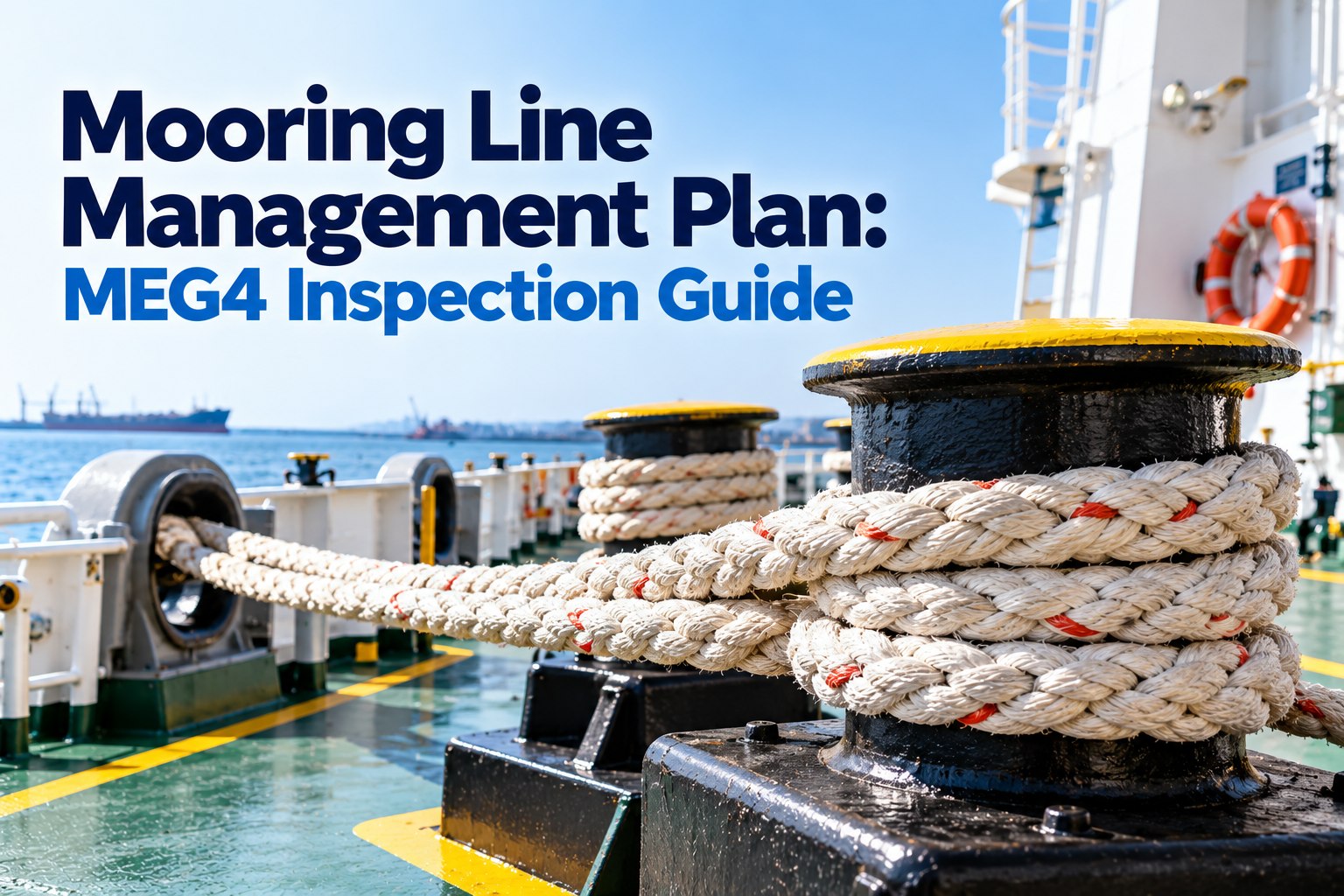
A mooring line management plan is the document, and the routine behind it, that tracks every mooring line and tail on board from purchase to retirement: what it is, where it works, how hard it has worked, what each inspection found and when it must come out of service. OCIMF’s fourth-edition Mooring Equipment Guidelines (MEG4) expect one, vetting inspectors ask for it, and since 1 January 2024 SOLAS II-1/3-8 has brought line inspection and retirement into statutory guidance. Get it wrong and the cost is a line that parts in service, a snap-back injury, a vetting observation or a deck full of ropes nobody can prove are fit to use.
From purchase to retirement: managing every mooring line and tail the way MEG4 expects
Line identity, inspection grades, tail rotation and retirement decisions in one plan the crew can keep up to date.
Free sign-up · Offline inspections on deck · Signed PDF reports
Most ships have always kept some record of their mooring lines. What MEG4 changed was the expectation that the record is complete, traceable and used to make decisions. Each rope should have a certificate tied to a unique identifier, its working history should be logged, and retirement should follow criteria set in advance rather than a judgement on the day.
This guide is about building and running that plan: the values MEG4 sets, what goes into the plan, how to inspect and grade synthetic lines, retirement criteria, tail management and rotation, records and what vetting inspectors review. It complements our SIRE 2.0 mooring inspection preparation guide, which covers the wider mooring chapter. To keep the plan on the crew’s phones, you can start a mooring line register free.
Mooring line management plan basics: the MEG4 numbers
MEG4, published in 2018, ties every line, tail and fitting to one ship-specific figure, the Ship Design Minimum Breaking Load (SDMBL). Rope makers and operator guidance summarise the key values like this:
All values as a percentage of SDMBL. LDBF, TDBF and the 75% retirement point as summarised by Wilhelmsen and Intertanko’s MSMP guidance; the 50% tail WLL from Wilhelmsen’s tail retirement guidelines. Nylon lines should have LDBF specified as break-tested wet.
What goes into a MEG4 mooring line management plan
Intertanko’s model Mooring System Management Plan (MSMP) treats the line management plan (LMP) as a standalone file referenced from Part D, with all line certificates filed in it. Wilhelmsen’s summary of MEG4 lists what the LMP should hold.
Ships not built to MEG4 should record their arrangements and any deviations in the MSMP, as Samson Rope’s MEG4 guidance notes.
Synthetic mooring line inspection: what to look for
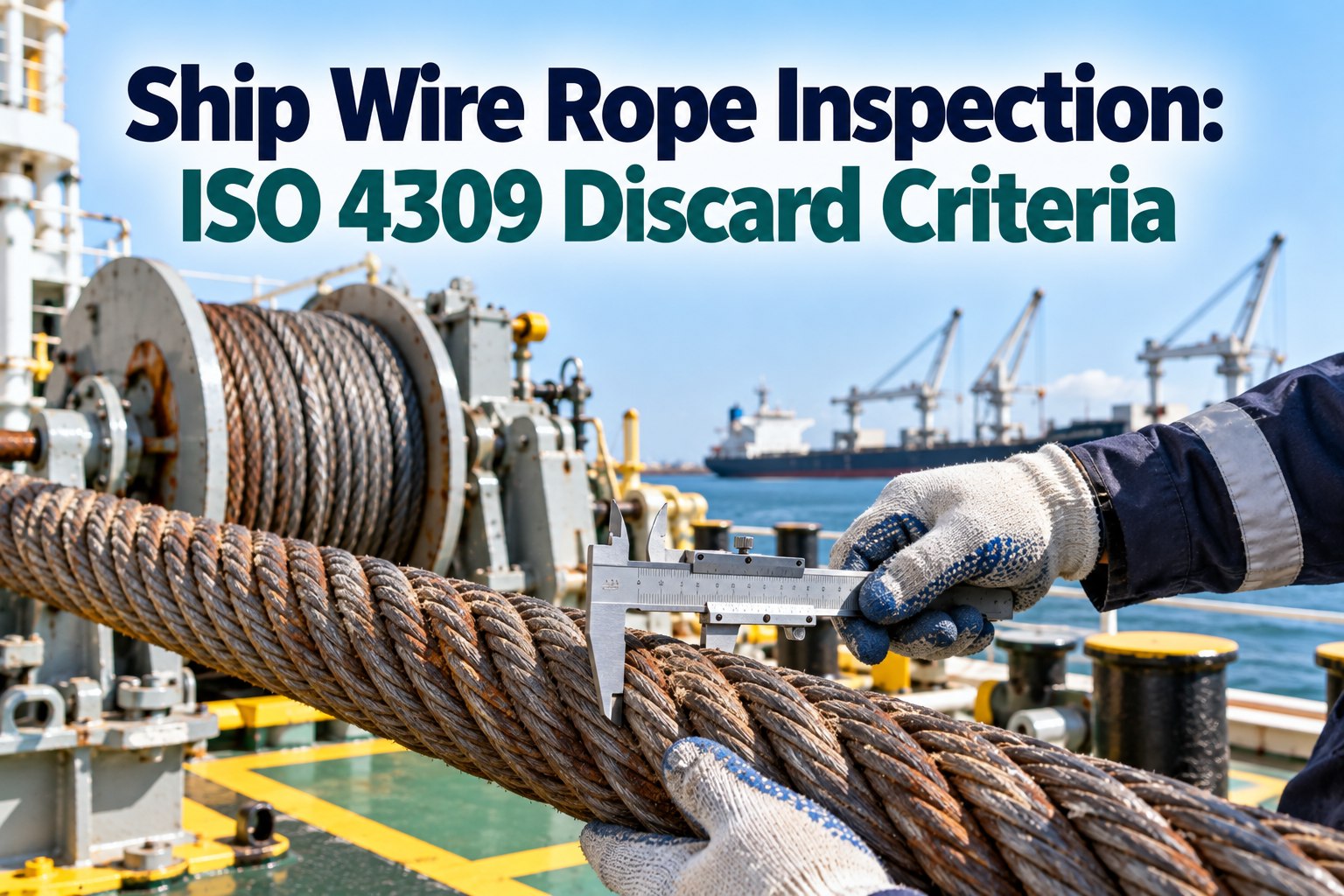
MEG4 expects periodic inspection to the rope maker’s guidelines, recorded in the LMP. Where the maker gives no guidance, operators can use their own procedures or the Cordage Institute’s fibre rope inspection and retirement criteria. Inspect the whole length, and pay most attention to the wear zones at fairleads, rollers and bitts.
Fuzzy, worn surface yarns, especially at wear zones. Localised, pronounced abrasion is a warning sign.
Monitor or actPowdered fibre inside the strands when the rope is opened, often from dirt and grit.
Monitor or actA few cut yarns can be monitored; clearly cut yarns across several strands mean retirement.
Retire if severeShiny, hard patches from friction heat. Marine Insight advises taking glazed rope out of service, not just monitoring it.
RetireMarine Insight cites up to 30% strength loss for a kink and up to 50% for a hockle. Straightening does not restore it.
RetireDiscoloured, brittle or hard fibres, or fibres that break by hand.
RetireWilhelmsen notes each twist per metre cuts tail strength by about 6%. Untwist at the first opportunity.
CorrectPulled yarns can be worked back in; pulled strands causing constructional damage mean retirement.
AssessCriteria drawn from Wilhelmsen’s tail inspection and retirement guidelines and Marine Insight. Always use your rope maker’s own criteria first.
Every line inspected, graded and photographed, linked to its certificate
Inspections done on deck, offline, with wear zones, shock loads and retirement dates kept in one register.
Free to start · Works offline on deck · Export to signed PDF
Mooring rope retirement criteria: when a line comes out of service
Intertanko’s model MSMP states the principle plainly: lines are retired when residual strength reaches 75% of SDMBL. Because that can only be confirmed by a break test, the plan needs criteria the crew can apply on deck.
- Glazed or fused fibres
- Kinks or hockles
- Cut yarns across several strands
- Chemical damage: hard, brittle, discoloured
- Maker’s retirement criteria met
- Heavy abrasion at a wear zone
- More than one yellow finding on the same rope
- A known shock load or overload
- Approaching maker’s design mooring hours
- Light, even surface wear
- A few cut yarns, monitored
- Within design hours, no shock loads
- Rotated or end-for-ended as planned
Strength loss from a single kink or hockle (Marine Insight figures)
Either is already below the 75% retirement point, which is why a kinked or hockled line comes straight out of service.
Wilhelmsen’s guidelines give design lives in mooring hours for its own tails, for example 1,000 hours for one product and 2,000 for others. Hours belong in the plan, but they are product-specific, so use your maker’s figures rather than a generic number.
Mooring tail replacement, rotation and end-for-ending
Tails do the hardest work in the system: they take shock loads, chafe at fairleads and are often the first thing to fail. Wilhelmsen sets a tail working load limit of 50% of SDMBL, with typical operating loads up to about 22%, and warns that shock loads can melt fibres inside a tail without visible damage.
Rotate positions
Some positions, such as head and stern lines at exposed berths, work harder than others. Moving lines between positions spreads the wear, and the plan should record each move.
End-for-end
Turning a line or tail end to end moves the wear zone to fresh rope. Wilhelmsen’s guidelines allow turning a rope end-to-end, where possible, instead of retiring it when a red finding is limited to one end.
Match the set
Use the same rope type on all positions working in parallel, so the load shares as designed.
Log the shocks
Record every shock load, excessive load and chemical exposure. Sudden swell or a passing ship means an immediate visual inspection.
Mooring line records and the SOLAS II-1/3-8 guidance
Since 1 January 2024, amendments to SOLAS II-1/3-8 have applied, supported by IMO guidance. As Wilhelmsen summarises it, MSC.1/Circ.1620 on inspection, retirement and replacement of mooring lines applies to all ships, while MSC.1/Circ.1619 on mooring arrangement design applies to ships built on or after 1 January 2024. Both point the same way as MEG4: documented lines, inspections and retirement.
| Record | What it should show | Why it matters |
|---|---|---|
| Certificate | LDBF or TDBF, linked to the rope’s unique identifier | Proves the rope matches the design |
| Service entry | Date rigged and position | Starts the life and inspection clock |
| Mooring hours | Time in service, by position | Compared with the maker’s design life |
| Inspection log | Date, inspector, findings by wear zone, grade, photos | Shows the rope was checked, not assumed |
| Load events | Shock loads, overloads, chemical exposure | Damage that inspection may not show |
| Rotation history | Position changes and end-for-ending | Shows wear was managed |
| Retirement | Date, reason, criteria met, sample tested | Proves the decision followed the plan |
Vetting mooring requirements: what inspectors review
Vetting inspectors compare the plan with the deck. The SIRE 2.0 mooring chapter covers much more; on line management specifically, these are the questions to be ready for.
How Marine Inspection supports a mooring line management plan
Marine Inspection keeps the line register, inspections and retirement decisions together, so the plan is always current and always matches the deck. The view below is illustrative.
| Line ID | Position | Hours | Last inspection | Status |
|---|---|---|---|---|
| ML-04 | Fwd head line | 1,240 | Light abrasion, wear zone 2 | In service |
| ML-07 | Aft spring | 980 | Shock load logged; inspected | Review |
| TL-02 | Fwd head tail | 1,610 | Glazed patch at eye | Retire |
| ML-11 | Aft stern line | 420 | Satisfactory, end-for-ended | In service |
For the full deck routine see deck inspection, and for plans by fleet size see Marine Inspection pricing.
Mooring line management plan: decide before you have to
A good mooring line management plan does three things: it knows every rope on board and where its certificate is, it records what each rope has been through, and it sets retirement criteria in advance so nobody has to decide on the day under pressure. Build it around MEG4’s values, inspect to the maker’s criteria, rotate and end-for-end on purpose, and keep the record live. Store the inspections and retirement decisions alongside the rest of the ship’s records in a digital logbook.
Show the vetting inspector every rope on deck, its certificate and its history
Free sign-up · Offline on deck · Signed PDF reports