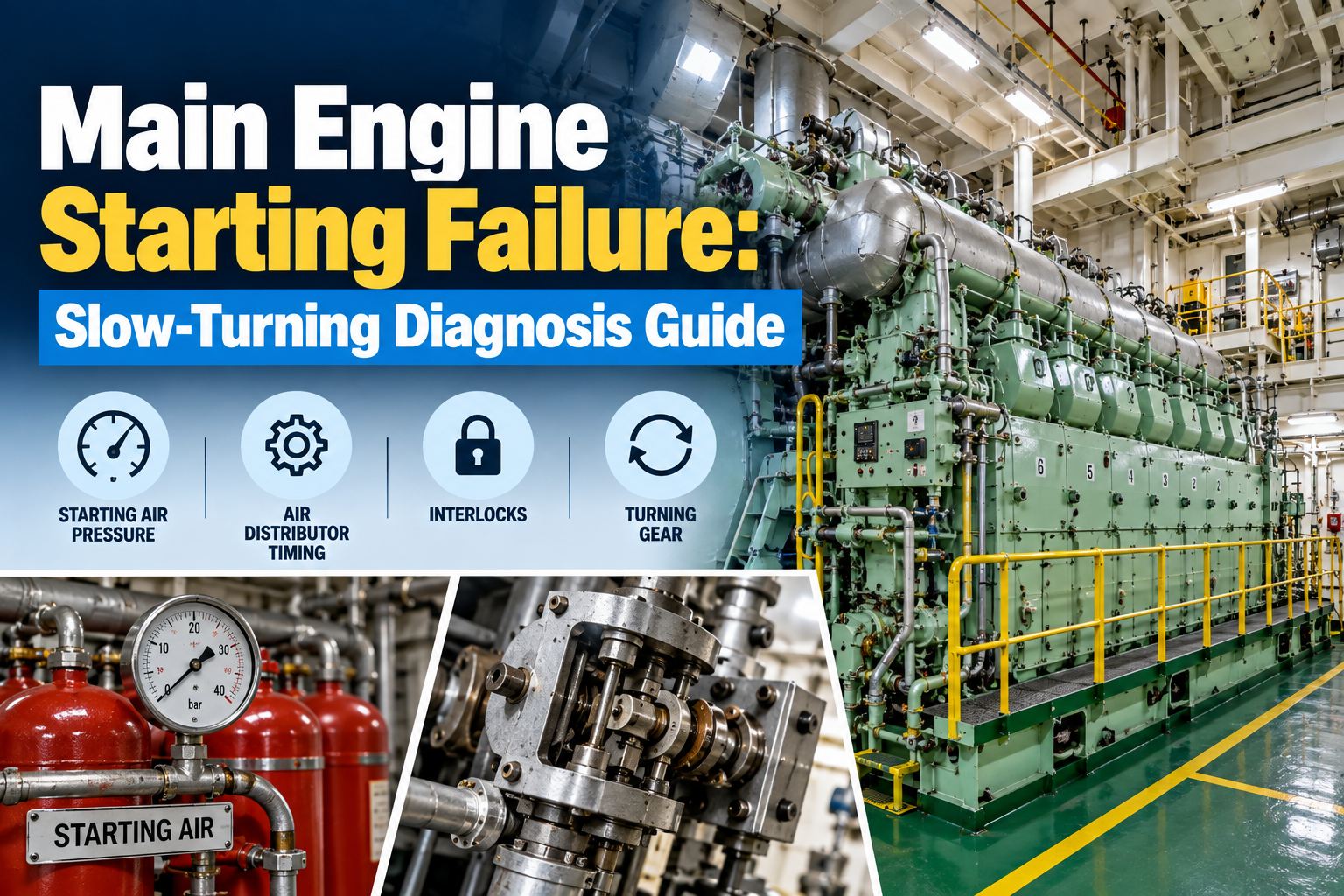
A main engine that will not start, or turns over slowly, is a problem you must solve before the ship can move, and usually with the pilot already booked. The fault is almost always found in one of a small number of places: the starting air supply, a safety interlock, the air distributor and start valves, or the turning gear. This guide gives the Chief Engineer a pressure and capacity reference, a four-lane symptom guide, the interlocks that can block a start, valve timing and leak-test facts, and a pre-departure check. Work from the cheapest and quickest check outward. Start a free trial of Marine Inspection to log pre-departure engine checks and starting faults with photos for the whole fleet.
START SEQUENCE
Five Gates Between the Telegraph and the First Fire
A start only completes if every gate opens in order. Find the gate that is shut and you have found the fault.
1
Air pressure
Receivers charged, valves open, drains cleared
2
Turning gear
Disengaged and its interlock proven
3
Safety chain
Shutdowns reset, control position correct
4
Air distributor
Right valves open at the right crank angle
5
Fuel and ignition
Fuel released, speed above ignition level
Free trial available. Or book a walkthrough built around your own engine room.
RULE REMINDER
Class and SOLAS-based rules call for starting air receivers able to supply at least 12 consecutive starts for a reversible propulsion engine and 6 for a non-reversible one, at least two receivers of similar size, and at least two compressors with one independently driven, able to fill the receivers within one hour. Check the exact figures against your class rules and the engine maker's manual.
Minimum Starts From Fully Charged Receivers, Without Refilling
Reversible propulsion engine
12
Non-reversible propulsion engine
6
Typical working pressure is in the 25 to 42 bar range. Every failed attempt spends air from this budget, so keep a count of attempts and watch the receiver pressure between them.
Starting air failures repeat on the same ships. See how Marine Inspection tracks recurring engine faults per vessel, so the pattern shows before the next departure.
Symptom Lanes: Start With What the Engine Is Doing
LANE A
Engine does not turn at all
1Turning gear still engaged or its interlock not made
2Starting air pressure low, or main starting valve closed
3Emergency stop or shutdown not reset
4Control position or telegraph in the wrong state
5Blocked air line, closed isolating valve
LANE B
Engine turns slowly
1Receiver pressure well below normal, or heavy pressure drop on the first turn
2Water or oil in the air lines, or a restricted line
3Mechanical drag: cold oil, a stuck piston, liquid in a cylinder
4Leaking air start valve bleeding air from one unit
5Start air supply restricted by a partly open valve
LANE C
Engine turns but does not fire
1Fuel supply or fuel rack not released by the start sequence
2Low fuel pressure or fuel temperature, air in the fuel system
3Scavenge or compression too low after a cold, long stop
4Direction interlock not matched to the telegraph
5Slow-turning or start sequence not complete
LANE D
Starts, then stops or fails again
1Misfire after the fuel change-over, then a repeat start
2Speed dropped below the ignition level
3Overspeed, low oil pressure or another shutdown trip
4Start impossible alarm after an interrupted start
5Too few starts left in the receivers
Causes in each lane are listed in a suggested order to check, cheapest and quickest first. This is our own summary of common practice. Your engine maker's manual decides the procedure for your engine.
Interlocks That Can Block a Start
| Interlock | What it blocks | How it is cleared |
|---|
| Turning gear | Starting air and fuel, to protect the gear and motor | Disengage the turning gear fully and confirm the interlock signal |
| Running direction | Fuel injection until the telegraph and engine direction agree | Match the telegraph order to the engine direction |
| Emergency shutdown | Fuel supply, until the shutdown is reset | Clear the cause, then reset the shutdown |
| Start impossible | A new start after an interrupted one | Move the telegraph to stop to reset the alarm |
| Control position | Start from the wrong control station | Transfer control to the correct position, or to the engine side |
Interlock behaviour varies by maker and control system. Use these as prompts for what to check, and follow your system's documentation.
Air Distributor and Start Valve Timing: The Reference Numbers
2-STROKE
~10 deg
Opens before TDC
The start valve closes about 5 degrees before the exhaust valve opens.
4-STROKE
4 deg
Opens before TDC
The start valve closes about 130 degrees after TDC.
OVERLAP
15 deg +
Minimum overlap
An overlap of about 20 to 90 degrees is desirable, so a valve is always open from any crank position.
Typical figures from marine engineering references. Timing is set by the engine maker and differs by design. Use the manual's values when checking or resetting a distributor.
Start Valve Leakage Test: The Steps
1
Close the air supply to the air distributor.
2
Open all the indicator cocks.
3
Supply air to the starting air receiver side, with the turning gear engaged.
4
Check each unit's indicator cock for air leaking past the start valve.
The steps follow a common marine engineering procedure. Follow your engine's own manual and permit-to-work rules, and keep people clear of the engine while the gear is engaged and air is supplied.
Make Starting Faults Easier to Find Next Time
Record start attempts, receiver pressures and interlock findings in one engine-room trail, so the next watch starts where the last one stopped.
Free trial available. Or book a walkthrough built around your own engine room.
Pre-Departure Starting Readiness Sheet
| Check type | Check | What good looks like |
|---|
| VISUAL | Receivers and drains | Drained of water and oil, valves in the right position |
| PRESSURE | Receiver pressure | Both receivers at full working pressure, compressors in auto |
| FUNCTION | Turning gear and interlock | Disengaged, with the interlock signal clear |
| FUNCTION | Start test, ahead and astern | Engine turns freely on air with indicator cocks open, then blows through clear |
| VISUAL | Air lines and start valves | No hot spots or leaks on the lines during manoeuvring |
| RECORD | Test log | Pressures, results and any fault recorded for the watch handover |
This sheet is our suggested template for a pre-departure check. Adjust it to your engine and company procedures.
Starting Air Line Fire and Explosion Risk
!A leaking start valve can let hot gas back into the air line
!Oil and carbon in the line can ignite and burn or explode
!Overheating on an air line during manoeuvring is a warning sign
!Safety devices and non-return valves must be kept in working order
General engineering knowledge. Treat a hot start air line as a fault to investigate before the next start.
What are the most common reasons a main engine will not start?
Low starting air pressure, the turning gear still engaged, a shutdown or interlock that has not been reset, a wrong control position or direction order, and fuel not released. Work through the five gates in order.
What is the minimum number of starts a ship must have?
Class rules typically require receivers able to give 12 consecutive starts for a reversible propulsion engine and 6 for a non-reversible one, without refilling. Check your class rules for the exact figure.
What is slow turning?
It can mean two things. Crew often use it for an engine cranking slowly on air, which points to low pressure, drag or a leaking valve. Many control systems also have a slow-turn mode that turns the engine slowly before a start if it has stood for a set time. One reference gives 30 minutes at 8 to 10 rpm. Check your maker's setting.
Book a walkthrough of engine check logging to record both.
How many times can I try to start?
Each attempt uses air, and the number of starts is limited by the receivers. Count your attempts, watch the pressure between them and find the fault before the air is spent.
Does the turning gear block a start?
Yes. A turning gear interlock blocks starting air to protect the gear and its motor. Disengage the gear fully and confirm the interlock signal.
Start Every Departure With Proof the Engine Is Ready
One trail for pre-departure tests, starting air readings and engine faults across every vessel in the fleet.
Free trial available. Or book a walkthrough built around your own engine room.