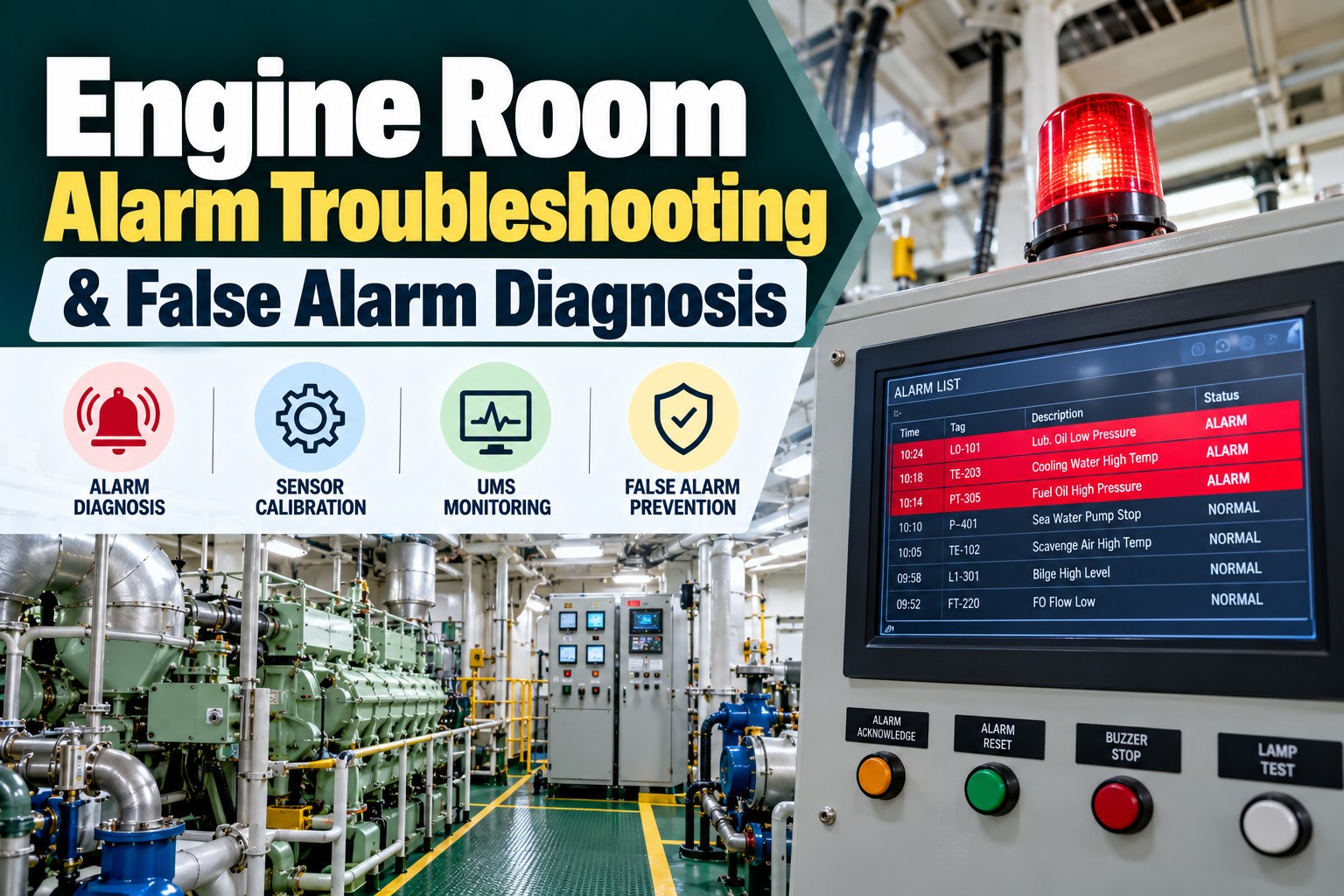
An alarm system only works if people believe it. Every nuisance alarm that is silenced without a diagnosis teaches the watch to treat the next one the same way, and that is how real faults get missed on an unmanned night. For the Second Engineer, who usually owns the alarm and monitoring system, the job is to tell real alarms from false ones quickly, fix the cause, keep sensors calibrated and keep overrides under control. This guide gives a real-or-false triage, a cause library, calibration checks, rules for isolations, and the unmanned machinery space (UMS) dependencies. Start a free trial of Marine Inspection to log alarm faults and sensor checks per vessel.
ALARM PANEL
Every Alarm Is Either Telling the Truth or Teaching the Watch to Ignore It
Six lamps to recognise on any engine room panel. Only the first one is a real fault.
REAL
A true fault. Act first, then find why.
SENSOR
Reading drifts or sticks. Calibrate or replace.
WIRE BREAK
Loop open or shorted. Check the cable and terminals.
CHATTERING
Cycles on and off. Add delay or fix the cause.
STALE
Stays in alarm for days. Fix it or remove it.
OVERRIDDEN
Isolated or in manual. Must be logged.
Free trial available. Or book a walkthrough built around your own engine room.
BENCHMARK
Process industry guidance (EEMUA 191 and IEC 62682) gives a useful yardstick: under 1 alarm in 10 minutes in normal operation, under 10 alarms in the first 10 minutes of an upset, no chattering alarms and no unauthorised suppressions. These come from plant control rooms, not ship rules, so use them to judge your own alarm log rather than as a class requirement.
Real or False? Four Questions in Order
1
Does a second source agree? (another sensor, local gauge, trend)
YESTreat as real until proven otherwise
NOSuspect the sensor or its wiring
2
Does the real process value match the alarm?
YESGo to the process and fix the cause
NOGo to sensor, cable and terminals
3
Is the alarm cycling on and off?
YESChattering. Check delay, deadband and connections
NOA steady alarm. Check calibration and drift
4
Does it clear after a proper reset?
YESLog it and watch for repeat
NOTreat as a standing fault. Do not leave it overridden
A suggested triage order. Never assume a false alarm until a second source has been checked.
Alarm Health Targets: How Many Is Too Many
Alarms per 10 min, normal running
under 1
Alarms in first 10 min of an upset
under 10
Standing (stale) alarms
under 10
Chattering or fleeting alarms
0
Limits from the EEMUA 191 column of an IChemE alarm management guide. Bars are scaled to the largest limit (30), and the first row is drawn at a minimum width for visibility. Scale them to the size of your own alarm list.
The fastest way to find bad actors is a log you can sort. See how Marine Inspection tracks alarm faults by sensor and by vessel, so repeat offenders are obvious.
False Alarm Cause Library
| Likely cause | Typical sign | First check | Usual fix |
|---|
| Sensor drift or poor calibration | Reading slowly moves away from a trusted gauge | Compare with a test gauge or reference | Recalibrate or replace, record as-found and as-left |
| Loose or corroded terminal | Alarm comes and goes with vibration | Check terminals and cable glands | Clean, tighten, seal |
| Open or shorted loop | Reading jumps to an extreme value or the wire-break alarm lights | Check the loop signal. A 4 to 20 mA loop reading far below 4 mA usually means a break | Repair the cable or replace the transmitter |
| Fouled or stuck sensor | Level or flow reading frozen or erratic | Inspect the float, probe or orifice | Clean or replace |
| Setpoint too tight, no delay | Alarm on every manoeuvre or load change | Review the trend against the setpoint | Agree a change under management of change |
| Electrical noise or earth fault | Several unrelated alarms together | Check earthing and screens | Fix the earth or screening |
| Power supply dip | Alarm group trips at once | Check the supply and the battery | Repair the supply, test the backup |
Our summary of common causes, listed from the most frequent to the least. Specific values depend on your system, so follow the maker's manual.
Calibration Checks by Sensor Type
PRESSURE
Against a test gauge
Compare the transmitter with a calibrated test gauge at two or three points across the range.
TEMPERATURE
Against a reference
Check the probe against a reference thermometer in a bath or dry block, and check its cable resistance.
LEVEL
Against a known level
Check the switch or transmitter against the sight glass or a physical test of the float.
ALARM TRIP
Test the setpoint
Confirm the alarm actually trips at the set value, and that the delay time is as documented.
Record the as-found and as-left values and the date every time. Our suggested methods. Use the equipment maker's procedure and calibrated instruments.
Stop Chasing the Same Nuisance Alarm Twice
Log each false alarm with its cause and fix, so repeat alarms stand out and sensor checks have proof.
Free trial available. Or book a walkthrough built around your own engine room.
Overrides and Isolations: Do and Don't
DO
Log every isolation with the reason, the person and the time
Set a time limit and a plan to fix it
Tell the duty engineer and the Chief Engineer
Review all isolations at every handover
DON'T
Leave a detector isolated going into UMS
Leave an alarm in manual or repose condition
Change set values without approval and a record
Silence a repeat alarm without finding the cause
Pre-UMS checks in a Marine Insight guide say all alarms and safety cut-outs must be operational, no detectors isolated, none in manual mode and set values unmanipulated.
UMS Dependency: What Rests on the Alarm System
PERSONNEL ALARM
30 min
Maximum pre-set period
One Norwegian operating-arrangements checklist asks for a one-man watch alarm that activates after a pre-set time not above 30 minutes, with a three-minute pre-warning in the machinery space.
DEAD MAN TIMER
24 min
Typical reset interval
A Marine Insight guide describes resetting at intervals not above 24 minutes, with a bridge alarm if the timer is not reset within 15 minutes.
START OF UMS
Log
Record the commencement
Inform the duty officer, and record the start of UMS in the engine room log book.
Settings differ by class and flag. Both figures are examples from the two sources, not one rule. Check your class notation and the vessel's operating arrangements.
Alarm Log Review Routine
| Interval | Action | Output |
|---|
| Every watch | Check for isolated or manual alarms, test lamps | Handover note |
| Weekly | Sort the alarm log, list the ten most frequent alarms | Bad actor list with an owner |
| Monthly | Check standing and shelved alarms, review isolations | Clean-up actions |
| Planned maintenance | Calibrate and function-test sensors and trips | As-found and as-left records |
Our suggested routine for a Second Engineer. Adjust it to the planned maintenance system and the Chief Engineer's standing orders.
How do I tell a false alarm from a real one?
Check a second source first. Compare the alarm with another sensor, a local gauge and the trend. If they agree, treat it as real. If not, suspect the sensor, its cable or its calibration.
How many alarms are acceptable?
Plant guidance (EEMUA 191) gives under 1 alarm in 10 minutes in normal operation and under 10 in the first 10 minutes of an upset. Ships have no single rule, so use these as a yardstick.
Can I isolate a nuisance alarm?
How often should sensors be calibrated?
Follow the planned maintenance system and the maker's guidance, and class survey requirements. Record as-found and as-left values each time.
What is a chattering alarm?
An alarm that switches on and off repeatedly, often from a loose connection, noise or a signal near its setpoint with no delay or deadband. It should be fixed, not silenced.
Keep the Alarm System Something the Watch Can Trust
One trail for alarm faults, sensor calibrations and isolations across every vessel, so UMS depends on records, not memory.
Free trial available. Or book a walkthrough built around your own engine room.