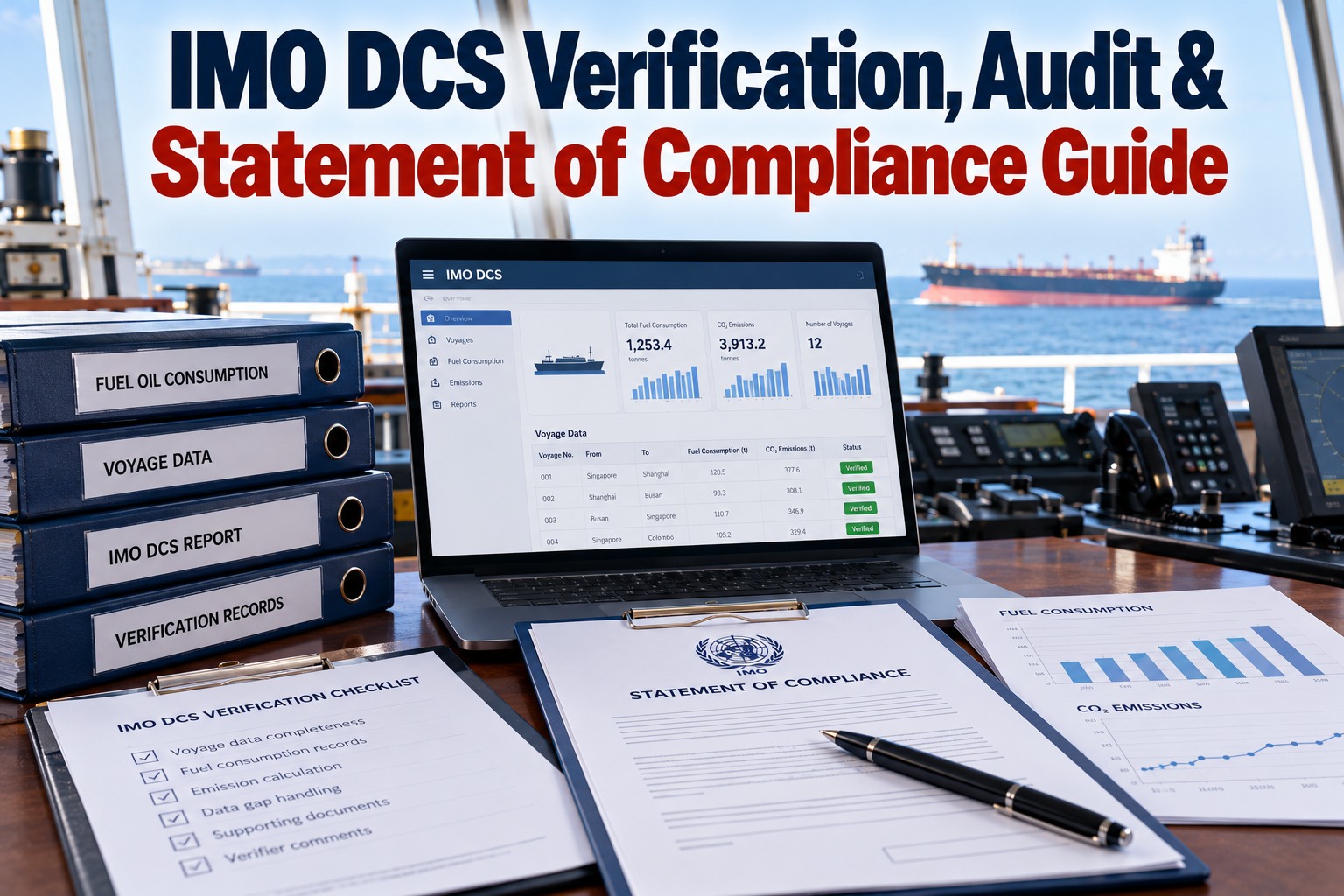
Every year, a fuel record that began as a noon report or a bunker delivery note has to survive a verifier's review and come out as a Statement of Compliance. When it works, the SoC arrives by the end of May and nobody notices. When it does not, a missing IMO number or a split voyage delays the certificate and takes up the compliance team's spring. This guide explains what the verifier looks at, how to handle gaps and corrections, and how to keep the process calm.
The DCS Calendar: From the Reporting Year to the Statement of Compliance
Which dates drive the work: data to the verifier, the SoC and the upload to IMO
DNV gives the DCS schedule as the fuel oil consumption report within three months after the end of each calendar year, which the FAQ lists as 31 March for submission to the verifier, and the SoC five months after the beginning of the calendar year, which it lists as 31 May. The Bahamas Maritime Authority notice adds that verified data is uploaded to IMO's database within one month after the SoC and not later than 30 June. Other flags may set different dates.
How many days each stage really gives you, and why the first stage is the one to protect
Counting from 1 January, the window to assemble and submit data is about 90 days. The verifier then has about 61 days to the SoC date, and the upload another 30. The first stage is the one the company controls, and it is the one most affected by data quality. LR says early submission gives the verifier time to find errors, and warns that late or incomplete submissions may need resubmission and extra verification. Our IMO Data Collection System guide to fuel consumption reporting requirements gives the background to the reporting rules.
How a Fuel Record Becomes a Statement of Compliance
The five steps from the ship's log abstract to the certificate on board
Ships report voyage data and bunker reports, and the company builds the annual report using the ship's SEEMP Part II method. The verifier reviews it and, once it is satisfied the data was collected and reported correctly, issues the SoC. DNV says verification is generally done in its offices rather than by a surveyor on board. LR says submissions need supporting evidence for verification under MEPC.348(78).
What the Verifier Expects: The Points That Delay or Speed the Statement
Which data points in a fuel report most often raise questions, and how to prepare for each
DNV's FAQ does not give a list of common errors, but it flags specific points that matter. Voyages crossing the year end must be split, bunker reports must show the receiving vessel's IMO number, ice class belongs in the report and in SEEMP Part II, fuel type should follow the ISO 8217 grade, and any distance travelled should be reported. The table adds the SEEMP condition and the evidence pack.
| Point checked | Why it matters | How to be ready |
|---|---|---|
| SEEMP Part II confirmed | DNV says FOC reports cannot be verified without a SEEMP Part II | Keep the confirmation of compliance on board and in the file |
| Year-end voyages | Voyages crossing the year end must be split with a log abstract event at the year end (DNV) | Add the split event before the report is built |
| Bunker report identifiers | The bunker report must show the IMO number of the receiving vessel (DNV) | Check every bunker delivery note before filing |
| Fuel type and grade | DNV says fuel type should follow the ISO 8217:2024 grade | Use the grade on the delivery note, not an abbreviation |
| Distance travelled | Any distance travelled should be reported, including small dynamic positioning distances (DNV) | Include manoeuvring and DP distance in the log abstract |
| Time at sea definition | DNV defines it as departure from berth to arrival at berth, excluding anchorage | Apply one definition across the whole fleet |
| Ice class | Ice class belongs in the FOC report and SEEMP Part II (DNV) | Check it matches class records |
| Supporting evidence | LR says submissions need supporting evidence for verification under MEPC.348(78) | Assemble the evidence pack before the deadline |
Why a missing SEEMP Part II blocks verification however clean the fuel data is
DNV says FOC reports cannot be verified without a SEEMP Part II, under MARPOL regulations 22.2 and 22A.1, and that the SEEMP II is confirmed by the flag or a recognised organisation, which issues a confirmation of compliance. On a change of flag or company, a new SEEMP II and confirmation are needed. Check the document is on board and current before the data work starts, not after.
Data Gaps and Corrections: Handling What Is Missing or Wrong
What the sources say to do when a log abstract or bunker report is missing
The honest answer is that sources differ. We did not find a general IMO rule that tells a ship how to treat a data gap. What we found is practical: rebuild from source documents where you can, submit early, and ask the verifier and flag how they want gaps explained. One flag, the Bahamas, describes a route for a company that cannot complete submission or review on time.
How corrections, changes of company and changes of flag change who reports what
DNV describes a correction route in its own system: notify the verifier, update the log abstracts and resubmit. For changes of company or flag, DNV says each manager reports its own part of the year and each flag period is verified. The table sets out the main cases.
| Situation | What the sources say | Source |
|---|---|---|
| Error found after the report is submitted | Notify the verifier, update the log abstracts and resubmit. The verifier sets the report to unsubmitted and the data refreshes. | DNV FAQ (DNV's own system) |
| Change of company | Each manager reports and submits the FOC report for its own part of the year (Reg. 22A.5) | DNV FAQ |
| Change of flag | A flag change triggers FOC verification for each flag period (Reg. 22A.4). A new SEEMP Part II and confirmation of compliance are needed. | DNV FAQ |
| Previous company does not provide the SoC | Consequences depend on the flag, because the regulation does not specify them | DNV FAQ |
| Lay-up or inactivity | Keep the last SoC on board for inspection | Bahamas notice |
| Expired SoC | Need not be kept once a new one is delivered on board | Bahamas notice |
The DCS Readiness Checklist: From the Ship to the Certificate
A checklist with a checkpoint type on each item that works for ships and for the office
Use the checklist below as a monthly routine and as a final check before submission. It is built from the sources above, so adapt it to your verifier's instructions. For how DCS connects to energy efficiency compliance more widely, see our EEXI compliance guide to the energy efficiency existing ship index.
| Item | What to check | Checkpoint type |
|---|---|---|
| SEEMP Part II and confirmation | On board and current | Record |
| Log abstracts for the year | No missing days, year-end voyage split | Visual |
| Bunker delivery notes | All present, IMO number and fuel grade correct | Record |
| Fuel quantities | Opening, bunkered and closing quantities reconcile for each tank group | Measure |
| Distance and hours | Distance includes DP and manoeuvring, time at sea uses one definition | Measure |
| Data submitted | Before the verifier's deadline, with evidence attached | Record |
| SoC on board | Issued and on board, with the date and validity noted | Record |
| Source documents | Kept for at least 12 months after the year end | Record |
Mistakes That Delay the Statement of Compliance
Six habits that turn an easy verification into a spring-long project
Systems That Keep Fuel Records, SEEMP Documents and the SoC in One Place
How a dated photo repository, task ownership and deadlines keep DCS evidence together
DCS is a year-long records exercise with a short, hard deadline. Marine Inspection supports a dated photo repository, observations turned into tasks with owners, deadlines and evidence, and certificate and equipment tracking. A dated photo of a bunker delivery note or a flow meter reading, attached to the voyage record, makes the evidence pack quick to assemble in March.