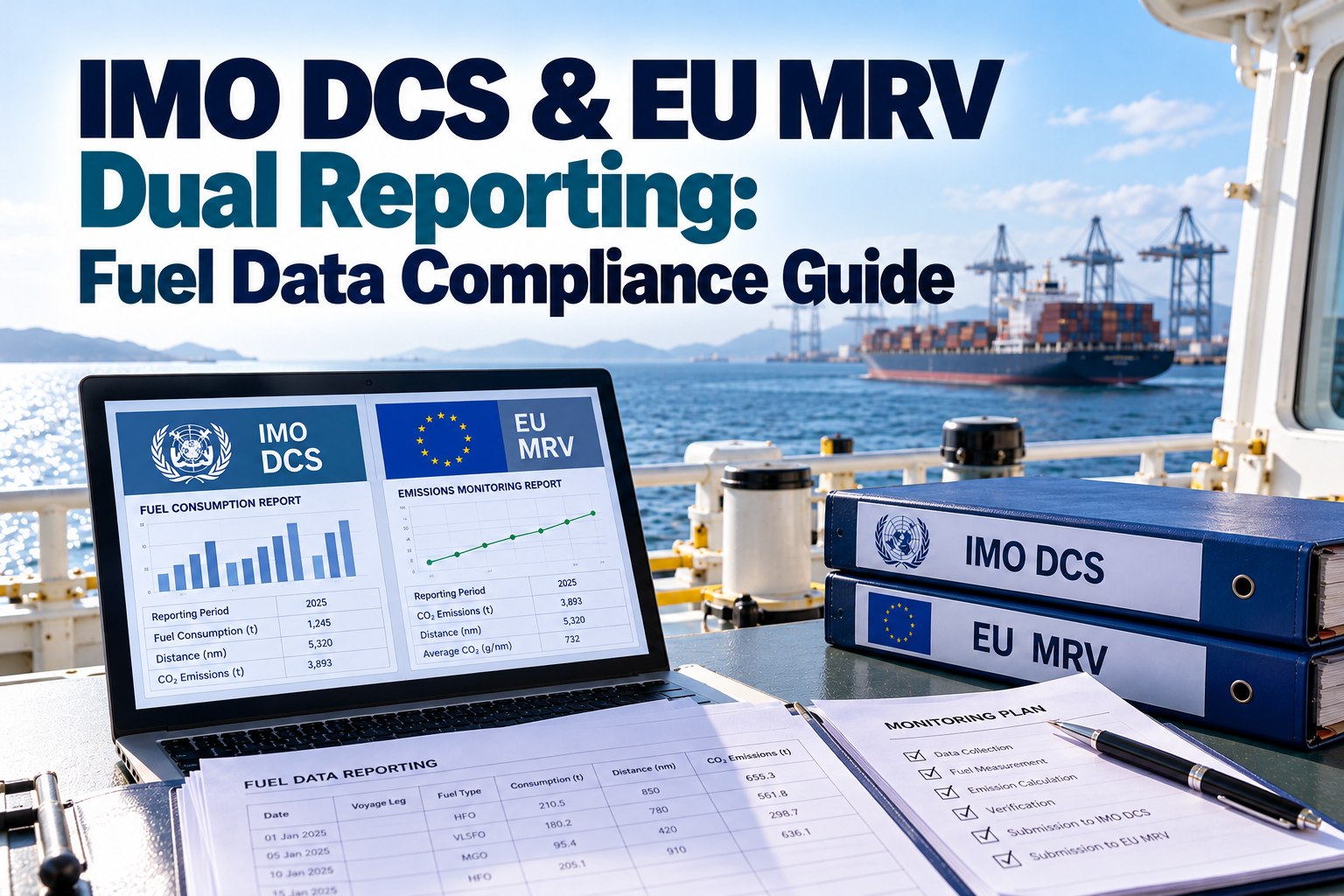
Most ships trading to Europe report the same fuel twice: once to the IMO Data Collection System and once to EU MRV. The fuel is identical, but scope, granularity and verification differ, and small mismatches turn into verifier queries. This guide shows how to build one fuel data set that feeds both reports cleanly. Book a demo to see DCS and MRV reports from one log.
IMO DCS and EU MRV dual reporting: one fuel record, two compliant reports
Collect the data once, at voyage-leg level, and both reports become views of the same record.
Ship data, recorded once
Noon reportsBDNsTank soundingsPort timesCargo carriedIMO DCS vs EU MRV: what each fuel data system requires
Both systems start from fuel consumption, but they answer different questions. DCS feeds the IMO’s global picture and each ship’s CII; EU MRV feeds the EU ETS and FuelEU Maritime. For 2024, 29,690 ships reported 223 million tonnes of fuel to the IMO database. Try the platform free.
| Topic | IMO DCS | EU MRV |
|---|---|---|
| Ships | 5,000 GT and above on international voyages | 5,000 GT and above, plus general cargo and offshore ships from 400 GT since 2025 |
| Voyages covered | All voyages, worldwide | Voyages to, from and between EU or EEA ports, and time in those ports |
| Granularity | Annual totals, with more detail from 2026 (fuel by consumer, fuel when not under way, shore power) | Per voyage, aggregated into an annual report |
| Gases | Fuel consumption, from which CO2 is derived | CO2, methane and nitrous oxide |
| Plan | SEEMP Part II | MRV monitoring plan |
| Checked by | Flag Administration or recognised organisation | Accredited verifier |
| Proof on board | Statement of Compliance by 31 May | Document of Compliance by 30 June |
| Used for | CII rating, IMO fleet data | EU ETS allowances, FuelEU Maritime, public ship data |
Where IMO DCS and EU MRV dual reporting goes wrong
Verifier queries usually come from definitions, not arithmetic. The same fuel is split differently by each system, and the splits must add up. Our EU ETS compliance guide explains why MRV figures now carry a direct cost.
Build one fuel data set that feeds both reports
The fix is structural: record fuel at voyage-leg level, with each leg tagged for both systems. Then DCS is the sum of all legs, and MRV is the sum of the EU-related ones.
Report once, satisfy both regimes
Keep fuel, distance and port times per leg with the evidence attached, and produce DCS and MRV totals from the same record.
Align the monitoring methods in SEEMP Part II and the MRV monitoring plan
Both plans describe how fuel is measured. Choosing the same method for both, and writing it the same way, removes the most common source of difference.
Reconcile DCS and MRV fuel data before submission
One simple test catches most errors: the MRV total plus fuel on non-EU legs should equal the DCS total for the same year. The example below is illustrative.
If the two sides differ, look first at year-end time zones, ROB corrections and legs with an unclear EU flag.
DCS and MRV verification calendar
The two systems share the 31 March deadline for the previous year’s data, so verification for both can run as one exercise.
Dual reporting compliance checklist
Use this before the year closes and again before submission. For CII, which uses the DCS data, see our guide to CII tracking software.
How Marine Inspection supports DCS and MRV reporting
Marine Inspection keeps fuel and voyage data in one log, with each leg traceable to daily records and evidence. Our environmental compliance reports compile DCS and MRV totals from that same record. The ledger below is illustrative.
IMO DCS and EU MRV FAQs
What is the difference between IMO DCS and EU MRV?
DCS collects annual fuel data for all voyages worldwide and feeds the CII. EU MRV collects per-voyage data for EU-related voyages, covers CO2, methane and nitrous oxide, and feeds the EU ETS and FuelEU Maritime.
Can one data set satisfy both DCS and MRV?
Yes, if fuel is recorded per voyage leg with an EU voyage flag and the same measurement method is used in both plans.
What new DCS data is required from 2026?
Fuel by consumer type, fuel when not under way, shore power used, and transport work for ships subject to CII, collected through the revised SEEMP Part II.
When are DCS and MRV reports due?
Both by 31 March for the previous year. The DCS Statement of Compliance follows by 31 May and the MRV Document of Compliance by 30 June.
Who verifies DCS and MRV data?
DCS data is verified by the flag Administration or its recognised organisation. EU MRV reports are verified by an accredited verifier.
Can Marine Inspection produce DCS and MRV reports?
Yes. Book a demo to see both reports compiled from one fuel log.
One record, two regimes, no double work
Leg-level fuel data with evidence and a simple reconciliation turns two reporting deadlines into one exercise.