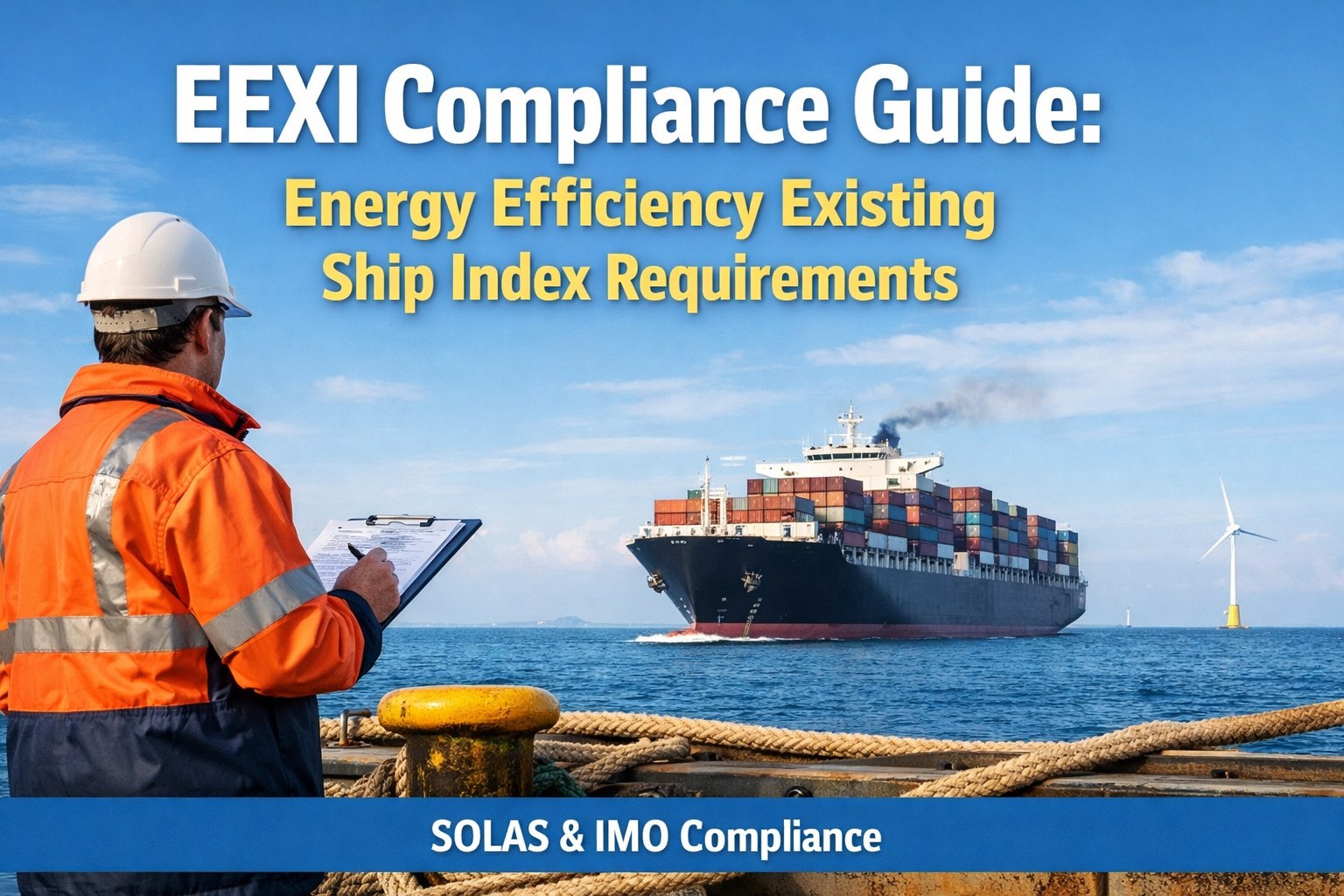
EEXI Compliance Guide: Energy Efficiency Existing Ship Index Requirements
The Energy Efficiency Existing Ship Index is the regulation that draws a definitive line in the sand for every existing merchant vessel: meet the required efficiency baseline, or you cannot trade internationally. Unlike CII which measures ongoing operational performance, EEXI is a one-time technical calculation that determines whether your ship's design efficiency — its hull, engine, and propulsion system — meets the minimum standard set by the IMO. Applied from the first IAPP survey on or after January 1, 2023, EEXI requires all existing ships of 400 GT and above to calculate their attained EEXI and demonstrate it falls below the required EEXI value for their ship type and size. Approximately 30% of the existing fleet needed modifications to comply — primarily through Engine Power Limitation (EPL), Shaft Power Limitation (ShaPoLi), or energy-saving device retrofits. For naval architects and fleet managers, EEXI compliance is now verified through the International Energy Efficiency Certificate (IEEC), valid for the life of the vessel. The regulation is under review in 2026, with potential amendments to reduction factors and reference lines. This guide covers the calculation methodology, compliance options, power limitation systems, survey requirements, and the 2026 review outlook. Start a free trial of Marine Inspection to track EEXI documentation, power limitation overrides, and energy efficiency records across your fleet.
EEXI: Energy Efficiency Existing Ship Index
400 GT+
Applicability
All existing ships in MARPOL Annex VI ship categories
One-Time
Calculation
Verified once — IEEC valid for vessel lifetime
~70%
Already Compliant
Ships meeting EEDI Phase 2 standards comply without modification
2026
Review Year
IMO reviewing effectiveness, reduction factors, and reference lines
Attained vs Required EEXI: The Compliance Test
EEXI compliance is binary — your attained value is either below the required value (compliant) or above it (non-compliant). There is no rating scale like CII. Understanding both values is essential for naval architects evaluating compliance options.
Attained EEXI
CO2 Emissions / (Capacity x Speed)
Calculated from your ship's actual technical characteristics — installed engine power, specific fuel consumption, capacity (DWT or GT), and reference speed. Uses same formula as EEDI. For ships with power limitation, 83% of the limited power enters the calculation (or 75% of installed MCR if lower).
must be less than or equal to
Required EEXI
Reference Line x (1 - Reduction Factor)
Determined by IMO reference lines for your ship type and size, multiplied by a reduction factor (%). The reference line establishes the baseline efficiency for each ship category. The reduction factor makes the requirement stricter — equivalent to EEDI Phase 2 requirements.
Attained EEXI > Required EEXI = Non-compliant. Must implement measures to reduce attained value before certification.
EEXI Reduction Factors by Ship Type
The reduction factor determines how far below the reference line your ship must perform. It varies by ship type and size — meaning a large bulk carrier faces different requirements than a small container ship. Book a Marine Inspection demo to see how the platform tracks EEXI compliance documentation for mixed fleets.
Table 1: EEXI Required Reduction Factors by Ship Type & Size
Ship Type
Size Threshold
Reduction Factor (%)
Notes
Bulk Carrier
10,000 DWT+
15-20%
Higher reduction for larger vessels. Most common EEXI modification candidates.
Gas Carrier
2,000-10,000 DWT
0-20%
Size-dependent. Smaller gas carriers may comply without modification.
Tanker
4,000 DWT+
15-20%
Higher for VLCCs. EPL widely adopted for older tankers.
Container Ship
10,000 DWT+
20-50%
Highest reduction factors in the fleet. Large containers face significant compliance challenge.
General Cargo
3,000 DWT+
0-15%
Lower thresholds. Many comply through existing design efficiency.
Refrigerated Cargo
3,000 DWT+
15%
Fixed reduction factor regardless of size above threshold.
Combination Carrier
4,000 DWT+
20%
Combined ore/oil carriers. Usually require power limitation.
LNG Carrier
10,000 DWT+
30%
High reduction factor but often offset by gas-fuelled propulsion advantages.
Ro-Ro Cargo
1,000 DWT+
5-15%
GT-based calculation for Ro-Ro. Variable by size category.
Ro-Ro Passenger
250 DWT+
5-20%
Significant variation by size. Larger Ro-Pax vessels face tighter requirements.
Cruise Passenger
25,000 GT+
5-30%
GT-based. Complex power profiles may require detailed calculation.
EEXI Compliance Options: How to Reduce Your Attained Value
If your attained EEXI exceeds the required value, you must implement technical measures to bring it into compliance. The options range from zero-CAPEX software changes to major retrofits — the right choice depends on how far your attained value exceeds the requirement.
Most Common
Engine Power Limitation (EPL)
Limits the maximum fuel injection to the engine, capping MCR output. For mechanical engines: a stopping screw/wire restricting fuel rack travel. For electronic engines: software-embedded fuel limit. Low cost, quick implementation. Reduces the power term in the EEXI formula directly.
Typical Cost: $10K-30K
Implementation: 1-4 weeks
Override: Master can override for safety — logged and reported
Most Common
Shaft Power Limitation (ShaPoLi)
Limits power delivered to the propeller shaft via a torque/power measurement and limiting system. Monitors actual shaft power and prevents exceeding the EEXI-compliant limit. More precise than EPL — measures output rather than input.
Override: Safety override with automatic logging and reporting
Energy-Saving Devices (ESDs)
Pre-swirl stators, propeller boss cap fins, wake equalizing ducts, Mewis ducts — reduce propulsion power needed for a given speed. Provides genuine efficiency improvement rather than just limiting power.
Typical Cost: $100K-500K
Implementation: Next dry-dock
Impact: 3-8% power reduction
Wind-Assisted Propulsion
Rotor sails, wing sails, kite systems — counted as innovative energy efficiency technology in the EEXI formula. Provides auxiliary thrust reducing main engine load.
Typical Cost: $1M-5M per unit
Implementation: 3-6 months
Impact: 5-15% (route dependent)
Waste Heat Recovery
Captures exhaust heat to generate electrical power, reducing auxiliary engine load. Enters the EEXI formula as innovative energy efficiency technology reducing auxiliary power demand.
Typical Cost: $500K-2M
Implementation: Major retrofit
Impact: 3-8% auxiliary power reduction
Alternative Fuel Conversion
LNG, methanol, or biofuel conversion reduces the carbon factor (CF) in the EEXI calculation. Most impactful but highest CAPEX. Typically considered for vessels with significant remaining economic life.
Typical Cost: $5M-25M
Implementation: 6-18 months
Impact: 20-25%+ CO2 reduction
Track EEXI Compliance & Power Limitation Records
Marine Inspection tracks IEEC certification, power limitation override logs, OMM documentation, energy-saving device maintenance, and SEEMP records — giving fleet managers complete EEXI compliance visibility.
EEXI verification is integrated into the existing IAPP survey framework. Understanding the process prevents delays and ensures your vessel is certified without interrupting trading schedules. Sign up for Marine Inspection to manage survey scheduling and certification documentation.
Table 2: EEXI Certification & Survey Requirements
Step
Activity
Who Does It
Documents Produced
1
Calculate attained EEXI using EEXI Technical File
Ship owner / naval architect
EEXI Technical File with calculation methodology, reference speed determination
2
Compare attained EEXI against required EEXI
Ship owner / classification society
Compliance assessment report
3
If non-compliant: implement EPL/ShaPoLi/ESD modifications
Ship owner / equipment supplier
Modification documentation, Onboard Management Manual (OMM) for power limitation
4
Verify attained EEXI and technical file at IAPP survey
Classification society (RO) that classifies the vessel for H&M
Verified EEXI Technical File
5
Verify power limitation system (if fitted)
Same classification society
Verified OMM, EPL/ShaPoLi system documentation
6
Issue International Energy Efficiency Certificate (IEEC)
Classification society on behalf of flag state
IEEC — valid for life of vessel (unless major conversion or flag change)
EPL vs ShaPoLi: Choosing the Right Power Limitation
For the majority of non-compliant ships, power limitation is the fastest and most cost-effective path to EEXI compliance. The two systems differ in how they limit power and what they measure.
Engine Power Limitation (EPL)
Controls: Fuel input to the engine
Mechanism: Mechanical screw or electronic software limit
Measures: Fuel rack position / injection quantity
Cost: Lower ($10K-30K)
Best for: Simpler engines, straightforward compliance gap
Limitation: Less precise — doesn't account for engine condition
Shaft Power Limitation (ShaPoLi)
Controls: Power delivered to the propeller shaft
Mechanism: Torque meter + power measurement + control system
Measures: Actual shaft torque and RPM → calculated power
Cost: Higher ($50K-150K)
Best for: Complex installations, precise compliance, performance monitoring
Advantage: Real-time measurement, data for CII tracking
Safety Override Requirements
Both EPL and ShaPoLi systems must be overridable by the Master or officer in charge for safety, life-saving, adverse weather, piracy, or engine maintenance purposes. Override usage must be logged, reported to the flag administration, and documented in the vessel's records. Manoeuvring characteristics on the pilot card, wheelhouse poster, and manoeuvring booklet must be updated to reflect the limited power parameters.
International Energy Efficiency Certificate (IEEC) issued and valid onboard
EEXI Technical File verified by classification society — calculation methodology documented
Attained EEXI value confirmed below required EEXI for ship type and size
SEEMP Part I onboard with EEXI compliance measures documented
Power Limitation (If Fitted)
Onboard Management Manual (OMM) for EPL/ShaPoLi approved and available
Power limitation system operational — limited power verified against EEXI calculation
Safety override mechanism functional — override logged and reportable
Pilot card, wheelhouse poster, and manoeuvring booklet updated with limited power parameters
Operational Awareness
Master and officers familiar with power limitation system and override procedures
Override log maintained — all override events documented with reasons
Minimum propulsion power requirements met — vessel can manoeuvre safely in adverse conditions
Crew aware that EEXI is a design/technical measure — distinct from operational CII rating
Frequently Asked Questions
What is the difference between EEXI and EEDI?
EEXI applies to existing ships; EEDI applies to new ships. Both use the same calculation methodology — measuring CO2 emissions per transport work based on design parameters. EEXI was introduced to create a level playing field by requiring existing ships to meet efficiency standards equivalent to EEDI Phase 2. EEXI is calculated once; EEDI is calculated at the design stage. The main technical difference is that ships with power limitation use 83% of limited power in EEXI (vs 75% of installed MCR for EEDI).
Which ships need EEXI certification?
All existing ships of 400 GT and above in MARPOL Annex VI ship categories: bulk carriers, gas carriers, tankers, container ships, general cargo ships, refrigerated cargo carriers, combination carriers, LNG carriers, Ro-Ro cargo ships, Ro-Ro passenger ships, and cruise ships. Ships built before January 1, 2023 must have calculated their attained EEXI and obtained an IEEC at their first IAPP survey on or after January 1, 2023.
What is the most common way to comply with EEXI?
Engine Power Limitation (EPL) and Shaft Power Limitation (ShaPoLi) are the most widely adopted solutions — they're the fastest to implement and lowest cost. EPL uses mechanical or electronic limits on fuel injection. ShaPoLi uses torque/power measurement on the propeller shaft. Both must include safety override capability with logging. For ships with larger compliance gaps, energy-saving devices, propeller modifications, or alternative fuels may be needed.
Can a ship limit power below minimum propulsion power requirements?
Yes — the power limitation for EEXI calculation can go below the minimum propulsion power guideline because the override mechanism allows the Master to release the limitation when needed for safety. The system is designed to be overridable in emergencies, adverse weather, piracy situations, and for engine maintenance. All overrides must be logged and reported.
What happens in the 2026 EEXI review?
The IMO mandated a review of EEXI effectiveness by January 1, 2026. The review examines whether current reference lines and reduction factors are achieving the intended GHG reduction targets, whether amendments are needed for the period up to 2030, and how EEXI interacts with the CII operational measure. Potential outcomes include adjusted reduction factors, updated reference lines, or changes to the calculation methodology — though EEXI remains a one-time technical assessment.
Complete EEXI Compliance Visibility for Your Fleet
IEEC tracking, EEXI Technical File management, power limitation override logs, OMM documentation, and SEEMP integration — Marine Inspection gives naval architects and fleet managers one platform for the full energy efficiency compliance picture.