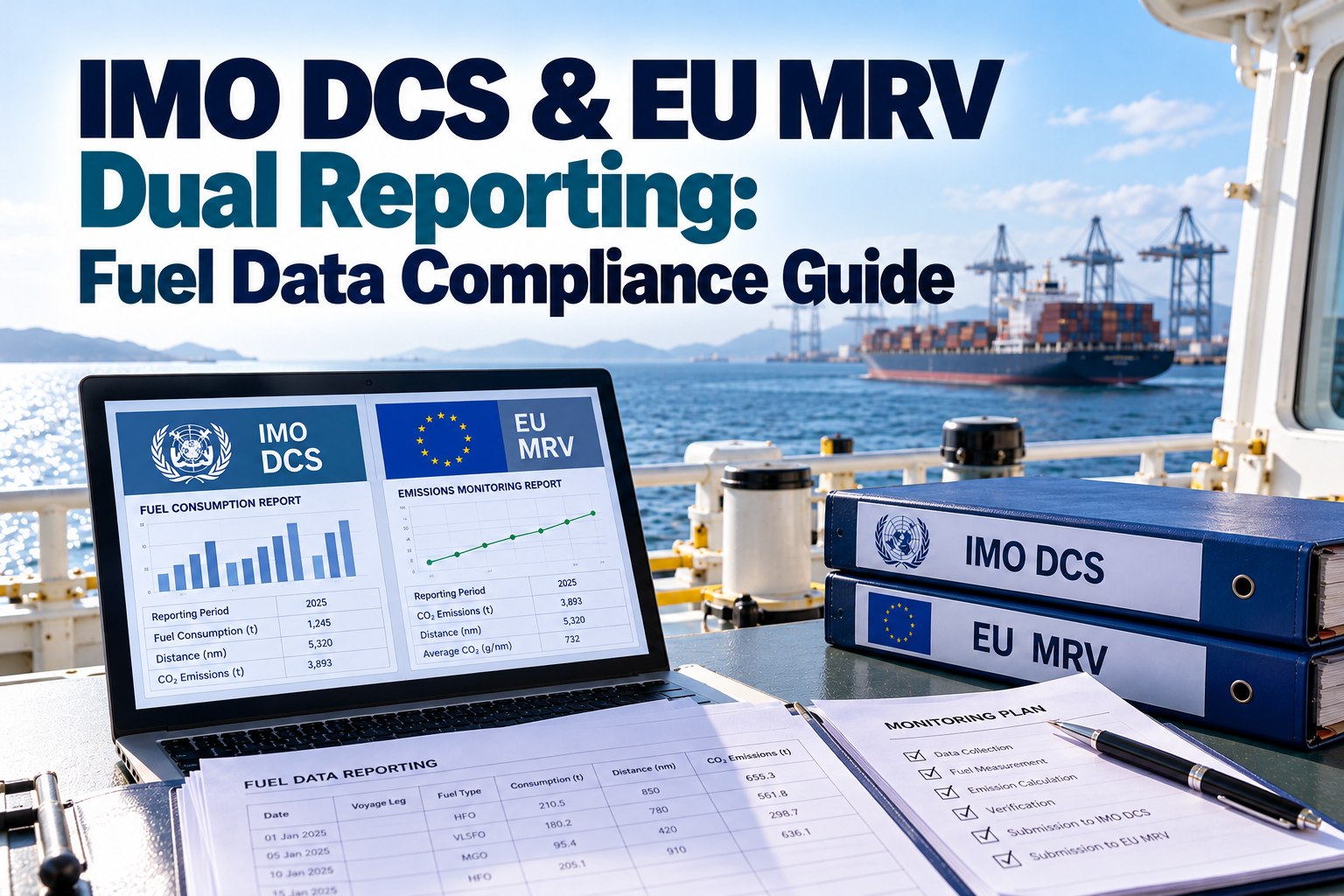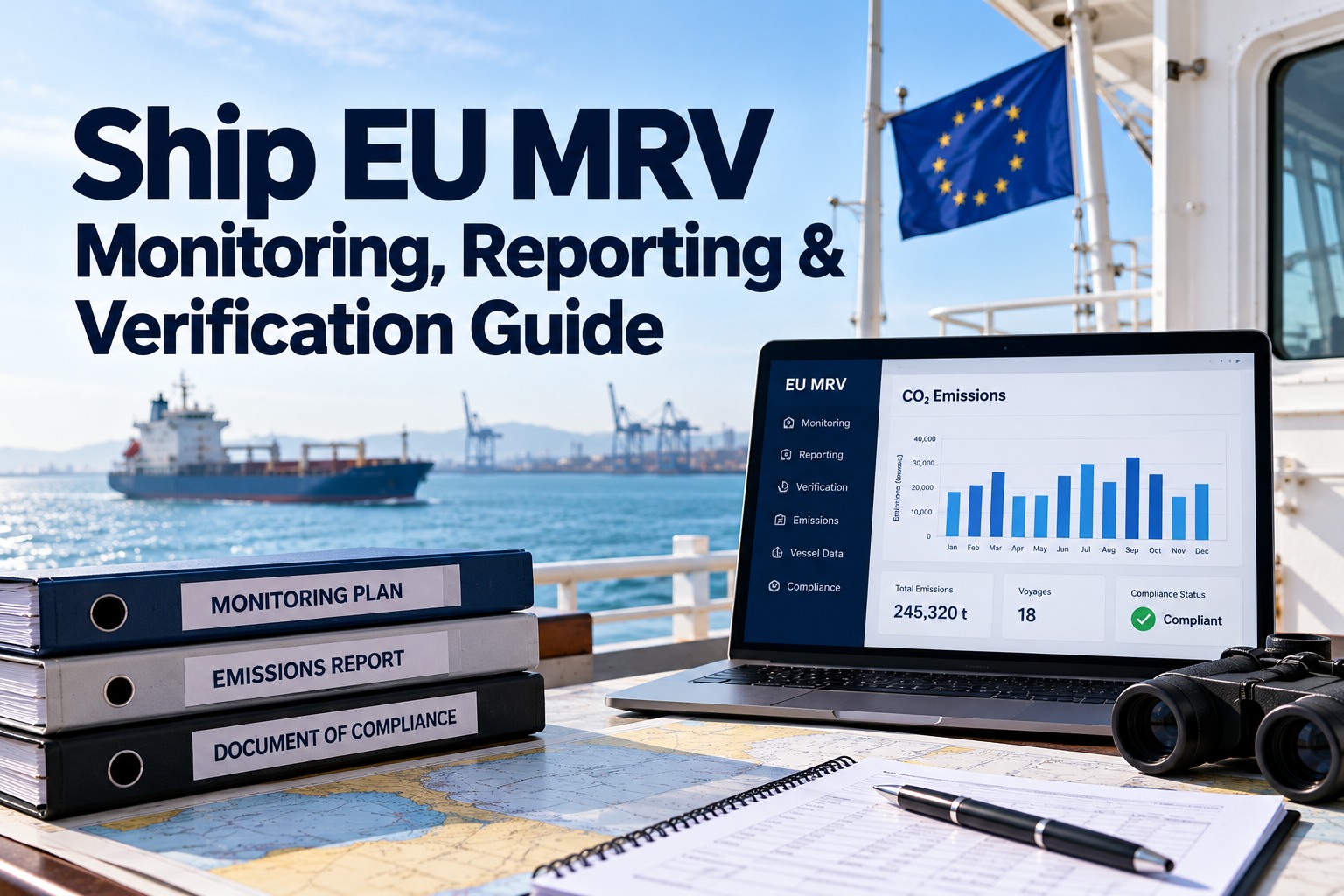
Every year a ship that calls at an EU or EEA port produces a fuel and emissions record, an independent verifier checks it, and by 31 March it must be with the authorities. That record, the MRV report, now also underpins the carbon price a company pays under EU ETS and sits beside the FuelEU Maritime reporting. What does a Technical Superintendent have to set up, who checks it and where do the dates fall? This guide covers the monitoring plan, the emissions report, the verifier's role, the Document of Compliance and the 2025 widening of scope, and points out where public sources disagree. For the carbon pricing side, see our EU ETS maritime compliance guide for shipping companies.
Who Must Report: Scope, Thresholds and Where the Sources Disagree
From 2018 CO2 reporting to 2025 general cargo and offshore ships
Regulation (EU) 2015/757 has required CO2 monitoring and reporting for large ships since 1 January 2018, according to Gard. Amendments to support EU ETS added methane and nitrous oxide from 1 January 2024 and extended scope to general cargo and offshore ships of 400 GT and above from 1 January 2025. Thommessen adds that offshore ships are in scope if designed or certified for offshore service, not by the work they currently do, and that the regulation applies regardless of flag or ownership. The table sets out the steps.
| When | What changed | Source |
|---|---|---|
| 1 January 2018 | CO2 monitoring and reporting for large ships under Regulation (EU) 2015/757 | Gard |
| 1 January 2024 | Ships of 5,000 GT and above carrying cargo or passengers commercially. Methane and nitrous oxide added to CO2 | Gard |
| 1 January 2025 | General cargo ships and offshore ships of 400 GT and above join. Offshore ships are those designed or certified for offshore service | Gard, Thommessen, DNV |
| 1 January 2025 onward | Companies within EU ETS scope also submit aggregated company-level emissions by 31 March | Gard, Thommessen |
| 17 July 2026, proposal only | A targeted revision to extend scope to more ship categories. Entry into force expected in 2028 or 2029. We saw this in one secondary summary only | Thommessen, unverified |
A threshold discrepancy to settle with your verifier
DNV's MRV page describes the regime as applying to ships of 400 GT and above on commercial cargo and passenger routes touching the EEA. Gard and Thommessen give 5,000 GT for cargo and passenger ships and 400 GT only for general cargo and offshore ships. The difference may reflect how each source summarises the 2025 change, but we could not resolve it from the pages we read. The Thommessen page also reports a July 2026 proposal to widen the scope. We saw it in only one secondary summary, so treat it as unverified.
The Annual Cycle: Plan, Monitor, Report, Verify, Carry the Document
The compliance year on one strip
The reporting period runs from 1 January to 31 December. The verified report is due by 31 March. The Document of Compliance goes on board by 30 June. The strip places those dates beside the ETS surrender date and the FuelEU dates quoted by Clyde & Co for the 2025 period, which helps a superintendent see where data work piles up in the first quarter.
The Monitoring Plan: What It Must Cover and Who Approves It
What changed in the plan from 2024
DNV states that since 2024 vessels must have updated monitoring plans that add an outline of the overall control system and CH4 and N2O emissions. Companies submit a plan for each relevant ship to the administering authority for approval, and an independent accredited verifier must assess it. Gard gives 1 April 2024 for the revised and verified plan and says new ships must submit within three months of their first EEA port call. The Irish EPA also says three months for ETS ships. Pennington Law says the plan goes to the verifier no later than two months after a first EU call, and Clyde & Co's FuelEU timeline also quotes two months for FuelEU. Because they differ, ask your verifier which applies to each ship.
Method, meters and the control system outline
The sources do not list technical monitoring methods in detail, so we do not reproduce them. What they do tell a superintendent is that the plan is a document the verifier and authority hold you to, so the method in the plan must be what the ship does. If a meter is replaced or a method changes, update the plan before the reporting period closes.
The Emissions Report: What Goes In and Who Receives It
Fuel, distance and cargo for voyages to, between and from EU ports
DNV says the emissions report covers fuel consumed, distance travelled and cargo carried on voyages to, between and from EU ports. The verified annual or partial report must reach the Commission, the administering authority and flag State authorities by 31 March of the following year. The company-level report has the same 31 March date and is verified after the ship reports. Gard says that from 2025, ships in EU ETS scope also need aggregated company-level data.
What the 2025 data shows about methane and scope
An ENGINE analysis of EMSA data, reported by Hellenic Shipping News, put 2025 reported emissions at 156 million tonnes CO2 equivalent, up 2.1%, with CO2 at 151 million tonnes and methane at 85,000 tonnes, up 30%. About 17,000 ships reported. The analysis says much of the increase came from newly in-scope vessels and that, excluding them, emissions would have fallen by up to 1.8%. It is a secondary analysis, so use it as context rather than a benchmark.
| Party | What it does | Evidence it should hold |
|---|---|---|
| Company | Submits monitoring plans, monitors fuel, distance and cargo, prepares the emissions report, and holds the Document of Compliance | Monitoring plan, fuel records, voyage records, verified report, DoC on board |
| Independent accredited verifier | Assesses the monitoring plan and verifies the emissions report. Gard notes most major classification societies are accredited | Verification opinion and approved plan |
| Administering authority | Approves plans for each relevant ship and receives verified reports. May ask for the verified report early, but not before 28 February (DNV) | Approval and submission record |
| European Commission, EMSA and flag State | Receive the verified report. THETIS-MRV holds the DoC | Published data and DoC record |
| Port State | After two or more consecutive failed reporting periods, an expulsion order may be issued. EEA-flagged ships may be detained (Gard) | Compliance history |
Verification and the Document of Compliance
The verifier's role and how to choose one
An independent accredited verifier assesses the plan and verifies the report. DNV says it is an accredited verifier and has verified MRV reports since 2018, which is a vendor statement. Gard recommends consulting the ship's classification society, since most major societies are accredited. Whoever you choose, agree the evidence list and the date before the end of the year so the first quarter does not become a rush.
Carrying the Document of Compliance
DNV and Thommessen say the Document of Compliance must be on board by 30 June, and DNV says it is available on THETIS-MRV. The pages we reviewed do not state a validity period, so check it against the regulation. Keep a clear link between the document on board and the reporting period it covers.
How MRV Data Feeds EU ETS and FuelEU Maritime
One operating record, three sets of dates
DNV states that MRV data is the foundation for the carbon cost under EU ETS, and that its reporting services cover EU MRV, IMO DCS and FuelEU Maritime. Clyde & Co's FuelEU timeline describes a separate per-vessel plan and its own dates, and does not describe a direct link to the MRV plan. That is why we advise reconciling the datasets instead of assuming they match. For FuelEU in detail, see our FuelEU Maritime guide to EU shipping emissions compliance in 2026.
| Regime | Core obligation | Date quoted in the sources |
|---|---|---|
| EU MRV | Monitor and report fuel, distance, cargo and emissions per voyage and year. Verified report | 31 March verified report. 30 June DoC on board |
| EU ETS | Surrender allowances for verified emissions. MRV data is the foundation of the carbon cost (DNV) | 30 September each year |
| FuelEU Maritime | Report energy use and compliance balance. A separate monitoring plan per vessel | 31 January report to verifier. 30 June penalty paid and DoC held (2025 period) |
EU MRV Readiness Checklist for the Technical Superintendent
A checklist with a checkpoint type on each item for fleet audits and desk reviews
Use the checklist in the autumn, before year-end data work starts. It is our template built from the sources above and not an official form.
| Item | What to check | Checkpoint type |
|---|---|---|
| Monitoring plan | Current plan approved, covering fuel, CO2, CH4 and N2O and the overall control system outline | Record |
| Method per fuel | Method for each fuel and each flow meter, tank sounding or bunker delivery note recorded | Record |
| Voyage records | Port calls, distance and cargo by voyage reconcile to the log and agent records | Record |
| Fuel quantity evidence | Bunker delivery notes, soundings and meter readings reconcile to consumption | Test |
| Meter condition | Flow meters and sensors listed in the plan are in place, calibrated and logged | Visual |
| Verifier contact | Verifier appointed and the verification schedule agreed before 31 March | Record |
| Document of Compliance | DoC carried on board and matches the reporting period by 30 June | Visual |
| Cross-regime check | MRV totals checked against the data used for ETS and FuelEU figures | Test |
| Named owner | One person per vessel owns the data with a deadline before the verifier's cut-off | Record |
Six Mistakes That Make the 31 March Deadline Harder
What the sources point to, in the order they usually surface
Systems That Keep MRV Evidence Together Across a Fleet
How a dated photo repository, task ownership and deadlines support MRV records
MRV is a yearly records exercise with a hard date and an outside checker. Marine Inspection supports a dated photo repository, observations turned into tasks with owners, deadlines and evidence, and certificate and equipment tracking. Dated photos of flow meters and sounding records, a task per vessel for each reconciliation with a named owner and a due date, and a tracked Document of Compliance give a superintendent a trail a verifier can follow. It does not replace the approved monitoring plan or the verifier. For fleet fuel data tools, see our best marine fuel management software for 2026.