For the first time, international law now governs what happens to a ship at the very end of its life, and the obligation reaches back across the whole of its operating career to get there. The Hong Kong International Convention for the Safe and Environmentally Sound Recycling of Ships entered into force on 26 June 2025, and with it every vessel of 500 gross tons and above on international voyages must build and maintain an Inventory of Hazardous Materials — a living document identifying the asbestos, heavy metals, hydrocarbons and other hazardous substances built into the ship's structure and equipment, along with their location and approximate quantities. This is not a one-off certificate to be obtained and filed; Part I of the inventory must be kept current throughout the operational life of the vessel, updated as materials are installed or removed, so that when the ship eventually reaches recycling, its hazards are fully known and it can be dismantled safely and without harm to workers or the environment. The convention places duties across the entire lifecycle and the entire chain — owners, flag states, port states and recycling facilities all carry a part — and it applies in practice even to ships flagged in states that have not ratified it, because no more favourable treatment is given. This guide sets out Hong Kong Convention compliance around the two phases that define it: the in-service obligation to hold and maintain the inventory, and the end-of-life obligation to recycle responsibly, together with the survey lifecycle, the responsibility chain and the deadlines that make this a live concern now. To keep the Inventory of Hazardous Materials and its supporting documentation maintained and current across your fleet, start a free trial or book a demo.
COMPLIANCE GUIDE · SHIP RECYCLING
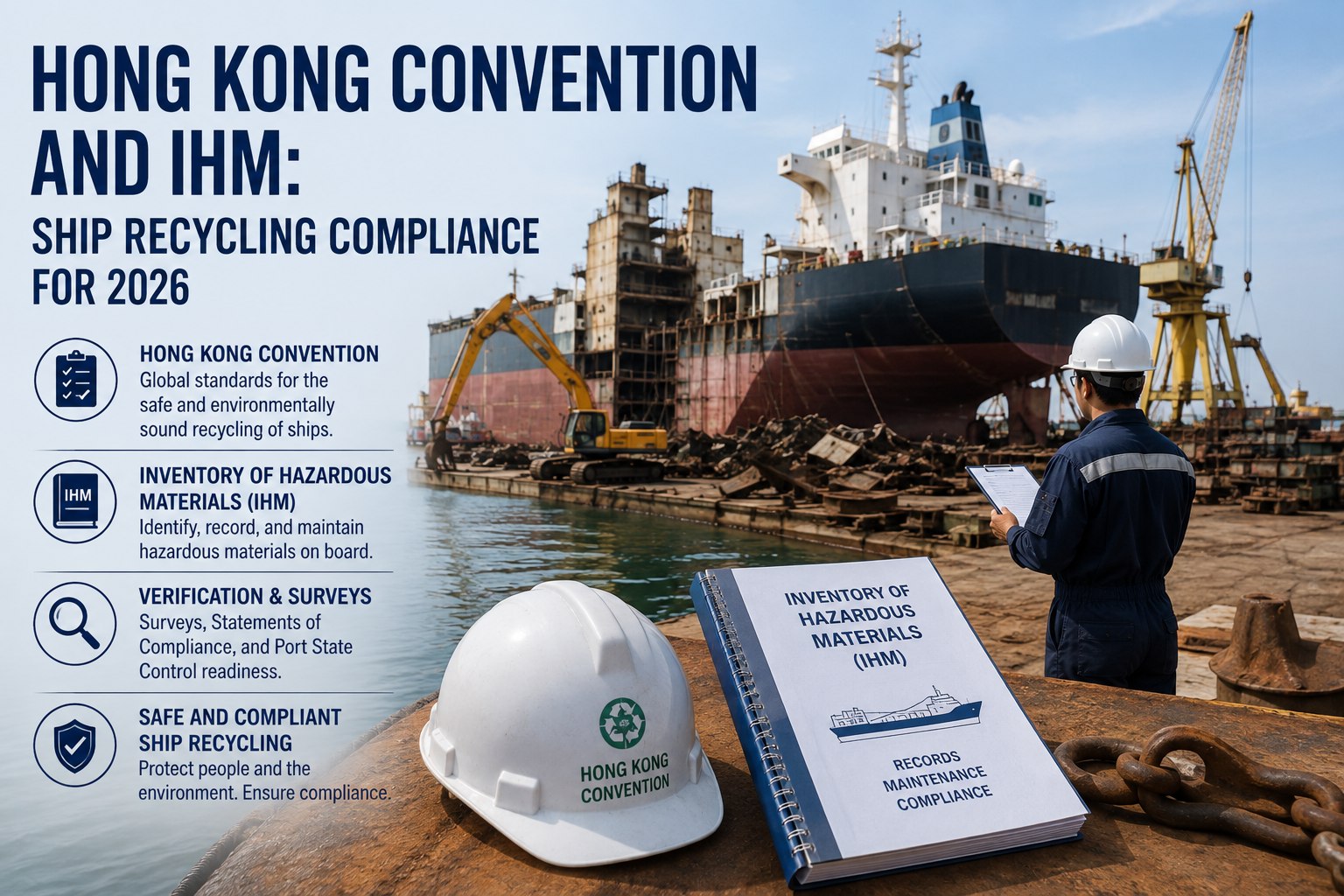
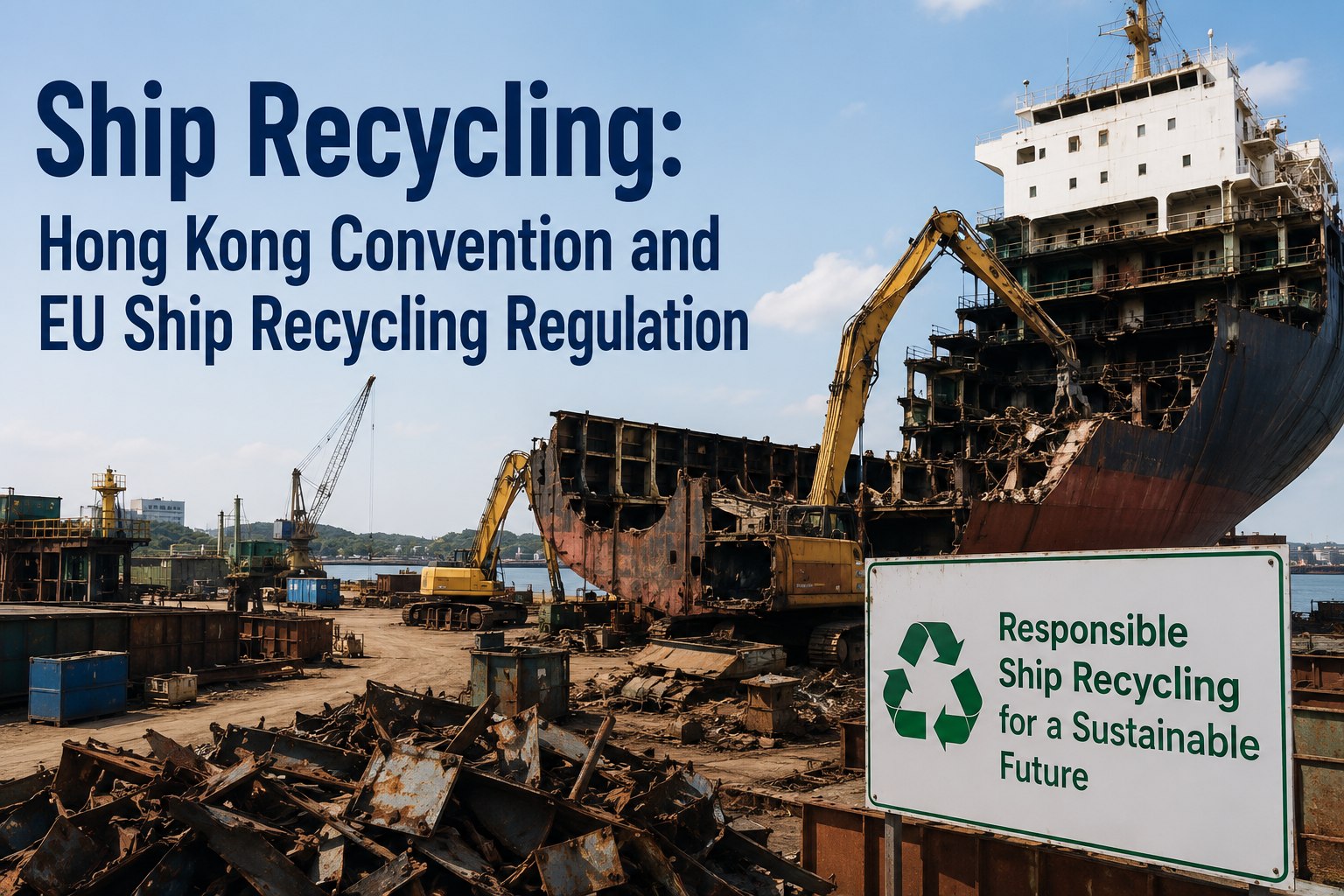
Hong Kong Convention and IHM: Ship Recycling Compliance for 2026
International law now governs ship recycling. Every vessel of 500 GT and above must build and maintain an Inventory of Hazardous Materials across its operational life, and recycle only at authorised facilities at the end of it. Here is what the convention requires, phase by phase.
One obligation, two phases
In service
Maintain IHM Part I and hold the certificate
End of life
Complete Parts II and III, recycle at an authorised yard
The Inventory of Hazardous Materials
At the heart of the convention sits a single document, the Inventory of Hazardous Materials, which identifies and quantifies the hazardous materials present in a ship's structure, equipment and systems. It is built in three parts, but those parts belong to different moments in the ship's life, which is the key to understanding what is required and when.
Part I
Materials in structure and equipment
Hazardous materials contained in the ship's structure and equipment — asbestos, heavy metals, hydrocarbons and others — with their location and approximate quantities. Prepared during construction for new ships or while in operation for existing ones, and, crucially, maintained continuously throughout the operational life of the vessel.
Required throughout service
Part II
Operationally generated wastes
The quantity of operationally generated hazardous wastes present on board. This part is completed only when the ship is to be sent for recycling, capturing what has accumulated through operation rather than what is built into the hull.
Completed before recycling
Part III
Stores
Ships' stores potentially containing hazardous materials that are present on board. Like Part II, it is prepared only at end of life, completing the full picture the recycling facility needs to dismantle the vessel safely.
Completed before recycling
The distinction matters enormously in practice. Part I is the operational obligation every in-service ship carries and must keep alive; Parts II and III are the end-of-life additions prepared only when recycling is imminent. An owner who treats Part I as a document to be created once and forgotten misses the point of the convention: the inventory is only useful, and only compliant, if it reflects the ship as it actually is at any given moment, which means updating it whenever hazardous materials are installed or removed. To keep Part I genuinely current as the vessel changes over the years, start a free trial or book a demo.
Phase One — The In-Service Obligation
Throughout its operating life, a ship in scope must hold the right certification and keep its inventory maintained. This is the obligation that applies to the working fleet today, and it is where compliance is either quietly kept up or quietly allowed to lapse.
Who is in scope
Ships of 500 gross tons and above engaged in international voyages, both existing ships and new builds.
Party-flag ships
Must carry an International Certificate on Inventory of Hazardous Materials, issued by the flag administration or a recognised organisation after verifying Part I.
Non-party-flag ships
Require a Statement of Compliance on Inventory of Hazardous Materials from their flag administration, because the convention's no-more-favourable-treatment principle means they are inspected in party ports too.
The continuous duty
Part I must be maintained and updated throughout operational life, recording new installations that contain hazardous materials and reflecting removals, so the inventory stays accurate.
i
The no-more-favourable-treatment principle
A ship flagged in a state that has not ratified the convention is not exempt in practice. Under the convention's no-more-favourable-treatment principle, such ships are liable to inspection when calling at ports within the jurisdiction of party states, and must carry a Statement of Compliance on their Inventory of Hazardous Materials. Beyond the regulatory position, charterers, insurers and financiers increasingly expect a verified inventory regardless of flag, and recycling through non-convention routes may not be acceptable to them. In practice, therefore, essentially all ships of 500 gross tons and above benefit from holding a verified inventory, whatever their flag — the convention's reach extends well past its formal parties.
Keep the inventory alive, not just issued
Part I is a continuous obligation, not a one-time certificate. Marine Inspection helps track the Inventory of Hazardous Materials, record new installations and removals as they happen, and keep certification current per vessel — so the inventory reflects the ship as it actually is at every survey.
Phase Two — The End-of-Life Obligation
When a ship reaches the end of its economic life, the convention imposes a second, distinct set of requirements that govern how it may be recycled. This is where the in-service inventory connects to the physical act of dismantling, and where the owner's due diligence is decisive.
Before delivery to a yard, the inventory must be completed with Parts II and III, capturing the operationally generated wastes and the ships' stores alongside the structural materials already recorded in Part I. A ship-specific Ship Recycling Plan must then be prepared by the chosen recycling facility in conjunction with the owner, based on that completed inventory, setting out how this particular vessel will be dismantled safely. The facility itself must be authorised: recycling may take place only at a yard holding a valid Document of Authorization to conduct Ship Recycling, which a competent authority issues following survey and which is valid for a maximum of five years. Finally, the ship undergoes a Final Survey verifying that the inventory is complete across all three parts, that the Ship Recycling Plan is present and correct, and that the nominated facility holds valid authorisation. On successful completion, the ship is issued an International Ready for Recycling Certificate, valid for a period not exceeding three months specifically to enable the final voyage to the yard. That certificate is the crucial link, tying the in-service inventory obligation to the end-of-life facility requirements and ensuring the owner has completed their recycling due diligence before the process begins. Selecting an authorised facility and exercising that due diligence is a direct responsibility the owner cannot delegate away. To have the maintained inventory ready to complete and hand over when a vessel reaches recycling, start a free trial or book a demo.
The Survey Lifecycle
Compliance is verified through a defined sequence of surveys that runs from a ship's first inventory verification to its last. Each has a distinct trigger and purpose.
Initial Survey
Verifies Part I of the inventory and leads to issuance of the International Certificate on Inventory of Hazardous Materials. For existing ships, carried out at or before the first renewal survey of other statutory certificates on or after entry into force.
Renewal Survey
Conducted at least every five years, re-verifying the inventory and renewing the certificate, with its term harmonised with the ship's other statutory certificates.
Additional Survey
Required where a substantial change to the ship takes place, ensuring the inventory is updated to reflect significant modifications to structure or equipment during service.
Final Survey
Carried out before recycling, verifying the complete inventory across Parts I, II and III, confirming the Ship Recycling Plan and the facility's authorisation, and leading to the International Ready for Recycling Certificate.
The Responsibility Chain
The convention deliberately spreads its duties across the whole lifecycle of a ship, so responsibility does not rest with any single party. Each link in the chain has a defined role.
Shipowner
Develops and continuously maintains the inventory, holds the certification, exercises due diligence in selecting an authorised recycling facility, and ensures the Ship Recycling Plan is prepared.
›
Flag state and RO
Verifies the inventory through survey, issues the International Certificate or Statement of Compliance, and conducts the Final Survey leading to the Ready for Recycling Certificate.
›
Recycling facility
Holds a valid Document of Authorization, prepares the ship-specific Ship Recycling Plan from the inventory, and dismantles the vessel safely and in an environmentally sound manner.
Why This Is a 2026 Concern
With the convention in force, the practical question for owners is one of timing, and the phase-in makes 2026 the period in which compliance has to be actively managed rather than deferred. Existing ships obtain their International Certificate or Statement of Compliance at the first renewal survey of their statutory certificates falling on or after entry into force, with full harmonisation of the inventory certificate with other statutory surveys required within the phase-in window that runs to 2030. That means every renewal survey a vessel undergoes now is a potential trigger point, and an owner who has not begun preparing the inventory risks arriving at a survey unready.
There is a commercial dimension too. The convention affects the end-of-life value and resale of older vessels, and it functions as a pressure valve for the fleet: as compliance costs rise and older ships become harder to trade or recycle outside the convention's framework, the economics of keeping an ageing vessel in service shift. A ship with a well-maintained inventory and clear compliance status is simply worth more, and easier to recycle responsibly, than one without. For owners, then, maintaining the inventory is not merely a regulatory box to tick but a way of protecting the residual value of the asset and avoiding a scramble at survey or at end of life. The ships that come through this transition smoothly are those whose inventories have been kept genuinely current all along, so that neither a renewal survey nor an eventual recycling decision presents a nasty surprise. To keep your fleet's inventories current, verifiable and ready for every survey and eventual recycling, start a free trial or book a demo.
Frequently Asked Questions
When did the Hong Kong Convention enter into force?
The Hong Kong International Convention for the Safe and Environmentally Sound Recycling of Ships entered into force on 26 June 2025, two years after it met its dual entry-into-force criteria: ratification by at least fifteen states representing at least forty per cent of world merchant shipping by gross tonnage, and a combined maximum annual ship-recycling volume of those states representing at least three per cent of world tonnage. With the convention now in force, its requirements apply to ships in operation and to recycling facilities, and the phase-in period for existing ships to obtain their inventory certification runs through to 2030. This makes the current period the time in which owners must actively manage compliance, since every statutory renewal survey is now a potential trigger for the inventory certificate.
What is the Inventory of Hazardous Materials?
The Inventory of Hazardous Materials, or IHM, is the core requirement of the convention: a document that identifies and quantifies the hazardous materials present in a ship's structure, equipment and systems, such as asbestos, heavy metals and hydrocarbons, with their location and approximate quantities. It has three parts. Part I covers materials in the ship's structure and equipment and must be maintained continuously throughout the vessel's operational life. Part II covers operationally generated wastes and Part III covers ships' stores, and both are completed only when the ship is to be sent for recycling. Part I is the ongoing obligation for every in-service ship, and it must be kept accurate by recording new installations of hazardous materials and reflecting removals, so it always represents the ship as it actually is.
Which ships must comply, and does flag matter?
The requirements apply to ships of 500 gross tons and above engaged in international voyages, covering both existing ships and new builds. Ships flying the flag of a state party to the convention must carry an International Certificate on Inventory of Hazardous Materials. Ships flagged in states that have not ratified the convention are not exempt in practice: under the no-more-favourable-treatment principle they are liable to inspection in the ports of party states and must carry a Statement of Compliance on their inventory. Beyond the regulation, charterers, insurers and financiers increasingly require a verified inventory regardless of flag, and recycling outside the convention's framework may be unacceptable to them. In practice, therefore, essentially all ships of 500 gross tons and above benefit from holding a verified inventory whatever their flag.
What is the International Ready for Recycling Certificate?
The International Ready for Recycling Certificate is issued to a ship destined for recycling after it passes a Final Survey, and it is valid for a period not exceeding three months, specifically to enable the ship's final voyage to the recycling yard. Before it can be issued, the inventory must be completed across all three parts, a ship-specific Ship Recycling Plan must have been prepared by the chosen facility based on that inventory, and the nominated facility must hold valid authorisation. The certificate is the crucial link that ties the in-service inventory obligation to the end-of-life facility requirements, ensuring the owner has completed their recycling due diligence before dismantling begins. It effectively confirms that the ship, the plan and the facility are all compliant and ready for the recycling to proceed safely.
Where can a ship legally be recycled under the convention?
Only at a ship recycling facility authorised in accordance with the convention. Such a facility must hold a valid Document of Authorization to conduct Ship Recycling, which a competent authority issues following a survey of the facility and which has a maximum validity of five years. The owner has a direct responsibility to exercise due diligence in selecting the facility, confirming that it holds valid authorisation, and this responsibility cannot be delegated away. The chosen facility also prepares the ship-specific Ship Recycling Plan in conjunction with the owner, based on the completed inventory, setting out how that particular vessel will be dismantled safely and in an environmentally sound manner. Recycling through a non-authorised facility does not meet the convention's requirements, which is why facility selection is a core part of compliant end-of-life management.
How does the convention affect the value of older ships?
The convention has a direct effect on the end-of-life value and resale of older vessels, and it acts as a pressure valve for the fleet. As compliance costs rise and older ships become harder to trade or to recycle outside the convention's framework, the economics of keeping an ageing vessel in service shift, and some older ships may exit the fleet sooner. A vessel with a well-maintained inventory and clear compliance status is worth more, and easier to recycle responsibly, than one without. For owners this means maintaining the inventory is not just a regulatory obligation but a way of protecting the residual value of the asset. Ships that come through the transition smoothly are those whose inventories have been kept current throughout, so that neither a renewal survey nor an eventual recycling decision brings an unwelcome surprise.
A Living Inventory, From First Survey to Last
The Hong Kong Convention makes the Inventory of Hazardous Materials a continuous obligation across a ship's whole life — and the owners who manage it well are those who keep it current all along, not those who scramble at survey or at recycling. Marine Inspection helps track and maintain the inventory, record installations and removals, and keep certification survey-ready across your fleet, protecting both compliance and the residual value of every vessel.