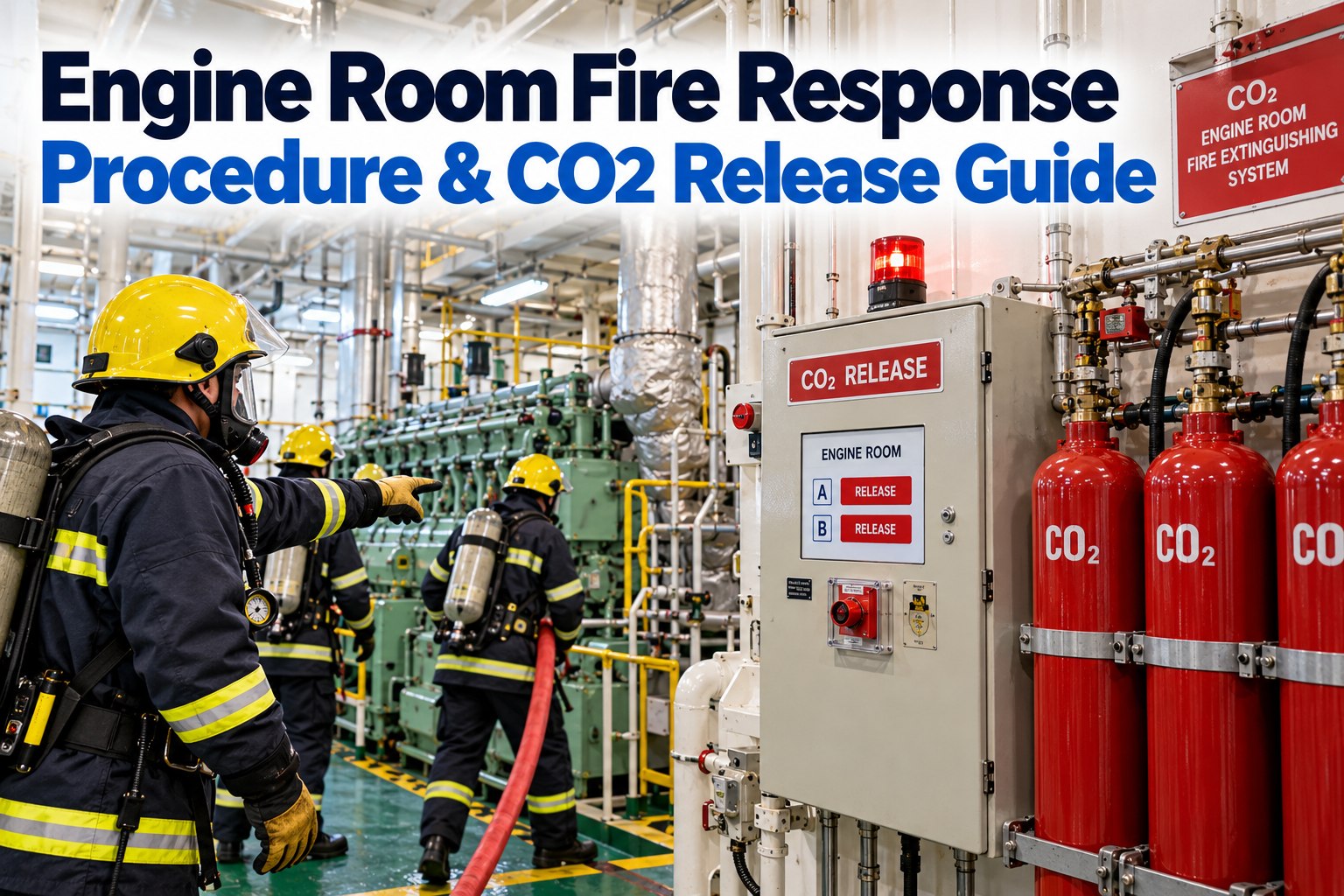
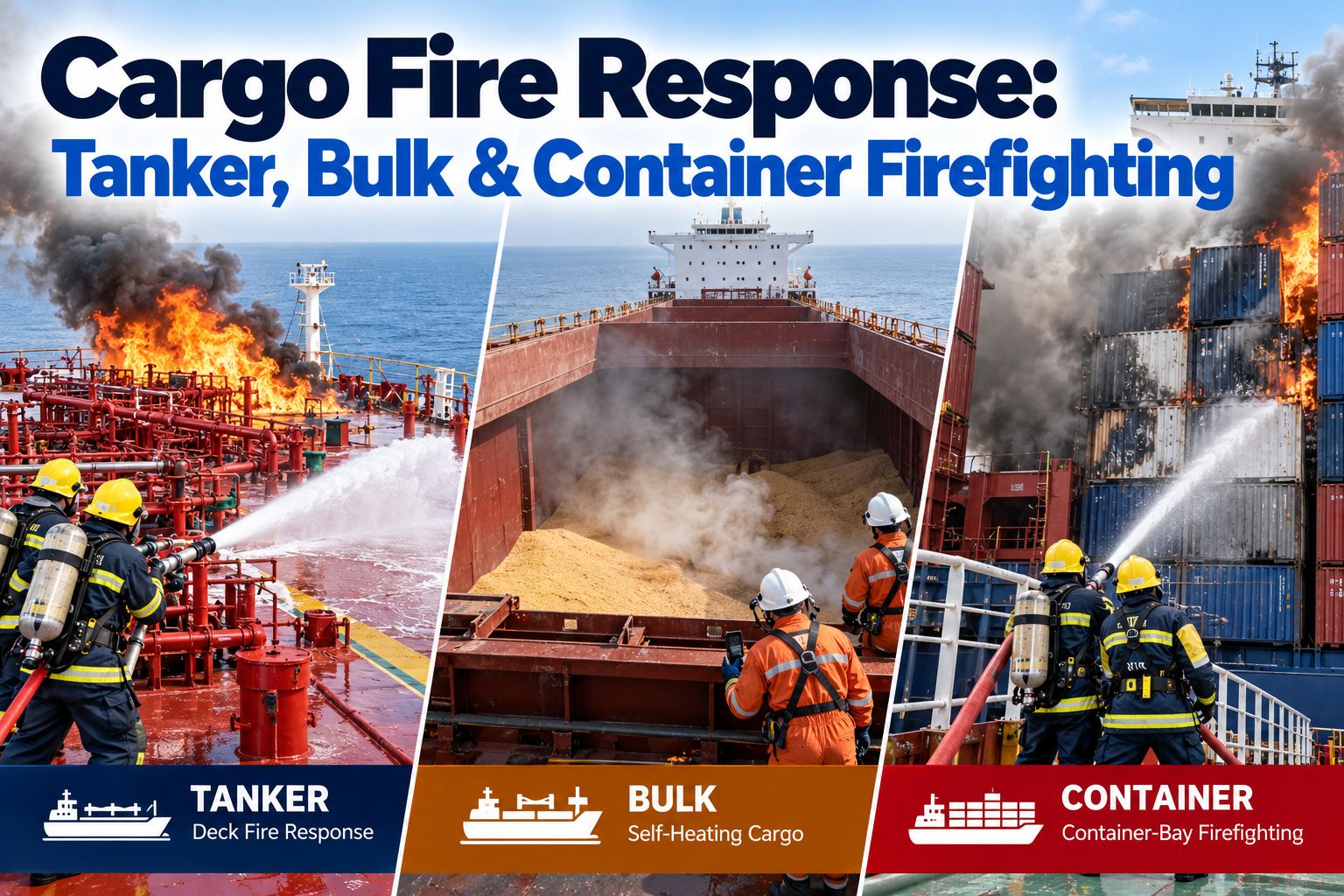
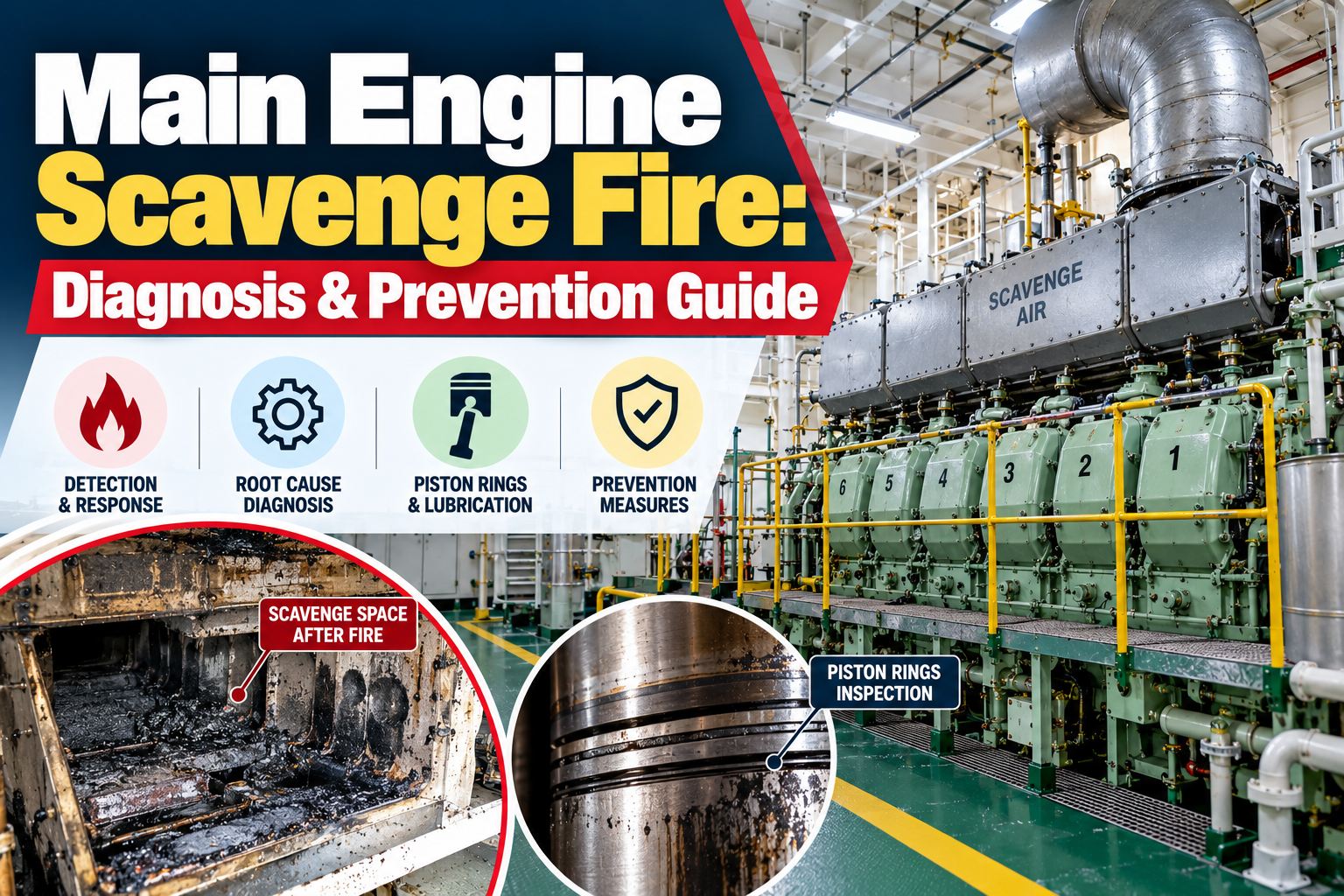
An engine room fire gives the crew very little time to do the right things in the right order. Isolate the fuel. Contain the space. Account for everyone. Then take one of the hardest decisions at sea: whether to flood the space with CO2. This guide, written for the Safety Officer, uses two published investigations, the FSS Code CO2 requirements and the IMO inspection guidelines to show what has gone wrong in real fires and how to train for it. For wider fire equipment and drill requirements, see our shipboard fire fighting equipment, procedures and SOLAS requirements guide.
Engine Room Fire: Contain It, Isolate It, Then Decide on CO2
The response sequence, the CO2 release decision gate and the lessons from real machinery-space fires, built for drills and inspections.
Free trial available. Or book a walkthrough built around your own fire drills and CO2 system.
Read this first. This guide supports training and planning. It does not replace the ship's fire control plan, safety management system procedures, the maker's CO2 system instructions, or the Master's decisions during a fire. Where a step below is our own outline, it says so.
85% in 2 min
Discharge rate in FSS text
The fixed piping must discharge 85% of the gas into a machinery space within 2 minutes (FSS Chapter 5, as amended by MSC.206(81)).
2 controls
Separate release controls
Two separate controls must be provided to release CO2 into a protected space, operating in sequence.
30 days
Monthly visual check
At least every 30 days under IMO MSC.1/Circ.1318/Rev.1.
Wait
Before re-entry
BMA lesson: entering too early after CO2 flooding can admit oxygen and reignite the fire.
The Response Sequence: What to Train From Alarm to Re-Entry
Why the order matters and where real fires have gone wrong
The TSB investigation into the Holiday Island fire and the BMA findings on the Pride of Hull show that engine room fires rarely fail at one point. Fuel keeps feeding the fire, openings let air in, a release does not do what the crew thinks, or the space is entered too early. The sequence below is our outline for drill discussion, built around those lessons. Your ship's fire control plan and SMS set the actual steps.
A Response Sequence to Discuss in Drills: From Alarm to Re-Entry (Our Outline, Not a Procedure)
1
Raise the alarm and report
Location, type of fire, people at risk.
2
Isolate the fuel and ignition sources
Remote fuel shut-offs, and power where the plan says so. Confirm they closed.
3
Contain the fire
Close openings, stop ventilation, cool boundaries as the plan directs.
4
Account for every person
Nobody in the space before any release.
5
Take the CO2 decision
By the person your SMS names, with the gate below satisfied.
6
Release and confirm
Confirm the gas actually discharged. Do not rely on feel.
7
Hold, monitor and re-enter late
Keep the space sealed. Decide re-entry on measured conditions.
Our outline built around the lessons below. The order and details on your ship come from your fire control plan, SMS and training. Boundary cooling is general firefighting practice and was not detailed in the sources we read.
The pre-release gate and why it is more than a checklist
Before CO2 goes into a machinery space, four things need to be true: everyone is out, the space is sealed, the fuel is isolated and the release has been done correctly. Each of those has failed in a published case. The gate below groups them. A ShipUniverse readiness list, which is a vendor tool and not a regulation, includes the same items. Your system's own instructions come first.
The Pre-Release Gate: What Must Be True Before CO2 Goes Into the Space (Drawn From the Sources, Our Grouping)
People
All personnel accounted for and out. CO2 is lethal to personnel.
Sealing
Ventilation stopped and dampers closed. In Holiday Island, air through open vents displaced CO2 and fed the fire.
Fuel
Fuel supply isolated. A fuel valve that did not fully close kept feeding the Holiday Island fire.
Release
Correct section identified, instructions followed and discharge confirmed, not assumed.
Sources: TSB investigation M22A0258 (Holiday Island) and a ShipUniverse readiness list, which is a vendor tool and not a regulation. Your system's own instructions come first.
Keep Fire Drills, CO2 Checks and Findings in One Record
Track CO2 system inspections, drill scenarios and corrective actions with dated photos and owners for every vessel.
Free trial available. Or book a walkthrough built around your own fire drills and CO2 system.
Two Real Machinery-Space Fires and What Each Teaches
Holiday Island: temporary repairs, a stuck fuel valve and a CO2 release that lost time
The TSB found that a fuel rail leak was dealt with for about a month using temporary repairs with non-standard materials and methods. When the last repair failed, fuel sprayed onto hot engine parts and ignited. A fuel valve that would not close fully let the day tank keep draining into the fire. The TSB also found that fire hose water likely spread the burning fuel, that the CO2 release was delayed because cable resistance gave a false sign of discharge, and that air through open vents displaced CO2.
Holiday Island, July 2022: What the TSB Found in an Engine Room Fire With a Delayed CO2 Release
ORIGIN
Temporary repairs on a fuel rail
A month of temporary repairs with non-standard materials and methods. The last one failed and fuel sprayed onto hot engine parts.
FUEL
A valve that would not close fully
A stuck, unlubricated part kept the day tank draining through the damaged rail.
WATER
Hose water spread the fire
The TSB says fire hose water likely spread the burning fuel and worsened the fire.
CO2
Release delayed by a false sign
Resistance on the release cable suggested the gas had gone. There was no direct feedback from the remote release, and the posted guidance was not explicit.
SEALING
Space not fully closed
Open vents let air in, displacing CO2 and feeding the fire. Replacement louvre dampers were the same less effective type.
Source: Transportation Safety Board of Canada, investigation M22A0258, findings summary (July 2025). The TSB also noted that temporary repairs should be assessed so they do not become normal practice.
Pride of Hull: water mist did not control it, CO2 did, and re-entry is a risk
The BMA attributed the Pride of Hull fire to mechanical failures in a thermal oil circulation pump. Water mist activated but did not control the fire, and the fixed CO2 system extinguished it. Among the lessons: frequent equipment failures point to a system weakness, suppression systems not on emergency power fail when mains power is lost, and re-entering a space after CO2 flooding is risky. This summary comes from a Nautilus news article about the BMA report. We did not read the full report.
Pride of Hull, October 2020: Water Mist Did Not Control It, CO2 Did (BMA Findings, From a Press Summary)
Fire near thermal oil circulation pumps after repeated pump failures
Power and propulsion lost soon after detection
Water mist activated but did not control the fire
Fixed CO2 system extinguished the fire
BMA lessons reported: frequent equipment failures point to a system weakness. Engineering changes need an impact assessment. Suppression systems not on emergency power fail when mains power is lost. Thermal imaging helps find the fire's seat. Re-entry after CO2 flooding is risky, because CO2 cools the seat only slightly and does not remove fuel.
Source: Nautilus Federation news summary of the Bahamas Maritime Authority report. We did not read the full BMA report.
The Fixed CO2 System: Requirements to Know and What to Verify
What the FSS Code text says about quantity, discharge rate, release and warning
IMO resolution MSC.206(81) amends FSS Chapter 5 on fixed gas fire-extinguishing systems. The text we read sets the quantity of CO2 by a percentage of the gross volume of the largest machinery space protected, including the casing, requires 85% of the gas to be dischargeable within 2 minutes and requires two separate release controls. It also requires an automatic audible and visual warning before release. The percentages differ by basis, and later amendments may have changed the text, so use the current consolidated FSS Code and your approved calculation.
What the FSS Chapter 5 text says for CO2 in machinery spaces (as read in IMO MSC.206(81); check the current consolidated FSS Code)| Topic | What the text says | What to verify on board | Checkpoint type |
|---|
| Quantity | Sufficient gas to give a minimum volume of free gas, set as a percentage of the gross volume of the largest machinery space, including the casing (35% or 40% depending on the basis in the text) | The approved calculation for your ship and the cylinder count match | Record |
| Discharge rate | The fixed piping is such that 85% of the gas can be discharged into the space within 2 minutes | Piping, nozzles and flow tests per the approved arrangement | Test |
| Release controls | Two separate controls provided to release CO2 into a protected space | Both controls located, labelled and operated in the correct sequence in drills | Visual |
| Warning | Automatic audible and visual warning of release, with a minimum time before release | Alarm and delay tested and audible in the space | Test |
| Space identification | Release instructions match the space protected | Box labels, plans and instructions agree | Visual |
Source: IMO resolution MSC.206(81) as read, with the quantity percentages left to your approved calculation. Check the current FSS Code and your class approval.
The inspection intervals in IMO MSC.1/Circ.1318/Rev.1 and what each one tests
The revised IMO guidelines set monthly, annual, biennial, five-yearly and ten-year inspections. Before any work, the safety plan should account for all personnel, and the first step should be measures to avoid accidental discharge, such as locking or removing the operating arms from directional valves. For how this fits into equipment inspection records, see our {L2}.
Maintenance and inspection intervals for fixed CO2 systems (IMO MSC.1/Circ.1318/Rev.1, summarised)| Interval | What it covers | Checkpoint type |
|---|
| Monthly (at least every 30 days) | General visual check: stop valves closed, release controls accessible, piping and cylinders intact, alarms undamaged | Visual |
| Annual | Enclosure integrity, cylinders and piping condition, nozzles not obstructed, doors closing and warning signs, release instructions clear | Visual |
| Every 2 years (passenger ships) or at surveys (cargo ships) | Weigh cylinders (refill below 90% of nominal charge), blow through piping, test release arrangements and the time delay | Test |
| At least every 5 years | Internal inspection of all control valves | Test |
| 10 years | Hydrostatic testing of at least 10% of cylinders, expanding if any fail, with all cylinders tested before their 20-year anniversary | Test |
Source: IMO MSC.1/Circ.1318/Rev.1 (25 May 2021), as reproduced in a Hong Kong Marine Department annex. Your flag and class may add requirements.
Drilling the Decision: Scenarios That Test More Than the Muster
Why a drill should include a failed first action and a missing person
The TSB says drills should reflect realistic scenarios and that muster lists should avoid assigning one crew member to duties in several simultaneous emergencies. A good machinery-space drill therefore adds a complication: the fuel valve does not close, the first release does not work, or a crew member is unaccounted for. It tests the decision as well as the movement. Our {L3} covers what inspectors look for in drill records.
The Engine Room Fire Readiness Checklist for the Safety Officer
A checklist with a checkpoint type on each item to use before drills and inspections
Use the table before each drill and before an inspection. It covers the plan, fuel isolation, ventilation, CO2 release, instructions, system records, drill content and temporary repairs.
Engine room fire readiness checklist, with a checkpoint type on every item (our suggested template)| Item | What to check | Checkpoint type |
|---|
| Fire control plan | Current, posted and matching the machinery space as it is today | Visual |
| Fuel isolation | Remote fuel shut-offs tested and confirmed closed on test | Test |
| Ventilation and dampers | Fans stop and dampers close from the remote position | Test |
| CO2 release | Both controls operated in drill and discharge confirmation understood | Test |
| Release instructions | Clear, posted and specific to the space, with unambiguous feedback described | Visual |
| CO2 system records | Monthly, annual and biennial checks recorded to MSC.1/Circ.1318/Rev.1 | Record |
| Drills | Scenarios include a CO2 decision, a missing person and a failed first action | Record |
| Temporary repairs | Any temporary repair on fuel or high-risk systems assessed, time-limited and recorded | Record |
Our suggested template. Checkpoint types: Visual, Test and Record.
Mistakes That Turned Engine Room Fires Into Bigger Emergencies
Six patterns from the published cases
1
Trusting the feel of the release cable
In Holiday Island, cable resistance gave a false sign that the gas had gone. Describe what confirms discharge and train it.
2
Releasing into a leaky space
Open vents displaced CO2 and fed the fire in Holiday Island. Close and verify before release.
3
Fuel not truly isolated
A valve that did not fully close kept the fire fed. Test remote closure and confirm it.
4
Re-entering too early
The BMA warns that entering too early after CO2 flooding can admit oxygen and reignite the fire.
5
Normalising temporary repairs
The TSB says temporary repairs should be assessed so they do not become normal practice.
6
Systems that fail with the power
The BMA notes suppression systems not connected to emergency power fail when mains power is lost.
Systems That Keep Fire Safety Evidence, Drills and Corrections Together
How a dated photo repository, task ownership and deadlines support fire readiness
Fire readiness is mostly a record of small checks. Marine Inspection supports a dated photo repository, observations turned into tasks with owners, deadlines and evidence, and certificate and equipment tracking. A dated photo of a labelled release box, a task for each failed damper test with a named owner, and a tracked CO2 inspection record give a Safety Officer evidence to bring to a drill review or an audit. It does not replace the fire control plan, your SMS or training.
Frequently Asked Questions About Engine Room Fire Response and CO2 Release
What does the FSS Code say about CO2 discharge time in machinery spaces?
The FSS Chapter 5 text we read, as amended by MSC.206(81), says the fixed piping must be such that 85% of the gas can be discharged into the space within 2 minutes. Check the current consolidated FSS Code and your approved system.
How many controls release the CO2?
The same text requires two separate controls for releasing CO2 into a protected space, operating in sequence.
How often must a fixed CO2 system be inspected?
Under IMO MSC.1/Circ.1318/Rev.1, monthly checks at least every 30 days, annual, biennial, five-yearly and ten-year inspections, each with its own scope.
What went wrong with CO2 release on Holiday Island?
The TSB found the release was delayed because resistance on the cable gave a false sign that gas had been released, there was no unambiguous feedback from the remote release, and the posted guidance was not explicit. Open vents also let air in.
Is it safe to re-enter after CO2 flooding?
The BMA report on the Pride of Hull fire says re-entry is risky, because CO2 cools the seat of the fire only slightly and does not remove fuel, so entering too early can admit oxygen and reignite it. Follow your procedure and measured conditions.
Does boundary cooling replace the CO2 release?
We found no source in this research that sets the order or priority between boundary cooling and CO2 release. Follow your fire control plan and SMS, and train the decision in drills.
Who decides to release CO2?
Your safety management system names the person. We did not find a source that sets this universally, so check your own procedure and make sure everyone knows it.
Make the Next Engine Room Drill Harder Than the Last
CO2 system checks, drill scenarios, findings and corrective actions for every vessel, in one record your Safety Officers and superintendents can open.
Free trial available. Or book a walkthrough built around your own fire drills and CO2 system.