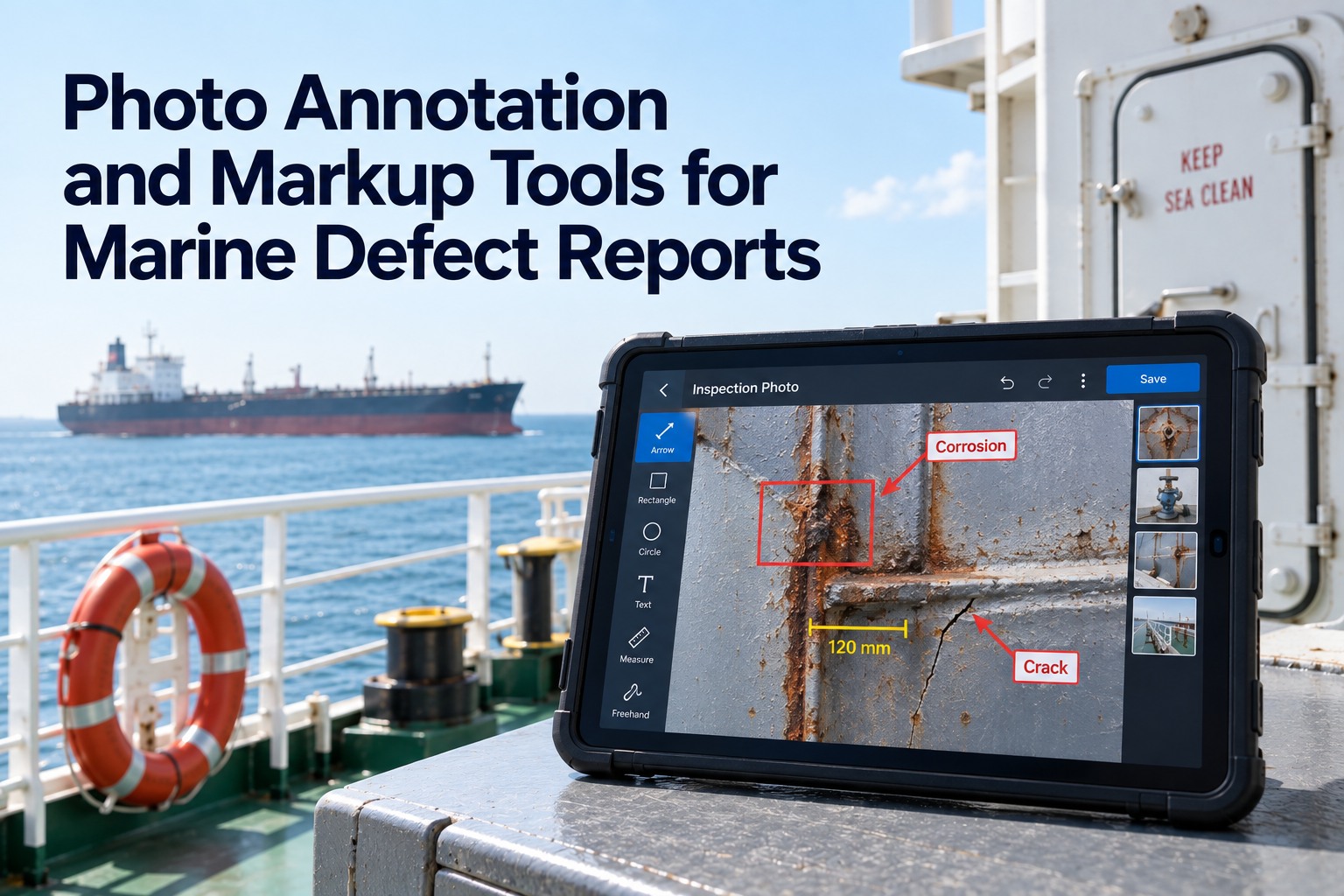
By 2026, "AI defect detection" has become a label stuck on almost every marine inspection product, and the real capability behind it varies enormously. Some tools genuinely localise a hairline crack in a weld and rate their own confidence; others are a digital form with a clever name. For anyone evaluating these tools for hull, structure or machinery inspection, the useful question is not "does it have AI" but "what can its computer vision actually do, on which defects, and how does the finding become action." This guide is built to answer that. Rather than rank a handful of named products that will look different in six months, it compares the capabilities that separate genuine defect detection from marketing — organised around the three defects that matter most in marine inspection: corrosion, cracks, and coating breakdown. Each behaves completely differently to a camera and a neural network, which is why a tool strong on one can be weak on another, and why understanding the underlying vision tasks is the key to a good buying decision. The regulatory ground has shifted to meet the technology: classification societies approved remote inspection techniques years ago, and by 2026 the gap between AI-equipped fleets and the rest is becoming decisive. This guide covers how the three defect types differ, the three computer-vision tasks behind detection, the accuracy you can realistically expect, the class and ecosystem landscape, and the criteria to bring to every demo. Start free trial or book a demo to see defect detection run on your own inspection images.
AI & SMART FEATURES · DEFECT DETECTION · 2026
Top AI Defect Detection Capabilities for Vessels in 2026
"AI" is now on every inspection product — but corrosion, cracks and coating breakdown each defeat the camera in a different way, and a tool strong on one can be blind to another. This is the capability comparison that separates genuine computer vision from a clever label.
Corrosion
Cracks
Coating breakdown
Deformation & fouling
Why the Defect Type Decides Everything
The single most important thing to understand before evaluating any tool is that these defects do not look alike to a neural network. AI vision is a category of techniques, not one capability, and matching the technique to the defect is the difference between a system that works and one that floods a surveyor with false alarms.
Large-area but visually subtle — corrosion often blends with the surrounding metal, spreading across a surface with vague, gradual boundaries rather than a sharp edge.
Best handled by Segmentation, which maps the exact extent pixel by pixel, because the value is in measuring how much of a surface is affected, not just whether corrosion is present.
The hard part Vague corrosion boundaries and variable lighting; salt exposure and reflective steel make consistent detection genuinely difficult.
Maturity The most developed of the three — research systems report pixel-wise segmentation accuracy well into the high nineties against standardised corrosion scales, though rating the type or severity of corrosion is harder than detecting it.
Sharp-edged and high-contrast but often microscopic — a crack is easy to see once found, but a hairline fracture in a weld can be a few pixels wide in an image of a vast structure.
Best handled by Detection with bounding boxes, and segmentation masks for sizing, because location and length matter — a crack's significance depends on where it is and how far it runs.
The hard part Scale. The crack is high-contrast but tiny, so image resolution and how close the capture got to the surface dominate whether it is found at all.
Maturity Strong on clear surface-breaking cracks in good imagery; the critical structural cracks are often in welds, where dedicated non-destructive methods still complement visual AI.
DEFECT 03
Coating breakdown
A condition to be graded, not a binary to be found — coating is assessed as GOOD, FAIR or POOR by how much of the protective surface has failed, which is the precursor to corrosion.
Best handled by Segmentation feeding a rating, assessing condition directly in proportion to the number of affected pixels, so a percentage becomes a GOOD/FAIR/POOR grade.
The hard part The line between failing coating and early corrosion is a continuum, and consistent grading across lighting and surface types is what separates a useful tool from a noisy one.
Maturity Advancing quickly, driven by class research into automated ballast-tank coating assessment as a decision-support tool for surveyors.
i
This is the buying insight most demos won't volunteer. A tool trained hard on corrosion segmentation may barely detect cracks, and a crack detector may have no concept of coating grade. Because the three defects need different vision tasks, a single accuracy figure quoted for "defect detection" is close to meaningless — it hides which defects the number applies to. The right question in a demo is specific: show me corrosion segmentation on a ballast-tank photo, crack detection on a weld, and coating grading on a hull section, each with its own confidence. A vendor who can only demonstrate one has one capability, whatever the label says.
The Three Vision Tasks Behind Every Tool
Underneath the marketing, defect detection resolves into three distinct computer-vision tasks. Most serious deployments use all three, choosing per defect and per asset. Knowing them lets you read past the brochure.
01
Classification — is a defect present?
Returns a single label for the whole image: "crack present" or "no defect." It is the fastest to run and simplest to deploy, and it is right for go/no-go screening of individual parts — but it tells you nothing about where the defect is or how large. A tool that only classifies cannot localise.
02
Detection — where is it, and how confident?
Draws a bounding box around every defect found, with a class label and a confidence score — for example, "crack at these coordinates, 96% confidence." This is the workhorse for locating multiple defects across a structure and the minimum bar for a tool that claims to find and flag defects for review rather than just detect their presence.
03
Segmentation — what is its exact shape and extent?
Maps the defect at the pixel level, tracing the precise outline rather than a box. This is what lets a tool measure how much of a surface is corroded or grade coating breakdown by area. It is the most demanding task and the one that turns detection into measurement — essential for corrosion and coating, valuable for sizing cracks.
The confidence score is not a detail — it is the whole safety model. Every credible tool attaches a confidence percentage and localises the finding, so a surveyor reviews the model's reasoning rather than trusting a verdict. The right posture, as the industry consensus now puts it, is that the AI should act like an inspection assistant that highlights exceptions, not a final authority that replaces survey judgment. Detected anomalies are typically classified by type and scored on a severity scale, with high-confidence findings flowing forward and borderline ones routed to a human. A tool that outputs a bare "defect found" with no confidence and no location is not ready for a class-facing workflow.
Test the capability, not the claim
Run Your Own Corrosion, Crack and Coating Images
The only honest test is your own imagery. Load a ballast-tank corrosion photo, a weld crack, and a hull coating section, and see whether the tool segments, localises and grades each one with a confidence you can review. Book a demo and bring your hardest images.
What Accuracy to Expect in 2026
Accuracy claims need reading carefully, because the honest numbers depend heavily on the defect, the image quality, and whether the task is detection or fine-grained classification.
Corrosion and crack detection
On good-quality images, modern models detect surface corrosion and cracks at around 94% accuracy — reported as matching or exceeding a trained inspector, at many times the speed and without fatigue. That figure is for detecting the defect, on clean imagery.
Pixel-level segmentation
Segmentation of corrosion extent can exceed 99% pixel-wise accuracy against standardised scales such as ASTM D610 in research settings — but classifying the type of corrosion is far harder, with type-classification accuracy dropping to roughly three-quarters.
Detection versus grading
A recurring pattern across the field: finding a defect is easier than rating it. Expect strong detection numbers and more modest severity- or type-classification numbers, and be sceptical of any tool that blurs the two.
Image quality dominates
Every number assumes decent imagery. Poor light, distance, motion blur and reflective wet steel all degrade accuracy, which is why capture method and lighting matter as much as the model.
i
Treat headline accuracy as a starting point, not a guarantee. A number produced on a clean research dataset is not what you will see on a phone photo taken in a dim ballast tank. The serious way to evaluate is to validate a tool against your own image population — your vessels, your capture method, your typical conditions — before trusting it in a workflow. The best vendors expect this and support it; the ones quoting a single impressive figure for everything are the ones to probe hardest.
The Class and Ecosystem Landscape
Defect-detection AI does not exist in a vacuum — it is being shaped by classification societies, established inspection firms and well-funded startups, and the regulatory acceptance is already substantial.
Remote inspection is approved
Class acceptance of remote inspection techniques — drones, climbers and ROVs — for close-up surveys dates back to January 2019, and in May 2025 Bureau Veritas issued Guidance Note NI693 defining exactly how these techniques can substitute for physical surveyor access. The regulatory path is established, not experimental.
Class societies are building it
DNV's corrosion-AI research combines image-based tools with fine-tuned deep learning to predict corrosion and coating breakdown and assess GOOD/FAIR/POOR levels by pixel proportion, hosted on its data platform, with drone-based hull survey projects run alongside industry partners. ABS partnered with major cloud and services firms to develop image recognition detecting corrosion and coating breakdown.
Startups are well funded
Purpose-built entrants have raised real money — a Berlin startup deploying an AI agent that analyses crew-uploaded inspection photos for corrosion and structural defects raised several million in Series A, and a multi-million AI-ROV project brings together a robotics maker, an AI firm, a class society and defence partners to analyse sonar and video for structural defects, corrosion and biofouling.
The direction is predictive
The stated trajectory across class research is to move from periodical inspection toward predictive inspection — tracking corrosion evolution over a vessel's lifetime to support data-driven maintenance and coating decisions, not just detect defects at a point in time.
The practical takeaway from the landscape is that defect detection is no longer a question of whether the technology is credible — class societies are developing it themselves and have written the rules for its use. The differentiation among tools has moved to how well the detection is integrated into a workflow, which is where the next section focuses.
The Criteria That Actually Separate Tools
With the technology proven, the consistent 2026 lesson is that AI is only as useful as its integration. A standalone detector finds corrosion; a platform links the finding to a risk score, a maintenance job and a tamper-proof record. Bring these questions to every demo.
Genuine localisation and confidence
Does it draw bounding boxes or segmentation masks and rate confidence for human review — or just output a label? Real computer vision localises and scores; a digital form does not.
The right task per defect
Does it segment corrosion and coating by area, and detect and size cracks by location? A tool using one task for every defect is optimised for none of them.
Detection becomes a work order
Does a defect above a severity threshold auto-generate a maintenance job with the annotated image, classification, location and recommended action — or does someone re-enter it by hand?
Onboard, offline processing
Does detection run onboard rather than depending on the cloud, so it works in real time in remote areas with no connectivity? Ships are not always connected.
Evidence tied to location
Is each finding linked to a hull zone, timestamp and vessel side, so it packages into class-ready evidence and can be compared against the last inspection? Loose footage is far less useful.
Fleet-level trending
Does it trend findings across the fleet over time, turning thousands of inspections into analytics that flag a developing problem — the basis of the shift toward predictive inspection?
Assistant, not authority
Is it positioned as a surveyor's assistant that highlights exceptions for human judgment, with review built into the workflow — rather than an automated verdict? The former is the defensible model.
Validated on your images
Will the vendor validate accuracy against your own document and image population before production, rather than quoting a headline number from a research dataset? The willingness to be tested is itself a signal.
The thread through this whole comparison is that the winning tool in 2026 is not the one with the highest single accuracy figure on a slide — it is the one whose computer vision is genuinely matched to each defect, whose findings are localised and confidence-rated for a surveyor to review, and whose detections flow into a risk score, a work order and a tamper-proof record that a class surveyor will accept. Corrosion, cracks and coating breakdown are three different problems in the eyes of a neural network, and the tools that treat them as one are the ones to be wary of. Evaluate the capability against your own images, insist on localisation and confidence, and weigh integration as heavily as raw detection — because a defect found and forgotten changes nothing, while a defect found, scored, scheduled and recorded is where the reported gains in fewer violations and faster inspections actually come from. Book a demo to see corrosion, crack and coating detection on your own inspection images.
Frequently Asked Questions
What defects can AI vision detect on a vessel?
Computer-vision models flag corrosion, cracks, coating breakdown and deformation from inspection photos, and analyse underwater imagery from divers, drones or ROVs for fouling and hull damage. The three highest-value targets are corrosion, cracks and coating breakdown — each of which behaves differently to a camera, which is why a tool's capability should be assessed per defect rather than as a single "defect detection" claim.
Book a demo.
Why does the type of defect matter when choosing a tool?
Because the three main defects need different computer-vision tasks. Corrosion is large-area but visually subtle and is best handled by segmentation that maps its extent; cracks are sharp-edged but often microscopic and need detection with bounding boxes plus sizing; coating breakdown is a condition graded GOOD, FAIR or POOR by affected area. A tool strong on one can be weak on another, so a single accuracy figure for "defect detection" hides which defect it applies to.
Book a demo.
What are the three computer-vision tasks in defect detection?
Classification returns one label per image, such as "crack present" — fast, but with no location. Detection draws bounding boxes around every defect with a confidence score, locating multiple defects across a structure. Segmentation maps a defect at the pixel level, measuring exact shape and extent, which is what allows corrosion area and coating grade to be quantified. Most serious deployments use all three, matched to the defect and asset.
Book a demo.
How accurate is AI defect detection in 2026?
On good-quality images, modern models detect surface corrosion and cracks at around 94% accuracy, reported as matching or exceeding a trained inspector at far greater speed. Pixel-level corrosion segmentation can exceed 99% against standardised scales in research settings, though classifying the type of corrosion is much harder, around three-quarters. Finding a defect is consistently easier than rating it, and every figure assumes decent imagery — so validation against your own images is essential.
Book a demo.
Does AI replace the class surveyor?
No. The established model is shared autonomy: human planning and review, robotic or crew capture, AI-assisted detection, and class-ready evidence packaging. The AI should act as an inspection assistant that highlights exceptions, not a final authority that replaces survey judgment — which is why credible tools attach confidence scores and route findings for human review. Classification societies have approved remote inspection techniques and are building the AI themselves, within this assistant model.
Book a demo.
Is AI hull inspection accepted by classification societies?
Yes. Class acceptance of remote inspection techniques — drones, climbers and ROVs — for close-up surveys dates to January 2019, and in May 2025 Bureau Veritas issued Guidance Note NI693 defining how they can substitute for physical surveyor access. Societies including DNV and ABS are actively developing corrosion and coating detection AI, so the regulatory path is established rather than experimental.
Book a demo.
What separates a genuine tool from a marketing label?
Genuine computer vision localises defects with bounding boxes or segmentation masks and rates confidence for human review, uses the right task per defect, and turns a detection above threshold into a work order with the annotated image and location. It runs onboard for offline areas, ties evidence to hull zone and timestamp, trends findings across the fleet, and is validated against your own images. A tool that outputs a bare label with no location or confidence is a digital form with a clever name.
Book a demo.
Does detection need to run onboard, or is the cloud fine?
Onboard processing matters because ships operate in remote areas without reliable connectivity. Running detection on the vessel rather than relying on the cloud means analysis happens in real time during the inspection, even at sea with no signal. A cloud-only tool that stalls when the connection drops is a poor fit for the environment marine inspection actually happens in.
Book a demo.
Match the Vision to the Defect. Then Weigh the Integration.
Marine Inspection's computer vision detects and localises corrosion, cracks, coating breakdown and deformation from inspection photos with bounding boxes and confidence scores for review, analyses underwater imagery for fouling and damage, runs onboard so it works offline at sea, and turns findings into work orders trended across the fleet — the assistant model class surveyors accept. Test it against your own hardest images and see the capability behind the label.