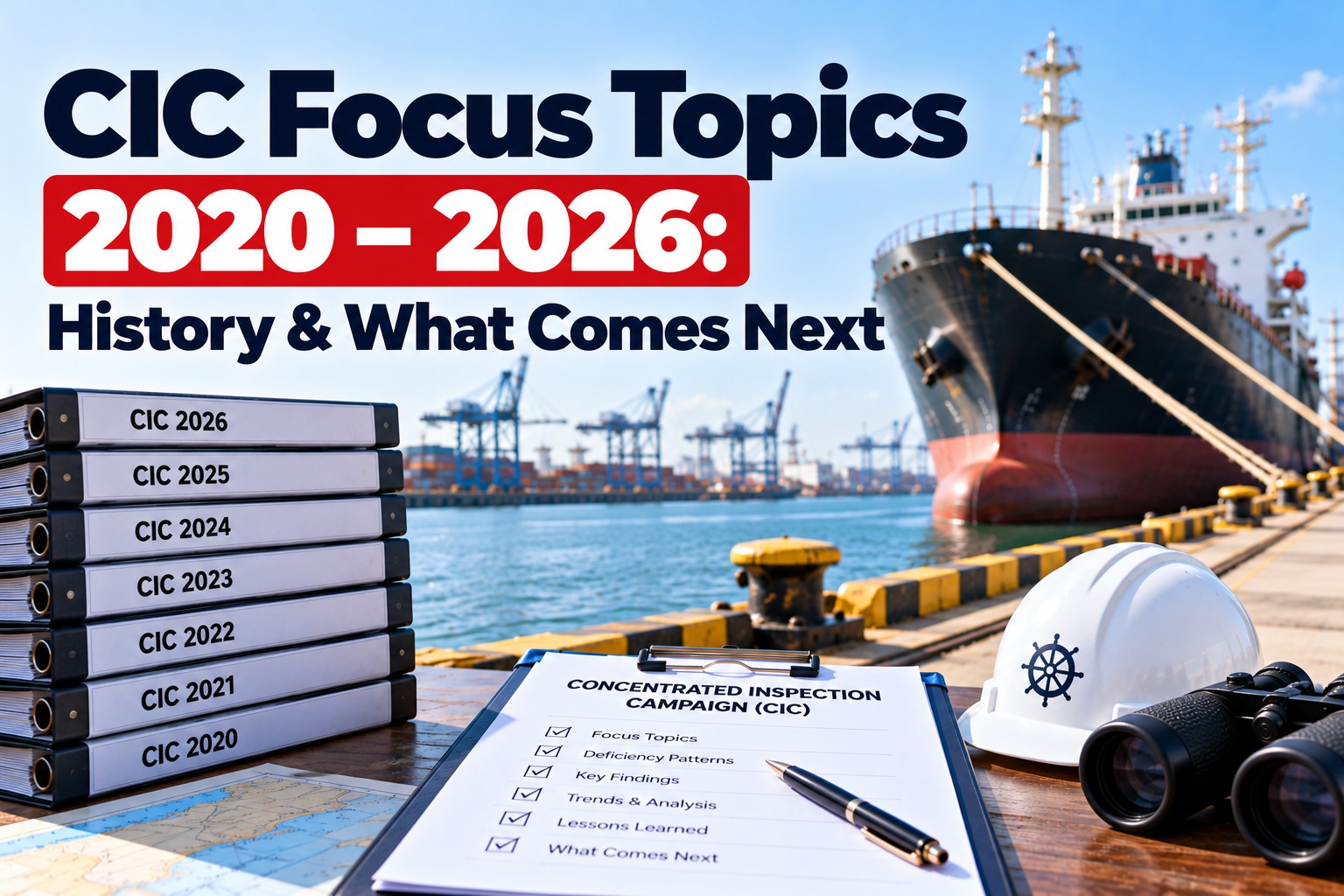
Seven campaigns have run since 2019 and no two of them behaved the same way. One produced twelve detentions across four thousand ships. One was declared satisfactory and was followed within eight months by an unannounced second campaign that found the same equipment in worse condition. The useful question is not which topic came up in which year — it is what each questionnaire actually found when it was answered honestly, because that is the only part of the record that tells you where the next one will bite.
The campaign that was called satisfactory, and what happened eight months later
Why two campaigns on the same ship feel completely different
A campaign is a questionnaire that rides along with an ordinary inspection for three months, and the way it behaves depends almost entirely on what kind of thing it asks about. Topics fall into two families, and the published results separate cleanly along that line.
Documentary topics
Mechanical topics
Knowing which family a topic belongs to is worth more than knowing the topic itself, because it tells a technical department whether to brief the crew or to budget for parts. For 2026 the answer is unambiguous, which is covered further down.
The campaigns and what each one found
Figures below are as published by the authority named in each row. Campaign results are reported differently by different regimes, so the rows are not a league a vessel can be ranked in — they show what each questionnaire exposed.
| Year | Topic | Published outcome | What the questionnaire exposed |
|---|---|---|---|
| 2019 | Emergency systems and procedures | Joint Paris and Tokyo campaign | Emergency arrangements as operated rather than as fitted |
| 2020 | No campaign | Deferred | The only gap year in the modern sequence |
| 2021 | Stability in general | 3,995 questionnaires, 12 detentions from the topic (0.30%), 200 findings — Paris MoU | Draught and displacement cross-checks (5.4% negative) and periodic verification of the stability instrument (4.8%) |
| 2022 | STCW | 4,112 questionnaires of 4,179 inspections, 571 findings — Paris MoU | Findings nearly tripled against 2021 on a topic widely assumed to be documentary |
| 2023 | Fire safety | 3,856 questionnaires, compliance judged satisfactory — Paris MoU | Fire doors 9.3% negative and fire drill performance 9.2%, which triggered a follow-up campaign in 2024 |
| 2024 | Crew wages and employment agreements | 3,863 questionnaires, 30 detentions (0.78%), average compliance 98.7% — Paris MoU | Agreements missing required elements (2.8% negative) and access to employment information (2.7%) |
| 2025 | Ballast water management | 624 questionnaires, 16 detentions from the topic (2.56%), 9.46% of questionnaires carrying a negative answer — Black Sea MoU | Treatment plant condition, record book completion and crew familiarity accounted for 89.3% of all non-compliance |
| 2026 | Cargo securing | 1 September to 30 November 2026, Paris and Tokyo with most other regimes joining | Documentation and planning, securing practice, and the condition of the securing equipment itself |
2021, stability: the quiet campaign that was not about stability
Twelve detentions out of 3,995 questionnaires is as close to a non-event as a campaign gets. The content of the failures is the part worth keeping. The two weakest questions were whether there was evidence on board that the calculated displacement and trim agreed with the observed draughts, and whether the accuracy of the stability instrument was verified periodically against an approved test condition.
Neither is a stability question in the engineering sense. Both ask whether a routine is being carried out and whether there is evidence of it afterwards. The ships that failed were not short of stability; they were ships where a cross-check happened in somebody’s head and was never written down. That shape repeats in every campaign that follows.
2022, STCW: a documentary topic that bit anyway
The 2022 campaign was answered on 4,112 ships and produced 571 findings against 200 the year before — close to three times the rate on a subject most operators treated as a paperwork exercise. The reason is that rest-hour compliance is not a document, it is an arithmetic consequence of how a ship is manned and worked, and the records either reconcile with the watch system or they do not.
The campaign also demonstrated a limit on what a questionnaire can enforce. Several items carried no detention recommendation at all, because the non-compliance had already happened and could not be put right before departure. A finding can be recorded, and follow the vessel, without the ship being held — which is the distinction set out in our guide to the deficiencies that lead to detention.
2023, fire safety: satisfactory, and then the follow-up
The Paris MoU Committee reviewed 3,856 questionnaires and concluded that overall compliance appeared satisfactory. Inside that verdict sat two numbers: fire doors failing at 9.3% and fire drill performance at 9.2%. The Committee said it expected the industry to deal with them.
The campaign runs
The expectation is published
An unannounced follow-up
13.9% non-compliance
Two lessons sit in that sequence. A satisfactory verdict is a statement about the fleet average, not about your ship. And a campaign that identifies a weak item has not finished with it — the weak item is now a named target, and the next look at it may come without notice.
2024, crew wages: 98.7% compliant and still worth reading
The 2024 campaign on crew wages and employment agreements is the cleanest result in the series: 3,863 questionnaires, average compliance of 98.7%, and 30 ships held — 0.78%. On the surface a campaign that found almost nothing.
What it did find was specific. The worst item asked whether the employment agreement contained all the elements the convention requires, with 2.8% answering no, and four of those turning into detentions. The second worst asked whether the seafarer could access information about their own employment conditions on board, at 2.7%. Both failures are in the content of a document that was present and signed. The agreement existed; it was simply incomplete, and nobody had read it against the requirement.
2025, ballast water: the campaign that found hardware
Ballast water broke the pattern of the preceding years. Where the Black Sea MoU reported, 624 of 775 inspections carried the questionnaire, 9.46% of them recorded at least one negative answer, and 16 ships were held on the topic — a 2.56% rate against the 0.30% of 2021 and the 0.78% of 2024.
The composition of the failures matters more than the rate. Roughly 89.3% of all non-compliance fell into three areas: the operating condition of the treatment system, completion of the record book, and crew familiarity with the management plan. Across the wider regional picture the treatment system alone accounted for about 46% of the findings serious enough to hold a ship, with crew training at 21% and the plan itself at 15%.
What all seven campaigns have in common
Lay the results side by side and the topics stop looking like the variable. The same four failure modes appear in every campaign regardless of subject, which is what makes the pattern useful.
Not one of the weakest questionnaire items across six years asked whether a piece of equipment existed. Every one of them asked whether it was being kept, operated or recorded. That is the thing a campaign measures, and it is why a fleet with a working routine tends to pass campaigns it did not specifically prepare for — you can see in a short demo how that routine is recorded across a fleet.
Reading 2026 against the record
The 2026 campaign runs from 1 September to 30 November on cargo securing, with the Paris and Tokyo regimes leading and most other regimes joining. The questionnaire covers three areas: documentation and planning, securing practice, and the condition and availability of the securing equipment. If you want the questionnaire running against your own vessels before September, book a demo and walk through it with us.
What the campaign does to a vessel’s standing afterwards, and how questionnaire findings feed the risk calculation that decides inspection frequency, is covered in our guide to the Tokyo MoU targeting regime. The month-by-month preparation plan for the 2026 campaign is set out in our CIC 2026 preparation guide.
How Marine Inspection handles what the campaigns find
The record is consistent across every subject: campaigns do not find missing equipment, they find missing practice and missing evidence. Each of the four recurring failure modes is a recording problem before it is an engineering one, which is the part a system can carry.
The practical result is that a campaign stops being an event to prepare for. The weak item is visible across the fleet as soon as one vessel reports it, which matters most when a campaign names a target and comes back for it without notice.