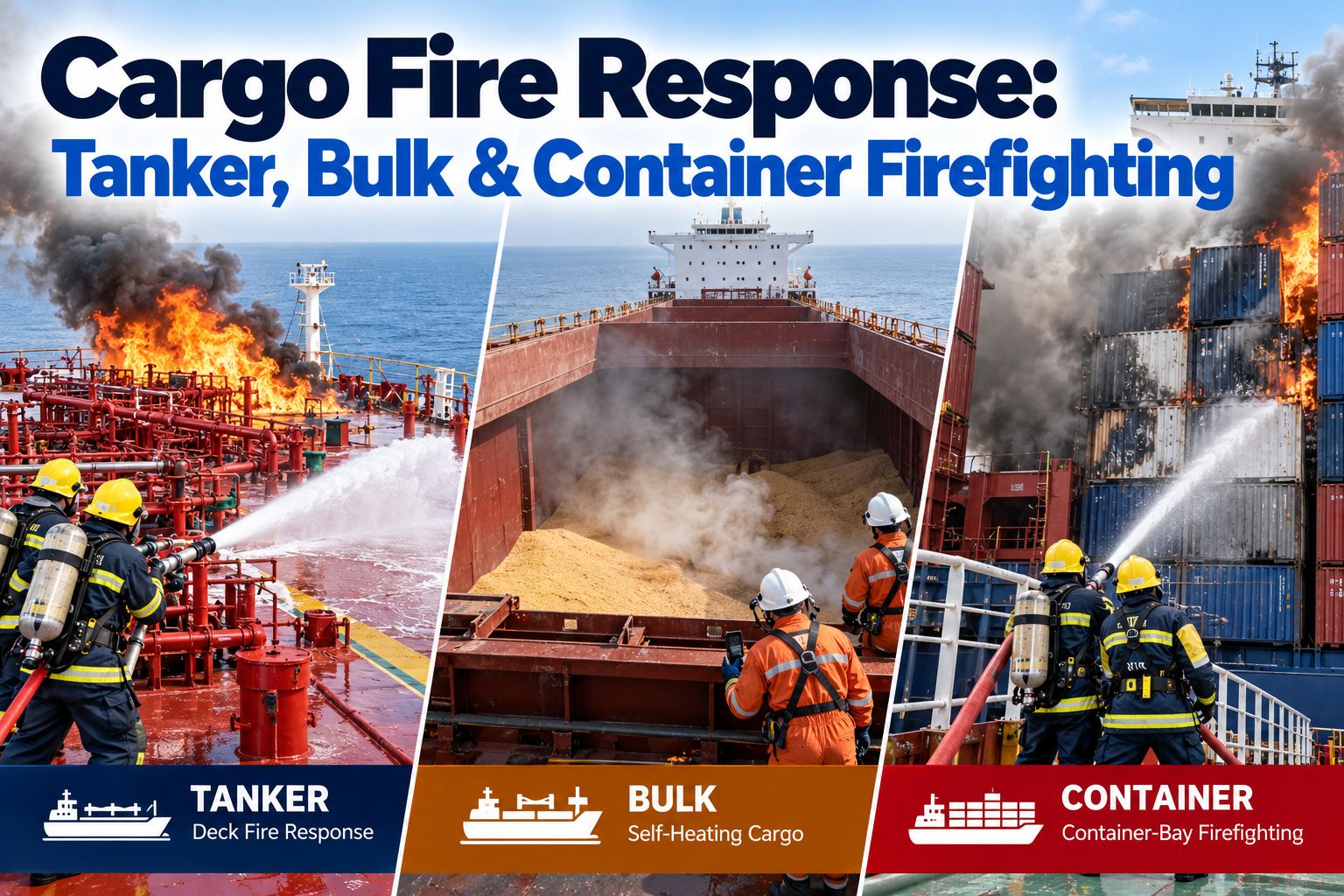
The cargo is what makes a ship's fire different from any other building fire. On a tanker it is the product on deck. On a bulk carrier it is a hold that has been heating for days. On a container ship it is a stack where nobody can be certain what is inside. This guide, written for the Chief Officer, sets out how the problem changes by ship type, what the published sources say about detection and response, and what is still draft. For the equipment behind the response, see our shipboard fire fighting equipment, procedures and SOLAS requirements guide.
Why Cargo Fires Differ by Ship Type and What That Means for the Chief Officer
Four ships, four problems, and one rule: know the cargo before you fight the fire
There is no single cargo fire procedure. The tools, the hazards and the warning signs depend on the ship. What they share is that the cargo information decides the strategy. IUMI notes that misdeclared cargo can lead to incorrect handling and a wrong firefighting strategy. The summary below groups what the sources say for each ship type.
Tanker Deck Fires: The Fixed Foam System and What We Could and Could Not Verify
The parts of a deck foam system and the checks that keep it ready
Deck foam is the main fixed system for a tanker's cargo area. A vendor brochure from Unitor describes a typical arrangement: a foam concentrate tank, a foam pump, a proportioner and monitors, with portable applicators. It states that the system meets IMO FSS Chapter 14 for fixed deck foam and that the foams comply with MSC.1/Circ.1312. It gives equipment capacities but no application rate or run time. The checks in the diagram are ours.
What we could not find and where the tactics should come from
We found no accessible primary guidance on deck fire tactics for tankers in this research. The IMO interpretation we read (MSC.1/Circ.1276) addresses a narrow point on pipe trunks and says they need not be included in the foam supply calculation. Tanker tactics belong in ISGOTT, your foam system manual, the ship's fire plan and company procedures. Use the checklist below to confirm that your own documents are in place, and see our marine fire safety inspections guide for how inspectors check fire readiness.
Bulk Cargo Self-Heating: Detecting It Early and What the First Moves Are
Why gas readings beat temperature probes in a coal hold
An IIMS article summarising London P&I Club analysis says self-heating usually occurs in localised hot spots, so temperature measurements are unlikely to identify problems. It says measuring CO concentration is the most effective method, with each hold monitored at least daily for CO, H2S, O2 and LEL-methane, and ventilation stopped at least four hours before readings. It cites IMSBC provisions including a 24-hour ventilation period after loading and a bar on loading coal above 55 degrees C.
What the article says to do when CO or LEL rises, and what not to do
On signs of self-heating, the article says to close hatches and all ventilation to the holds, check adjacent spaces before entry, consider boundary cooling, identify the nearest ports of refuge, and notify owners and the P&I Club. It warns against continuing to ventilate once self-heating has started, because added oxygen can worsen it. It does not mention inert gas or CO2 and covers coal only, so cargoes such as DRI need their own IMSBC schedule and expert advice.
Container Ship Fires: Misdeclared Cargo, Limited Capacity and Rules in Transition
What insurers say about misdeclaration and firefighting capacity
IUMI's policy agenda of 7 May 2026 says misdeclaration is a recurring safety problem and that firefighting capacity on large containerships has long been considered insufficient. It reports that roughly 20% of containers in transport are reportedly misdeclared, and that just over a quarter of incidents with detected causation in one incident system were due to misdeclared cargo. IUMI is an insurers' body, so read it as an industry position, not a regulation.
Which container fire requirements are in force and which are still draft
Under rules adopted in 2013 and effective 1 January 2016, newbuilds with five or more container tiers on or above the weather deck carry mobile water monitors and at least one water mist lance, per IUMI. DNV reports that SSE 12 in March 2026 produced draft requirements for water mist lances and portable infrared thermal imagers, with further work on detection and control in holds and on cargo decks heading to SSE 13 in March 2027. The package is aimed at 1 January 2032.
EV and Lithium Battery Fires: The Hazard and the Limits of Current Guidance
What the Vehicle Carrier Safety Forum says and what it does not say
The VCSF's fire response guidelines, covered by an IIMS page dated 9 February 2026, apply to PCCs, PCTCs, ro-ro and ro-pax vessels. They describe thermal runaway of a lithium-ion battery as a distinct hazard and say evidence suggests an early-stage battery fire may be harder to control onboard than a fuel-engine fire. The page also says the origin may not be a battery. The guidelines are a framework, and operators write their own procedures.
Why a Chief Officer should train for it even on ships that carry few vehicles
Vehicles and battery-powered cargo can travel on ships that are not purpose-built car carriers. We found no source in this research that covers lithium battery cargo in containers, so we make no claim about it. The sound step is to read your cargo manifest for batteries and vehicles, check what your fire plan says about them and train the team on the hazard the VCSF describes.
What Changed on 1 January 2026 and Why It Matters Less for Cargo Fires Than You Might Expect
A short guide to the SOLAS II-2 amendments now in force
UK MGN 713 summarises the SOLAS II-2 amendments in force from 1 January 2026. Most concern fire detection in cargo ship accommodation, ro-ro and special category spaces on passenger ships, fuel flashpoint declarations and a ban on PFOS in extinguishing media. They are worth knowing, but they do not set new rules for fighting fires in cargo holds or on container decks.
| Resolution | What it covers | Relevance to cargo fires |
|---|---|---|
| MSC.550(108) | Main SOLAS II-2 amendments: fire detection in accommodation and service spaces of cargo ships, ro-ro and special category space requirements | Limited. Mostly detection, containment and ro-ro passenger ship measures |
| MSC.555(108) | FSS Code amendments | Water mist systems are in Chapter 7. The MGN page does not describe any lance requirement |
| MSC.520(106) | Oil fuel flashpoint declarations before bunkering | Fuel, not cargo |
| MSC.532(107) | Ban on extinguishing media containing PFOS | Check your foam concentrate and fixed system media |
A Chief Officer's Preparation by Ship Type
One table to turn the sources into actions before loading and during a fire
The table below is our template. It sets out preparation for each ship type and the first points in a fire. It does not replace your fire plan or company procedures.
| Ship type | Before loading or sailing | If a fire starts | Checkpoint type |
|---|---|---|---|
| Tanker | Foam system tested, concentrate in date, monitors free and cargo information at hand | Follow the ship's fire plan and ISGOTT. Use the fixed foam system as the plan directs | Test |
| Bulk carrier (self-heating cargo) | Declaration read, hold atmosphere meters calibrated and a reading routine set | Close hold and ventilation, check readings, call owners and P&I as the IIMS article advises | Record |
| Container ship | Cargo declarations checked for dangerous goods, lance and monitors located and tested | Use the actual stowage and cargo documents to choose the strategy. Do not assume the declaration is right | Visual |
| Vehicle carrier or ro-ro | Crew trained on thermal runaway, written procedures reflect the vessel's equipment | Follow the company procedure built on the VCSF framework | Record |
The Cargo Fire Readiness Checklist for the Chief Officer
A checklist with a checkpoint type on each item to use before loading and before drills
Use the table before loading and before each fire drill. It covers cargo information, fixed and portable equipment, gas meters, training, contacts and the fire plan.
| Item | What to check | Checkpoint type |
|---|---|---|
| Cargo information | Cargo declarations and stowage plan available to the bridge and fire team | Record |
| Dangerous goods | Declared dangerous goods located on the plan and their hazards understood | Record |
| Fixed systems | Foam, water and other fixed systems tested to their manuals | Test |
| Portable equipment | Water mist lances, monitors and thermal imagers located, charged and tested where fitted | Test |
| Gas meters | Hold atmosphere meters calibrated, with readings logged for self-heating cargoes | Record |
| Crew training | Drills include a cargo fire scenario for the ship type | Record |
| Contact list | Owners, P&I Club and cargo experts reachable, with numbers current | Record |
| Fire plan | Posted and reflecting the cargo actually on board | Visual |
Mistakes That Make a Cargo Fire Harder to Fight
Six habits drawn from the cited sources
Systems That Keep Cargo Fire Evidence, Drills and Corrections Together
How a dated photo repository, task ownership and deadlines support cargo fire readiness
Cargo fire readiness is a set of small checks done before the fire. Marine Inspection supports a dated photo repository, observations turned into tasks with owners, deadlines and evidence, and certificate and equipment tracking. A dated photo of a foam monitor run, a task for each overdue gas meter calibration with a named owner, and tracked drill records give a Chief Officer evidence to bring to a review. It does not replace the cargo information or your company procedures.