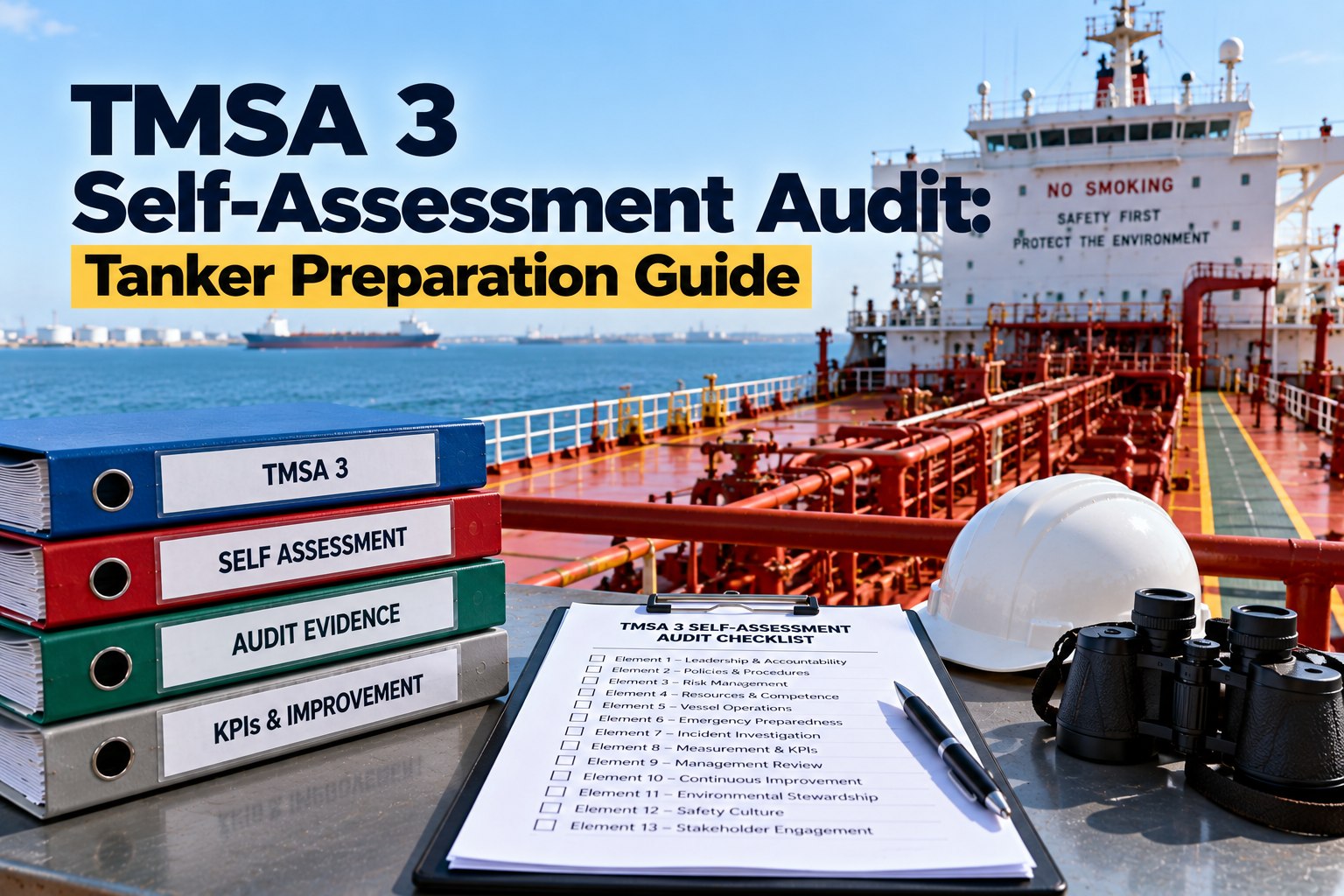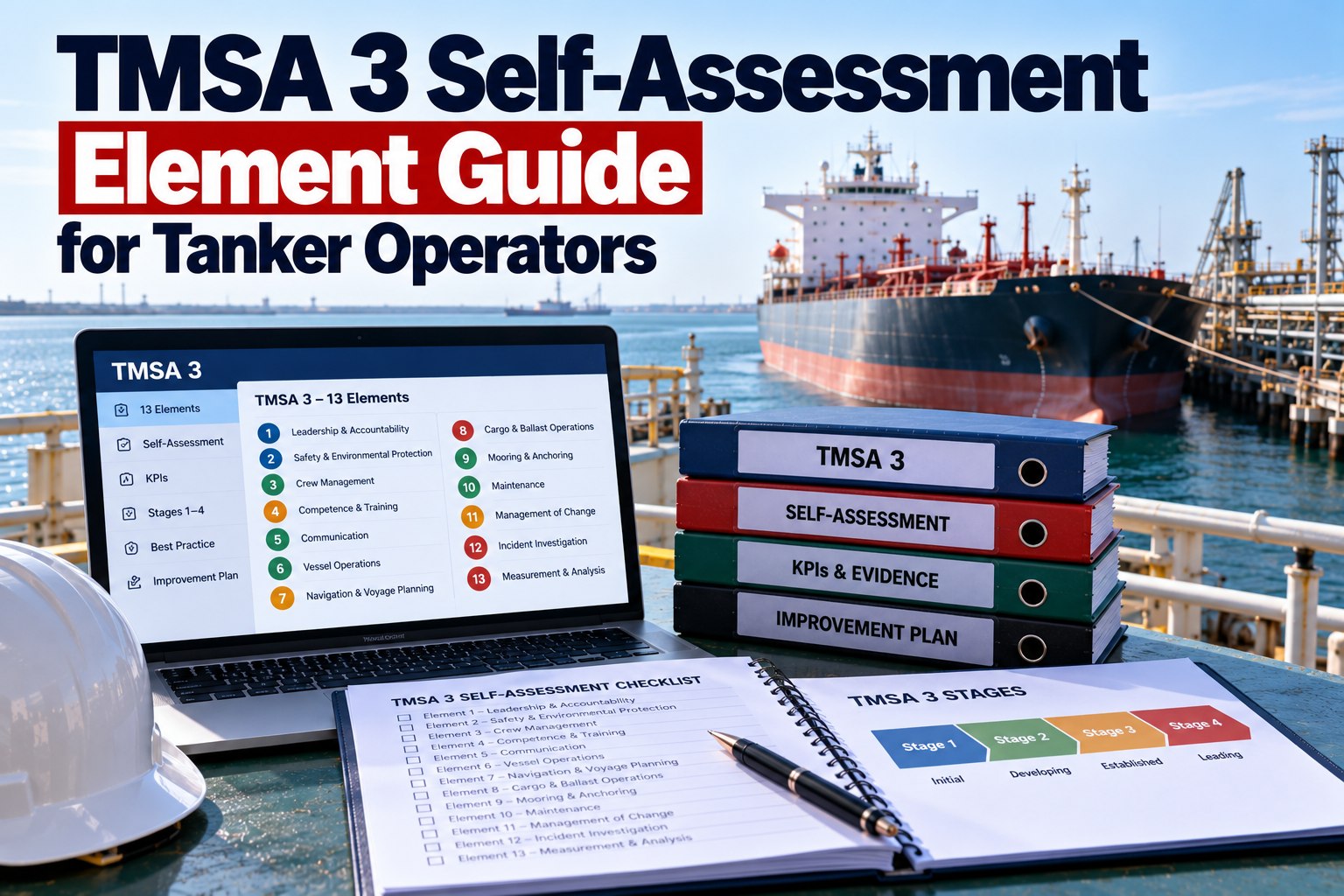
TMSA 3 is the OCIMF framework tanker operators use to measure their shore management against best practice. It has 13 elements, each with KPIs set across four stages, and is read alongside SIRE 2.0 results on the ships. This guide goes through the elements one by one: what each covers, what Stage 1 asks for, what higher stages add, and where SIRE 2.0 tests the claim on board. Book a demo to see TMSA evidence tracked.
TMSA 3 self-assessment: 13 elements, 4 stages, one honest score
How TMSA 3 is structured: elements, stages, KPIs and guidance
OCIMF published TMSA 3 in April 2017, and it replaced TMSA 2 from 1 January 2018. Each element is a set of rows, and each row has a stage, a KPI and best-practice guidance. KPIs are answered yes or no, and an element’s stage is the highest level fully met.
Paraphrased from TMSA 3. Use the official OCIMF text for your self-assessment.
The 13 TMSA 3 elements, one by one
Each card shows the element’s focus, a Stage 1 example, what higher stages add, and where SIRE 2.0 inspections may show the result on board. Stage 1 examples are paraphrased; higher-stage notes and SIRE links are our summary.
Leadership and the SMS
+1AStage 1Management commitment is set out in policies and procedures.
HigherLeaders visit ships, set HSSE targets and review the SMS with crew input.
SIRE 2.0: procedures crews can follow
Shore-based personnel
Stage 1Recruitment and competence of office staff are managed.
HigherSuccession planning, training plans and retention measured.
SIRE 2.0: office support visible in records
Vessel personnel
+3AStage 1Procedures cover hiring, recruitment and promotion of crew.
HigherCompetence assessed, retention tracked, wellbeing supported.
SIRE 2.0: crew interviews and PIFs
Reliability and maintenance
+4AStage 1Critical equipment is identified in the SMS and PMS.
HigherCondition monitoring and failure trends drive maintenance.
SIRE 2.0: hardware condition and defects
Navigational safety
Stage 1Named shore staff are responsible for navigation standards.
HigherNavigation audits, voyage data review and fleet trend analysis.
SIRE 2.0: bridge team practice
Cargo, ballast, tank cleaning, bunkering
+6AStage 1Procedures exist for these operations on every ship type.
HigherOperations monitored; mooring equipment and lines managed through life.
SIRE 2.0: cargo and mooring operations
Management of change
Stage 1Changes to people, ships and procedures go through a defined process.
HigherRisk assessed, reviewed after the change and lessons shared.
SIRE 2.0: crews aware of recent changes
Incident investigation
Stage 1Incidents and significant near misses are reported and investigated promptly.
HigherRoot causes trended, lessons shared fleet-wide and externally.
SIRE 2.0: near-miss culture on board
Safety management
+9AStage 1Shore visits monitor safety standards across the fleet.
HigherLeading indicators, behaviour-based programmes and shipboard safety inspections.
SIRE 2.0: permits, risk assessments
Environmental and energy
Stage 1An environmental policy and management plan is in place.
HigherEmissions and energy targets set, monitored and improved.
SIRE 2.0: pollution prevention
Emergency preparedness
Stage 1Ship emergency plans cover credible scenarios and notification.
HigherShore and ship drills together, with lessons fed back.
SIRE 2.0: drill performance
Measurement and improvement
+12AStage 1A ship inspection plan and documented audit procedures are in place.
HigherFindings analysed across the fleet and used to improve.
SIRE 2.0: results feed the review
Maritime security
New in TMSA 3Stage 1Documented security plans are in place.
HigherCyber risk covered; backups trained for key security roles.
SIRE 2.0: security practice on board
Claim only the stages you can prove
Link each KPI to live evidence from every ship, so the self-assessment holds up when vetting teams compare it with inspections.
TMSA stages: what moving from Stage 1 to Stage 4 takes
Stages build on each other: a higher stage counts only when every KPI below it is met. Our TMSA 3 self-assessment audit guide covers testing the evidence in detail.
Evidence: documents, records
Evidence: fleet records, KPIs
Evidence: trend data over time
Evidence: improvement history
Stage descriptions are a plain-language summary, not OCIMF definitions.
TMSA KPIs and best-practice evidence by element
Measured results are what move an element past Stage 1. These examples show the kind of fleet measure that supports a claim; they are not official TMSA KPIs.
| Element | Example fleet measure | Evidence source |
|---|---|---|
| 3 Vessel personnel | Officer retention rate | Crewing records |
| 4A Critical equipment | Overdue critical maintenance jobs | Planned maintenance system |
| 8 Incidents | Near-miss reports per ship per month | Incident reporting system |
| 9 Safety | Lost time injury frequency | Safety statistics |
| 10 Environment | Fuel use and emissions against target | Energy and emissions data |
| 12 Improvement | Average closure time for findings | Inspection and audit records |
TMSA alignment with SIRE 2.0 shore-based scrutiny
TMSA rates the company and SIRE 2.0 inspects the ship, but each is read alongside the other. There are three main ways SIRE 2.0 tests what the shore side says. See our SIRE 2.0 inspection guide for the inspection side.
The TMSA self-assessment cycle
OCIMF recommends re-taking the self-assessment every 12 months. Spreading the review across the year keeps evidence current. The cycle below is illustrative.
TMSA 3 self-assessment checklist
Use this before publishing the self-assessment.
How Marine Inspection supports TMSA 3 self-assessment
Marine Inspection links inspection results, corrective actions and fleet records to TMSA elements, so evidence builds as work happens. The heatmap below is illustrative. Our TMSA 3 compliance software guide covers this further.
TMSA 3 FAQs
How many elements does TMSA 3 have?
Thirteen, with sub-elements 1A, 3A, 4A, 6A, 9A and 12A. Element 13, maritime security, was added in TMSA 3.
What are the TMSA stages?
Four levels in each element. Stage 1 is the minimum expected standard and stages 2 to 4 add increasing best practice. Each stage needs all lower KPIs met.
How often should TMSA be submitted?
OCIMF recommends re-taking the self-assessment every 12 months, covering the whole fleet.
How does TMSA relate to SIRE 2.0?
TMSA assesses the company and SIRE 2.0 inspects ships. Vetting teams read both, and SIRE 2.0 can verify declared audits and code process findings to TMSA KPIs.
When did TMSA 3 take effect?
OCIMF published TMSA 3 in April 2017, and it replaced TMSA 2 from 1 January 2018.
Can Marine Inspection help with TMSA evidence?
Yes. Book a demo to see TMSA elements linked to fleet evidence.
Set the course for the next stage
Evidence on every ship, every element, every year, so your TMSA score and your SIRE 2.0 results tell the same story.