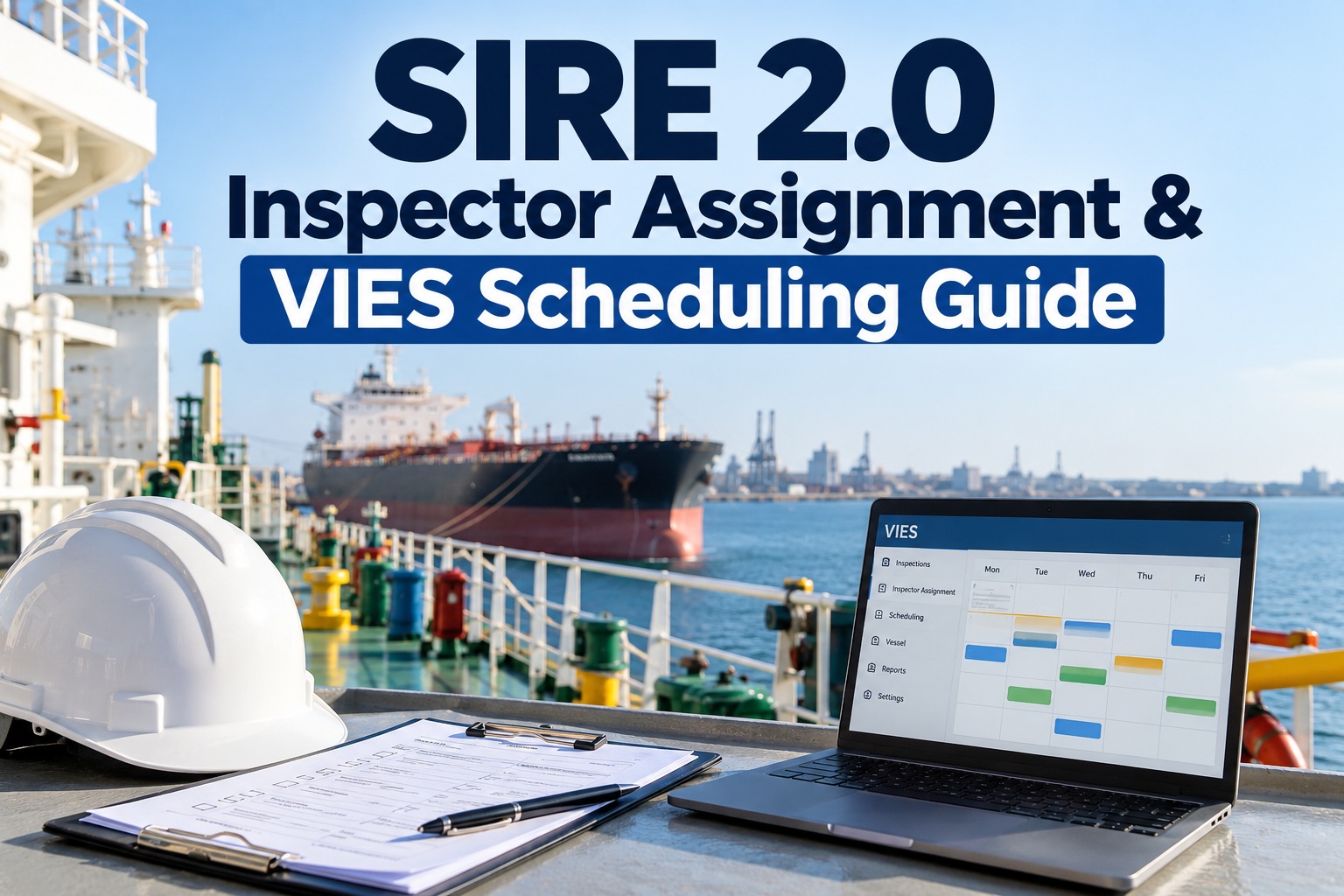
Understanding SIRE 2.0 inspector assignment and scheduling takes much of the surprise out of vetting. For a Marine Superintendent, the questions are practical: who requests the inspection, who chooses the inspector, how long do we have to prepare and what must be done before the inspector arrives? This guide walks through the request and assignment flow, how SIRE inspectors are accredited, where VIES fits in your own scheduling process and a planning calendar you can use for every tanker. Start a free trial of Marine Inspection to track every inspection from request to close-out.
- Operators can request a SIRE inspection through the SIRE platform and nominate up to five Submitting Companies in priority order.
- The request stays live for two weeks or until a company accepts and commissions the inspection.
- The accepting Submitting Company assigns an accredited inspector, and the system releases the compiled questionnaire to that inspector once the pre-inspection questionnaire is done.
- Complete the pre-inspection questionnaire at least two days ahead, and give the master 14 days to answer negative observations.
- Category 1 inspectors need at least 60 months of sea service and 18 months in a senior tanker rank, plus specific certificates and training.
How a SIRE 2.0 Inspection Is Requested and Assigned
A SIRE 2.0 inspection is not booked like an ordinary survey. It runs through the SIRE platform, with the operator, a Submitting Company and an accredited inspector each playing a part. Knowing the order of events lets you prepare the ship and the paperwork at the right moments.
| Stage | Who | What happens | Your action |
|---|---|---|---|
| 1. Request | Operator | Submits an inspection request through the SIRE platform | Check your SIRE registration and request details are valid |
| 2. Offer | Submitting Company | Request is offered to the nominated companies in the operator's priority order | Order your priority list with care. Up to five companies |
| 3. Commission | Submitting Company | Accepts the request and commissions the inspection | The request stays live for two weeks or until accepted |
| 4. Assign | Submitting Company | Assigns an inspector from its accepted pool | Note who is assigned and plan the visit |
| 5. Prepare | Operator | Completes and edits the Pre-Inspection Questionnaire | Finish at least two days before the inspection |
| 6. Compile | SIRE system | Algorithm compiles the vessel-specific questionnaire and releases it to the inspector | Nothing to do. You cannot see the question set in advance |
| 7. Inspect | Inspector | Carries out the inspection on a tablet and submits the report | Support the inspector and keep your own notes |
| 8. Respond | Operator | Master comments on negative observations | 14 days to comment after the draft is released |
Operator-initiated requests and the priority list
OCIMF's bulletin says operators with vessels registered in SIRE can submit inspection requests directly, instead of contacting Submitting Companies one by one. The operator can designate up to five Submitting Companies in a priority-ordered sequence, and the system offers the request to them in turn. A request remains live for two weeks or until it is accepted and an inspection is commissioned.
That makes the priority list a real planning tool. The companies you name decide who commissions the inspection, so review the list at least once a year against your commercial relationships and the ports your ships trade to.
When requests are declined, cancelled or fail validation
If all queued companies decline, the operator is notified and can submit a new request to other Submitting Companies. OCIMF's support portal also carries articles on cancelling a SIRE 2.0 inspection request and resolving validation errors when submitting one. Add a named owner for these tasks in your own procedure, so a stalled request does not go unnoticed.
Where VIES Fits in Your Scheduling Process
Many operators and service providers talk about VIES when they describe inspection assignment and scheduling. We could not find the term in OCIMF's public SIRE 2.0 documents or in its support portal article titles. We therefore do not claim a definition. What matters for a Superintendent is that whatever system you use, it should map cleanly to the stages above.
How SIRE Inspectors Are Accredited
OCIMF accredits SIRE inspectors, and Member Submitting Companies nominate candidates through an electronic SIRE registration portal. The nominating company checks the candidate's qualifications and decides whether they are suitable to represent the programme. OCIMF's accreditation guidance sets different requirements for Category 1 and Category 3 inspectors.
| Requirement | Category 1 (standard) | Category 3 |
|---|---|---|
| Experience at sea | At least 60 months as a certificated officer on ocean-going vessels over 3,000 gt, with at least 18 months in a senior rank on tankers | At least 2 years of sea time on relevant vessels, or equivalent suitable training |
| Certificates | Valid STCW certificate (II/1, II/2, III/1 or III/2), advanced dangerous cargo training and an ISO/ISM auditor course | Navigation watch officer or Master (under 500 gt), Second Engineer, barge master or chief engineer licence, as applicable |
| Language and fitness | Proficient English and physically able to carry out a full inspection | Proficient English, plus the language of the vessel's personnel, and physical ability |
| Training | Accompanied inspections, an accreditation course and online refreshers allocated by OCIMF | Accompanied inspections, a course and face-to-face refreshers |
| Initial assessment | A successful audited physical SIRE inspection | An initial audit under OCIMF guidelines |
Keeping inspectors current
Accreditation is not a one-off. Category 1 inspectors complete online refresher courses allocated by OCIMF, Category 3 inspectors attend face-to-face refreshers, and existing Category 1 inspectors take a one-day ECDIS course. OCIMF has suspended the requirement for existing inspectors to be assessed during physical inspections and instead runs continuous performance reviews, ordered by accreditation expiry. Programmes Quality Assessors, who work exclusively for OCIMF, also assess inspector quality.
What Accreditation Means for Your Inspection on Board
Accreditation tells you what to expect from the person at the gangway: a senior, tanker-experienced mariner trained in non-technical skills and in the human-factor approach of SIRE 2.0. OCIMF says inspectors are trained to understand the impact an inspection has on the crew, including the importance of language and choice of words.
What the inspector does not choose
The inspector does not write the question set. The system compiles a vessel-specific questionnaire from core, rotational, campaign and conditional questions once the pre-inspection questionnaire is complete, and releases it to the assigned inspector. Anglo-Eastern and Idwal Marine both stress that this makes last-minute preparation unreliable, which is the case for continuous readiness.
What this means for preparation
- Prepare for the standard, not the person. You cannot predict the questions or the inspector's style, so cover every question category.
- Prepare the crew to explain. Expect to be asked how, not only whether, procedures are followed.
- Prepare the data. Questionnaire errors in the HVPQ and PIQ create negative observations that no inspector chooses to raise.
Scheduling Without Surprises
The aim is a state in which a request can arrive at any time without alarm. Use a standing readiness routine, and then use the request and assignment stages as triggers for specific actions.
| When | Action | Owner |
|---|---|---|
| As soon as the vessel is in the pool | Confirm SIRE registration, vessel particulars and the priority list of Submitting Companies | Superintendent |
| 4 to 6 weeks before a likely inspection | Start self-inspection and photo refresh. Kaiko recommends about four weeks | Master and Superintendent |
| When a request is accepted | Record the Submitting Company and inspector, confirm port and berth window, brief the master | Superintendent |
| At least 2 days before | Complete and check the Pre-Inspection Questionnaire against the vessel | Superintendent and Master |
| Inspection day | Support the inspector, note the observations as they are raised | Master and officers |
| Within 14 days of the draft report | Review each negative observation and submit the master's comments | Master and QHSE |
Inspection Day and the 14-Day Window
The onboard inspection takes about eight hours and is run on a tablet. Brief the master and senior officers beforehand, nominate a person to accompany the inspector and keep your own notes of each observation as it is raised. These notes make the response easier.
After the inspection, the Submitting Company releases a draft report, and the master has 14 days to comment on negative observations. Approved reports stay available on the OCIMF index for 12 months and in the database for two years, so the quality of the response matters. Turn each observation into an owned corrective action and track it to closure with evidence.
Common Scheduling Pitfalls
What to Track for Every Inspection
| Field | What to record |
|---|---|
| Request date and number | When it was submitted and the ID in the SIRE system |
| Submitting Company | Who accepted the request |
| Inspector | Name, accreditation category and company |
| Inspection date and port | Plus the berth or anchorage |
| Questionnaire status | Pre-Inspection Questionnaire completed and checked, with date |
| Self-inspection coverage | Share of question categories covered before the visit |
| Observations | Count by hardware, process and human factor |
| Master's comments | Submitted and date, against the 14-day window |
Keeping the Process Organised
Spreadsheets can hold these fields, but they struggle with reminders, evidence and follow-up across a fleet. Marine Inspection links the scheduling side to the readiness side: tracking which question categories each vessel has covered, keeping a current photo repository, and converting observations into tasks with deadlines, responsible persons and evidence. Book a walkthrough to see how a request, a self-inspection and the follow-up sit together.