Every SIRE 2.0 inspection revolves around a single document: the Compiled Vessel Inspection Questionnaire (CVIQ). Unlike VIQ7's fixed ~300-question checklist that every tanker crew could memorize, the CVIQ is a bespoke, algorithmically-generated questionnaire of approximately 100 questions — uniquely tailored to your vessel's type, equipment, operational history, and risk profile. No two CVIQs are identical. No consecutive inspection on the same vessel will have the same question set. And your crew must be prepared for every question in the full SIRE 2.0 Question Library. This guide breaks down exactly how the CVIQ is built, what each question type means, and how to prepare your fleet systematically. Operators ready to track CVIQ question coverage across their fleet can sign up for Marine Inspection's compliance platform to identify preparation gaps before the inspector does.
SIRE 2.0 CVIQ: The Numbers Behind Every Inspection
~100
Questions per CVIQ
Selected algorithmically from the full question library
~50%
Core Questions
Safety-critical questions included in every inspection
12
Inspection Chapters
Covering all operational areas of the vessel
3
Assessment Dimensions
Hardware · Procedures · Human Factors
What Is the CVIQ and Why Does It Matter?
The Compiled Vessel Inspection Questionnaire (CVIQ) is the inspection document that replaced the VIQ7 questionnaire when SIRE 2.0 went live on September 2, 2024. It is the actual set of questions the SIRE inspector uses on their tablet device during the onboard inspection — and it is compiled fresh for every single inspection using an OCIMF-developed algorithm.
Here's what makes the CVIQ fundamentally different from VIQ7: the SIRE 2.0 inspection compiler software reads data from your vessel's Harmonised Vessel Particulars Questionnaire (HVPQ) and Pre-Inspection Questionnaire (PIQ), then selects questions from the SIRE 2.0 Question Library based on vessel type, outfitting, operational history, risk ranking, and question assignment history. The result is a bespoke questionnaire with no irrelevant questions — every question in the CVIQ applies directly to your specific vessel and its operations.
The CVIQ is only compiled and made available to the inspector after the vessel operator completes the Pre-Inspection Declaration. This means your PIQ and HVPQ data directly influence which questions appear — and inaccurate declarations can trigger conditional questions you're not prepared for. Book a demo to see how Marine Inspection tracks CVIQ coverage across your fleet.
The CVIQ algorithm does not consider past inspection performance of an individual vessel or fleet when generating questions. It considers information provided by the vessel operator through the HVPQ and PIQ when selecting the question pool. This means a vessel with a clean inspection history gets the same algorithmic treatment as one with multiple negative observations — there is no penalty-based question escalation, but there is also no way to "game" the system through good past performance.
How the CVIQ Algorithm Builds Your Inspection
Understanding what feeds the CVIQ compiler helps you control what you can control — the accuracy and completeness of your pre-inspection data submissions. The algorithm processes multiple data inputs in a specific sequence to generate each unique questionnaire.
Step 1 — Operator Data Inputs (You Control This)
HVPQ (Harmonised Vessel Particulars Questionnaire) — Permanent and infrequently changing vessel data: construction, outfitting, equipment fitted, certification. Auto-populates parts of the inspection report and manages question assignment for vessel-specific equipment.
PIQ (Pre-Inspection Questionnaire) — Dynamic operational history: crew matrix, superintendent inspections, specialist audits, incident history, manning data, common working language, lube oil analysis. Triggers conditional questions based on your declarations.
Photo Repository — Standardized vessel photographs updated every 6 months. Inspector corroborates uploaded photos with actual vessel condition onboard. Photographs tagged as 'not applicable — equipment not fitted' where relevant.
Certificate Repository — Upload all current vessel certificates. Ensure HVPQ is updated first, then certificate details — the system links them. Class Survey Status Reports (CSSR) should be included where the classification society offers them.
Step 2 — Algorithm Processing (OCIMF Controls This)
Question applicability filter — Eliminates questions not applicable to the vessel type and outfitting. No "Not Applicable" questions appear — every question in the final CVIQ is relevant to your vessel.
Risk-ranking via bow-tie methodology — OCIMF's bow-tie risk assessment categorizes every question as core or rotational based on the severity of the risk it addresses. Core questions cover risks that may lead to catastrophic or severe incidents.
Rotational randomization — Algorithm checks the vessel's question assignment history in the OCIMF database and selects rotational questions in a non-predictable manner. Ensures full coverage over multiple inspections.
Time allocation — Each question is assigned a notional time. Each vessel inspection area gets an allotted timing. The total onboard inspection time (~8 hours) equals the sum of all allocated question times.
Step 3 — CVIQ Delivered to Inspector
Pre-boarding review (4+ hours) — The compiled CVIQ is transferred to the inspector's intrinsically safe tablet. The inspector reviews the CVIQ, photographs, certificates, and PIQ data before boarding — arriving already familiar with the vessel and its history.
The 4 CVIQ Question Types — Deep Dive
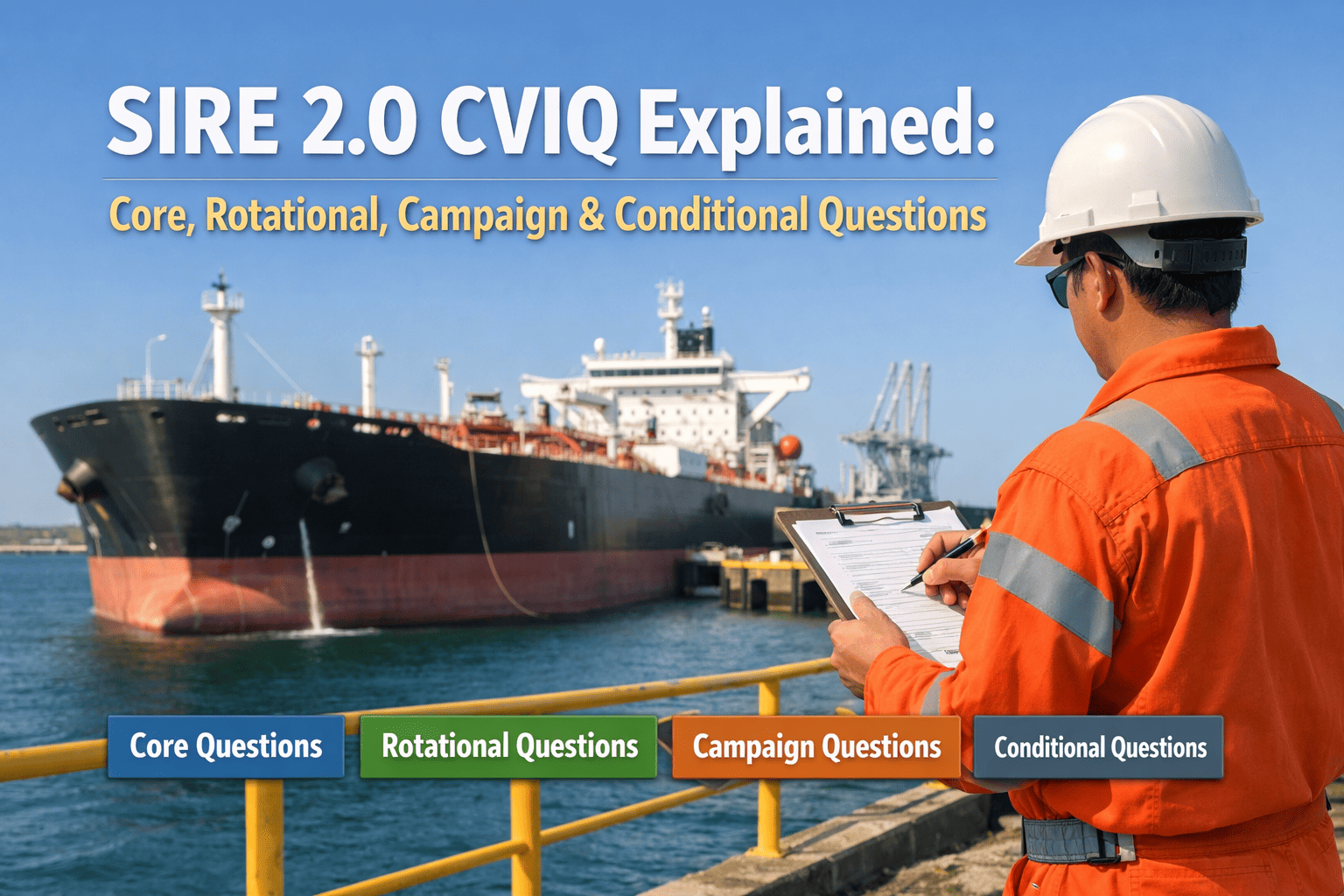
Every question in the SIRE 2.0 Question Library is classified into one of four types. The CVIQ compiler draws from all four categories to create each inspection's unique questionnaire. Understanding how each type works — and what triggers them — is essential for systematic preparation.
What they are: Safety-critical questions included in every CVIQ where applicable to the vessel type and outfitting. These address the risks that OCIMF's bow-tie analysis identified as potentially leading to catastrophic or severe incidents — including collision, grounding, cargo spill, explosion, and loss of life.
How they're selected: All core questions applicable to the vessel are automatically included. No randomization. If the question applies to your vessel type, it will appear every time.
Coverage areas: Navigation safety, cargo operations, fire protection, pollution prevention, emergency preparedness, mooring operations, and structural integrity.
Preparation strategy: Since core questions appear every inspection, treat them as your baseline. Every crew member should be able to demonstrate competency in every core question relevant to their role — not just recite the procedure, but explain why and show how.
≈ 50% of every CVIQ · Appears every inspection · Highest risk ranking
What they are: Non-core questions that are rotated across inspections to ensure the full question library is covered over time. They address operational areas that are important but not classified as the highest-severity risks.
Two tiers of rotation:
Rotational 1 — Appears approximately every 3rd or 4th inspection. Covers mid-tier risk areas.
Rotational 2 — Appears approximately every 6th inspection (roughly double the R1 interval). Covers lower-frequency assessment areas.
How they're selected: The algorithm checks the OCIMF database for the vessel's previous question assignment history, then randomizes rotational selection. OCIMF cannot guarantee the same rotational question won't appear in consecutive inspections, but the algorithm is designed to vary them.
Preparation strategy: This is where unpredictability hits hardest. You cannot predict which rotational questions will appear next. The only strategy is comprehensive readiness across the full library — and tracking which categories have been covered across inspections so you can focus crew preparation on gaps.
Randomized allocation · R1 every 3rd–4th inspection · R2 every ~6th inspection
What they are: An existing rotational question that OCIMF elevates to mandatory status for every inspection during a fixed period. Campaigns are activated in response to a specific incident trend, emerging safety concern, or industry-wide pattern that OCIMF identifies through aggregated data.
How they work: Think of campaign questions like port state control concentrated inspection campaigns — a focused, time-limited spotlight on a specific area. Once the campaign period ends, the question returns to its normal rotational assignment.
Preparation strategy: Monitor OCIMF communications for active campaigns. When a campaign is active, the related question will appear in every CVIQ — meaning every vessel in your fleet needs to be prepared for it simultaneously. This is where fleet-wide communication becomes critical.
Time-limited · Elevated from rotational pool · Industry trend response
What they are: Questions triggered specifically by your vessel's data — the information you declare through the HVPQ and PIQ. They are generated based on vessel type, operator history, specific equipment fitted, cargo type, operational declarations, and audit/inspection claims.
Preparation strategy: Only declare what you can fully verify. If you declare a specialist audit was completed, the inspector will ask to review the audit report and evidence. If you declare STS operations, STS-specific questions will appear. Inaccurate declarations generate conditional questions that lead to negative observations when the inspector finds the declared activity was not actually completed or properly documented.
Triggered by HVPQ/PIQ data · Vessel-specific · Declaration-dependent
Track CVIQ Question Coverage Across Your Fleet
Marine Inspection maps which core, rotational, campaign, and conditional questions each vessel has covered — so you know exactly where preparation gaps exist before the next inspection.
The 12 CVIQ Inspection Chapters
The SIRE 2.0 Question Library is organized into 12 chapters — the same number as the original SIRE programme, though some questions have been reassigned to more relevant chapters. Each chapter corresponds to a defined inspection area of the vessel, and each area is allotted a notional inspection timing. Every CVIQ question is allocated to a specific chapter and inspection area.
SIRE 2.0 Question Library — 12 Inspection Chapters
1
General Information — Vessel particulars, certification, class status, management and operational data verification.
2
Certification & Documentation — Statutory certificates, SMS documentation, defect reporting systems, superintendent inspections.
3
Crew Management — Manning levels, qualifications, training records, working hours, fatigue management, common working language.
4
Navigation & Communications — Bridge equipment, ECDIS, passage planning, watchkeeping, communication systems, voyage data recorder.
5
Safety Management — Emergency preparedness, fire protection, lifesaving, enclosed space entry, work permits, PPE, lifting equipment.
6
Pollution Prevention — Oil record books, SOPEP, garbage management, ballast water, air emissions, oily water separator.
7
Structural Condition — Hull integrity, tank coatings, corrosion monitoring, deck condition, structural survey status.
8
Cargo & Ballast Systems — Cargo pumps, pipelines, tank venting, gauging systems, ballast operations, cargo heating.
9
Cargo Operations — Loading/discharging procedures, ship-shore safety checklist, tank cleaning, crude oil washing, gas freeing.
10
Mooring — Mooring equipment condition, mooring procedures, snap-back zones, personnel safety during mooring operations.
11
Engine & Machinery — Main engine, generators, steering gear, fuel systems, machinery space management, alarm systems.
12
General Appearance & Accommodation — Housekeeping, accommodation standards, galley, stores, general vessel condition.
How Each CVIQ Question Is Structured
Every question in the SIRE 2.0 Question Library follows a standardized structure that is significantly more detailed than VIQ7. Where a typical VIQ7 question occupied half a page, the equivalent SIRE 2.0 question can span multiple pages with structured guidance sections. Understanding this structure helps your crew anticipate exactly what the inspector is looking for.
Anatomy of a SIRE 2.0 CVIQ Question
Component
Purpose
What It Means for Your Crew
Top-Level Question
The primary inspection question displayed on the tablet
This is what the inspector is assessing — covers Hardware, Procedures, and Human
Objective
States the overall purpose of the question
Understand the "why" behind the question — inspectors assess intent, not just compliance
Industry Guidance
Best practice references from industry bodies and regulations
Includes TMSA references, ISM references, and governing regulations
Inspection Guidance
Detailed expectations for vessel SMS and operational standards
This is what the inspector benchmarks against — study this section carefully
Suggested Actions
Specific steps the inspector should take to verify compliance
Know what the inspector will physically check, review, or ask to see demonstrated
Expected Evidence
Documentation the inspector expects to be available
Have these documents ready and accessible — not buried in filing cabinets
Potential Negatives
Pre-defined grounds for a negative observation
Your checklist of exactly what to avoid — each becomes a codified SOC/NOC if found
The Three Response Dimensions: Hardware · Procedures · Human
Every CVIQ question is assessed across three dimensions. A single question can generate negative observations in one, two, or all three dimensions simultaneously — meaning one area of the vessel can produce multiple findings if the hardware is deficient, the procedure is inadequate, and the crew cannot demonstrate competency. This is a fundamental change from VIQ7, where each question generated a single binary answer.
Hardware Assessment
Equipment, Structure & Machinery Condition
Inspectors assess whether the physical hardware — vessel structure, machinery, equipment, and safety systems — is in satisfactory operational condition. Hardware deficiencies are recorded with codified observations. Negative observations in this dimension may include defective equipment, corroded structures, inoperative safety systems, or equipment not maintained per manufacturer specifications. Note: Positive observations are not available for hardware — only negative findings or "as expected" ratings.
Procedures Assessment
Company SMS, Processes & Documentation
Inspectors evaluate whether adequate company procedures exist, are accessible to crew, cover the task fully, and align with regulatory requirements and TMSA expectations. Process-based negative observations are classified using TMSA KPI coding — linking procedure gaps directly to the operator's self-assessment framework. Each process negative is recorded separately. Note: Like hardware, positive observations are not available for procedures — only the human dimension supports "exceeds expectations" ratings.
Human Factors Assessment
Crew Competency, Knowledge & Performance
The most significant addition in SIRE 2.0. Inspectors assess whether crew members are familiar with company procedures, can demonstrate task execution, and understand the safety rationale. The Human Response Tool uses a four-level grading scale: Exceeds Expectations (best practice — the only way to receive a positive observation), As Expected, Largely as Expected, and Not as Expected (generates a negative observation with mandatory PIF tagging). Inspectors assess "work as done" versus "work as imagined" — watching actual task performance, not just checking whether a manual exists. Every negative human observation must be linked to at least one of the 9 Performance Influencing Factors (PIFs).
Preparing for CVIQ Unpredictability: A Practical Framework
The core challenge of SIRE 2.0 is that you cannot predict which rotational, campaign, or conditional questions will appear in your next CVIQ. The only viable strategy is systematic preparation across the full question library — and that requires a framework, not a last-minute scramble. Here is a practical approach that leading tanker operators are adopting.
Ongoing Fleet-Wide Preparation
Track rotational question coverage per vessel — After each inspection, record which rotational questions appeared. Over multiple inspections, identify which R1 and R2 categories have not yet been covered — these are your highest-probability gaps for the next inspection.
Monitor OCIMF campaign announcements — When a campaign question is activated, it will appear in every CVIQ fleet-wide. Cascade the alert immediately and ensure all vessels prepare for the specific campaign area.
Audit your PIQ declarations before every inspection — Every declaration triggers potential conditional questions. Only declare superintendent inspections, specialist audits, and operational capabilities that you can fully verify with documentary evidence. Review declarations at least 96 hours before inspection.
Run crew readiness drills across all 12 chapters — Rotate internal crew assessments through the full question library chapter by chapter. Focus on the human element: can each crew member explain and demonstrate tasks in their own words?
Pre-Inspection Specifics (48–96 Hours Before)
Complete the Pre-Inspection Declaration accurately — The CVIQ is only compiled after you sign the declaration. Double-check all HVPQ data, PIQ responses, photo repository, and certificate repository. Cargo type entries must be accurate — they trigger cargo-specific questions.
Brief the crew on likely conditional triggers — Based on your PIQ declarations, brief crew on which conditional verification questions may appear. If you declared a navigation audit, ensure the audit report is accessible and the relevant officers can discuss findings.
Verify all "expected evidence" documents are accessible — For every chapter, ensure the documentary evidence listed in the question library is organized, current, and readily available. The inspector has reviewed your uploaded data before boarding — they arrive knowing what to look for.
Post-Inspection Intelligence Gathering
Record the full CVIQ question set from the draft report — Log every question that appeared, categorized by type (core, R1, R2, campaign, conditional). Feed this data back into your fleet tracking system to update rotational coverage maps.
Convert negative observations to corrective actions immediately — Each finding becomes a tracked task with deadline, responsible person, completion evidence, and audit trail. The next inspector will verify remediation documented in the OCIMF database — which retains reports for 12 months.
Why Manual CVIQ Tracking Fails at Fleet Scale
The CVIQ's algorithmic unpredictability is manageable for a single vessel. For a fleet of 10, 20, or 50+ tankers — each with different inspection histories, different rotational question coverage, different PIQ declarations, and different crew rotations — spreadsheet tracking collapses. The operators succeeding in the SIRE 2.0 era are those who have moved to digital systems that automatically map question coverage per vessel, flag rotational gaps, track campaign question readiness fleet-wide, and link corrective actions from negative observations directly to maintenance and training workflows.
Marine Inspection's platform is purpose-built for this challenge: it tracks CVIQ question type coverage across every vessel in your fleet, manages Photo Repository update cycles, monitors PIQ declaration accuracy, and converts negative observations into auditable corrective actions with deadlines and evidence requirements. The result is that your shore team knows — at any moment — which vessel has which preparation gap, and your crew arrives at every inspection with documented evidence of continuous readiness. Schedule a walkthrough to see how CVIQ tracking works across a multi-vessel fleet.
Master Every CVIQ Question Type — Across Every Vessel
From core question readiness to rotational gap analysis, Marine Inspection gives you fleet-wide visibility into SIRE 2.0 preparation — photo evidence, corrective actions, crew competency tracking, and certificate management in one platform.
Frequently Asked Questions
What does CVIQ stand for in SIRE 2.0?
CVIQ stands for Compiled Vessel Inspection Questionnaire. It is the bespoke, algorithmically-generated set of approximately 100 questions that each SIRE 2.0 inspector uses during an inspection. The CVIQ is compiled by OCIMF's inspection compiler software using data from the vessel's HVPQ (Harmonised Vessel Particulars Questionnaire) and PIQ (Pre-Inspection Questionnaire), and draws questions from the full SIRE 2.0 Question Library based on vessel type, risk ranking, and rotational history. No two CVIQs are identical.
Can the inspector add questions to the CVIQ during the inspection?
No. The CVIQ is a fixed set of questions generated before the inspection begins. The inspector cannot add, remove, or modify questions during the onboard inspection. However, OCIMF has developed processes for inspectors to report on concerns not specifically covered by an assigned CVIQ question — ensuring that significant safety issues observed during the inspection can still be documented in the report.
How do PIQ declarations affect which CVIQ questions appear?
Your PIQ declarations directly trigger conditional questions. For example, declaring that a superintendent inspection was completed generates a verification question where the inspector will review the inspection report. Declaring specific operational capabilities (STS operations, specialist audits, navigation assessments) triggers related conditional questions. If a declaration is inaccurate — for example, claiming an audit was completed when it wasn't — the resulting conditional question will generate a negative observation when the inspector cannot find the supporting evidence.
What is the difference between Rotational 1 and Rotational 2 questions?
Both are non-core questions rotated across inspections, but they differ in frequency. Rotational 1 (R1) questions have an allocation frequency of approximately every 3rd or 4th inspection. Rotational 2 (R2) questions appear roughly every 6th inspection — approximately double the R1 interval. This two-tier system ensures that lower-criticality operational areas are still systematically covered, just over a longer timeframe. The algorithm randomizes which specific R1 and R2 questions appear, making consecutive inspections unpredictable.
Does the CVIQ algorithm penalize vessels with past negative observations?
No. The CVIQ compiler algorithm does not consider past inspection performance of an individual vessel or fleet when generating the questionnaire. It only uses the information provided by the vessel operator through the HVPQ and PIQ to select applicable questions. However, SIRE 2.0 inspectors do review previous inspection reports and negative observations during their pre-boarding preparation — and they will verify whether corrective actions for past findings have been completed and documented.
How can operators track which CVIQ questions have been covered across inspections?
OCIMF registers the questions assigned to each vessel's inspection in its database and uses this data when compiling future CVIQs. However, operators do not have direct access to the algorithm's tracking. To build your own fleet-wide picture, record every question from each inspection's draft report, categorize by question type (core, R1, R2, campaign, conditional), and map coverage gaps per vessel. Digital platforms like Marine Inspection automate this process — tracking coverage across your entire fleet and highlighting which categories need preparation focus before the next inspection.