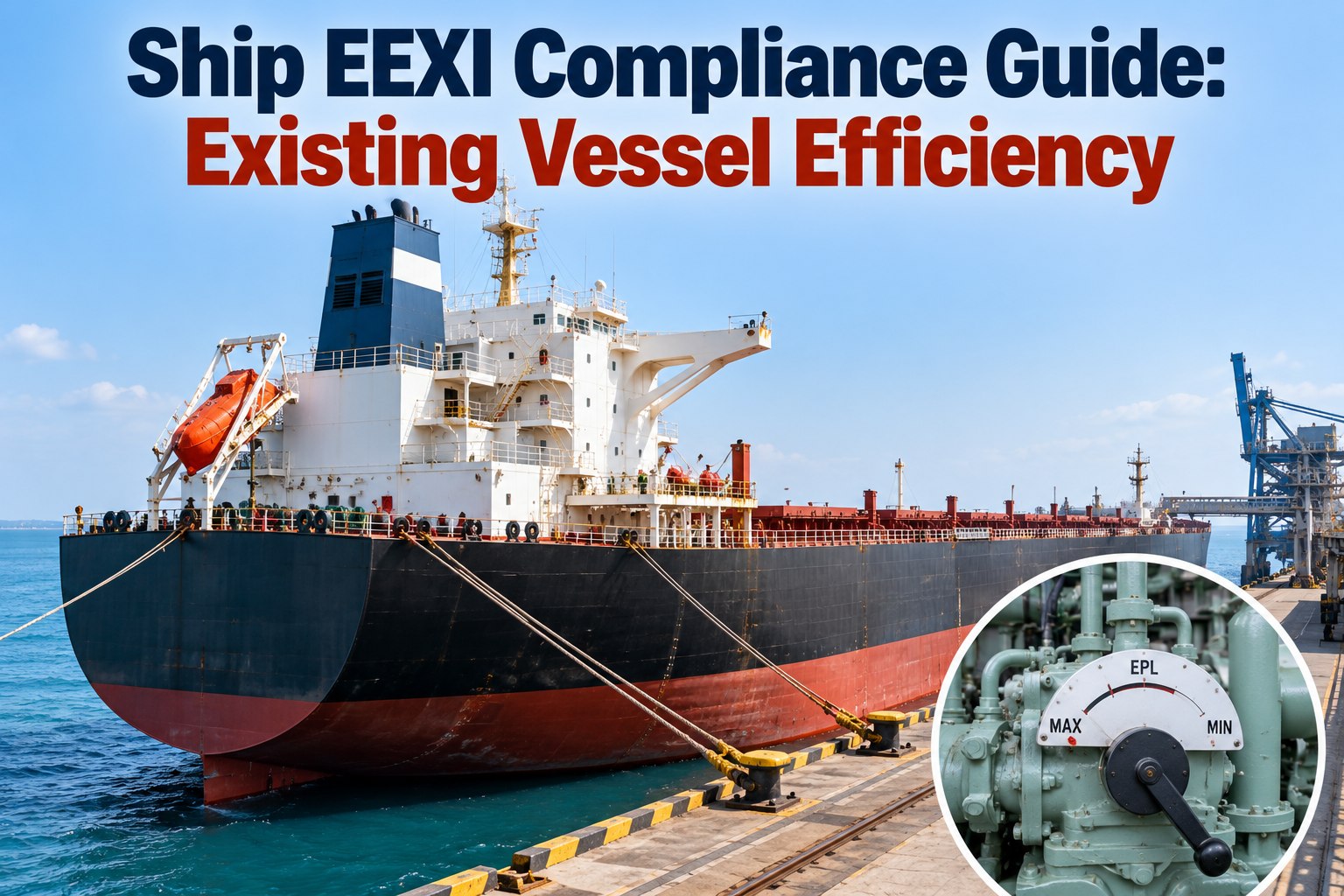
EEXI was a one-time test for existing ships, but its effects last for the life of the vessel. A ship that met the limit by capping its engine power now carries a sealed limiter, a management manual, a bridge alarm and a set of procedures that the crew, the Master and the pilot all need to understand. This guide explains the attained and required index, the technical file and the verification path, and then spends most of its time on running a power-limited ship safely.
EEXI for Existing Ships: Pass the Index, Then Run the Limit Safely
Attained against required EEXI, the technical file, engine power limitation and the onboard routines that keep an existing vessel compliant.
Free trial available. Or book a walkthrough built around your own EEXI documents.
400 GT
Ships covered
On international voyages, plus a DWT threshold by ship type (ClassNK).
1 Jan 2023
First IAPP survey on or after
The point by which existing ships had to comply.
20%
Tanker reduction, 20,000 to 200,000 DWT
Below the EEDI reference line (ClassNK table).
3 months
OPL override drill interval
Recommended by OCIMF for ships with a power limit.
The EEXI Test: Attained Index Against Required Index
How the attained EEXI is calculated and what must stay at or below the limit
ABS describes the attained EEXI as based on CO2 emissions from propulsion and auxiliary services at a single draft and speed, expressed in grams per tonne-nautical mile. Ship speed can come from model tests, sea trials, a formula for certain ship types, numerical calculations, in-service measurements or statistical data. The rule is simple: attained EEXI must be equal to or less than required EEXI, under MARPOL Annex VI regulations 23 and 25.
Attained Against Required: Three Illustrative Ships (Our Example, Not Real Data)
Ship B after power limit
Pass
Required EEXI (limit)Attained EEXI, compliantAttained EEXI, over the limit
Our illustration of the rule that attained EEXI must be equal to or less than required EEXI (MARPOL Annex VI regulations 23 and 25, as summarised by ABS). Positions are invented to show the idea: lower is better and the limit is the dashed line.
Why the required EEXI depends on ship type and size, and what the reduction factors look like
ClassNK explains that required EEXI is the EEDI reference line multiplied by (1 minus X/100), where X is the reduction factor for the ship type and size. Where the table gives a range, X is interpolated by ship size. Tankers and bulk carriers of 20,000 to 200,000 DWT have X of 20, while large containerships have far higher factors. The chart converts a selection of factors into the share of the reference line that the ship may reach.
Required EEXI as a Percentage of the EEDI Reference Line, by Ship Type and Size (100 Minus the Reduction Factor)
Containership, 200,000 DWT and above
50%
Containership, 80,000 to 120,000 DWT
65%
LNG carrier, 10,000 DWT and above
70%
General cargo ship, 15,000 DWT and above
70%
Bulk carrier or tanker, 20,000 to 200,000 DWT
80%
Bulk carrier or tanker, 200,000 DWT and above
85%
Ro-ro cargo ship (vehicle carrier), 10,000 DWT and above
85%
Ro-ro cargo ship, 2,000 DWT and above
95%
Source: ClassNK Technical Information TEC-1274 (Rev. 1, April 2024). Required EEXI is the EEDI reference line multiplied by (1 minus X/100). Where the table gives a range, X is interpolated by ship size. Check MARPOL Annex VI regulation 25 and your class for your exact ship.
Which ships are in scope, and which thresholds apply by ship type
ClassNK says EEXI applies to ships of 400 GT and above on international voyages, with a DWT threshold by ship type. Examples include tankers at 4,000 DWT, bulk carriers and containerships at 10,000 DWT, gas carriers at 2,000 DWT and general cargo ships at 3,000 DWT. Platforms, ships not propelled by mechanical means and Polar Code Category A ships are excluded. For the regulation in more detail, see our EEXI compliance guide to the energy efficiency existing ship index.
Meeting the Limit: When the Attained Value Is Too High
What an existing ship can do if the attained value exceeds the required value
ClassNK lists measures such as an engine power limitation, energy-saving devices or low-carbon fuel conversion. A power limitation is the lowest-effort route, because it changes how much power the engine may use, not the hull or the machinery. It also brings an Onboard Management Manual and a surveyed limiter with it. The options tree shows the choices.
What Follows If the Attained EEXI Is Over the Limit: The Options Tree
Attained EEXI above Required EEXI?
NO: COMPLIANT AS IS
Technical file reviewed and confirmed. IEE Certificate re-issued. No power limit needed, so no Onboard Management Manual.
YES: IMPROVE THE ATTAINED VALUE
Engine or shaft power limitationNeeds an Onboard Management Manual and an on-board survey.
Energy-saving equipmentDescribed in the technical file.
Low-carbon fuel conversionListed by ClassNK as another way to improve the attained value.
Options as listed by ClassNK (TEC-1274): measures such as an engine power limitation, energy-saving devices or low-carbon fuel conversion. The tree layout is ours.
Keep the EEXI File and Limit Records in One Place
Track the IEE Certificate, technical file, OMM, drill dates and override reports for every ship, with alerts and evidence attached.
Free trial available. Or book a walkthrough built around your own EEXI documents.
The Technical File, the OMM and the Verification Path to the IEE Certificate
What each EEXI document contains and which ships need which one
The EEXI Technical File holds the data needed to calculate attained and required EEXI. If a power limitation is fitted, the Onboard Management Manual must also be submitted, and it must be kept on board with the IEE Certificate. ClassNK adds that if the attained EEDI is at or below the required EEXI, the EEDI Technical File serves as the EEXI Technical File. ABS says re-approval is required if later modifications affect the file.
Documents in an EEXI submission and what each contains| Document | What it contains | When it is needed |
|---|
| EEXI Technical File | Basic data (DWT or GT, engine MCR, ship speed, SFC), power curves, propulsion and electrical particulars, power curve estimation method, energy-saving equipment, attained EEXI | Always, for ships without an approved EEDI file |
| Additional Information | Tank test facility description, lightweight and displacement table, tank test and speed trial reports, ship speed calculation details | Where used to support the speed calculation |
| NOx Technical File | Used to confirm specific fuel consumption | Part of the review documents |
| Onboard Management Manual (OMM) | Ship and engine particulars, MCR and limited power, sealing and monitoring methods, release procedures and time to unlimit, survey and reporting procedures | Only if a power limitation is adopted. Kept on board with the IEE Certificate. |
| EEDI Technical File | Serves as the EEXI Technical File if the attained EEDI is at or below the required EEXI | For ships with an approved EEDI |
Sources: ClassNK TEC-1274 (Rev. 1, April 2024) and ABS Regulatory News 08/2022.
How class review, the on-board survey and the certificate fit together
ClassNK describes a two-stage process. First a document review of the technical file and, if applicable, the OMM. Then an on-board survey, carried out with the first IAPP periodical survey on or after 1 January 2023 for ships delivered before that date, and with the IEE initial survey for later ships. For ships with a power limit, the surveyor confirms that it operates as described in the OMM. ABS notes the re-issued IEE supplement shows the attained and required values.
The Verification Path From Document Review to IEE Certificate
1
Document review
Class reviews the technical file and, if a power limit is fitted, the OMM, before any on-board survey.
2
On-board survey
At the first IAPP survey on or after 1 January 2023 for existing ships. At the initial survey for ships delivered after.
3
Power limit check
If fitted, the surveyor confirms the limit operates as described in the reviewed OMM.
4
IEE Certificate
Issued or re-issued, with the supplement showing attained and required EEXI.
Sources: ClassNK TEC-1274 and ABS Regulatory News 08/2022. Process steps vary by class society.
Running a Power-Limited Ship: Override, Alarm, Drills and Reporting
How the limit, the override alarm and the recording are meant to work together
An overridable limit is meant to cap power in normal service and make the reserve available for safety. ABS says the reserve may be used only for ship safety or saving life at sea, that override is shown by a bridge alarm and that deliberate use starts data recording automatically. A system is tamper-proof if it prevents unauthorised overriding from any operating or control position. If settings critical to NOx are changed beyond the engine technical file, the engine must be re-certified.
How an Overridable Power Limit Is Meant to Work: Limit, Alarm, Reserve, Record
1
Limit applied
Mechanical engines can be limited with a sealing device. Electronic engines can be limited directly. Tamper-proof.
2
Override decided
Reserve power only for ship safety or saving life at sea. The decision rests with the Master or officer in charge of the watch.
3
Alarm and recording
A bridge alarm shows the override. Data recording starts automatically.
4
Report
Report use of the reserve without delay to the flag Administration or its organisation and the destination port.
Sources: ABS Regulatory News 08/2022 (override alarm, recording, safety-only use) and OCIMF paper on EEXI compliance risks, July 2024 (mechanical and electronic limits, Master or OICNW decision, reporting).
What OCIMF says can go wrong at reduced power, and what it recommends crews do about it
OCIMF's 2024 paper on EEXI compliance risks sets out four risks for tankers, listed below, and recommends override drills every three months, crew familiarity with the OMM, passage planning that avoids needing an override and consideration of escort tugs where limited power reduces pilot control. It adds that the functionality and operation of the limit are subject to Port State Control inspection. For how this connects to tanker vetting, see our SIRE 2.0 inspection guide to the OCIMF tanker vetting programme. The paper does not say how SIRE inspectors assess it, so we do not claim that.
1
Manoeuvrability
Reduced maximum propulsion power may reduce manoeuvring capability in adverse weather. OCIMF says wind, waves and limited power can cause erratic behaviour and loss of course stability.
2
Pilotage waters
OCIMF calls the ability to use full installed power the principal barrier to averting allisions, collisions and groundings in pilotage waters.
3
Heavy weather
Bow slamming, heavy pitching and synchronous rolling can damage the hull and engine if not controlled.
4
Engine load diagram
For mechanical engines, limiting the fuel index narrows the load diagram, which can reduce acceleration and affect passage through the barred speed range.
The EEXI Onboard Checklist: Certificates, Limit and Drills
A checklist with a checkpoint type on every item for the ship and the superintendent
Use the checklist below as a base. It covers the paper side (certificate, file and manual), the physical side (seals and settings) and the human side (posters, drills and reports). The checkpoint types show which items are checked by eye, by test or from records.
EEXI and power limitation onboard checklist, with a checkpoint type on each item (our suggested template)| Item | What to check | Checkpoint type |
|---|
| IEE Certificate and supplement | Valid, shows attained and required EEXI | Record |
| EEXI Technical File | Approved copy on board | Record |
| Onboard Management Manual | On board with the certificate, if a power limit is fitted | Record |
| Limit seals or settings | Intact and matching the OMM | Visual |
| Override alarm and recording | Alarm works and recording starts on override | Test |
| Manoeuvring posters and pilot card | Show limited-power handling, and reserve-power handling where applicable | Visual |
| Override drill | Done at least every three months (OCIMF recommendation) | Test |
| Override log and reports | Any use of reserve power logged and reported without delay | Record |
Our suggested template, built on ABS, ClassNK and OCIMF sources. Adapt it to your class society's instructions and your company procedure.
Mistakes That Leave an EEXI-Compliant Ship Exposed
Six habits that turn a one-time certificate into a continuing weakness
1
Treating EEXI as a one-time certificate
The certificate is issued once, but a power limit has to be kept sealed, drilled and understood for the life of the ship.
2
Poster and pilot card not updated
OCIMF says manoeuvring posters and pilot cards should show limited-power handling. Pilots cannot guess what the ship can do.
3
Leaving override to the last moment
OCIMF says overrides should happen early, before a critical situation develops, and the decision rests with the Master or OICNW.
4
Not reporting a power reserve use
Failing to report use of the reserve may lead to findings at Port State Control, according to OCIMF.
5
Changing the engine and forgetting the file
ABS says re-approval is required if future modifications affect the technical file, and NOx-critical changes may need re-certification.
6
No record of drills
OCIMF recommends override drills every three months. Without records there is no proof they happened.
Systems That Keep the Limit, the Drills and the File Visible
How a dated photo repository, task ownership and deadlines keep EEXI evidence together
EEXI evidence is spread across class documents, the engine room and the bridge. Marine Inspection supports a dated photo repository, observations turned into tasks with owners, deadlines and evidence, and certificate and equipment tracking. A dated photo of an intact seal, with the drill record and the poster, is a simple way to show an inspector that the limit is real, understood and in use.
Frequently Asked Questions About EEXI Compliance
What is EEXI?
The Energy Efficiency Existing Ship Index is a one-time technical measure under MARPOL Annex VI. A ship's attained EEXI, calculated from CO2 emissions at a set draft and speed, must be equal to or less than its required EEXI.
Which ships does EEXI apply to?
ClassNK says it applies to ships of 400 GT and above on international voyages, with a DWT threshold by ship type, for example 4,000 DWT for tankers and 10,000 DWT for bulk carriers. Some ships, such as platforms and ships not propelled by mechanical means, are excluded.
When did existing ships have to comply?
At the first annual, intermediate or renewal survey of the IAPP Certificate on or after 1 January 2023, according to ABS and ClassNK. Ships delivered on or after that date comply at the initial survey.
How is the required EEXI set?
It is the EEDI reference line multiplied by (1 minus X/100), where X depends on ship type and size. For a tanker of 20,000 to 200,000 DWT, ClassNK gives X as 20.
What is an engine power limitation?
A way to cap engine or shaft power so the attained EEXI meets the required value. It must be tamper-proof and overridable for safety, and it needs an Onboard Management Manual.
When can the power reserve be used?
Only to secure the safety of the ship or to save life at sea, according to ABS and OCIMF. The override is shown by a bridge alarm and recorded, and use should be reported without delay.
How often should override drills be done?
OCIMF recommends every three months for ships with an overridable power limit.
Keep Every EEXI Certificate, Seal and Drill on Record
IEE Certificates, technical files, OMMs, drill dates and override reports for the whole fleet, in one system your engineers and superintendents can use.
Free trial available. Or book a walkthrough built around your own EEXI documents.