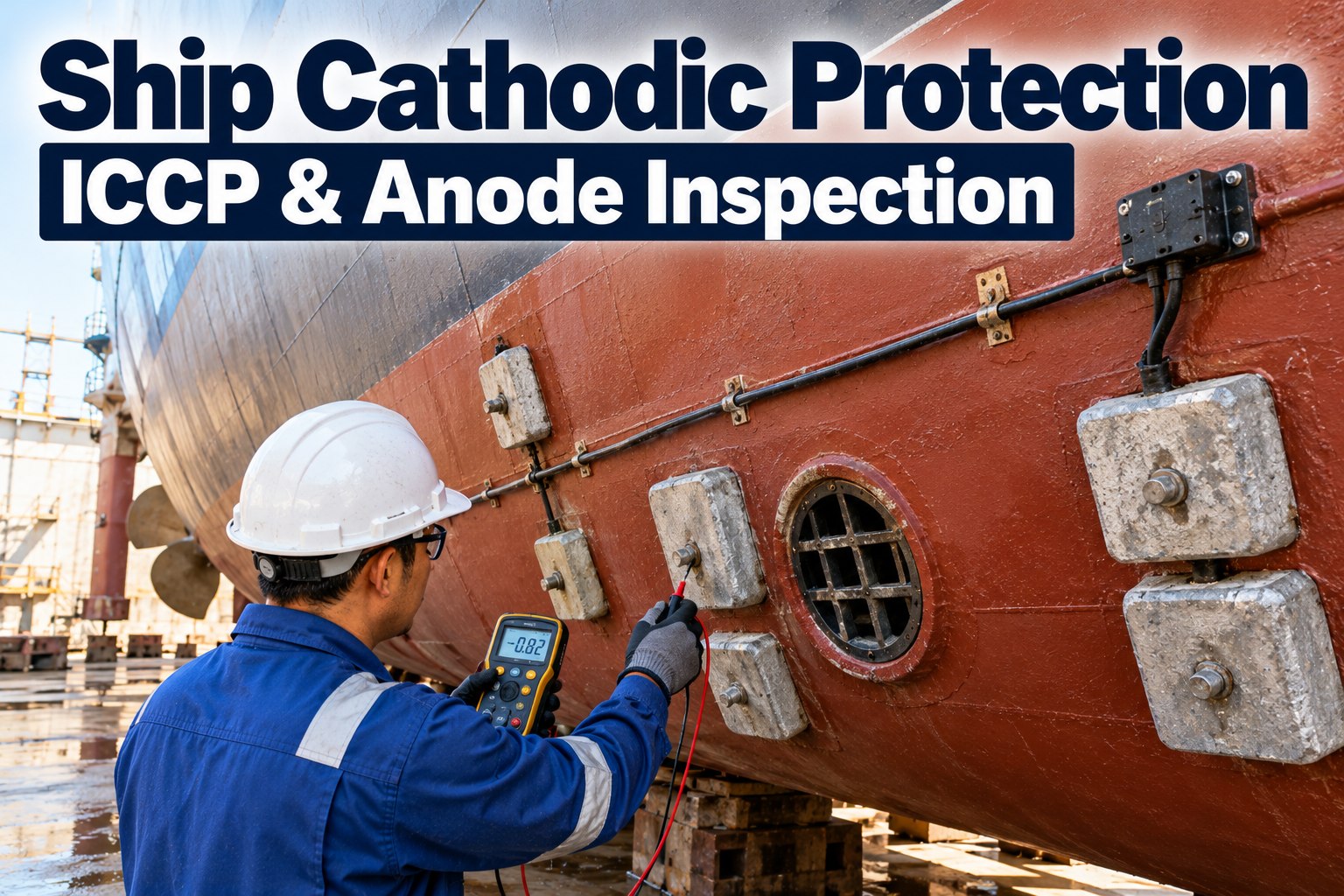
Hull corrosion is slow, which is why ship cathodic protection is easy to leave until the dock. What does ship cathodic protection need to achieve, how do impressed current and sacrificial anode systems differ, and what should a Technical Superintendent or Chief Engineer be able to show at a survey? This guide covers ship cathodic protection, ICCP system checks, reference electrode readings, sacrificial anode depletion, sea chest anodes and dry-dock inspection. It draws on ABS guidance notes, a class docking checklist, a vendor blog and two trade sources, and it flags where the sources are secondary or disagree. For hull condition work, see our hull inspection.
What Hull Potential Readings Mean for an ICCP or Sacrificial Anode System
The protection range, the overprotection limit and the reference electrode caveat
The core measurement in ship cathodic protection is the potential between the hull and a reference electrode in the seawater. ABS's Guidance Notes on Cathodic Protection of Ships, December 2017, give a protection potential of -0.80 V or more negative against a silver/silver chloride seawater electrode for carbon and low-alloy steel, with a negative limit of -1.10 V for mild steel. They say potential measurements should be made with a high-impedance meter, at least 10 megohms, with the electrode in the seawater as close as practicable to the hull, and that permanent electrodes should be periodically checked against another electrode. Electrode readings also vary with chloride concentration, temperature and light.
The number that matters depends on the electrode. ABS Table 2 gives +244 mV as the protection reading for a zinc reference electrode in seawater, which looks nothing like -0.80 V. A reading that is correct on one electrode type will be wrong on another, so every log entry should say which electrode produced it.
ICCP Versus Sacrificial Anodes: What Each System Needs From the Crew
Two ways to make the hull the cathode, with different failure modes
- Anodes are inert and powered. A reference electrode reading lets the controller adjust the output
- Needs a controller, rectifier, cables, anodes and reference electrodes to be working
- Overprotection is possible if the control goes wrong. A trade article says too much current can make paint peel
- Hull anodes cannot be inspected afloat, so inspection focuses on cofferdams, connections and outputs (vendor guidance)
- Zinc or other anodes corrode in place of the steel. ABS gives zinc a natural potential of about -1030 mV against Ag/AgCl
- No power or control, so no controller faults, but they waste away
- ABS says anode replacement is needed when about 50% or more is consumed
- Zinc is limited to about 60 degrees Celsius, according to ABS
The two approaches can coexist on one ship, and sea chests are a place where class docking checklists ask specifically about anodes. ABS notes that cathodic protection in a sea chest can adversely affect box coolers if they are electrically isolated, which is one reason sea chest protection appears on dock checklists.
ICCP Maintenance and Inspection: A Routine From Daily Logs to the Dry Dock
Who checks what, and how often, according to the sources
There is no single published ICCP schedule. The vendor blog from Evac, which owns the Cathelco brand, suggests daily rectifier checks, monthly log sheets, a detailed annual inspection and a full inspection at least every three years or yearly where class requires it. It is vendor guidance and internally inconsistent on frequency. A trade article adds that ICCP is typically overhauled during dry docking, and that parameters are logged daily from the remote monitoring panel in the engine control room. The grid below sets out the routine our sources imply.
Reference electrode life and the checks that keep readings honest
ABS Table 6 states that no system components need replacement except reference electrodes, which last 10 years. That is a design statement, not a rule to wait for. If readings are inconsistent, the vendor blog says to recalibrate or replace the electrode, and ABS says permanent electrodes should be checked against another. Put the electrode type, installation date and last cross-check into the equipment record, for example through your {L3}.
Sacrificial Anode Inspection and Replacement: When Zinc Anodes Are Used Up
What ABS says about consumption, potential and temperature
ABS says anode replacement is needed when about 50% or more is consumed, that galvanic anode operating potential is generally more negative than -1.00 V against silver/silver chloride, and that zinc has a natural potential of about -1030 mV and is limited to about 60 degrees Celsius. We did not find a single published pass mark for how to measure remaining mass at dock, so record each anode's position, condition and the estimated percentage consumed with a photograph, and compare it with the last dock.
Sea chest anodes deserve their own line in the record, because class docking checklists ask for confirmation that the corrosion protection in way of sea chests, including anodes, is in satisfactory condition. Schedule the anode job and its spares through maintenance work orders so that the parts are on board before the ship docks.
ICCP and Anode Fault Finding: Symptoms, Likely Causes and First Checks
A first-check guide, not a repair manual
The table summarises what the sources say about faults. It is our summary, and it does not replace the maker's troubleshooting chart. Work on an ICCP system involves electrical supplies and, in dock, work around the hull, so follow your isolation and permit procedures.
| Symptom | Likely cause | First check | Suggested action |
|---|---|---|---|
| Rectifier voltage or current outside its usual range | Failing anode, damaged wiring or a rectifier fault (Evac) | Compare with the last logged values, check connections for oxidation | Locate the fault with a qualified person and record it |
| Inconsistent reference electrode readings | Electrode fault or drift | Compare against another electrode, as ABS says permanent electrodes should be periodically checked | Recalibrate or replace the electrode |
| Paint peeling near anodes | Too much current into the hull (Marine Insight) | Reference readings against the protection range, controller setting | Investigate overprotection and correct the control |
| Little or no reading in fresh or brackish water | Low conductivity, so the reference electrode may not see the potential (Marine Insight) | Water conditions, panel behaviour | Follow the maker's procedure for fresh water passage |
| Heavily consumed hull or sea chest anode | Normal consumption, reaching about 50% (ABS) | Remaining mass against the replacement criterion | Plan replacement at the next opportunity |
| Coated anode or reference electrode in dock | Overpainting during hull work | Visual inspection, as in a class docking checklist | Clean to the maker's instruction before undocking |
Cathodic Protection Dry-Dock Inspection Checklist for the Superintendent
A checklist with a checkpoint type on each item
A class docking checklist we reviewed asks for visual inspection that anodes and reference electrodes are not coated and that the dielectric shield around each anode is installed appropriately, and for the sea chest corrosion protection, rudder and propeller to be examined. A trade checklist adds that ICCP anodes should be in position with covers removed, rudder anodes refitted and no TBT-based paint used. The checklist below is our template. Your class society's requirements, tracked through class society compliance tracking, decide what applies to your ship.
| Item | What to check | Checkpoint type |
|---|---|---|
| ICCP anodes and reference electrodes | Visual inspection that they are not coated with paint | Visual |
| Dielectric shield | Shield around each anode installed appropriately and undamaged | Visual |
| ICCP anode covers | Anodes fitted in position and any dock covers removed before undocking | Visual |
| Hull sacrificial anodes | Fitted properly with covers removed, remaining mass compared with the 50% replacement guide | Visual |
| Sea chest protection | Corrosion protection, including anodes, in satisfactory condition and sea chest gratings fitted | Visual |
| Rudder anodes and bonding | Rudder anodes refitted and the rudder bonded to the hull where fitted | Visual |
| Shaft earthing | Brushes and slip ring clean and the shaft-to-hull reading recorded, with the maker's acceptable value | Test |
| Controller and rectifier | Output tested, alarms tested and readings compared with commissioning values | Test |
| Hull potential | Potential measured with a high-impedance meter against the right reference electrode and compared with the criteria | Test |
| Reference electrode check | Permanent electrodes checked against another electrode and replaced if inconsistent | Test |
| Dock records | Anode condition, replacements, test results and photographs filed against the ship | Record |
Six Cathodic Protection Myths That Lead to Missed Findings
What the sources say instead
Keeping Cathodic Protection Readings, Photos and Dock History in One Place
How a dated photo repository, task ownership and deadlines support hull protection
Hull protection decisions depend on history that survives crew changes. Marine Inspection supports a dated photo repository, observations turned into tasks with owners, deadlines and evidence, and certificate and equipment tracking. A dated photo of each anode at every dock, a task for an inconsistent reference electrode with a named owner and due date, and tracked electrode installation dates give a superintendent the trend that a single reading cannot. It does not replace the ICCP maker's manual or class requirements, and we make no claim about class approval. Use electrical maintenance and testing for the electrical side and see Marine Inspection pricing for plans.