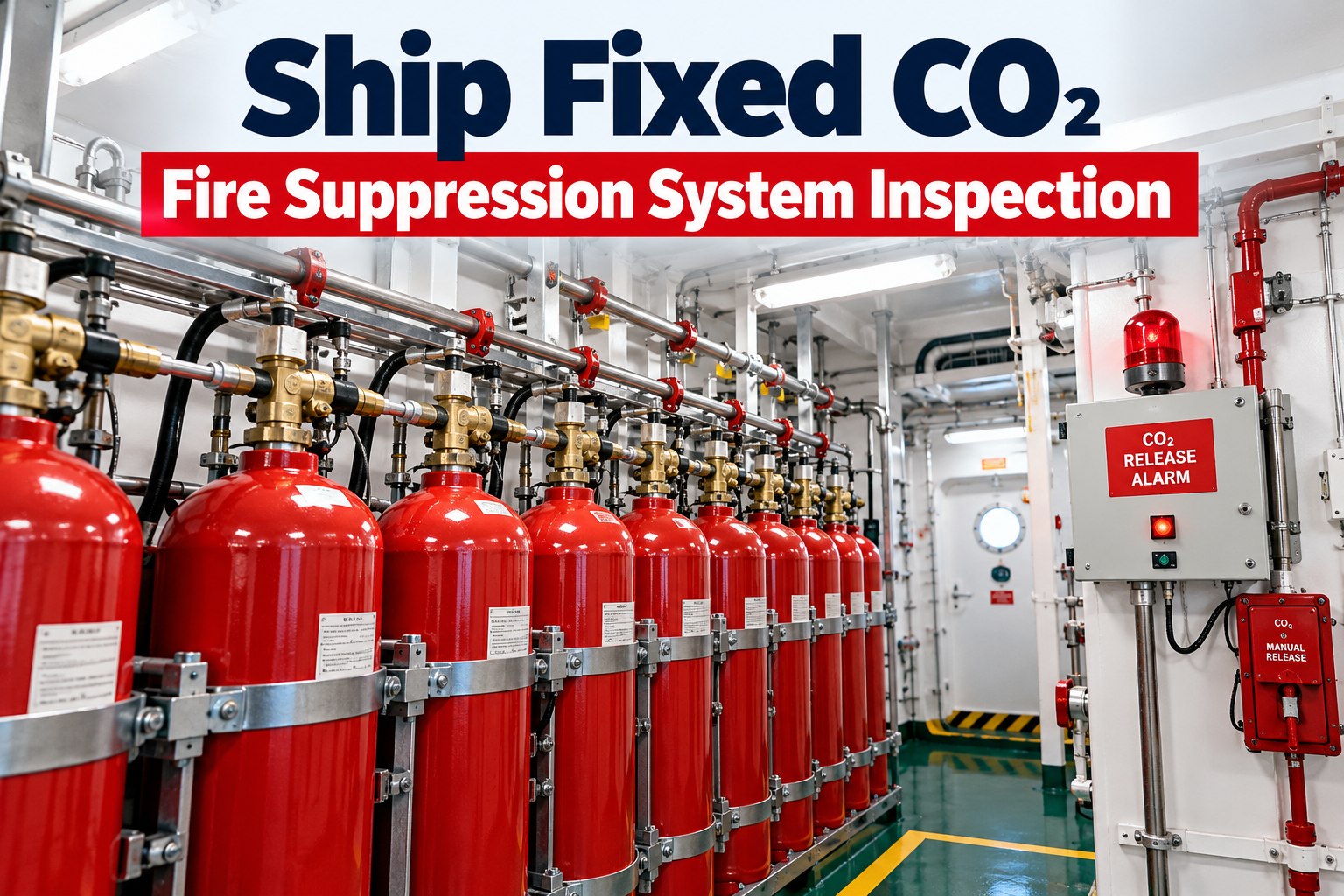
A fixed CO2 system is the last line of defence in an engine room fire, and the most dangerous system on board to get wrong. It must release on demand, it must never release by accident, and its cylinders must actually hold their charge. This guide covers how the system works, the SOLAS and FSS Code requirements, cylinder weighing, pipework and alarm checks, and the monthly to ten-yearly inspections in IMO’s maintenance guidelines. Book a demo to track CO2 servicing.
Ship fixed CO2 system inspection: from 30-day checks to 10-year cylinder tests
How a fixed CO2 fire suppression system works
Most ships use a high-pressure system with a bank of cylinders, piped to the protected spaces. Some larger installations use a low-pressure refrigerated tank. Release follows a set sequence.
Simplified. Follow your ship’s fire control plan and the maker’s instructions for the exact sequence.
SOLAS and FSS Code requirements for CO2 systems
SOLAS Chapter II-2 requires fixed systems in machinery spaces, and the Fire Safety Systems (FSS) Code Chapter 5 sets how CO2 systems are built. These are the points most often checked on board.
Summary of FSS Code Chapter 5 provisions. Exact wording, exemptions and dates of application vary; check your ship’s approved plans.
Fixed CO2 inspection intervals under MSC.1/Circ.1318/Rev.1
IMO’s revised guidelines for maintenance and inspection of fixed CO2 systems set what should be checked and when. They belong in the ship’s planned maintenance system.
| Interval | Main checks | Typically by |
|---|---|---|
| Every 30 days | General visual check: stop valves closed, release controls in place and reachable, piping undamaged, cylinders secured, alarms present | Competent crew |
| Annual | Space boundaries intact, cylinders free of damage or rust, piping and nozzles clear, hoses tight, doors close, warning signs and instructions posted | Crew or service provider, to maker’s instructions |
| Biennial | Weigh cylinders or verify contents; blow through piping with dry air or nitrogen; test release controls, alarms, time delays and interlocks | Trained service technician |
| 5 years | Internal inspection of all control valves | Service technician |
| 10 years | At least 10% of cylinders internally inspected and hydrostatically tested; all cylinders tested by the 20-year point; flexible hoses replaced within 10 years | Approved service station |
Biennial checks: every 2 years (±3 months) for passenger ships, and at each intermediate, periodical or renewal survey for cargo ships. Summary of MSC.1/Circ.1318/Rev.1.
CO2 cylinder weighing: the 90% rule
Cylinders are weighed, or contents checked by another reliable method such as liquid level measurement, at the biennial service. Any cylinder with less than 90% of its nominal charge should be refilled. The example below is illustrative.
Contents are the CO2 charge, not the gross weight. Compare against the tare and charge stamped on each cylinder or recorded by the service provider.
Never lose track of a CO2 service date
Schedule 30-day, annual, biennial, 5-year and 10-year tasks, log cylinder weights and attach service reports per ship.
CO2 pipework and nozzle checks
Pipework faults are easy to miss because the system is rarely used. A loss prevention bulletin from West P&I describes a newly built ship whose CO2 system failed when needed after an engine room fire, despite a recent service by an authorised agent.
What to check
- Piping, supports and nozzles undamaged and nozzles clear
- Flexible hoses tight and within their replacement date
- Discharge piping blown through to prove it is clear
- No low points where water can collect and corrode
Faults found in that case
- Joints leaking even after tightening
- Valve actuator arms held by a small screw; most zone valves loose
- Pilot cylinders that did not operate automatically
- Manuals, placards and drawings that did not match the ship
CO2 release alarms and safeties
CO2 is lethal at extinguishing concentrations, so the system is built to prevent accidental release and to warn people out before discharge. The biennial service tests these functions.
CO2 flooding decision: the sequence before release
Releasing CO2 into a space is a command decision. Practise the sequence in engine room fire drills, using a simulated release. See our SOLAS emergency drill guide for drill planning.
General outline only. Follow the ship’s fire control plan and company procedures.
Fixed CO2 system inspection checklist
Use this for the monthly visual check and before the annual inspection.
How Marine Inspection tracks fixed CO2 inspections
Marine Inspection keeps every CO2 task on a schedule, records cylinder contents, links service reports and raises defects as jobs. Fire equipment sits alongside drills in our crew safety inspection module. The board below is illustrative.
Fixed CO2 system FAQs
How often should CO2 cylinders be weighed?
At the biennial inspection under MSC.1/Circ.1318/Rev.1, by weighing or another reliable method. Cylinders below 90% of nominal charge should be refilled.
What is checked every 30 days?
A general visual check: valves closed, release controls in place, piping undamaged, cylinders secured and alarm devices present.
When must CO2 cylinders be hydrostatically tested?
At the 10-year inspection, at least 10% are tested, with more if any fail. All cylinders must be tested before the 20-year point and every 10 years after.
How long must the pre-discharge alarm sound?
Long enough to evacuate the space, and not less than 20 seconds, under the FSS Code.
Who services the CO2 system?
Crew can do routine visual checks. Biennial testing of controls and alarms, and longer-interval work, is done by trained service technicians.
Can Marine Inspection track CO2 servicing?
Yes. Book a demo to see CO2 schedules, cylinder records and service reports.
Ready to release, safe from release
Full cylinders, clear pipework, working alarms and records that prove it, every interval on time.