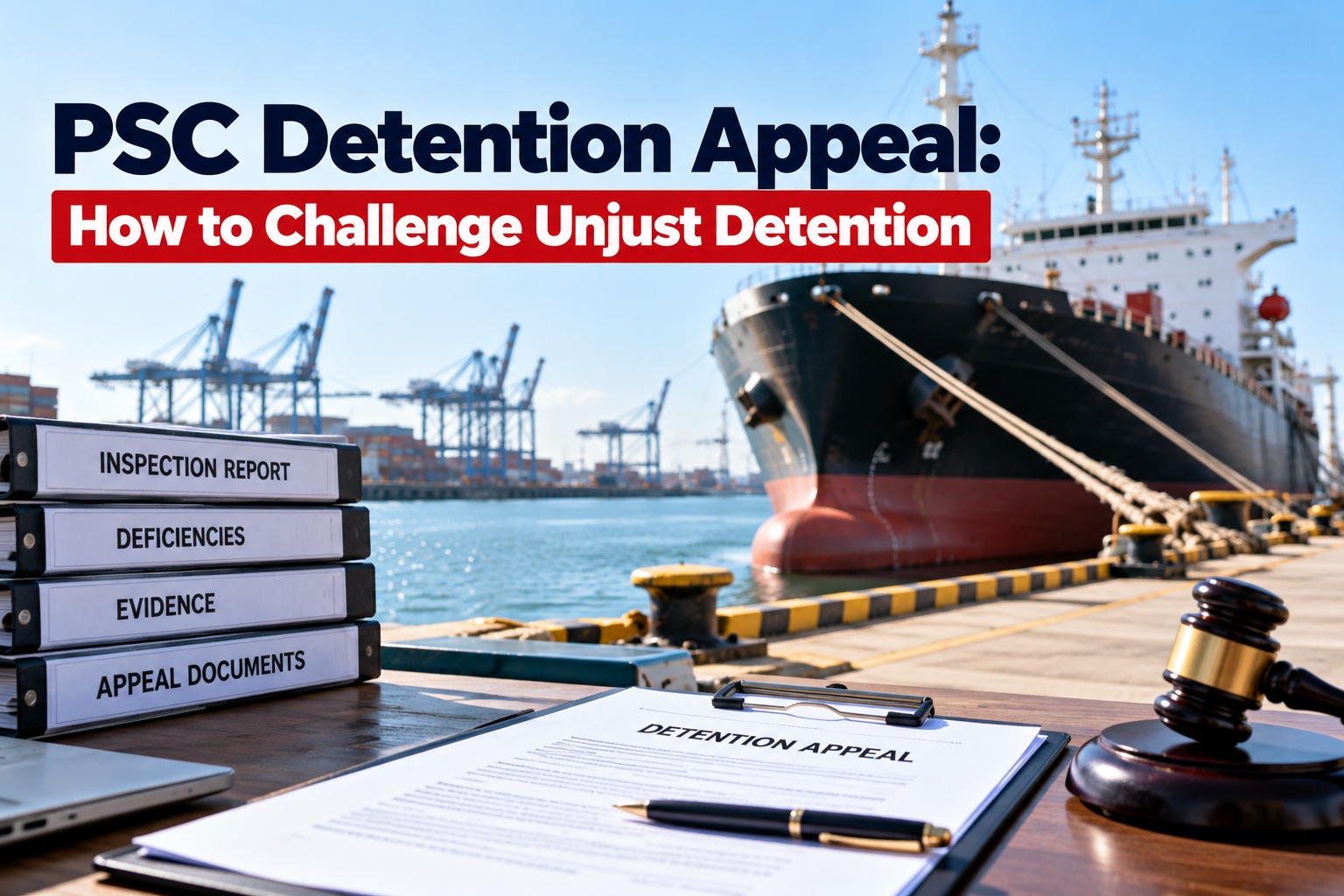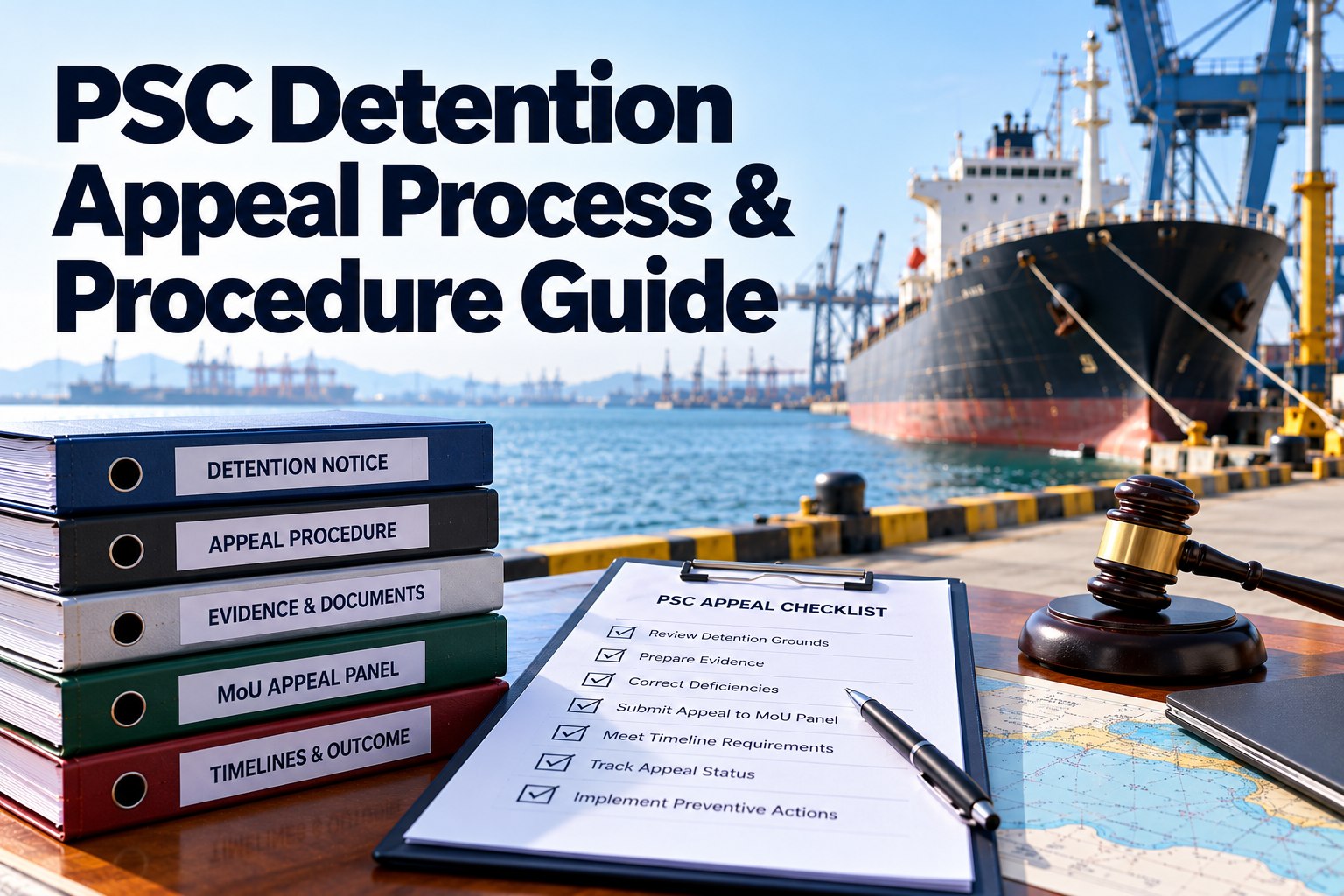
A detention is a legal decision by a port State, and it stays on the ship's record and its owner's profile. Sometimes a detention is justified. Sometimes the evidence behind it is thin, a count of small items or a misread statement. What can a company do if it believes a detention was unjustified, and how much time does it have? This guide, written for the Fleet Manager, sets out the two routes after a detention, the time limits published by the Paris and Tokyo MoUs, two real review panel cases, the evidence to gather from day one and a realistic view of outcomes. For preparation before the inspection, see our complete port state control preparation guide for ship masters.
Two Routes After a Detention, and Why the Order Matters
National appeal first, MoU review only if the national route was not used
The Paris MoU says a detention is imposed where deficiencies make a ship unfit to proceed to sea or pose an unreasonable environmental risk, and that the master is told the owner or operator has a right of appeal. National procedures are printed on the back of the detention notice and differ between member States. The MoU detention review is for an owner who did not use the national appeal and still wants to complain. The Tokyo MoU is stricter: if the legal national appeal procedure has been implemented, a request for review will not be accepted.
- The inspector tells the master of the right to appeal. Details are on the back of the detention notice
- Deadlines and bodies differ by country
- Some authorities start with a direct review by a senior officer, then a tribunal or court
- Only the flag State or recognised organisation submits the request
- Panel reviews procedural and technical aspects
- Findings advisory. Port State may amend the record
The owner cannot ask the panel directly
Under both MoUs the owner or operator complains to the flag State or a recognised organisation authorised to act for it. If the flag State or recognised organisation thinks the detention was unjustified, it asks the port State to reconsider and then, if unsatisfied, requests a review from the Secretariat. Panama's flag notice MMN-11/2026 advises operators to try first to resolve the issue with the inspector professionally, preserve all evidence, contact the flag State early, and notes that the flag Administration can act as intermediary and support escalation to the MoU. The comparison table collects the routes.
| Authority or MoU | Route described | Limits noted in the source |
|---|---|---|
| Paris MoU | National appeal first. Otherwise a complaint to the flag State or recognised organisation, which requests port State reconsideration, then a review by the Secretariat and four rotating authorities | 120 days from release. 90 days waiting for the port State reply. Findings not binding |
| Tokyo MoU | National appeal first. Otherwise a complaint to the flag State or recognised organisation, then a panel of three authorities chosen alphabetically | 120 days or 4 months from release, whichever is longer. Not accepted if the national procedure was used. Not a basis for compensation |
| AMSA, Australia | A direct approach to the Manager Ship Inspection and Registration. Then the Tokyo or Indian Ocean MoU panel through the flag State, or the Administrative Appeals Tribunal | No day limits stated on the page we read |
| Flag State view, Panama MMN-11/2026 | Resolve professionally with the inspector first, preserve evidence, contact the flag State early. The Administration reviews and can escalate to the MoU | An appeal does not suspend the detention. Detailed timelines are in a separate circular we did not see |
The Clock: Deadlines That Start at Detention or at Release
Different limits start from different events
Some limits run from the date of detention, such as Italy's 30 days to ask the port State to reconsider. The MoU review limits run from release. The Paris page gives 120 days from release and says a flag State or recognised organisation may request review if it is dissatisfied or receives no response within 90 days. The Tokyo page gives 120 days or 4 months, whichever is longer. The Paris Secretariat's summary of panel opinions follows within 30 days of accepting the request, or 30 working days on another page. The chart puts them on one scale.
Grounds: What Review Panels Actually Look At
Procedural and technical aspects, and consistency with the IMO guidelines
Panels consider the procedural and technical aspects of the inspection. In the 2018 case the panel held that the detention was not consistent with the IMO guidelines for the detention of ships, found that no clear link had been drawn between each deficiency and the safety management system and no objective evidence such as photos, video or records supported a serious management failure, and said it was inappropriate to detain based only on the number of deficiencies. In the 2016 case the panel found the log entries for lowering and manoeuvring the boats met the SOLAS requirement, that no rule requires photographs of drills, and that the inspector's concerns were a clear ground for a more detailed inspection, not an immediate basis for detention.
What the cases teach, and what they do not
Both cases were won on evidence and on how the port State reasoned, not on the ship's goodwill. A later class audit and flag survey were not accepted against findings made at the time, and a mismatch between a record book and a junior officer's statement gave the port State its argument. These are two published cases out of many, selected by the MoU for summary. Treat them as lessons in documentation, not as evidence that appeals usually work.
Evidence: What to Collect From the First Hour
The file that a flag State can actually use
Panama's notice asks operators to collect and preserve all supporting evidence, including records, statements, photos, videos and technical documentation. The case summaries add three points: tie each deficiency to the SMS, keep records consistent with crew statements and verify statements made by junior officers. The table sets out the file with a checkpoint type for each item so it can be audited. It is our template.
| Item | What to collect | Checkpoint type |
|---|---|---|
| Inspector's findings | The written deficiency list and detention notice, with each item and its code | Record |
| Condition of the item | Dated photos and video of each disputed item as found | Visual |
| Test results | Function test records for equipment questioned, witnessed where possible | Test |
| Link to the SMS | For ISM findings, the exact procedure and the record showing it was or was not followed | Record |
| Crew statements | Written statements from those questioned, checked with senior officers for accuracy | Record |
| Logs and drill records | Entries that match the statements and physical evidence | Record |
| Class and flag input | Surveyor reports and the flag State's technical review, dated | Record |
| Rectification evidence | Photos, receipts and survey reports for each repair, with dates | Visual |
| Timeline of dates | Detention date, release date and each deadline in the notice | Record |
A Realistic View of Outcomes
What the one published set of figures shows
AMSA's 2020 page reports 20 ship detention appeals, each reviewed in full, with one detainable deficiency removed for lack of sufficient evidence. One appeal went to the Tokyo MoU panel, which found the detention warranted, and of three tribunal appeals two were withdrawn and one was still pending. The page does not give outcomes for the other 19 initial appeals. This is one authority and one year, so it cannot give a success rate. It does suggest that the strongest cases are those with specific, documented evidence.
Protecting the record while you decide
A detention counts towards the ship's history and risk profile, which the West of England P&I Club and the Paris MoU describe as based on inspections, deficiencies and detentions. The first step is therefore to rectify genuine defects, document the rectification and contest only items you can support. ANAVE's guidance on preparation says to contest outstanding deficiencies that could lead to detention with technical arguments before registration, which is cheaper than an appeal afterwards. For defect follow-up, see our marine defect tracking software.
Detention Response Checklist for the Fleet Manager
A checklist with a checkpoint type on each item for the first week after a detention
Use the checklist as soon as a detention notice is received. It is our template, built from the procedures and cases above.
| Item | What to check | Checkpoint type |
|---|---|---|
| Right of appeal | Master given the appeal details on the notice, and the company has chosen whether to use the national route | Record |
| Contact list | Flag State, class, P&I club or lawyer, and company contact reached the same day | Record |
| Deadline tracker | Every deadline entered with an owner, including the national appeal limit and the MoU review window | Record |
| Evidence file | Evidence list above collected and stored in one dated location | Record |
| Honest assessment | Each deficiency marked as accepted and rectified, or contested with technical grounds | Record |
| Rectification | Genuine defects repaired and verified before release | Test |
| Record check | Database entry checked after release and any reversal confirmed | Record |
| Lessons | Root cause found for each deficiency, with preventive tasks and owners | Record |
Six Mistakes in Appealing a Detention
What the procedures and cases point to
Systems That Keep Detention Evidence and Deadlines Together
How a dated photo repository, task ownership and deadlines support the response
A detention response is a race between deadlines and evidence. Marine Inspection supports a dated photo repository, observations turned into tasks with owners, deadlines and evidence, and certificate and equipment tracking. Dated photos of each disputed item, a task per deficiency with a named owner and due date and a tracked list of deadlines give a Fleet Manager the file a flag State needs. It does not file an appeal or replace legal advice. For the inspection regime itself, see our Tokyo MOU port state control inspection regime and targeting system.