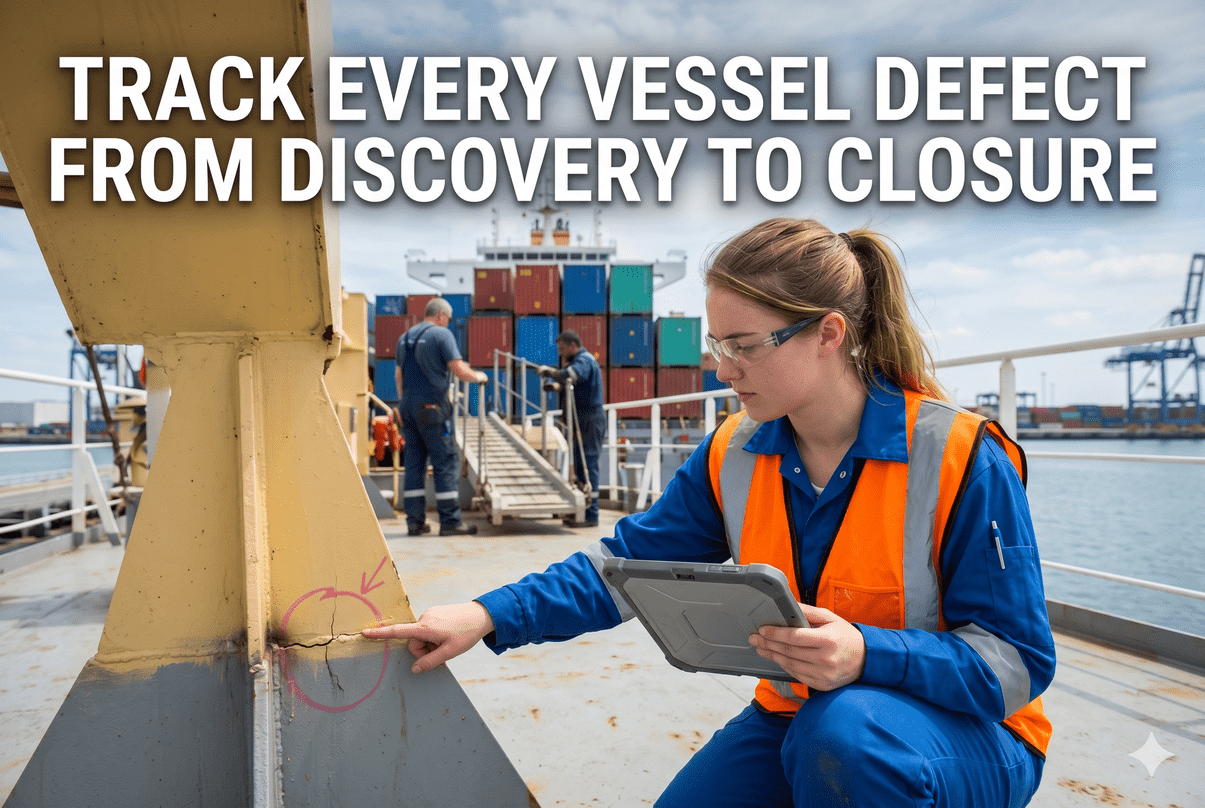
A vessel defect that lives in a logbook note, an email to the office, and a line in the next handover report is a defect that will resurface as a PSC deficiency, a class survey finding, a charter dispute, or an insurance claim — long after the moment when timely action could have closed it. Marine defect tracking software replaces that scattered approach with a single timestamped lifecycle from discovery through closure: structured capture with photos and equipment context at the source, immediate notification to the responsible superintendent, escalation rules when SLAs slip, work-order generation, parts procurement linkage, and closure evidence with un-editable audit trail. The 2026 environment makes the discipline non-negotiable. PSC inspectors, class surveyors, and charterer vetting reviewers all read defect history before they read anything else. Start a free trial of Marine Inspection to track every vessel defect from discovery to closure with the audit-grade lifecycle the 2026 environment requires.
Marine Defect Tracking Software · 2026
From Discovery To Closure. Every Defect Tracked. Every Audit Defended.
Structured capture, automated escalation, work-order integration, un-editable audit trail — the defect lifecycle the 2026 PSC, class, and charterer vetting environment expects.
MECH · HIGH
CO2 system pressure low
STRUCT
Corrosion port frame
ELEC
Emergency gen battery
SAFETY
Lifeboat davit grease
VERIFIED
Fire main pressure
The Five Lifecycle Stages Every Defect Must Pass Through
A credible defect tracking system runs every defect through five sequential stages. Skip a stage and the defect goes from discovered to dormant — surfacing later as a PSC finding or audit gap. Each stage produces specific evidence required for the next.
Stage 1
Discovery & Capture
Crew member identifies the defect during routine round, scheduled inspection, or operational event. Structured capture: equipment ID, location on vessel, severity rating, photo evidence with GPS-timestamp, initial assessment.
Stage 2
Categorization & Routing
Defect categorized by system (mechanical, electrical, structural, safety, navigation, accommodation), severity (critical, high, medium, low), and trigger (PSC finding, internal inspection, near-miss). Auto-routed to responsible superintendent.
Stage 3
Assignment & Planning
Superintendent reviews and decides: vessel crew work order, shore contractor requisition, drydock backlog item, or class society notification. Parts procurement raised. SLA assigned per severity.
Stage 4
Execution & Evidence
Crew or contractor executes the corrective action. Completion photos captured. Parts consumed logged. Time recorded. Master or chief engineer counter-signs critical closures.
Stage 5
Verification & Closure
Superintendent verifies closure evidence. Cross-references against the original finding photo. Closes the defect with audit trail entry. Trend analysis updates fleet-wide pattern detection.
The Defect Severity And Category Matrix
Defects are not equal. A critical-severity safety defect on the main propulsion blocks vessel departure; a low-severity cosmetic defect waits for the next drydock backlog. The matrix below maps the working severity-by-category structure most fleets adopt in 2026. Scroll horizontally on mobile.
| Category |
Critical (SLA <24h) |
High (SLA <7d) |
Medium (SLA <30d) |
Low (Next Drydock) |
| Main Propulsion |
Engine failure, prop damage |
Turbocharger irregularity |
Fuel pump performance |
Cosmetic component wear |
| Steering & Navigation |
Steering failure |
Autopilot intermittent |
ECDIS minor anomaly |
Display brightness |
| Safety Equipment |
Lifeboat unusable |
Fire main pressure low |
SCBA pressure check |
Emergency lighting |
| Electrical & Power |
Black-out condition |
Emergency generator |
Switchboard anomaly |
Cabin lighting |
| Structural |
Hull breach |
Active corrosion zone |
Coating breakdown |
Cosmetic deck wear |
| Cargo Systems |
Cargo system leak |
Hold ventilation issue |
Cargo gear wear |
Hold ladder paint |
| Accommodation |
Galley fire risk |
HVAC failure |
Plumbing leak |
Cabin furniture |
The Five Escalation Rules That Make SLAs Stick
Without escalation, defect SLAs become aspirational. Five escalation rules built into the platform make slippage visible and assign accountability before the defect ages out of relevance.
01
Time-Based Escalation
Defect overdue per SLA escalates automatically to the next authority level. Critical 24-hour SLA escalates to fleet manager. 7-day SLA escalates to technical director. 30-day SLA escalates to DPA.
02
Repeat-Finding Escalation
Same defect category on same equipment within 90 days flags repeat-finding pattern. Escalates for root cause review beyond simple closure. Trend analysis surfaces fleet-wide pattern.
03
Severity Re-Classification
Defect severity upgraded after capture (high becomes critical when context surfaces). Escalation re-triggers with shortened SLA. Original capture preserved in audit trail.
04
Port Call Approach
Open defects approaching a PSC-active port surface for pre-arrival review. Operator decides: close before arrival, document mitigation, or notify port authorities. PSC defence position established.
05
Class Survey Trigger
Open defects approaching scheduled class survey surface for pre-attendance disposition. Conditions of class avoided through proactive closure rather than reactive responses to surveyor findings.
Defect Tracking Demo · 30 Minutes
Walk Through Your Fleet's Defect Lifecycle Live
A 30-minute session with a Marine Inspection product expert. Bring your current defect backlog. Walk through the five-stage lifecycle, severity-by-category matrix, escalation rules, and audit pack generation on your fleet's actual data.
What Centralized Defect Tracking Delivers That Spreadsheets Cannot
Spreadsheets and email chains handled defect tracking adequately when fleets ran 2-5 vessels and PSC inspections were 5-yearly. Neither survives the 2026 environment. Book a defect lifecycle walkthrough to see the centralized model on your fleet.
SPREADSHEET + EMAIL
Defects scattered across vessel files
Severity assigned inconsistently per superintendent
SLAs aspirational, no escalation enforcement
Repeat-finding patterns invisible
PSC inspector retrieval takes hours
Class survey defect backlog assembled retrospectively
No fleet-wide trend analysis
CENTRALIZED DEFECT TRACKING
Single defect lifecycle across the fleet
Severity-by-category matrix enforced
SLAs with automatic escalation rules
Repeat-finding detection across vessels
PSC defence pack assembled in minutes
Pre-survey defect disposition workflow
Fleet-wide trend dashboard with drill-down
Why Marine Inspection For Defect Tracking
Marine Inspection delivers centralized defect tracking on the five-stage lifecycle, severity-by-category matrix, and five-rule escalation framework with un-editable audit trail. Start a free trial or book a 30-minute demo to see the platform.
Five-Stage Lifecycle Workflow
Discovery, Categorization, Assignment, Execution, Verification — every stage produces required evidence for the next. Cannot be skipped. Cannot be retroactively modified.
Severity-By-Category Matrix
Pre-built matrix across mechanical, electrical, structural, safety, navigation, cargo, accommodation. Critical 24h, High 7d, Medium 30d, Low next-drydock SLAs. Customizable per operator.
Five Escalation Rules
Time-based, repeat-finding, severity re-classification, port-call approach, class-survey trigger — escalation built in rather than relying on superintendent memory.
Work-Order Integration
Every defect produces a linked work order with parts, labour, deadlines. PMS integration prevents duplicate systems. Procurement workflow triggered automatically for shore-supply items.
Un-Editable Audit Trail
Every stage transition timestamped and signed. Original capture preserved through every modification. PSC inspector, class surveyor, or auditor sees the full defensible record in seconds.
Fleet-Wide Trend Detection
Recurring patterns surfaced across sister vessels — same equipment failing, same operational scenario producing near-misses. Capex and operational decisions informed by visual data.
Frequently Asked Questions
What does marine defect tracking software do?
Marine defect tracking software replaces logbook notes, handover lines, and scattered emails with a single timestamped lifecycle from defect discovery through closure. Structured capture at the source records equipment ID, location on vessel, severity, photo evidence with GPS-timestamp, and initial assessment. Automated routing notifies the responsible superintendent immediately, eliminating the back-and-forth email chase. Severity-by-category matrix assigns SLAs — critical 24 hours, high 7 days, medium 30 days, low next-drydock. Escalation rules surface slippage automatically. Work orders, parts procurement, and contractor requisitions integrate to the lifecycle. Closure requires evidence and supervisory verification. Every stage transition produces an un-editable audit trail for PSC defence, class survey, charterer vetting, and insurance claims. Fleet-wide trend analysis surfaces recurring patterns across sister vessels for capex and operational decisions.
What are the five defect lifecycle stages?
A credible defect tracking system runs every defect through five sequential stages, each producing specific evidence required for the next. Stage 1 Discovery and Capture — crew member identifies the defect during routine round, scheduled inspection, or operational event, with structured capture of equipment ID, location, severity rating, photo evidence with GPS-timestamp, and initial assessment. Stage 2 Categorization and Routing — defect categorized by system (mechanical, electrical, structural, safety, navigation, accommodation) and severity (critical, high, medium, low), auto-routed to the responsible superintendent. Stage 3 Assignment and Planning — superintendent decides vessel crew work order versus shore contractor versus drydock backlog versus class society notification, with parts procurement raised and SLA assigned. Stage 4 Execution and Evidence — corrective action executed with completion photos, parts consumption, time logged, supervisory counter-signature on critical closures. Stage 5 Verification and Closure — superintendent verifies evidence, cross-references against original finding photo, closes with audit trail entry, trend analysis updates.
How does the severity-by-category matrix work?
The severity-by-category matrix structures every defect along two axes — system category (Main Propulsion, Steering and Navigation, Safety Equipment, Electrical and Power, Structural, Cargo Systems, Accommodation) and severity (Critical with under-24-hour SLA, High with under-7-day SLA, Medium with under-30-day SLA, Low with next-drydock disposition). Examples by category — Main Propulsion Critical means engine failure or propeller damage, High means turbocharger irregularity, Medium means fuel pump performance, Low means cosmetic component wear. Safety Equipment Critical means lifeboat unusable, High means fire main pressure low, Medium means SCBA pressure check, Low means emergency lighting bulb. Structural Critical means hull breach, High means active corrosion zone, Medium means coating breakdown, Low means cosmetic deck wear. The matrix ensures consistent severity assignment across superintendents and vessels, preventing the inconsistency that plagues spreadsheet tracking where the same defect type gets different severity from different superintendents.
What escalation rules make SLAs stick?
Five escalation rules built into the platform make slippage visible and assign accountability before defects age out of relevance. Time-Based Escalation — defect overdue per SLA escalates automatically (critical 24-hour to fleet manager, 7-day to technical director, 30-day to DPA). Repeat-Finding Escalation — same defect category on same equipment within 90 days flags repeat-finding pattern, escalates for root cause review beyond simple closure. Severity Re-Classification — defect severity upgraded after capture (high becomes critical when context surfaces) re-triggers escalation with shortened SLA while preserving original capture. Port Call Approach — open defects approaching a PSC-active port surface for pre-arrival review with operator decision on close-before-arrival, document mitigation, or port authority notification. Class Survey Trigger — open defects approaching scheduled class survey surface for pre-attendance disposition with conditions of class avoided through proactive closure.
How does centralized tracking compare to spreadsheets?
Spreadsheets and email chains handled defect tracking adequately when fleets ran 2-5 vessels and PSC inspections were 5-yearly. Neither survives the 2026 environment. Spreadsheet-and-email reality means defects scattered across vessel files, severity assigned inconsistently per superintendent, SLAs aspirational with no escalation enforcement, repeat-finding patterns invisible across vessels, PSC inspector retrieval taking hours of search effort, class survey defect backlog assembled retrospectively in the days before attendance, and no fleet-wide trend analysis capability. Centralized defect tracking delivers single lifecycle across the fleet, severity-by-category matrix enforced consistently, SLAs with automatic escalation rules, repeat-finding detection across sister vessels, PSC defence pack assembled in minutes, pre-survey defect disposition workflow, and fleet-wide trend dashboard with drill-down to vessel and defect detail.
How does Marine Inspection track vessel defects?
Marine Inspection delivers centralized defect tracking on the five-stage lifecycle (Discovery, Categorization, Assignment, Execution, Verification) with severity-by-category matrix and five-rule escalation framework. Pre-built matrix covers mechanical, electrical, structural, safety, navigation, cargo, accommodation categories with Critical 24-hour, High 7-day, Medium 30-day, Low next-drydock SLAs customizable per operator. Work-order integration with PMS prevents duplicate systems. Procurement workflow triggered automatically for shore-supply items. Un-editable audit trail with every stage transition timestamped and signed, original capture preserved through every modification. Fleet-wide trend dashboard surfaces recurring patterns across sister vessels. PSC defence pack, class survey pre-attendance pack, charterer vetting evidence assembled in minutes. 6-12 week deployment for typical mid-size fleets. Free trial available with full functionality before any commitment.
Ready When You Are
Every Defect Captured. Every SLA Enforced. Every Audit Defended.
Five-stage lifecycle, severity-by-category matrix, five-rule escalation framework, work-order integration, un-editable audit trail, fleet-wide trend detection — all in one platform built for the 2026 defect tracking reality.

.png)
.png)