Lubricating oil is the only component of a diesel engine that touches every moving part, and it is also the only one that reports back. Every bearing that is wearing, every liner that is scuffing, every cooler that is weeping and every injector that is dribbling leaves a trace in the oil long before it leaves a trace anyone can see. That makes the lube oil system two things at once: a machine to be maintained, with purifiers, filters, pumps and coolers of its own, and a diagnostic instrument that only works if samples are taken properly and results are trended. Most oil-related failures are avoidable, because the warning ran through the sample bottle months earlier and nobody compared it with the one before. This guide covers the whole picture: how crosshead and trunk piston systems differ and why their limits differ with them, where contamination comes from, the onboard tests worth doing and the laboratory tests worth paying for, how to run and maintain a purifier so it actually separates, how to read a trend rather than a single result, and the records that prove the system is managed. Treat the figures as typical guidance, because the engine maker and the oil supplier set the limits for your ship. To keep sample results, purifier records and filter findings against the machinery they belong to, try Marine Inspection free.
Take the sample from the right place, test the same things every time, and compare with the last result. Almost everything on this page follows from those three habits, and most oil-related failures were visible in the log long before they reached the bearing.
Two system types, two sets of expectations
Before reading any limit, be clear which system the sample came from. A crosshead engine keeps its crankcase oil largely separate from combustion, while a trunk piston engine's oil is exposed to everything the cylinder produces. That difference drives the whole of oil management.
- System oil lubricates bearings, crosshead and often cools pistons
- Cylinder oil is separate and once-through, fed to the liner
- The diaphragm keeps most combustion products out of the crankcase
- System oil charges can last for years with purification and top-up
- Cylinder oil feed rate and base number are matched to fuel sulphur
- One oil lubricates bearings and the cylinder area
- Exposed to soot, unburnt fuel, acids and cat fines
- Base number is consumed by the fuel's sulphur content
- Insolubles and viscosity rise faster, so limits are tighter
- Charges are renewed more often, on condition
Where contamination comes from
Every contaminant has a route in, and each leaves a different signature in the analysis. Knowing the routes turns a laboratory report into a search.
Onboard testing: quick, weekly and worth doing
Onboard tests will not replace a laboratory, but they catch fast-moving problems between samples and tell you whether to send a sample early.
Sampling: the step that decides whether the result means anything
A laboratory can only analyse what arrives in the bottle. Most misleading reports come from a poor sample, not a poor test.
Reading the analysis
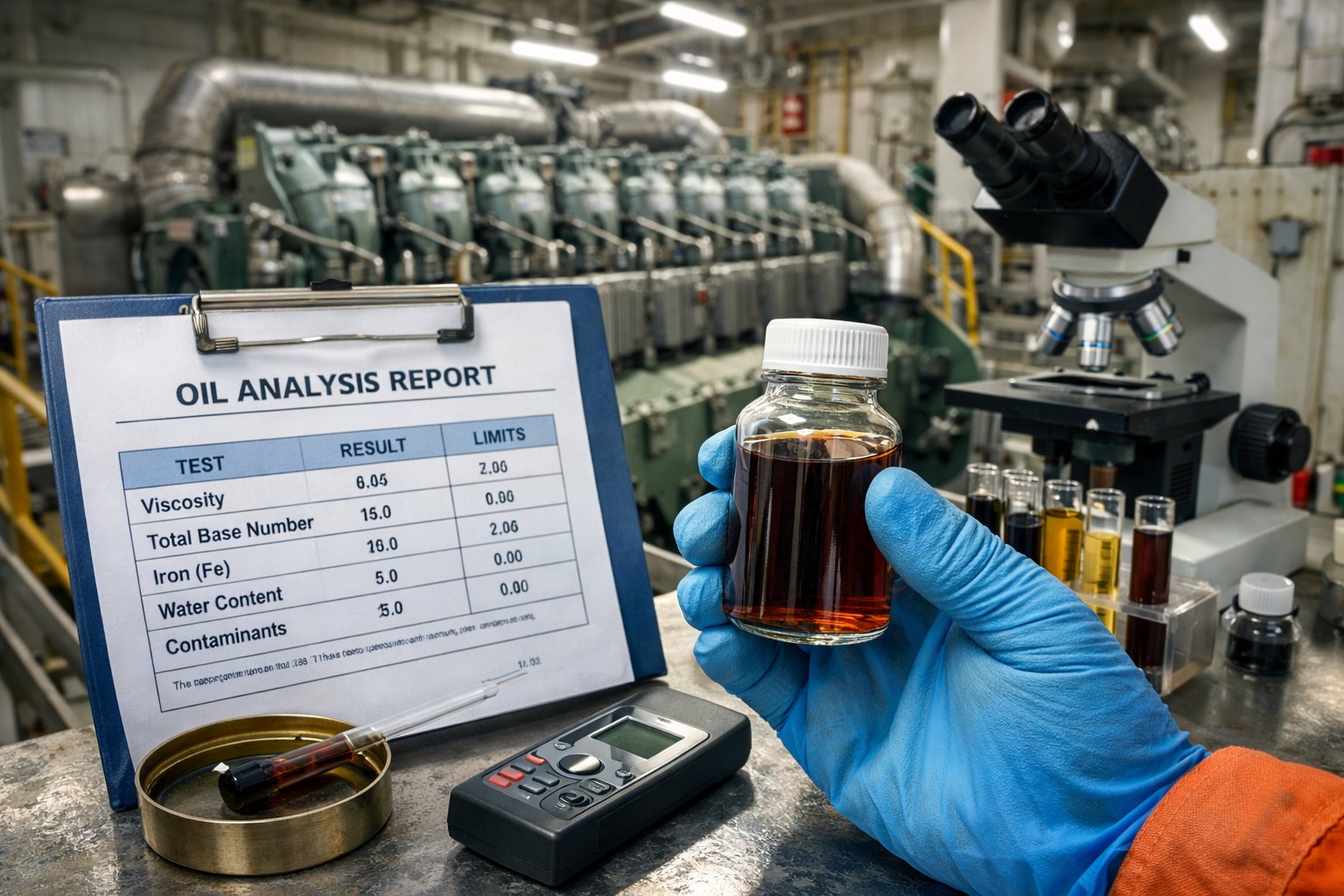
Laboratory reports typically cover viscosity, water, base or acid number, insolubles, flash point and wear metals, compared against the maker's limits, the previous samples and the normal condition of that equipment. The value of the report is in the comparison, not the single number.
| Parameter | Rising means | Falling means | Where to look |
|---|---|---|---|
| Viscosity | Soot loading, oxidation, residual fuel contamination, water emulsion | Dilution by distillate fuel, or mixing with a lighter oil | Combustion, purifier performance, injection equipment, recent top-up grade |
| Water content | Cooler or jacket leak, piston cooling leak, condensation | Purifier working, or the leak stopped | Coolers, seals, sump level trend, purifier operation |
| Base number | Rarely rises, unless topped up with fresh or higher base oil | Acid neutralisation by sulphur in the fuel, and normal ageing | Fuel sulphur, oil consumption and top-up rate, feed rate on cylinder oil |
| Acid number | Oxidation and acidic contamination | Fresh oil addition | Oil temperature, air entrainment, oil age |
| Insolubles | Soot, blow-by, poor combustion, poor filtration | Effective purification | Rings and liners, injection, purifier throughput and temperature |
| Flash point | Not usually significant | Fuel dilution, sometimes significant safety implications | Injection equipment, pump seals, high-pressure pipes |
| Iron | Liner, ring, gear, bearing or shaft wear | Wear reduced after corrective work | Correlate with scavenge inspections and filter debris |
| Copper and lead or tin | Bearing or cooler wear, and copper also accelerates oil oxidation | — | Bearing condition, cooler tubes, filter and magnet debris |
| Sodium and magnesium | Seawater ingress, classically indicated when the two appear in roughly a four to one ratio | — | Seawater coolers, stern tube, sea chest side of the system |
| Silicon and aluminium | Cat fines from the fuel, or dust ingress | — | Fuel treatment plant, purifier settings, air filtration |
Water: the limits that matter most
Water is the contaminant most likely to be found onboard and the one with the clearest action levels. Published guidance for crosshead engines commonly puts the normal limit at less than 0.2% water in the system oil, with immediate action between 0.5% and 1.0%, and serious risk above that. For trunk piston engines the figures are tighter: less than 0.1% normally, with immediate action above 0.5%. A common rule of thumb across both is that 0.2% should prompt investigation of the source, and 0.5% calls for remedial action.
Seawater is worse than freshwater at the same percentage, because of the salt. If sodium and magnesium appear together, treat it as seawater until proved otherwise and find the leak before anything else.
Purifier operation: temperature, throughput and the water seal
A purifier that is running is not necessarily separating. Three settings decide how well it works, and all three are easy to get wrong without anyone noticing until the oil report comes back.
Separation needs the oil at the correct temperature, commonly in the range of about 85 to 95 °C for lubricating oil, and efficiency improves towards the upper end. A heater that is not holding temperature quietly halves the purifier's usefulness.
Slower is better. Separation improves as flow reduces, so the correct practice is the lowest throughput that still turns the sump over as the maker requires, not the highest the pump can manage.
The seal must be established correctly before oil is admitted, and the gravity disc or paring arrangement must match the oil density. The wrong disc means either oil going overboard with the water or water staying in the oil.
Set the discharge interval to the fouling rate, not to a default. Watch the quantity and appearance of what is discharged, since a change there is a message from the engine.
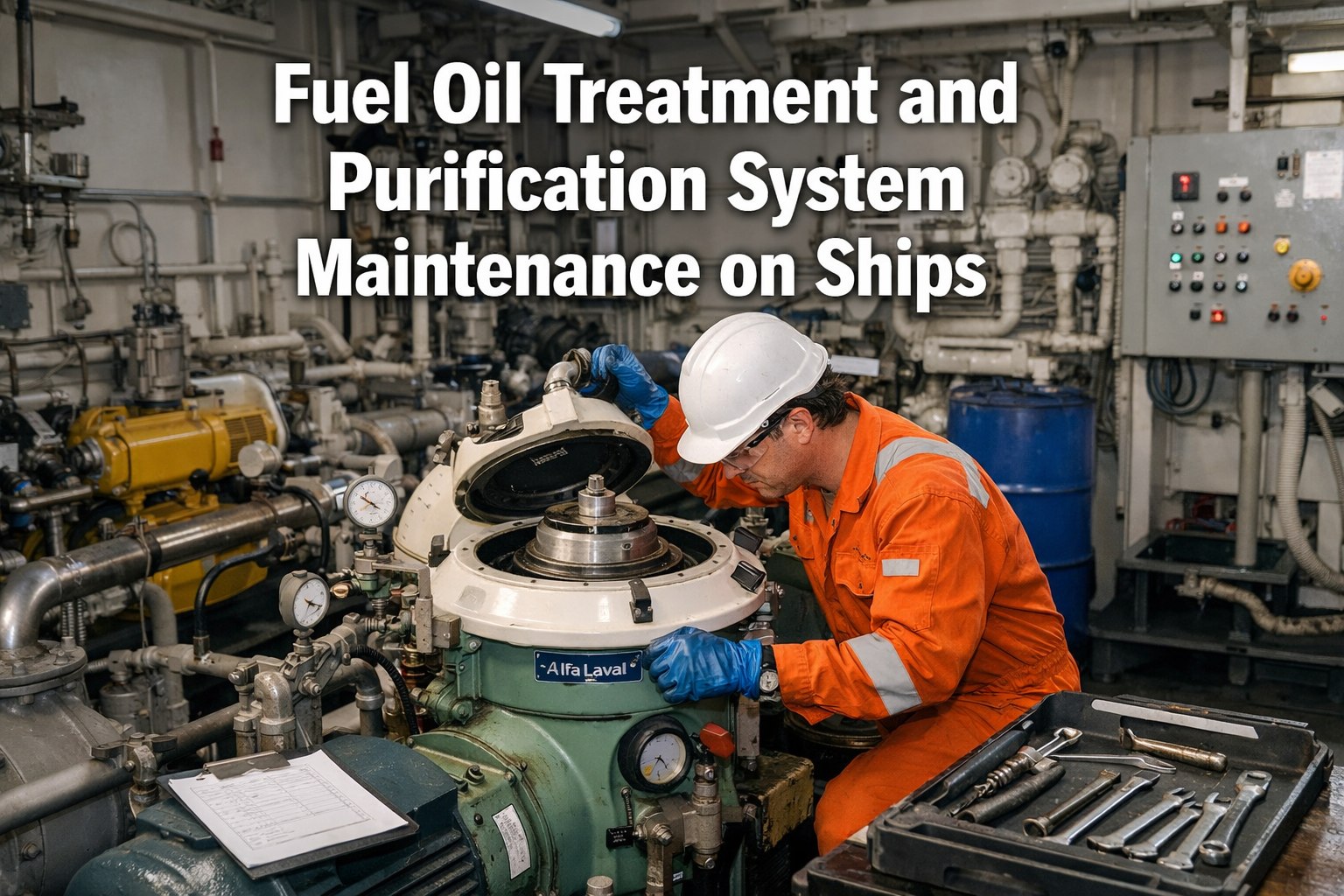
Open, clean and inspect on the maker's interval. Deposits between discs reduce capacity long before an alarm sounds, and damaged or incorrectly assembled stacks cause vibration.
Test the water transducer, vibration alarm and sludge discharge function, and record the results. These are the protections that stop a small fault becoming a bowl failure.
Batch purification and sump care
Where contamination is heavy, or after a repair, continuous purification may not be enough. Batch treatment cleans a charge properly, and the sump itself needs attention on a regular cycle.
Filters, strainers and magnets
Filtration works alongside purification, not instead of it. The filter is also the cheapest debris detector on the ship.
Troubleshooting matrix
Records that prove the system is managed
Frequently asked questions
Regularly enough to build a trend, typically on a fixed interval set by the oil supplier's programme and the engine maker, with extra samples whenever something changes: a repair, a contamination event or an unusual onboard test result.
Guidance commonly cites less than 0.2% for crosshead engines, with immediate action between 0.5% and 1.0%, and less than 0.1% for trunk piston engines, with immediate action above 0.5%. A widely used rule of thumb is to investigate at 0.2% and take remedial action at 0.5%. The engine maker's figures govern.
Separation of lubricating oil is commonly carried out in the region of 85 to 95 °C, with efficiency improving towards the upper end of the range. Check the figure for your separator and oil.
Only partly. Purification removes water and solids. Viscosity, flash point and base number can only be restored by a full or partial oil change, so a report showing those out of limits means renewal, not more purifying.
Together, and classically in roughly a four to one ratio, they indicate seawater contamination. Treat it as urgent and find the leak path before returning the charge to normal service.
Sample and analysis records with running hours, purifier maintenance and alarm tests, filter and sump inspection records, and evidence that recommendations from the laboratory were acted on. See our main engine overhaul guide and cooling water guide, since water in the oil usually starts there.
Marine Inspection records samples, purifier work, filter findings and sump inspections at the machine, offline, links them to running hours, and keeps the laboratory reports with the equipment for the next surveyor.