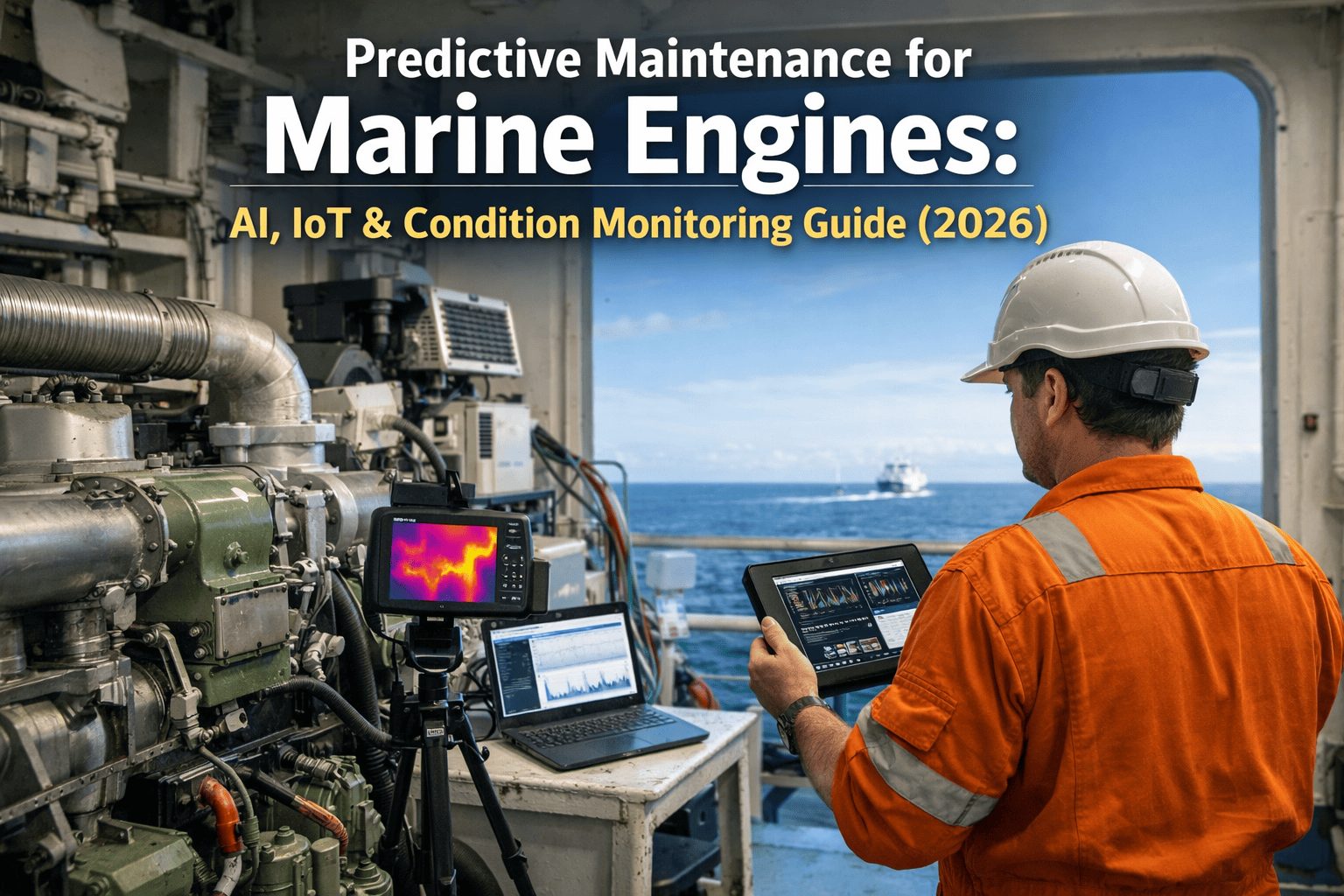
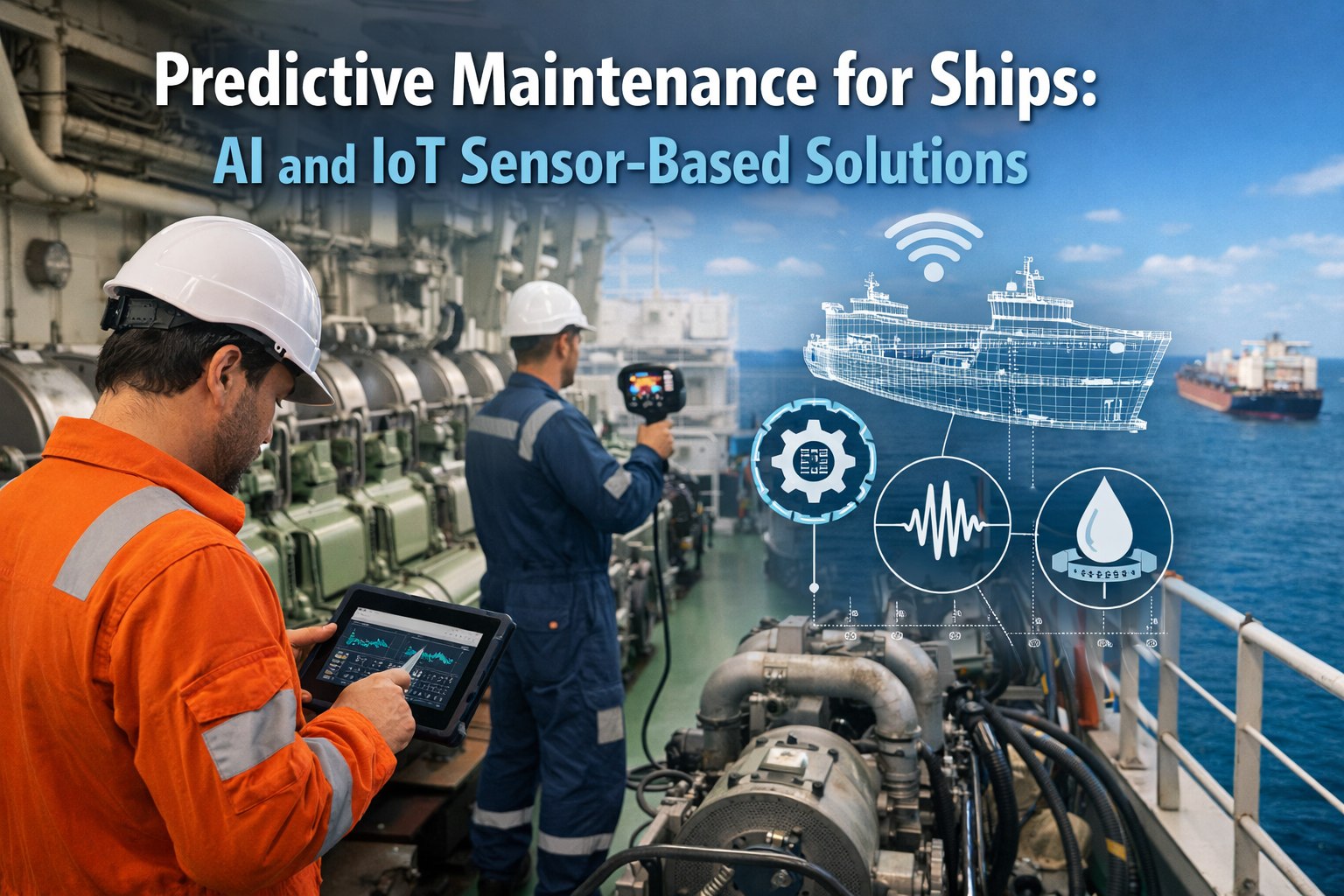
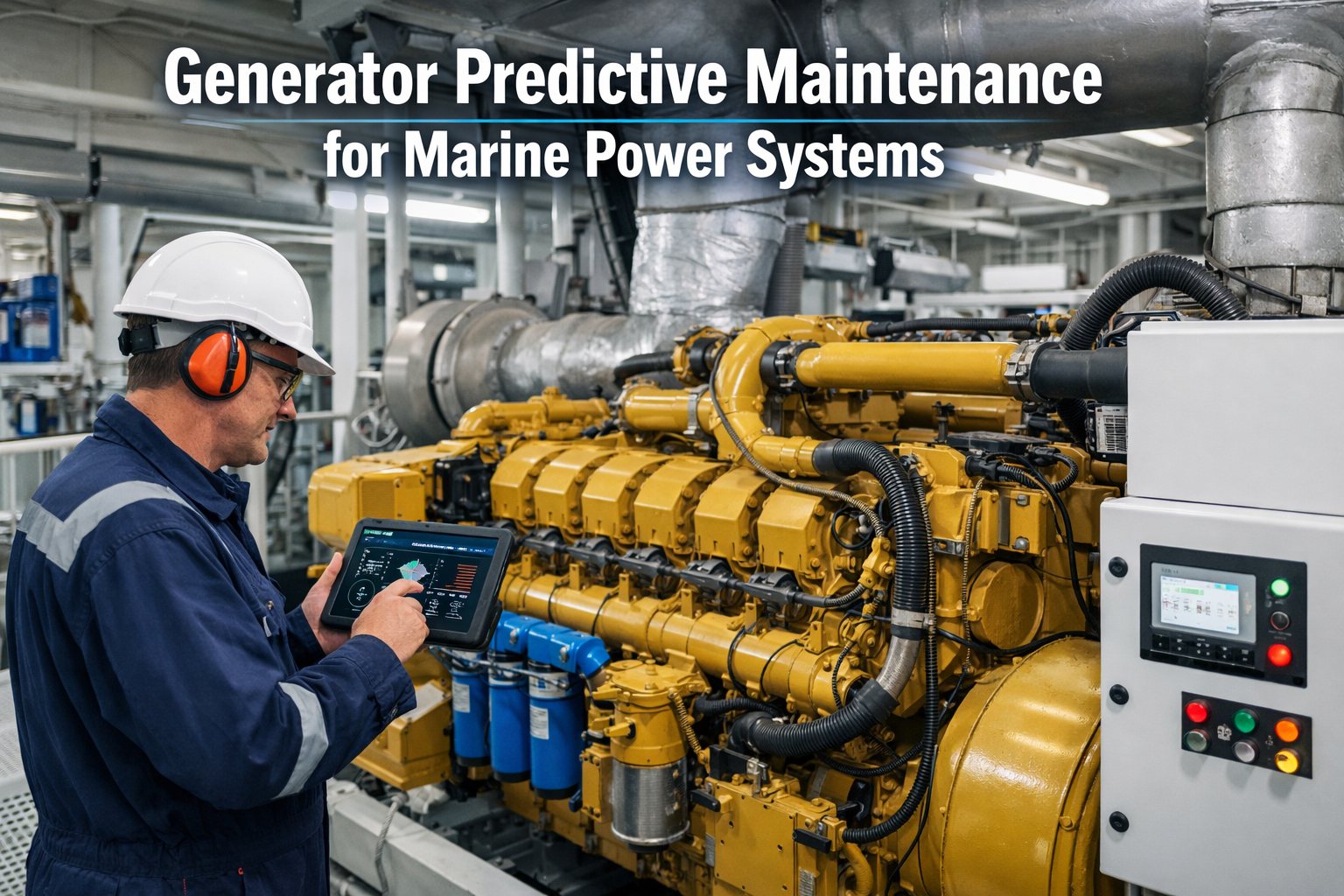
Unplanned engine failures cost vessel operators between 10% and 30% of total operating expenses — not counting the safety risks, charter penalties, and reputational damage that follow an engine breakdown mid-voyage. The traditional approach of scheduled maintenance based on running hours or calendar intervals doesn't prevent failures; it just spaces them out. Predictive maintenance changes the equation entirely: instead of servicing engines on a fixed schedule, AI and IoT sensors monitor engine health in real time and predict failures before they happen — giving engineers the window to fix problems during planned stops rather than emergency port calls. With the maritime AI market projected to reach nearly $19 billion by 2029, this isn't future technology — it's happening now. Operators ready to digitize their engine monitoring and maintenance workflows can sign up for Marine Inspection's vessel management platform to start building the maintenance data foundation that predictive systems depend on.
Predictive Maintenance for Marine Engines: The Numbers
10–30%
Operating Costs
Lost to unscheduled maintenance annually
92%+
Fault Detection Accuracy
Achieved by leading AI diesel engine models
25%
Downtime Reduction
Typical improvement with PdM adoption
~$19B
Maritime AI Market by 2029
Growing at 38.9% CAGR (Technavio)
Reactive → Preventive → Predictive: The Maintenance Evolution
Understanding where predictive maintenance fits requires understanding what it replaces. Most fleets still operate somewhere between reactive and preventive — but the economics of predictive maintenance are rapidly shifting the calculus.
Three Maintenance Strategies Compared
Aspect
Reactive (Run-to-Failure)
Predictive (AI/IoT-Driven)
Trigger
Equipment breaks → then repair
AI detects anomaly → repair before failure
Data Used
None — wait for symptoms or failure
Real-time sensor data + ML pattern recognition
Downtime
Maximum — failures always unplanned
Minimized — repairs scheduled at optimal time
Cost Profile
Low upfront, catastrophic when failures hit
Higher upfront investment, lowest total lifecycle cost
Parts Waste
Components used to destruction
Components replaced based on actual condition data
Preventive maintenance (time/hours-based scheduling) sits between these two — better than reactive, but it often replaces components that still have useful life remaining, and it can't predict the failures that happen between service intervals. Predictive maintenance eliminates both problems by monitoring actual condition continuously.
How It Works: The AI + IoT Predictive Maintenance Stack
Predictive maintenance isn't a single product — it's a technology stack with four layers, each building on the one below. Here's how the complete system works, from sensor to decision.
Layer 1 — IoT Sensors (Data Acquisition)
What it does: IoT sensors mounted on engine components continuously capture vibration, temperature, pressure, RPM, exhaust gas temperature, fuel flow, coolant flow, and oil quality data — streaming readings every few seconds.
Key point: New-build vessels come with sensors pre-installed. Older vessels can be retrofitted with cost-effective sensor packages on critical components — the ROI on retrofitting critical assets is often very fast.
Layer 2 — Data Transmission & Storage
What it does: Sensor data is transmitted via onboard networks to edge computing devices or satellite/LEO uplinks to shore-based cloud platforms. Edge processing handles time-critical alerts; cloud processing handles deep analytics and fleet-wide pattern recognition.
Layer 3 — AI & Machine Learning Analytics
What it does: ML models trained on historical failure data establish a "healthy baseline" for each engine. The AI continuously compares live data against this baseline, detecting minute deviations — anomalies — that signal an impending fault. Models improve over time as more data is collected.
Key point: The AI needs approximately 2 weeks of operational data to learn a vessel's "normal" baseline. After that, it begins flagging anomalies with increasing accuracy — leading platforms report 92%+ fault detection accuracy on diesel engines.
Layer 4 — Actionable Alerts & Maintenance Planning
What it does: When the AI identifies an anomaly, it generates an alert to shore-based fleet managers and onboard engineers — specifying the component, the nature of the deviation, estimated time to failure, and recommended action. This turns raw data into scheduled maintenance tasks.
The 5 Core Monitoring Technologies
Predictive maintenance systems use multiple monitoring techniques simultaneously. Each technology detects different failure modes — and combining them provides the comprehensive engine health picture that makes accurate prediction possible.
Accelerometers detect changes in vibration patterns that indicate bearing wear, misalignment, imbalance, looseness, or gear damage — often weeks before audible symptoms appear. Frequency analysis pinpoints which specific component is degrading.
Detects: bearings, shafts, gears, misalignment
Samples analyzed for metal particles, viscosity changes, contamination (water, fuel, coolant), and additive depletion. Each metal type traces to a specific component — iron from cylinder liners, copper from bearings, chromium from piston rings. Online sensors now provide continuous monitoring.
Detects: internal wear, contamination, lubrication failure
Temperature sensors on exhaust gas lines, cylinder heads, cooling systems, and bearings detect overheating before damage occurs. Infrared thermal imaging scans electrical panels, turbochargers, and piping for hot spots invisible to the naked eye. Exhaust gas temperature per cylinder is one of the strongest predictors of engine health.
Detects: overheating, cooling failures, combustion issues
Sensors tracking fuel pressure, lube oil pressure, cooling water flow, and cylinder compression pressures detect blockages, leaks, pump degradation, and injector failures. Deviations from baseline flow rates often indicate developing problems before other symptoms appear.
Detects: leaks, blockages, pump wear, injector faults
High-frequency acoustic sensors detect the stress waves produced by cracks, leaks, and electrical discharges that are inaudible to the human ear. Ultrasonic testing measures component thickness (e.g., pipe walls, hull plating) and can detect internal flaws without disassembly. Increasingly integrated into AI platforms for automated anomaly detection.
Detects: crack propagation, gas/steam leaks, electrical faults
Build the Data Foundation Predictive Systems Need
AI predictive maintenance depends on organized maintenance records, structured fault history, and documented component lifecycles. Marine Inspection gives you the digital platform to track it all — so when you're ready for AI, your data is ready too.
Digital Twins: The Next Frontier
A digital twin is a virtual replica of your physical engine that mirrors its real-time operational state. Fed by the same IoT sensor data, the digital twin simulates operations and predicts outcomes under varied conditions — answering questions like "what happens if we increase load by 15% in these sea conditions?" or "how many hours until this turbocharger bearing reaches its wear limit?" Digital twins are moving from research into commercial deployment, forming the technical foundation for remote engine management and, eventually, autonomous vessel operations.
Implementation: Getting Started with Predictive Maintenance
You don't need to retrofit an entire fleet overnight. The most successful PdM implementations follow a phased approach — starting with critical assets on a pilot vessel and scaling based on proven ROI.
Practical Implementation Roadmap
1
Audit your data — Assess current sensor coverage, historian logs, maintenance records, and class data. Data quality is the #1 barrier to PdM success — fix gaps before investing in AI.
2
Start with critical assets — Main engine, generators, and turbochargers deliver the highest ROI. Don't try to monitor everything at once — focus on failure modes with the biggest cost impact.
3
Retrofit IoT sensors — Older vessels can be fitted with vibration, temperature, and acoustic sensors on critical components. Standardize sensor packages across the fleet for consistent data.
4
Integrate with your CMMS — Connect the AI platform to your maintenance management system so predictions automatically generate work orders. Avoid siloed systems.
5
Train your crew — Engineers must understand what AI alerts mean and how to act on them. Focus on human-AI collaboration, not replacing human judgment — the AI informs, the engineer decides.
6
Scale after proving ROI — Once the pilot vessel demonstrates measurable results (reduced downtime, lower costs), use it as the blueprint to roll out fleet-wide.
Real-World Benefits
Operators deploying predictive maintenance are reporting measurable improvements across key performance indicators.
↓ Downtime
Unplanned Repairs Drop Significantly
AI catches developing faults during normal watch duties — before they become emergency breakdowns. On-time arrival rates improve by up to 25% as repairs shift from unplanned to scheduled.
↓ Costs
Maintenance Spending Becomes Optimized
Components are replaced based on actual condition, not arbitrary schedules — eliminating unnecessary maintenance while preventing the catastrophic cost of run-to-failure. Spare parts inventory is optimized based on predicted demand.
↓ Emissions
CO₂ Reduced ~8% on Average
Engines running at optimal parameters burn less fuel. Catching combustion issues early (through exhaust gas monitoring) maintains efficiency and helps meet CII and EU-ETS emission targets.
↑ Safety
Catastrophic Failures Prevented
Predicting turbocharger failures, cooling system breakdowns, or fuel system faults before they cause engine room fires or loss of propulsion directly improves crew safety and vessel integrity.
Start with the Foundation: Organized Maintenance Data
Every AI system depends on the quality of the data it learns from. Marine Inspection gives you the platform to build structured maintenance records, track component lifecycles, and document every inspection — creating the digital foundation your fleet needs.
Frequently Asked Questions
What is predictive maintenance for marine engines?
Predictive maintenance (PdM) uses IoT sensors and AI/machine learning algorithms to continuously monitor engine health parameters — vibration, temperature, oil quality, pressure, acoustics — and predict failures before they occur. Instead of servicing engines on fixed schedules (preventive) or after breakdowns (reactive), PdM triggers maintenance only when data indicates a developing fault, optimizing both cost and reliability.
Can older vessels use predictive maintenance?
Yes. While new-build vessels come with sensor arrays pre-installed, older vessels can be retrofitted with IoT sensor packages on critical components (main engine, generators, turbochargers). The retrofit cost is often recovered quickly through reduced unplanned downtime. The primary barrier is not technology but data quality — ensuring sensors are properly calibrated and data is structured for ML analysis.
How accurate is AI at predicting engine failures?
Leading maritime AI platforms report 92%+ accuracy on diesel engine fault detection. Accuracy improves over time as the ML models learn from more operational data. The AI typically needs about 2 weeks of baseline operational data to learn what "normal" looks like for a specific engine before it can begin reliably flagging anomalies.
What does predictive maintenance cost to implement?
Costs vary significantly by fleet size, vessel age, and scope. Sensor retrofit packages for critical assets on a single vessel can range from $10,000–$50,000+. Cloud-based AI analytics platforms typically operate on subscription models. The ROI calculation should compare implementation cost against current unplanned downtime losses (typically 10–30% of operating costs), unnecessary scheduled maintenance, and emergency repair premiums.
How does predictive maintenance help with emissions compliance?
Engines operating at optimal parameters burn fuel more efficiently, producing fewer emissions. PdM detects combustion anomalies (via exhaust gas temperature monitoring) that cause excess fuel consumption and emissions. Operators report average CO₂ reductions of approximately 8%, directly supporting CII ratings and EU-ETS compliance targets — turning a maintenance investment into a regulatory compliance tool.