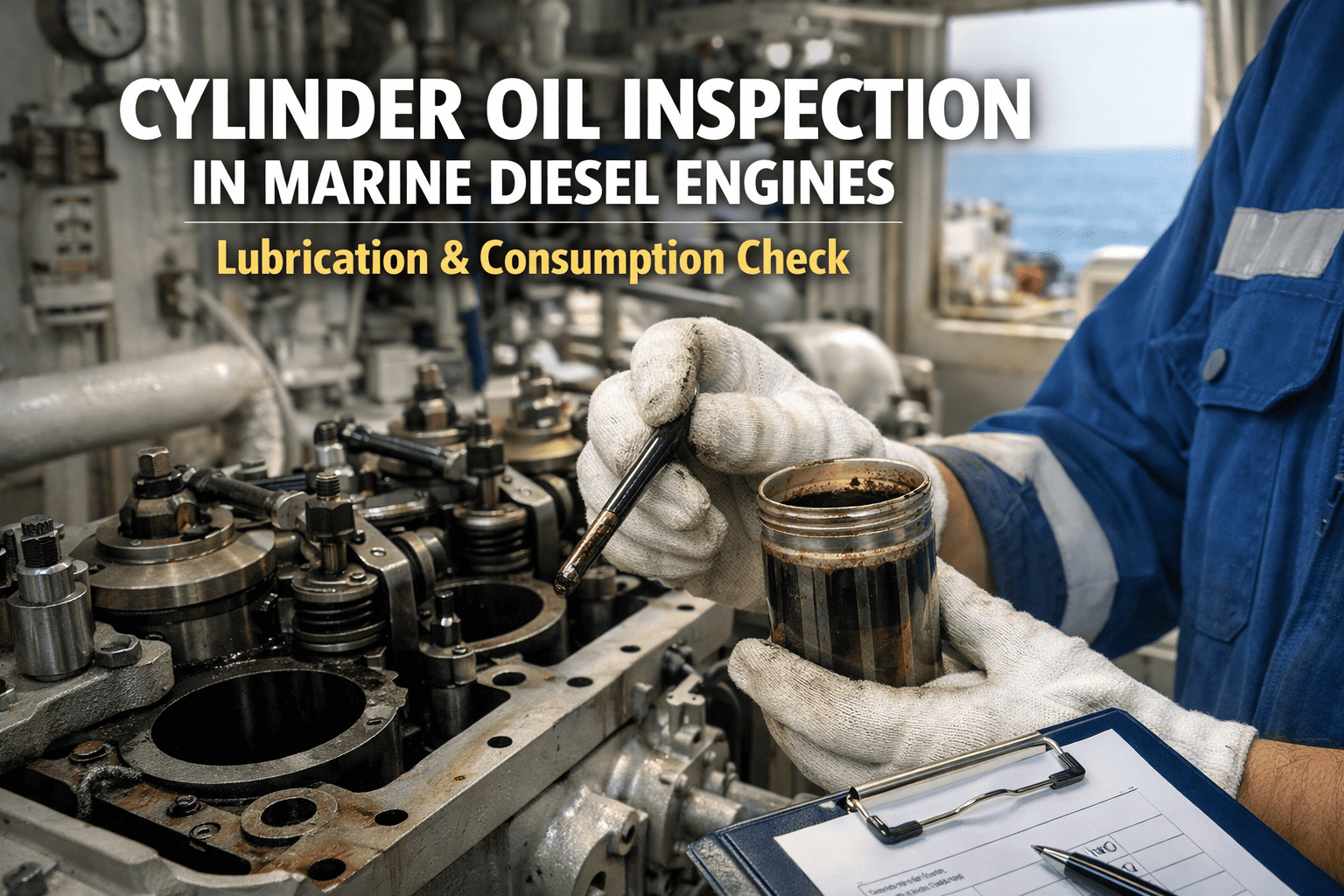
Cylinder oil is the lifeblood of every two-stroke marine diesel engine — and getting it wrong costs far more than the oil itself. Under-lubrication causes accelerated liner and piston ring wear, scuffing, and potential seizure. Over-lubrication wastes expensive cylinder oil and creates carbon deposits that jam piston rings and damage exhaust components. The key lies in finding the optimal feed rate for your specific engine, fuel sulphur content, and operating conditions — then continuously monitoring drain oil to confirm the balance is right. This guide covers how cylinder oil works, what inspections reveal, how feed rates are optimized, and what the drain oil analysis numbers actually mean. Engineers looking to track cylinder oil consumption, inspection findings, and maintenance actions digitally can sign up for Marine Inspection's vessel management platform to log everything in one system.
Cylinder Oil Inspection: Key Reference Numbers
0.6–1.5
Feed Rate (g/kWh)
Typical range — varies by engine mark & fuel
10–30
Drain Oil BN Target
mg KOH/g — residual alkalinity in drain oil
<150 ppm
Iron (Fe) Target
Drain oil iron content — key wear indicator
<0.1 mm
Liner Wear Rate
Per 1,000 running hours — acceptable limit
What Cylinder Oil Actually Does
Cylinder oil in a two-stroke crosshead engine serves three critical functions simultaneously — and each demands a careful balance that changes with fuel type, engine load, and operating conditions.
Function 1
Lubrication — Preventing Metal-to-Metal Contact
The oil film between piston rings and cylinder liner prevents direct metal contact at extreme pressures and temperatures. If the film breaks down — from insufficient feed rate, wrong viscosity, or excessive cat-fines in fuel — scuffing and seizure can destroy the liner surface in minutes. Minimum viscosity: SAE 50 (≥18.5 cSt at 100°C) for current MAN engine marks.
Function 2
Acid Neutralization — Combating Corrosive Wear
Fuel combustion produces sulphuric acid (from fuel sulphur) that condenses on cooler liner surfaces and attacks the metal. The cylinder oil's Base Number (BN) provides the alkaline reserve to neutralize this acid. Higher fuel sulphur = higher BN required. With the global 0.50% sulphur cap, BN requirements have shifted: Cat. II BN 40 oils are now standard for low-sulphur fuels on newer engines.
Function 3
Cleaning — Keeping Rings and Lands Deposit-Free
Detergent and dispersant additives prevent carbon and combustion residues from accumulating on piston ring lands and grooves. Deposits restrict ring movement, causing blow-by, increased wear, and liner scuffing. Cat. II cylinder oils (introduced by MAN) provide improved cleaning performance regardless of BN value — solving the deposit problems seen with early VLSFO operations.
BN Selection: Matching Cylinder Oil to Fuel Sulphur
Choosing the correct Base Number is the foundation of cylinder lubrication management. The wrong BN for your fuel sulphur content causes either corrosive wear (BN too low) or deposit buildup (BN too high for too long).
Cylinder Oil BN Selection by Fuel Sulphur Content
Fuel Sulphur
Recommended CLO
Key Considerations
0–0.50% S
Cat. II BN 40 (Mk. 9+ engines)
Standard for VLSFO/MGO/LNG — single oil simplicity
0–0.50% S
Cat. I or Cat. II BN 40 (Mk. 8 & lower)
Older engines — Cat. I BN 40 acceptable if conditions good
0.50–1.5% S
Cat. II BN 40 (may need higher BN)
Monitor drain oil BN — switch to higher BN if acid neutralization insufficient
1.5–3.5% S
Cat. II BN 100–140+ or Cat. I BN 70
HSFO with scrubber — high acid load requires high alkalinity
Fuel change
Change CLO BN to match new fuel
Inspect at scavenge ports after fuel/oil change — adjust feed rate as needed
Feed Rate Optimization: The Balancing Act
Feed rate — measured in grams of cylinder oil per kilowatt-hour (g/kWh) — determines how much oil reaches the liner surface. Too little = accelerated wear. Too much = wasted oil and carbon deposits. The optimal feed rate is found through a systematic process of adjustment, inspection, and drain oil analysis.
Breaking-In Period (0–500 Running Hours)
Start high, reduce stepwise — New liners and piston rings start at elevated feed rates (~1.5 g/kWh) to flush wear particles from rough surfaces as the running-in coating wears off. Reduce in steps over 500 hours to the normal operating feed rate. Scavenge port inspection every 100 hours during breaking-in.
Familiarization Period (500–3,000+ Hours)
Stepwise reduction with monitoring — Feed rate is reduced in steps of ~600 running hours. Before moving to the next step, cylinder condition is assessed through scavenge port inspection and drain oil analysis. The ACC (Adaptable Cylinder oil Control) factor is adjusted based on results. Do not proceed if inspection reveals seizures or irregularities.
Normal Operation — Continuous Optimization
Minimum feed rate baseline — For low-sulphur fuels, the feed rate is controlled by the "Minimum Feed Rate" setting (typically 0.6 g/kWh). The ACC system automatically increases feed rate with higher fuel sulphur content. During manoeuvring, starting, and load changes, the system increases feed rate by 25% above normal.
Consumption cross-check — Verify cylinder oil consumption on the MOP/HMI against the service tank daily consumption. Values should be within 10%. If deviation is excessive, raise feed rate for all units and check the lubrication system before reducing again.
The 2 Inspection Methods: What They Reveal
Cylinder condition is assessed through two complementary methods — visual inspection through scavenge ports and laboratory analysis of drain oil. Both are essential; neither alone gives the full picture.
What it is: Visual and tactile examination of the cylinder liner surface, piston rings, and piston crown through the scavenge air space openings — performed while the engine is stopped.
What to look for: Liner surface condition (honing marks visible = good, polished/glazed = concerning), scuffing marks, blow-by deposits, carbon buildup on ring lands and piston crown, ring groove deposits restricting ring movement, and running-in coating wear progress on new rings.
Emerging technology: Image-based deep learning systems now capture and analyse scavenge port images to objectively assess wear and deposits — reducing human subjectivity in condition rating.
Visual — requires engine stopped · Every 100 hrs during break-in
What it is: Laboratory analysis of used oil collected from the under-piston scavenge drain. This oil has passed through the combustion zone and carries measurable evidence of wear, acid neutralization, and contamination.
Key parameters tested:
• Residual BN (mg KOH/g) — target 10–30 above 50% load. Below 10 = insufficient acid neutralization = corrosive wear risk.
• Iron content (Fe) — target below 150 ppm (below 200–300 depending on engine). Rising Fe = increasing liner/ring wear.
• Viscosity — deviation indicates fuel dilution or excessive oxidation.
Decision rule: If BN is high and Fe is acceptable, the feed rate can be reduced. If Fe is rising while BN is dropping, increase the feed rate or change to a higher BN oil immediately.
Lab analysis — can be done underway · ASTM D5185 & ISO 3771
Track Every Inspection, Sample & Feed Rate Change
Marine Inspection logs scavenge port inspection findings, drain oil analysis results, feed rate adjustments, and cylinder liner measurements — building the data history your engine needs for optimal lubrication management.
Troubleshooting: When Cylinder Condition Goes Wrong
When scavenge port inspection or drain oil analysis reveals problems, systematic diagnosis prevents the wrong corrective action — which can make things worse.
Urgent
Rising Iron (Fe) in Drain Oil
Indicates: Accelerating cylinder liner and/or piston ring wear.
Check: Drain oil BN (is acid neutralization failing?), feed rate (is it too low?), fuel quality (cat-fines present?), liner temperature (too cold = acid condensation), and scavenge port condition (scuffing visible?). If Fe rises rapidly above 200–300 ppm, open the scavenge box and inspect immediately — do not wait for the next scheduled inspection.
Urgent
Scuffing or Seizure Marks on Liner
Indicates: Oil film breakdown — metal-to-metal contact occurred.
Check: Feed rate (increase to safe setting of 1.2 g/kWh immediately), lubricator operation (are all quills delivering?), cat-fine levels in fuel (high Al+Si destroys the oil film), and liner temperature profile. Cat-fines above 15 ppm at engine inlet are the most common cause — increasing feed rate will NOT protect against cat-fines; fuel treatment is required.
Monitor
Excessive Deposits on Ring Lands
Indicates: Insufficient cleaning by the cylinder oil — detergency inadequate for the current fuel/operating conditions.
Check: Switch to a Cat. II CLO with higher detergency. If running Cat. I BN 40, move to Cat. II BN 40. If deposits persist, temporarily increase to a higher BN oil (Cat. II BN 100–140+) for one week, then reassess. Excessive deposits lead to ring sticking, blow-by, and accelerated wear.
Monitor
Low Residual BN in Drain Oil
Indicates: Acid neutralization capacity is depleted — corrosive wear will increase if not corrected.
Check: Fuel sulphur content (has it increased since last bunker?), feed rate (increase if below minimum for current sulphur level), and CLO BN selection (may need to switch to a higher BN oil). Target drain oil BN of 10–30 mg KOH/g at loads above 50%. Below 10 = take action immediately.
Consumption Monitoring: The Economics
Cylinder oil is expensive — and on a large two-stroke engine, it's a significant operating cost. The temptation to reduce feed rates aggressively is strong. But the economics only work when wear rates remain within acceptable limits (<0.1 mm/1,000 hours for liner wear). A cylinder liner replacement costs tens of thousands of dollars plus dry-dock time; the oil savings from aggressive feed rate reduction are measured in hundreds. The optimal feed rate is the lowest rate that maintains acceptable wear and BN — not the absolute minimum the engine will tolerate.
All feed rate specifications are based on MCR load. Before evaluating part-load consumption, recalculate the actual dosage to what it would be at MCR. A vessel operating consistently at 60% load will consume less oil than the same engine at full power — but the per-kWh rate may be the same or higher.
Inspection Schedule Summary
Cylinder Oil Inspection & Monitoring Schedule
D
Daily — Check cylinder oil consumption on MOP/HMI against service tank usage. Verify within 10%.
W
Weekly — Verify lubricator operation for all cylinders. Check for alarm conditions or delivery failures.
100h
Every 100 hrs (break-in) — Scavenge port inspection during breaking-in period. Do not proceed to next feed rate step if issues found.
600h
Every 600 hrs (familiarization) — Scavenge port inspection + drain oil sample before each ACC factor step change.
R
Regular (in service) — Drain oil sampling at intervals set by engine maker or whenever fuel type/sulphur changes significantly.
!
Immediately — If high liner temp fluctuation, suspected scuffing, or abnormality — increase feed rate to 1.2 g/kWh safe setting and inspect.
Log Every Sample, Every Inspection, Every Adjustment
Marine Inspection gives engineers one platform to record drain oil analysis results, scavenge port inspection findings, feed rate changes, liner wear measurements, and cylinder overhaul history — building the data picture that drives optimal lubrication decisions.
Frequently Asked Questions
What BN cylinder oil should I use with VLSFO?
For engines Mk. 9 and newer operating on low-sulphur fuels (0–0.50% S), MAN recommends Category II BN 40 cylinder oils. These provide adequate acid neutralization for low-sulphur fuel while delivering the improved cleaning performance needed to prevent the deposit problems that plagued early VLSFO operations. For older engines (Mk. 8 and below), Cat. I or Cat. II BN 40 are acceptable. Monitor drain oil BN to confirm adequate neutralization.
What is a good target for drain oil BN and iron content?
At loads above 50%, target a residual BN of 10–30 mg KOH/g and iron (Fe) content below 150 ppm (some sources accept up to 200–300 ppm depending on engine type). BN below 10 indicates insufficient acid neutralization — corrosive wear risk increases. Rising iron above 200 ppm signals accelerating wear and requires immediate investigation. Laboratory testing per ASTM D5185 (iron) and ISO 3771 (BN) gives the most reliable results.
How often should scavenge port inspections be done?
During breaking-in (new liners/rings): every 100 running hours. During the familiarization period: before each ACC factor step change (~every 600 hours). In normal service: at regular intervals set by the engine maker, after any fuel type change, and immediately if abnormal conditions are detected (high liner temperature fluctuation, suspected scuffing, or rapidly rising iron in drain oil).
Will increasing cylinder oil feed rate protect against cat-fines?
No. Increasing the cylinder oil feed rate will not protect against catalytic fines damage. Cat-fines (aluminum and silicon particles) are hard abrasives that destroy the oil film mechanically — no amount of additional oil prevents this. Cat-fine protection comes from proper fuel treatment: effective settling, separation (purifier operating at correct throughput and temperature), and filtration to reduce Al+Si below 15 ppm at the engine inlet.
What is the safe feed rate setting if something goes wrong?
If you observe high liner temperature fluctuations, suspected scuffing, or other abnormalities, increase the feed rate immediately to 1.2 g/kWh — this is the safe setting recommended by MAN for abnormal conditions. Revert to the previous setting that produced good cylinder conditions, then investigate the root cause before attempting further optimization. Never reduce feed rate during or immediately after an abnormal condition.