On a chemical tanker, the cargo tank is the product. A parcel of high-purity solvent or edible oil is only worth what it is worth because the tank it sits in is clean to a standard measured in parts per million, and the entire commercial value of the voyage can turn on a single wall wash sample failing at the load port. Tank cleaning is where that value is protected or lost. It is an operation that blends hard chemistry with practical seamanship: understanding what the last cargo left behind, what the next cargo demands, how the tank coating will react, which washing method and temperature to use, and finally how to prove — to a surveyor, a charterer, and a shore laboratory — that the tank meets the required cleanliness standard before a drop of the next cargo goes in. Get it right and the parcel loads on schedule; get it wrong and the vessel faces recleaning, delay, a rejected tank, or a contamination claim that dwarfs the cost of doing it properly. This guide works through the whole discipline for the officers and superintendents who run it: the cleaning methods and how the previous and next cargoes drive the plan, the coating types and their limits, the cleanliness standards and reference guides that define the target, the wall wash test suite and what each test detects, the verification and inspection process at the load port, and the compatibility and regulatory framework that governs it all. To plan tank cleaning, capture wall wash results, and hold the inspection evidence across your fleet in one place, start a free trial or book a demo.
INDUSTRY GUIDE · CHEMICAL TANKERS
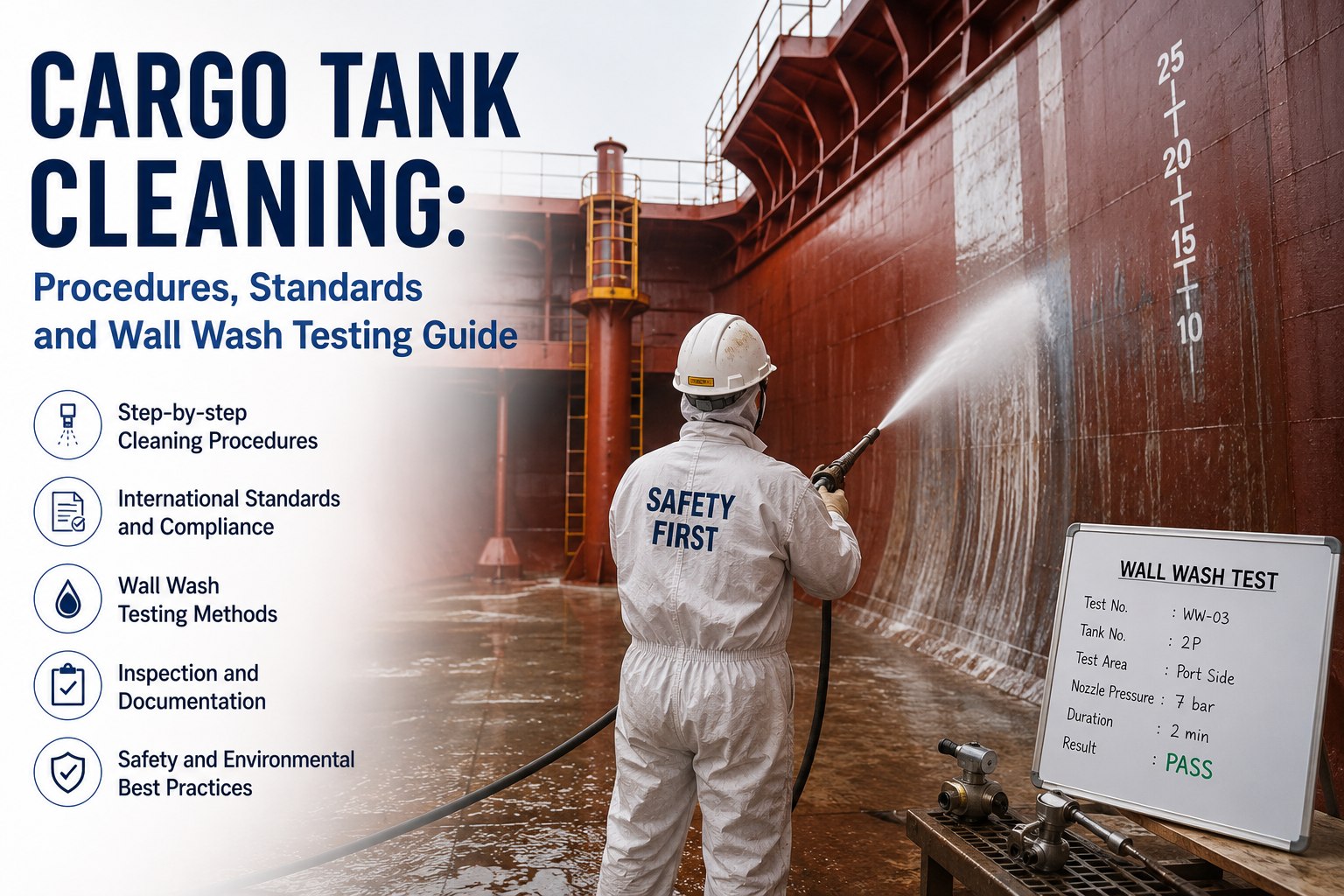
Cargo Tank Cleaning: Procedures, Standards and Wall Wash Testing
A working guide for chemical and product tanker officers to cleaning methods, coating limits, cleanliness standards and the wall wash test suite — from the previous cargo to the surveyor's pass at the load port that lets the next parcel load.
What this guide covers
1 Why the two cargoes drive the plan
2 Cleaning methods
3 Coatings and their limits
4 Cleanliness standards and guides
5 The wall wash test suite
6 Verification at the load port
7 Compatibility and regulation
8 Getting it right first time
1. The Plan Starts With Two Cargoes, Not One
Every tank cleaning operation is defined by the relationship between two cargoes: the one just discharged and the one about to load. Neither alone tells you what to do — it is the transition between them, the grade change, that sets the required standard and therefore the whole cleaning plan. This is the first and most important principle, and it explains why tank cleaning cannot be reduced to a single routine.
The previous cargo determines what has to be removed — its residues, how it clings to the coating, whether it is a hydrocarbon, an inhibited chemical, a drying oil or a solidifying substance. The next cargo determines how clean the tank must be, because the acceptance standard is set by what that cargo can tolerate: a tank fit to load another parcel of the same grade may need almost nothing, while a tank going from a coloured aromatic to a high-purity clear solvent must reach a standard measured in traces. Between clean petroleum products such as gas oil and kerosene, a simple hot or cold seawater wash may disperse the residue adequately, and in some product-trade grade sequences no washing is required at all — which is why the cleaning decision is often made only once the next grade is known.
The consequence is that the cleaning plan is built backwards from the acceptance standard. You start with the next cargo's requirement, work out the standard the tank must reach, look at what the previous cargo left and how the coating holds it, and only then choose the method, the medium, the temperature and the duration. Reaching for the hoses before that analysis is done is how tanks get over-cleaned at needless cost, or under-cleaned and rejected at the load port.
i
The crew cannot know every cargo
Given the vast number of chemicals and products carried, it is unlikely a ship's crew will be familiar with every cargo and every transition. This is precisely why the industry relies on published cleaning guides and specialist advice rather than crew memory. Where a grade change is unusual, aggressive or high-value, consulting a tank cleaning specialist company is a recommended practice, not an admission of weakness — the cost of expert guidance is trivial against the cost of a contaminated parcel. The reference guides exist to fill exactly the gap that no individual officer can be expected to carry in their head.
2. Cleaning Methods
Tank cleaning is a toolbox of methods, chosen and sequenced to suit the residue and the standard. Verification of the tank's cleanliness is generally required before the charterer permits the next cargo to load, so the methods below are the means to a provable end rather than ends in themselves.
Butterworthing (machine washing)
The core method, so central that the machines, their water supply and the method itself are all loosely called Butterworth. Fixed or portable machines with revolving nozzles, driven by water-powered gearing, throw a spherical wash pattern that covers the tank surfaces. Portable machines and their hose are lowered through a tank-top opening; fixed machines are built in. The wash medium may be cold or hot seawater or fresh water depending on the residue and coating.
Recirculation and injection
Reusing wash water, sometimes dosed with cleaning chemicals, recirculated through the machines to build cleaning power without unlimited water. Injection introduces cleaning agents into the wash stream. These raise effectiveness on stubborn residues while managing the volume of slops generated.
Steaming and hot work
Steam and hot water lift residues that cold washing leaves behind, particularly greasy or waxy deposits, and help drive off odours. Temperature is powerful but constrained by the coating, which is why hot washing is always checked against coating limits before it is used.
Crude oil washing (COW)
On crude tankers, the tanks are washed with the crude cargo itself during discharge to remove sludge and wax, rationalising cleaning and cargo work, improving out-turn, and reducing pollution by minimising residual oil retained aboard. It runs to a documented procedure covering which tanks, the order, single or multi-stage washing, machine numbers, and duration.
Stripping, mopping and drying
The finishing stages: stripping and educting the wash water and residues out of the tank, mopping up the last of the liquid in corners and on structure, and drying the surfaces. For high-purity cargoes the tank must be not just clean but bone dry, so drying is a genuine cleaning step, not an afterthought.
Ventilation, gas-freeing and inerting
Ventilation and gas-freeing make the tank safe to enter and remove vapours; for aggressive cargoes absorbed into an epoxy coating, periodic ventilation at elevated temperature is what desorbs residues that washing alone cannot reach. Inerting maintains the safe atmosphere. These atmosphere-control steps are woven through the cleaning sequence, not separate from it.
Tank entry is enclosed-space entry
Any cleaning task that requires entering the tank is enclosed-space entry, and the tank must be gas-free and the atmosphere verified safe before anyone goes in. Tank cleaning generates flammable and toxic atmospheres, and cleaning operations on crude and product tankers must manage the tank atmosphere throughout — including the interaction with the inert gas system. The methods in this section are carried out under strict atmosphere control and entry procedures, and no cleanliness standard is worth a life. Where cleanliness can be verified by wash water analysis instead of entry, that avoids the enclosed-space entry altogether.
3. Coatings and Their Limits
The tank coating is not a passive lining — it is an active constraint on how the tank can be cleaned, and misjudging it damages the tank or fails the clean. Coatings are chosen so that cargoes of differing chemical properties do not attack the tank structure, and they fall into three broad families, each with its own behaviour and cleaning limits.
Stainless steel
Most tolerant · high temperature
The most chemically resistant and cleanable option, tolerating aggressive cargoes and hot washing that would harm organic coatings — a hot wash regime typically runs to high temperature for a shorter duration. It is favoured for the widest cargo range and the most demanding purity standards, which is why the most sophisticated chemical parcel tankers are stainless. It is also the most expensive to build.
Zinc silicate
Solvent-resistant · acid-sensitive
Resistant to many solvents but attacked by acids and unsuitable for some cargoes — a high free-fatty-acid edible oil in a zinc tank, for example, is hard to clean and often needs extra work. Cleaning tends to use very hot water over a longer duration, and acid-forming residues must be neutralised. Coating manufacturer guidelines govern what it can carry and how it is cleaned.
Epoxy
Absorbs residue · temperature-limited
Widely used but the most cleaning-sensitive: aggressive cargoes are absorbed into the coating and leave residues that washing will not desorb — only periodic ventilation at elevated temperature removes them. Hot washing can soften epoxy, so high temperature is avoided or agreed case by case, and softened coating may need extended forced ventilation to re-cure. The manufacturer's resistance guide is the authority.
i
The coating manufacturer's guide governs
For every coating, the manufacturer's coating resistance and cleaning guidelines are the final word on which cargoes it may carry, what temperature it tolerates, and how it is cleaned. Cargoes that soften or attack a coating, temperatures that damage it, and residues that absorb into it are all addressed there. The recurring cause of coating damage during cleaning is exceeding a temperature or using a medium the coating cannot take, which is why the resistance guide is consulted before the method is set rather than after the damage appears. A damaged coating is both a cleaning failure and a repair cost, and it can render the tank unfit for its intended trade.
Turn tank history into a cleaning plan and a record
The right clean depends on knowing the last three or more cargoes, the coating, and its limits — and proving what was done. Marine Inspection holds tank history, coating details and cleaning records per tank, schedules the operation, captures wall wash results and inspection photos, and keeps the evidence a charterer or surveyor may ask for at any time. See how it makes every clean planned from real history and provable after the fact.
4. Cleanliness Standards and Reference Guides
A tank is not clean in the abstract — it is clean to a standard, agreed in advance and measured against a benchmark. The cleanliness standard should be agreed well before the pre-loading tank inspection, and several established references define both the target and the method to reach it.
Dr. Verwey's Tank Cleaning Guide
The most widely used cleaning reference on chemical tankers, giving cargo-by-cargo cleaning procedures, sequences and precautions — often paired with or alternative to the Miracle cleaning guide. Operating manuals and safety management procedures are expected to reference it and to require its application when cleaning for a chemical product or grade change. It is the practical answer to the fact that no crew knows every cargo.
INTERTANKO Cargo Tank Cleanliness Standards
A clear, unambiguous benchmark for what "clean" means, recommended as the reference against which tank cleanliness standards are agreed between owner and charterer ahead of the inspection. Agreeing to a defined standard in advance removes the dispute that arises when "clean" is left to interpretation at the load port.
Energy Institute HM 50 and HM 40
HM 50 gives guidelines for cleaning tanks and lines on vessels carrying petroleum and refined products; HM 40 covers crude oil washing and the heating of crude in transit. These are the petroleum-side references complementing the chemical-side cleaning guides, defining good practice for product and crude trades.
MARPOL Annex II and the IBC Code
The regulatory floor. MARPOL Annex II requires a prewash for certain chemical cargoes and governs residue discharge and slop handling, while the IBC Code Procedures and Arrangements Manual sets how each ship handles its cargoes and residues. These are compliance obligations that sit underneath the commercial cleanliness standard, not alternatives to it.
5. The Wall Wash Test Suite
For high-purity chemical cargoes, visual cleanliness is not enough — the tank must be proven clean to parts per million, and the wall wash test is how that proof is generated. A solvent, usually laboratory-grade methanol, is sprayed onto the tank wall and collected as it runs down, and the resulting sample is analysed for contaminants. A shipboard spectrometer reads the sample across the visible spectrum, and each test in the suite targets a specific class of contamination.
Hydrocarbon (HC) test
Miscibility
Detects hydrocarbon residues by miscibility: the wall wash is mixed with deionised water and shaken, and because hydrocarbon is insoluble, any present shows as turbidity or a foam layer on top when viewed against a light in a darkened space. A clear, non-turbid sample passes; a foam layer indicates significant hydrocarbon, often re-circulated cargo remaining. It is done before a final fresh-water rinse, so that a hydrocarbon failure is caught before further rinsing is wasted.
Chloride test
Limit < 2 ppm
Measures chloride contamination, typically from seawater washing, using silver nitrate and nitric acid to produce a turbidity read against a standard. The common acceptance limit is less than 2 ppm. A chloride failure usually points to inadequate final fresh-water or deionised-water rinsing after seawater washing, and it matters because chlorides drive corrosion and contaminate sensitive cargoes.
Permanganate time test (PTT / PMTT)
Typically > 50 minutes
Evaluates oxidisable impurities in alcohols and ketones. Potassium permanganate is added to the sample in a temperature-controlled water bath — around 15°C for methanol, 25°C for acetone — and the time for the colour to fade is measured; a common acceptance is greater than fifty minutes. It detects inhibited products and organic matter, but notably does not react with hydrocarbons, so it complements rather than replaces the HC test. A quick fade to straw yellow is a fail.
Colour (APHA / Hazen)
Around 455 nm
Measures the colour of the sample against the APHA (Hazen) platinum-cobalt scale, since coloured contamination betrays residues even at low concentration. On the spectrometer the colour is read around 455 nm. For water-white cargoes the acceptable colour is very low, and a sample showing yellow tint fails against a tight colour specification.
Visual and odour
Sensory checks
The sample is checked for suspended particles or impurities and for any persistent foreign odour. Simple but revealing: particles betray incomplete rinsing or scale, and a residual odour betrays absorbed cargo that the instrument tests may not fully capture, especially with epoxy coatings that hold odour.
i
Sampling technique decides the result
A wall wash result is only as good as the sample. All equipment — funnels, bottles, tubes — is rinsed with methanol on entering each tank to avoid cross-contamination, a sampling location is chosen on the wall or bulkhead, and the solvent is sprayed from at least a metre above the funnel so it runs down a representative area of wall into the bottle. Nessler tubes are cleaned with acid and rinsed through water, deionised water and methanol before use. Sloppy sampling produces false failures as readily as false passes, so the discipline of clean technique is part of the test, not preparation for it.
Do not chase the test instead of the clean
Because the permanganate test can be beaten by pre-spraying the tank with potassium permanganate to pre-empt the surveyor's medium, the temptation exists to treat the test rather than clean the tank. This is malpractice: it produces a passing number on a tank that is not actually clean, and the contamination it hides surfaces in the next cargo as a claim far larger than the recleaning avoided. The wall wash exists to verify a genuinely clean tank, and manipulating it defeats the entire purpose of the standard. The honest and ultimately cheaper path is always to clean to the standard and let the test confirm it.
6. Verification and Inspection at the Load Port
Shipboard testing prepares the tank; the load port decides it. The final acceptance is not the crew's call but the cargo surveyor's, and understanding that process shapes how the vessel prepares.
There are two broad ways cleanliness is verified, and which applies depends on the cargo and the charter. The first is enclosed-space entry for a visual inspection and coating assessment, which may include wall wash testing inside the tank. The second is wash water analysis, testing the final rinse water rather than entering the tank, which has the significant safety advantage of eliminating the enclosed-space entry. Where the cargo and terms allow it, wash water analysis avoids putting people into the tank at all.
For the classic chemical parcel, the sequence at the load port is well established: once the vessel arrives, a cargo surveyor boards and takes the wall wash samples themselves, and those samples go to a shore-based laboratory. Cargo loading commences only after the surveyor's samples pass. This is why the crew's own shipboard wall wash testing matters so much — it is the vessel's advance check that the tanks will pass the surveyor's independent samples, done before arrival so that any failure is found and rectified at sea rather than discovered at the berth with the parcel waiting. The charterer may request the ship's wall wash result data and UV scan graphs at any time, so the shipboard testing is both a rehearsal and a record.
7. Compatibility and the Regulatory Framework
Cleaning does not happen in isolation from what the tank may legally and safely carry next. Compatibility — between cargo and coating, cargo and previous cargo, and cargo and the vessel's approvals — frames the whole exercise, and several regimes govern it.
Cargo and coating compatibility
The next cargo must be one the coating can carry, and some combinations are simply excluded — a cargo that attacks the lining is not made acceptable by cleaning. Compatibility is checked against the coating manufacturer's list before the clean, because there is no point cleaning a tank for a cargo the tank cannot hold.
Previous cargo restrictions
For sensitive trades, what the tank carried before is regulated. Edible oil trades under FOSFA rules work from a List of Banned Immediate Previous Cargoes and a List of Acceptable Previous Cargoes, and may look back several cargoes — with specific allowances, such as mild steel tanks on short-sea voyages only where the last three cargoes were all edible or oleochemical oils, fats or molasses.
Food and edible-oil regimes
Beyond FOSFA, edible cargoes engage NIOP, EU rules, CODEX and Kosher considerations, each with its own requirements on previous cargoes, cleaning and materials — including prohibitions such as copper and copper-alloy fittings in edible-oil tanks. These layer on top of the general cleaning standard for food-grade parcels.
The wider regulatory stack
SOLAS, the IBC Code, the IMDG Code, MARPOL, the ISM Code, flag state rules and port state control including the USCG all bear on tank cleaning, residues and the carriage that follows. Prewash requirements, slop decanting and the timely discharge of residues ashore are compliance obligations, not options.
i
If a tank fails and the charterer wants more cleaning
A tank failing inspection and the charterer requesting additional cleaning is a commercial and contractual moment, not just a technical one. The recommended practice is to contact the vessel's P&I club to clarify the details before commencing extra cleaning, because the responsibility for additional cleaning, the standard being applied, and the cost can all be in dispute. Cleaning beyond the agreed standard on request, without clarifying who bears the cost and whether the demand is contractually justified, can prejudice the vessel's position. The clean is technical; who pays for a re-clean is contractual.
8. Getting It Right the First Time
Everything in this guide points to one operational truth: the cheapest tank clean is the one that passes first time, and passing first time is a product of planning, not luck. The vessel that reaches the load port and passes the surveyor's samples on the first attempt has usually done the same things in the same order.
1
Confirm the next cargo and its standard early
Agree the cleanliness standard with the charterer well before the pre-loading inspection, ideally against a defined benchmark such as the INTERTANKO standard, so the target is unambiguous and the plan can be built to it rather than guessed.
2
Work from tank history and the cleaning guide
Read the previous cargoes, check the coating and its limits, and follow Dr. Verwey's or the equivalent guide for the specific grade change — bringing in a specialist where the transition is unusual or high-value rather than improvising.
3
Clean to the coating, not past it
Choose the method, medium, temperature and duration the coating can take, checking the manufacturer's resistance guide, and manage the tank atmosphere and any entry under strict enclosed-space procedures throughout.
4
Test honestly before arrival, and record it
Run the shipboard wall wash suite with clean technique as a genuine rehearsal of the surveyor's check, rectify any failure at sea, and keep the results and UV scans on file — because the charterer can ask for them, and the record protects the vessel.
Cargo tank cleaning is, at bottom, the management of a transition — from what was carried to what will be carried — to a standard that someone else will independently verify before the vessel earns its freight. The discipline that makes it reliable is the same each time: understand both cargoes, respect the coating, choose the standard and the reference guide before touching a hose, clean to that standard with the right method and atmosphere control, and prove the result with an honest wall wash before the surveyor proves it for you. The vessels that do this consistently are not the ones with the most powerful washing gear; they are the ones where the tank history is known, the plan is built from it, the coating limits are respected, and the wall wash is a confirmation rather than a gamble. That is the difference between a parcel that loads on schedule and a tank rejected at the berth with the clock running and a claim forming. To hold tank history, cleaning plans, wall wash results and inspection evidence together across your fleet, start a free trial or book a demo.
Frequently Asked Questions
What is a wall wash test?
It is a method of proving a cargo tank is clean to parts per million for high-purity chemical cargoes. A solvent, usually laboratory-grade methanol, is sprayed onto the tank wall and collected as it runs down, and the sample is analysed — by a shipboard spectrometer and by tests for hydrocarbons, chlorides, oxidisable impurities and colour. It goes beyond visual cleanliness to detect contamination the eye cannot see, and its results determine whether the tank is suitable for the next cargo.
What tests make up the wall wash suite?
The main tests are the hydrocarbon test, a miscibility check where insoluble hydrocarbon shows as turbidity or foam; the chloride test, using silver nitrate with an acceptance limit commonly under 2 ppm; the permanganate time test (PTT/PMTT), where potassium permanganate is added in a temperature-controlled bath and the fade time measured, often needing to exceed fifty minutes; and the APHA or Hazen colour test around 455 nm. Visual and odour checks complete the suite. Each targets a different class of contamination, which is why several are run together.
What are Dr. Verwey's standards?
Dr. Verwey's Tank Cleaning Guide is the most widely used cleaning reference on chemical tankers, giving cargo-by-cargo cleaning procedures, sequences and precautions for grade changes. Chemical tanker operating manuals and safety management procedures are expected to reference it — or the equivalent Miracle guide — and to require its application when cleaning for a chemical product or grade change. It exists because no crew can know the cleaning requirements of every cargo, so the guide supplies the specific procedure for each transition.
What acceptance limits apply to the wall wash tests?
Common benchmarks include chlorides under 2 ppm and a permanganate time test result greater than around fifty minutes, with colour assessed against a tight APHA specification for water-white cargoes and the hydrocarbon test requiring a clear, non-turbid sample. Exact limits depend on the specific cargo and the standard agreed with the charterer, so they should be confirmed against the cargo's requirement and a benchmark such as the INTERTANKO Cargo Tank Cleanliness Standards rather than assumed. The agreed standard, set before inspection, governs.
How does the tank coating affect cleaning?
The coating is an active constraint. Stainless steel is the most resistant and tolerates aggressive cargoes and hot washing; zinc silicate resists solvents but is attacked by acids and needs very hot water over longer periods for some residues; epoxy absorbs aggressive cargoes and can be softened by hot washing, so residues may need periodic ventilation at elevated temperature to remove and high temperatures are avoided or agreed case by case. The coating manufacturer's resistance guide governs which cargoes it carries, what temperature it tolerates, and how it is cleaned.
Who decides if a tank passes at the load port?
The cargo surveyor, not the crew. On arrival at the loading port a surveyor boards and takes wall wash samples, which go to a shore-based laboratory, and cargo loading commences only after those samples pass. The vessel's own shipboard wall wash testing is an advance check that the tanks will pass the surveyor's independent samples, done before arrival so any failure is found and fixed at sea. Cleanliness can also be verified by wash water analysis, which avoids enclosed-space entry, depending on the cargo and charter.
Is a prewash always required?
Not always, but it is mandatory for certain cargoes under MARPOL Annex II, which governs prewash requirements, residue discharge and slop handling for chemical cargoes. Beyond the regulatory prewash, whether and how much a tank is cleaned depends on the grade change: between compatible clean petroleum products a simple water wash may suffice, and some product-trade sequences need no washing at all, while a demanding grade change to a high-purity cargo needs a full cleaning and wall wash regime. The prewash is a compliance floor, not the whole cleaning decision.
What special rules apply to edible oil cargoes?
Edible and vegetable oil trades are governed by regimes such as FOSFA, which maintains a List of Banned Immediate Previous Cargoes and a List of Acceptable Previous Cargoes and may consider several previous cargoes, along with NIOP, EU, CODEX and Kosher requirements. These impose rules on previous cargoes, cleaning and materials — including prohibitions such as copper and copper-alloy fittings in edible-oil tanks — that go beyond the general chemical cleaning standard, so a food-grade parcel requires checking the applicable regime as well as cleaning the tank.
Clean to the Standard. Prove It Before the Surveyor Does.
Marine Inspection holds tank history, coating limits and cleaning records per tank, schedules the operation from the real previous cargoes, captures wall wash results and inspection photos, and keeps the UV scans and evidence a charterer or surveyor can request at any time. Build every clean from what the tank actually carried, respect the coating, and reach the load port with tanks that pass the first time across your whole fleet.