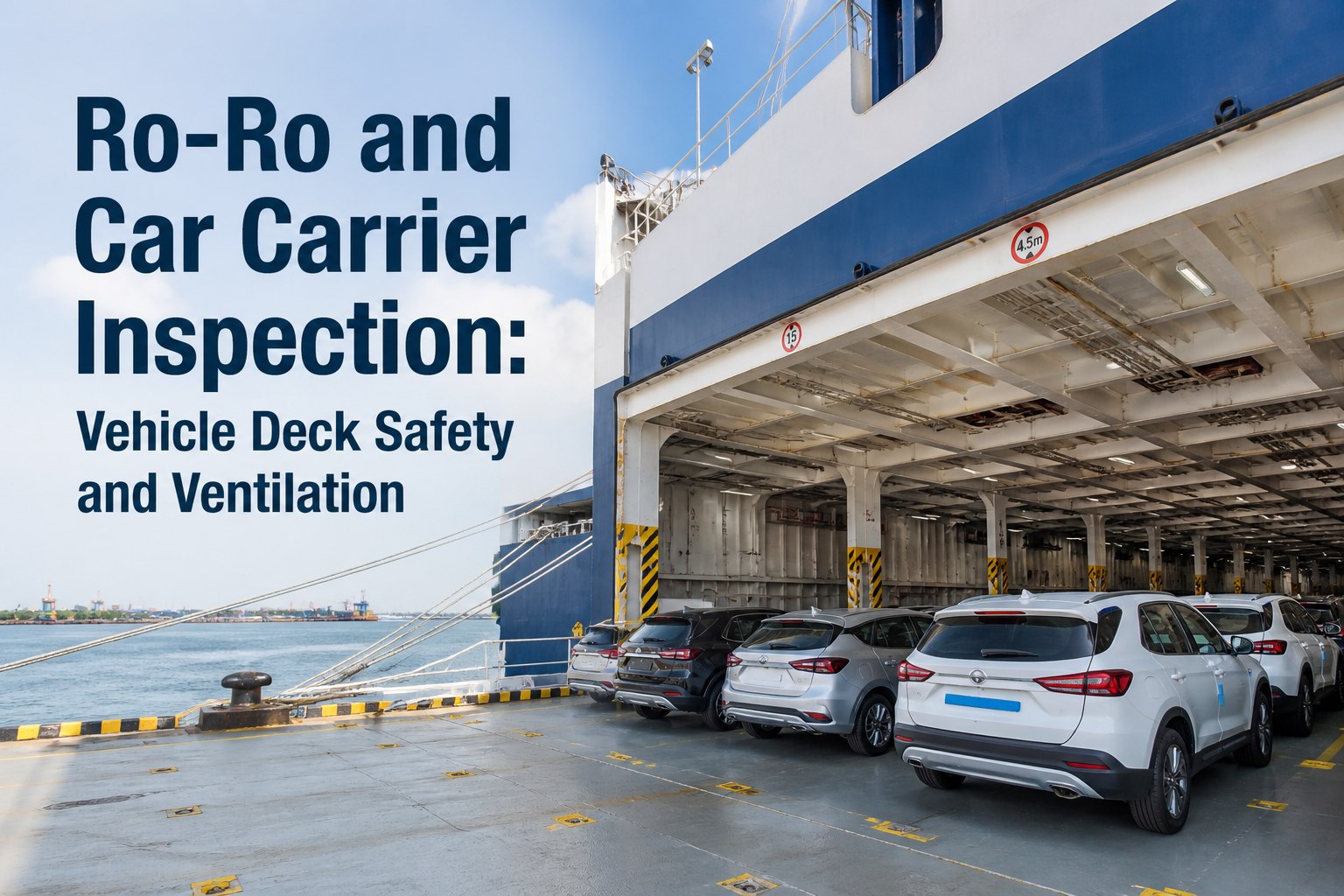
The regulatory landscape for Ro-Ro and Pure Car & Truck Carrier (PCTC) inspection changed materially on 1 January 2026. New SOLAS Chapter II-2 amendments adopted via Resolutions MSC.550(108), MSC.555(108), MSC.532(107) and MSC.534(107) entered into force, introducing individually addressable smoke and heat detectors, linear heat detection systems with both zonal and point capability, and tightened requirements for vehicle space fire protection. Behind the new rules sit a generation of catastrophic incidents — Felicity Ace (2022), Fremantle Highway (2023, 3,800 vehicles incl. ~500 EVs), Morning Midas (2025, 3,000 vehicles incl. 800 EVs) — that have made vehicle deck fire safety the highest-priority inspection focus in commercial shipping. The IMO Maritime Safety Committee at MSC 109 (December 2024) set a target completion of 2027 for comprehensive new-energy-vehicle SOLAS amendments, with entry into force scheduled for 1 January 2028. For RoPax, RoRo and PCTC operators, inspection in 2026 is the bridge between two regulatory eras. Start a free trial of Marine Inspection to digitize the new SOLAS II-2 detection workflows and prepare your fleet for the 2028 EV-specific framework.
Ro-Ro & PCTC Inspection — A Sector at the Regulatory Inflection Point
2026
SOLAS Amendments In Force
MSC.550(108), MSC.555(108) — addressable detection now mandatory
2028
Target EV Rules Entry-Into-Force
MSC 109: short-term measures + 2027 target completion
5
IUMI Focus Areas (2025 Update)
Gas accumulation, peak temps, PCTC design, Fixed First, foam limits
1,000C
Peak EV Battery Fire Temp
vs ~600C for ICE vehicles — beyond design assumptions
Why Ro-Ro Inspection in 2026 Is Different From Ro-Ro Inspection in 2024
Two years ago, Ro-Ro inspection was governed primarily by SOLAS Chapter II-2 as it had stood for over a decade. Today it operates under three layered authorities: the original SOLAS framework, the 1 January 2026 amendments now in force on new vessels, and a body of interim guidance — IMO MSC.1/Circ.1615, EMSA Guidance, MCA MGN 653(M), ClassNK EV Guidelines, MTF EV Carriage Report (April 2025), and the Vehicle Carrier Safety Forum (VCSF) fire response guidelines released in February 2026. Vessel operators must demonstrate compliance with all of them, despite the fact that mandatory IMO regulation specific to electric vehicles will not enter into force until 1 January 2028. This is the core inspection challenge of 2026: the rules are real, the cargo is here, and the gap is the operator's responsibility. Book a Marine Inspection demo to see how vessel carriers digitize multi-framework compliance for SOLAS II-2, IUMI, MCA, EMSA and VCSF in one place.
The 1 January 2026 SOLAS Amendments Already In Force
Adopted by Resolutions MSC.550(108) and MSC.555(108) at MSC 108 (May 2024), these amendments to SOLAS Chapter II-2 and the FSS Code entered into force on 1 January 2026. They reshape vehicle space fire detection with individually addressable detection, linear heat detection coverage, and tightened technical requirements that reflect lessons learned from the recent generation of vehicle carrier fires.
SOLAS Chapter II-2 + FSS Code — Effective 1 January 2026
A
Individually Addressable Detectors
Smoke and heat detectors must enable identification of fire LOCATION (not just zone). For RoRo spaces previously fitted with conventional zone-based systems, this means major detection system upgrades. Critical for tightly packed PCTC decks where finding the fire source within a 200-vehicle bay was previously hours.
B
Linear Heat Detection Systems
Both zonal and point-detection capability required. Heat-sensing cables along ducts, ramps and across vehicle decks supplement traditional point smoke detection. Particularly effective for early identification of vehicle deck fires before they reach flame stage.
C
Combined Smoke + Heat Detection
Where combined smoke-and-heat detectors are voluntarily installed in RoRo spaces of PCTCs constructed on or after 1 January 2026, the number of required detectors may dramatically increase. Inspection focus: detector spacing, density, false-alarm management.
D
Weather-Deck Vehicle Areas
New passenger ships with weather-deck vehicle carriage now require fixed fire detection AND fixed water-based monitor extinguishing systems for those areas. Drives major changes in RoPax newbuild design and inspection scope.
E
Effective Video Monitoring
RoPax and increasingly RoRo vessels require effective video monitoring systems for vehicle decks. Continuous recording, bridge-display, integration with detection alarm. Inspection: camera coverage, recording retention period, integration with patrol procedures.
F
Drainage & Stability Compliance
Drainage capacity for combined deluge water + firefighting water now subject to tighter validation. Free-surface effect calculations, scupper sizing, sump arrangements all formally evidenced. SOLAS II-2/20.7 inspection regime expanded.
Three Vessel Types — Three Distinct Compliance Profiles
The "Roll-On Roll-Off" cargo handling architecture is shared. The vessel categories that use it are not. Three types operate under sharply different SOLAS regimes, passenger profiles and inspection priorities.
Passenger / Vehicle Ferry
Passengers:More than 12 — passenger ship
Trade pattern:Short-sea, ferry routes, ferry tourism
Cargo profile:Cars, trucks, trailers, walk-on passengers — mixed used and new vehicles
EV-specific risk:Higher — passengers may charge devices, used cars more common, age unknown
Survey scope:Strictest — passenger ship survey + RoRo spaces + lifesaving + EV interim guidelines
Key 2026 amendment:Weather-deck vehicle area detection + monitor extinguishing — primarily targeted at RoPax
Cargo Ro-Ro
Passengers:Up to 12 — typically truck/lorry drivers only
Trade pattern:Short-sea, domestic, regional routes
Cargo profile:Trucks, trailers, project cargo, mafi trailers, mixed wheeled cargo
EV-specific risk:Variable — open decks improve airflow but complicate firefighting; reefer power connections a known cause
Survey scope:Cargo ship — RoRo spaces, fire safety, stability, cargo securing
Key 2026 amendment:Addressable detection mandatory; SSE 12 March 2026 advancing further II-2/9 amendments
Pure Car & Truck Carrier
Passengers:Up to 12 — typically none
Trade pattern:Long-haul ocean — China-Europe, Korea-US, Japan-global
Cargo profile:Cars only or cars + trucks; tightly packed, multi-deck
EV-specific risk:Highest concern — vehicles tightly packed, little emergency access, rapid fire spread
Survey scope:Cargo ship — multi-deck RoRo, fire, stability, cargo accounting
Key 2026 amendment:Combined smoke + heat detector coverage rules; "Fixed First" IUMI recommendation hardening
The EV Thermal Physics Driving Regulatory Change
Updated IUMI guidelines (September 2025) articulate the precise way lithium-ion battery fires differ from internal combustion engine vehicle fires. The total energy released is comparable. The PEAK heat release, the gas chemistry, the duration, and the firefighting response curve are not.
Peak Temperature Differential
Higher peak temperatures exceed deck structure design limits set when SOLAS Chapter II-2 was written.
01
Thermal Runaway
Self-sustaining electrochemical reaction within battery cells. Generates own oxygen — atmospheric displacement (CO2) cannot stop it. Cell-to-cell propagation continues until all cells exhausted.
02
Gas Accumulation
During thermal runaway, EVs release flammable gases. In unventilated spaces — closed RoRo decks, sealed PCTC bays — gas accumulation creates explosion risk. Detection & ventilation now front-line defences.
03
Toxic Off-Gas
Hydrogen fluoride, hydrogen chloride, hydrogen cyanide and other hazardous gases released during cell breakdown. Direct hazard to crew attempting manual firefighting; PPE and BA equipment requirements escalated.
04
Re-Ignition Risk
A "controlled" battery fire can re-ignite hours or days later as residual cells reach thermal runaway threshold. Single-shot CO2 systems offer no second chance — driving doubled-capacity recommendations.
05
PCTC Structural Vulnerability
Modern PCTCs have large, undivided horizontal decks with minimal compartmentation. Once a fire establishes, rapid spread is structural. IUMI 2025 guidelines explicitly identify this as a regulatory gap.
The Guidance Stack Vessel Operators Must Navigate
Until 2028 EV-specific SOLAS amendments enter into force, vessel operators rely on a layered stack of guidelines, recommendations and interim measures. Inspection in 2026 means demonstrable compliance with all applicable layers — none alone is sufficient.
IMO
MSC.1/Circ.1615 Interim Guidelines
IMO interim guidelines for the safe carriage of EVs and other alternative-fuel vehicles. Foundational reference layer until binding SOLAS amendments enter force.
All RoPax / RoRo / PCTC
EU
EMSA Guidance — Safe Carriage of EVs/AFVs
European Maritime Safety Agency guidance with specific chapters on RoPax (Ch. 1, 2 + Annexes) and RoRo / PCTC (Ch. 1, 3 + Annexes) — referenced in EU port state audits.
EU operations
UK
MCA MGN 653(M) — EV Fire Safety
UK Maritime & Coastguard Agency Marine Guidance Notice. Focused on RoPax but applicable to RoRo and PCTC. Front-line guidance for UK-flagged and UK-trading vessels.
UK flag / trade
IUMI
IUMI EV Carriage Recommendations (2025 Update)
International Union of Marine Insurance updated guidelines September 2025. Five focus areas: gas accumulation, peak temperatures, PCTC structural vulnerability, "Fixed First" approach, foam limitations.
Insurance + technical
VCSF
Vehicle Carrier Safety Forum Guidelines
Released February 2026. Vehicle Carrier Safety Forum guidelines specifically for fire response on PCC, PCTC, RoRo and RoPax vessels. Practical operational scaffolding.
Operational
ClassNK
ClassNK EV Carriage Guidelines
Class society guidance on safe maritime transportation of electric vehicles. Particularly relevant for Japanese-flagged and Japanese-trading vessels and for class-society notation alignment.
Japan / class
MTF
Maritime Technologies Forum EV Report
Published April 2025. Covers fire detection, firefighting, explosion prevention and crew safety on PCTCs. Practical measures supporting regulatory development at IMO.
PCTC technical
ICS
ICS Vehicle Loading Common Guidance
International Chamber of Shipping common guidance on the presentation and loading of vehicles. Covers used vehicle screening, damage assessment, charge state at loading.
RoRo + PCTC
Compliance With Eight Guidance Frameworks — On One Platform
SOLAS II-2 (2026 amendments), MSC.1/Circ.1615, EMSA, MCA MGN 653(M), IUMI, VCSF, ClassNK, MTF, ICS — pre-loaded templates and audit-ready evidence packs for every audit, every authority.
The "Fixed First" PCTC Firefighting Hierarchy
One of the most significant doctrinal shifts in the 2025–2026 guidelines is the IUMI/MTF formalisation of the "Fixed First" approach for PCTC fire response. The principle: on board a PCTC, fixed extinguishing systems must always be applied before manual firefighting is employed. The rationale is structural — vehicle deck access for crew is unsafe in established fires, and PCTC compartmentation cannot contain a fire long enough for manual intervention to be effective. Sign up for Marine Inspection to deploy "Fixed First" drill records and fire system maintenance workflows across your PCTC fleet.
1
Detection & Verification
Individually addressable detector activates; bridge-team verifies via video monitoring or rapid-response patrol. Critical: short response time. Verification must NOT delay activation in established fires.
2
Boundary Cooling & Sealing
Adjacent compartments isolated by fire dampers and door closure. Boundary water cooling activated where structurally accessible. Ventilation to fire space stopped.
3
Fixed System Deployment
CO2 flooding, water deluge, or high-expansion foam — whichever is fitted. Per IUMI: PCTC CO2 capacity should be doubled to allow re-application. Industry shift toward foam systems for new builds.
4
Continuous Monitoring
Thermal imaging, point-temperature monitoring of compartment boundaries, atmosphere checks for re-ignition gas signatures. Manual firefighting only as last-resort, post-cooling intervention.
Inspection focus: "Fixed First" doctrine drives inspection of fixed system readiness (per voyage), bridge-team training and drills, video monitoring and detection integration, and vehicle deck patrol procedures. Crew competence in not attempting unsafe manual intervention is now an inspectable element of safety management.
Vehicle Deck Ventilation: The First Line of Containment
Before fire suppression — ventilation. Vehicle decks must maintain breathable atmospheres during loading (when running engines emit exhaust), purge any flammable vapours during voyage, and increasingly support gas-detection systems for early identification of EV thermal runaway pre-cursor gases. The ventilation system is the most safety-critical machinery system on a Ro-Ro after main propulsion.
Vehicle Space Ventilation — Functional Requirements
10/hr
Loading Operations Air Change Rate
Engine exhaust during vehicle loading drives peak ventilation demand. Industry standard: 10 air changes per hour during loading. Verified at COI / class survey via airflow measurement, fan condition, ducting integrity.
6/hr
At-Sea Ventilation Rate
Reduced cycle during voyage maintains atmosphere quality and supports gas-detection accuracy. Failure mode: vapour accumulation creates explosion risk. Continuous monitoring via gas detectors increasingly specified.
Sep.
Independent Fan Systems
RoRo space ventilation independent from accommodation and machinery space ventilation. Prevents cross-contamination during fire events. Verified in fire system isolation tests.
FD
Fire Damper Closure
Ventilation openings fitted with fire dampers operable from outside the protected space. Critical for CO2 system effectiveness — fire space must be sealable. Function-tested at each major survey + monthly walk-rounds.
GD
Gas Detection (Emerging)
Increasingly specified on new builds and retrofits. Detects flammable vapours and EV pre-thermal-runaway gas signatures. Integration with bridge alarm and ventilation increase logic. Inspection: calibration, sensor placement, alarm-to-action protocols.
Pre-Embarkation Vehicle Screening — The IUMI/ICS Recommendation
IUMI and ICS guidance establish pre-embarkation screening as the first defensive layer in EV fire prevention. Used vehicles carry the highest risk: hidden mechanical damage from prior accidents can compromise battery pack intactness without external visual evidence. There has never been a fire on a RoRo or PCTC proven to have been caused by a factory-new EV.
VISUAL
External Damage Inspection
Body damage assessment including underbody, especially around battery pack location. Used vehicles photographed and logged. Visible mechanical damage triggers loading rejection or special stowage.
CHARGE
State of Charge Limits
EV state of charge typically capped at 50% for ocean carriage (varies by carrier policy). Lower charge state means lower stored energy in battery pack — proportionally lower thermal runaway hazard.
DOC
Documentation Verification
VIN matched to manifest, battery type confirmed, OEM certification documents reviewed. Used cars require proof of recall compliance and pre-export inspection.
SEPARATION
Stowage Segregation
EVs stowed with consideration for separation from used vehicles, dangerous goods, and ignition sources. Some carriers (Hoegh practice) disconnect used car batteries before stowage.
RECORD
Per-Vehicle Audit Trail
VIN, condition, charge state, stowage location, photographs all logged digitally per vehicle. Insurance, OEM and charterer audit requirement — increasingly standard.
REJECT
Cargo Rejection Authority
Master and chief officer must have explicit authority to refuse loading of vehicles that fail screening. SMS procedures should document this authority. Carrier policy on rejection is itself an inspectable item.
The Cost of Inspection Failure on a Vehicle Carrier in 2026
Vehicle carriers operate in 2026 with multiple high-stakes pressures: charter rates at record levels, OEM customer scrutiny intensified after Felicity Ace and Morning Midas, and the regulatory landscape moving faster than paper-based compliance can track.
PSC
2026 Detention Triggers
Port state inspection focus has shifted to verify the 2026 SOLAS amendments. Addressable detection system non-compliance, video monitoring deficiencies and ventilation findings drive new detentions on RoPax/RoRo entering EU and UK ports.
OEM
Charter Eligibility
BYD, Geely, MG, BMW, Tesla and other OEMs run rigorous carrier audits. Inspection record gaps now disqualify carriers from major automotive shipping contracts — a permanent commercial cost beyond a single voyage.
Total
Catastrophic Loss
Morning Midas (2025), Fremantle Highway (2023), Felicity Ace (2022) — major PCTC fires regularly result in vessel total loss with 3,000–4,000 vehicles. Each event reshapes underwriter capacity and rates sector-wide.
P&I
Insurance Exposure
Marine insurance markets have priced EV-related risk into RoPax/RoRo/PCTC premiums. Inspection record quality directly affects renewal pricing and clauses; clean records = significant annual savings.
How Marine Inspection Closes the 2026 Compliance Gap
The eight-framework compliance environment is impossible to manage on paper or single-purpose spreadsheets. Marine Inspection is built specifically for the multi-authority, multi-vessel-class reality of vehicle carrier operations in 2026. Book a demo to see RoPax, RoRo and PCTC-specific workflows.
01
2026 SOLAS Amendments Pre-Loaded
Templates aligned with MSC.550(108), MSC.555(108), MSC.532(107), MSC.534(107) — addressable detection verification, linear heat detection logs, video monitoring records, weather-deck monitor extinguishing systems.
02
Multi-Framework Evidence Packs
Single-click evidence packs for SOLAS II-2, MSC.1/Circ.1615, EMSA, MCA MGN 653(M), IUMI, VCSF, ClassNK, MTF and ICS. Each authority gets its expected format; one source of truth underneath.
03
Per-Vehicle Pre-Embarkation Records
VIN-level screening data: external damage photos, charge state at loading, battery type, stowage location, OEM certification reference. Audit trail for OEM, charterer and insurance audits.
04
"Fixed First" Drill & Training Records
Bridge-team and crew drills aligned with IUMI/MTF "Fixed First" doctrine. Training competence records, drill log timestamps, scenario-specific evaluations, video debrief storage.
05
Ventilation, Drainage & Stability Logs
Air-change verification, fan condition, fire damper tests, scupper capacity, free-surface effect calculations — the SOLAS II-2/20.7 and II-2/20.8 evidence chain that PSC inspectors increasingly demand.
06
Stern Door, Ramp & Lashing Surveys
Post-Estonia watertight integrity regime: stern door hydraulic tests, sealing inspection, opening cycle records, internal ramp condition, lashing equipment inventory with SWL tags, deck D-ring load-test history.
Run Vehicle Carrier Compliance for the 2026–2028 Regulatory Wave
SOLAS II-2 amendments, EV screening, ventilation testing, fire system maintenance, lashing inspections, ramp surveys, multi-authority audit packs — one cloud platform built for vehicle carriers and ferry operators.
2026 Vehicle Carrier Inspection Readiness Checklist
Use this as the master pressure-test before any class society survey, port state inspection, OEM charterer audit, or pre-embarkation customer screening. Items below combine SOLAS II-2 (including January 2026 amendments) with the layered guidance frameworks now driving inspection scope.
Vehicle Carrier 2026 Pre-Inspection Quick-Check
Statutory Documentation
Cargo Ship / Passenger Ship Safety certificates current per vessel type
ISM Document of Compliance (DOC) and Safety Management Certificate (SMC)
Cargo Securing Manual approved by flag state / RO and onboard
Cargo Stowage Manual with deck loading limits
EV / new energy vehicle SMS procedures developed and crew-trained
2026 SOLAS II-2 Amendments
Individually addressable smoke and heat detectors verified (new construction)
Linear heat detection systems function-tested where fitted
Combined smoke + heat detector coverage per FSS Code revisions
Weather-deck vehicle area detection + monitor extinguishing (new RoPax)
Effective video monitoring system operational and recording
Drainage capacity calculations validated; stability per II-2/20.7
EV Carriage & "Fixed First"
Pre-embarkation EV screening procedure documented
Per-vehicle records: VIN, charge state, damage assessment, stowage
Bridge-team "Fixed First" training and drill records
Master / chief officer cargo rejection authority documented
CO2 / deluge / foam fixed system pressure-tested; release controls operational
Portable IR thermal imagers calibrated; water mist lances inventoried
Ventilation, Doors & Cargo Securing
Air change rates verified (10/hr loading, 6/hr at sea typical)
Ventilation fan emergency stops function-tested
Fire dampers operational; closure verified
Stern door / ramp hydraulic system, seals, securing arrangements inspected
Bow door (where fitted) inner watertight door operational; cycle records on file
Internal hoistable car decks: locking, hydraulic synchronisation verified
Lashing equipment (chains, web straps, twist locks) — SWL-tagged and condition-verified
Deck lashing points (D-rings, pad eyes) — visual inspection and load-test history
Frequently Asked Questions
What changed in SOLAS Chapter II-2 on 1 January 2026?
Resolutions MSC.550(108), MSC.555(108), MSC.532(107) and MSC.534(107) entered into force, introducing major updates to vehicle space fire detection. Key changes: individually addressable smoke and heat detectors enabling fire-LOCATION identification (not just zone); linear heat detection systems with both zonal and point-detection capability; updated requirements for weather-deck vehicle area detection and fixed water-based monitor extinguishing (primarily for new passenger ships); effective video monitoring; tightened drainage and stability validation. The amendments apply to new construction from 1 January 2026 and drive certification updates on existing fleet at next major survey.
When will mandatory IMO regulation specifically for EVs enter into force?
MSC 109 (December 2024) set a target completion of 2027 for comprehensive new-energy-vehicle SOLAS amendments. Entry-into-force is scheduled for 1 January 2028. Until then, vessel operators rely on layered interim guidance: IMO MSC.1/Circ.1615 Interim Guidelines, EMSA Guidance, MCA MGN 653(M), IUMI Recommendations (updated September 2025), Vehicle Carrier Safety Forum (VCSF) guidelines (February 2026), ClassNK EV Guidelines, MTF EV Carriage Report (April 2025), and ICS Common Guidance on vehicle loading. Inspection in 2026–2027 means demonstrable compliance with all applicable layers.
What is the "Fixed First" approach for PCTCs?
"Fixed First" is the IUMI/MTF formalised firefighting hierarchy for PCTC fire response: fixed extinguishing systems (CO2, deluge, foam) must always be applied before manual firefighting is employed. The rationale is structural — PCTC vehicle decks have large, undivided horizontal compartments allowing rapid fire spread, and crew access during established fires is unsafe. The four-step doctrine is detection & verification, then boundary cooling & sealing, then fixed system deployment, then continuous monitoring with manual firefighting only as last-resort post-cooling intervention.
Why are EV battery fires harder to fight than ICE vehicle fires?
Lithium-ion battery thermal runaway is a self-sustaining electrochemical reaction. The cells generate heat and oxygen internally — atmospheric oxygen displacement (CO2 flooding) cannot stop the reaction. Updated IUMI 2025 guidelines identify five distinguishing factors: peak temperatures exceeding 1,000C versus ~600C for ICE fires; flammable gas accumulation in unventilated spaces creating explosion risk; toxic off-gas (hydrogen fluoride, hydrogen chloride, hydrogen cyanide) endangering crew; re-ignition risk hours or days after apparent extinguishment; and PCTC structural vulnerability with undivided horizontal decks facilitating rapid spread.
Are factory-new EVs more dangerous than used vehicles?
No — the opposite. There has never been a fire on a RoRo or PCTC proven to have been caused by a factory-new EV. Modern EVs incorporate extensive safety mechanisms during manufacture and quality control. Used vehicles carry higher risk: hidden mechanical damage from prior accidents can compromise battery pack intactness without external visual evidence. IUMI and ICS guidelines explicitly recommend pre-embarkation screening of used vehicles including external damage inspection, charge state limits (typically capped at 50%), and per-vehicle audit trail records.
What ventilation rates do vehicle decks require?
SOLAS II-2/20.8 requires permanent mechanical ventilation in vehicle and RoRo spaces. Industry practice (varying by flag state and vessel) requires approximately 10 air changes per hour during loading operations when engines run, and 6 air changes per hour during voyage. Ventilation must be independent from accommodation and machinery space ventilation. Fire dampers must be operable from outside the protected space, fans must have emergency stops, and gas detection systems are increasingly specified on new builds and retrofits to detect both flammable vapours and EV pre-thermal-runaway gas signatures.
How does Marine Inspection support multi-framework compliance?
Pre-loaded templates aligned with the eight major guidance frameworks: SOLAS Chapter II-2 (with January 2026 amendments), MSC.1/Circ.1615 Interim Guidelines, EMSA Guidance, MCA MGN 653(M), IUMI 2025 Recommendations, Vehicle Carrier Safety Forum Guidelines, ClassNK EV Guidelines, Maritime Technologies Forum EV Report, and ICS Common Guidance. Single-click evidence packs in each authority's expected format from one source of truth. Per-vehicle EV screening records, "Fixed First" drill records, ventilation logs, fire system maintenance, ramp inspection — fleet-wide visibility and audit-ready exports.
2026 in Force, 2028 Coming — Run Your RoPax / RoRo / PCTC Fleet Audit-Ready
SOLAS II-2 amendments, EV screening, "Fixed First" drills, ventilation testing, fire system maintenance, ramp inspections, lashing records — Marine Inspection is the platform built for vehicle carrier operators.