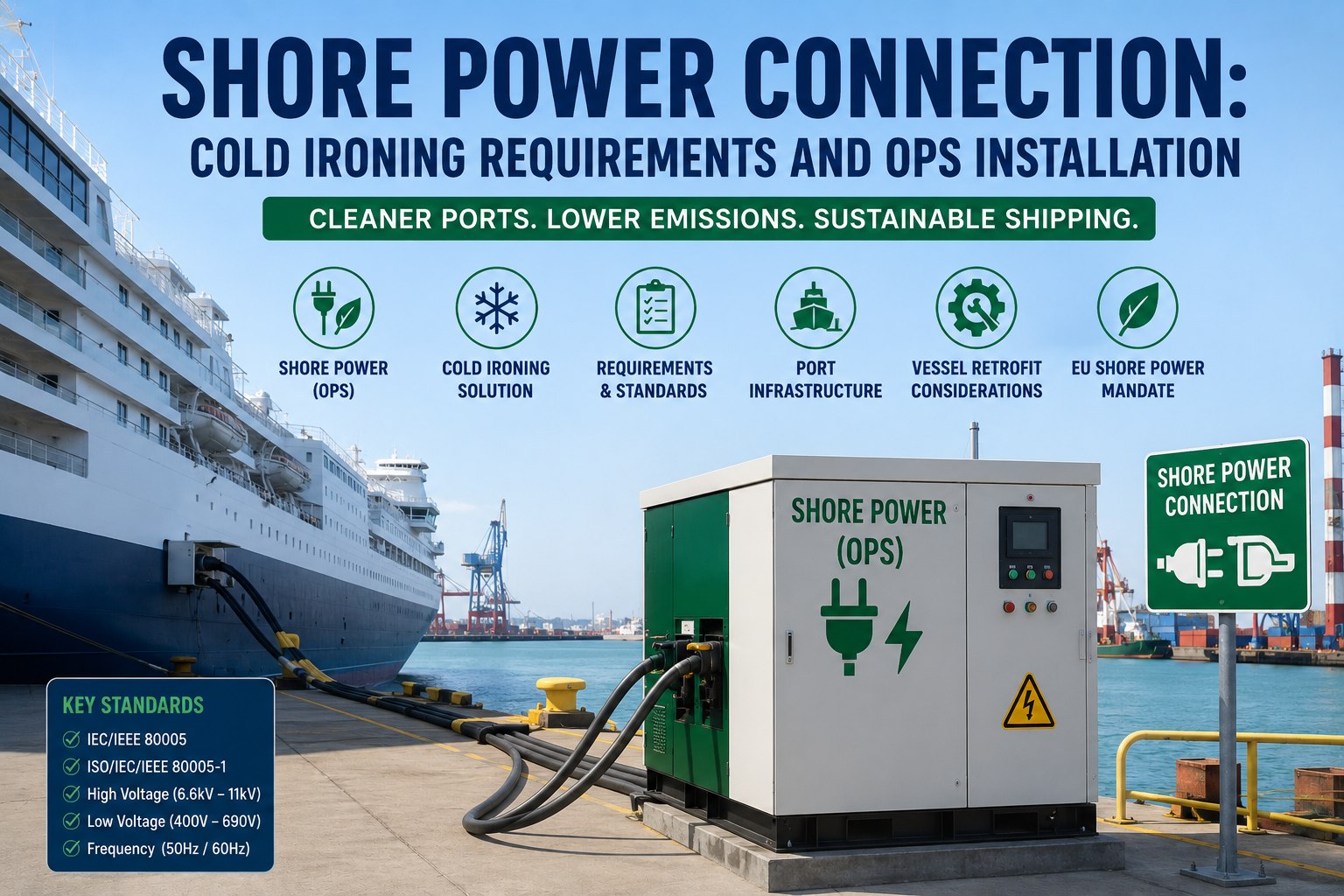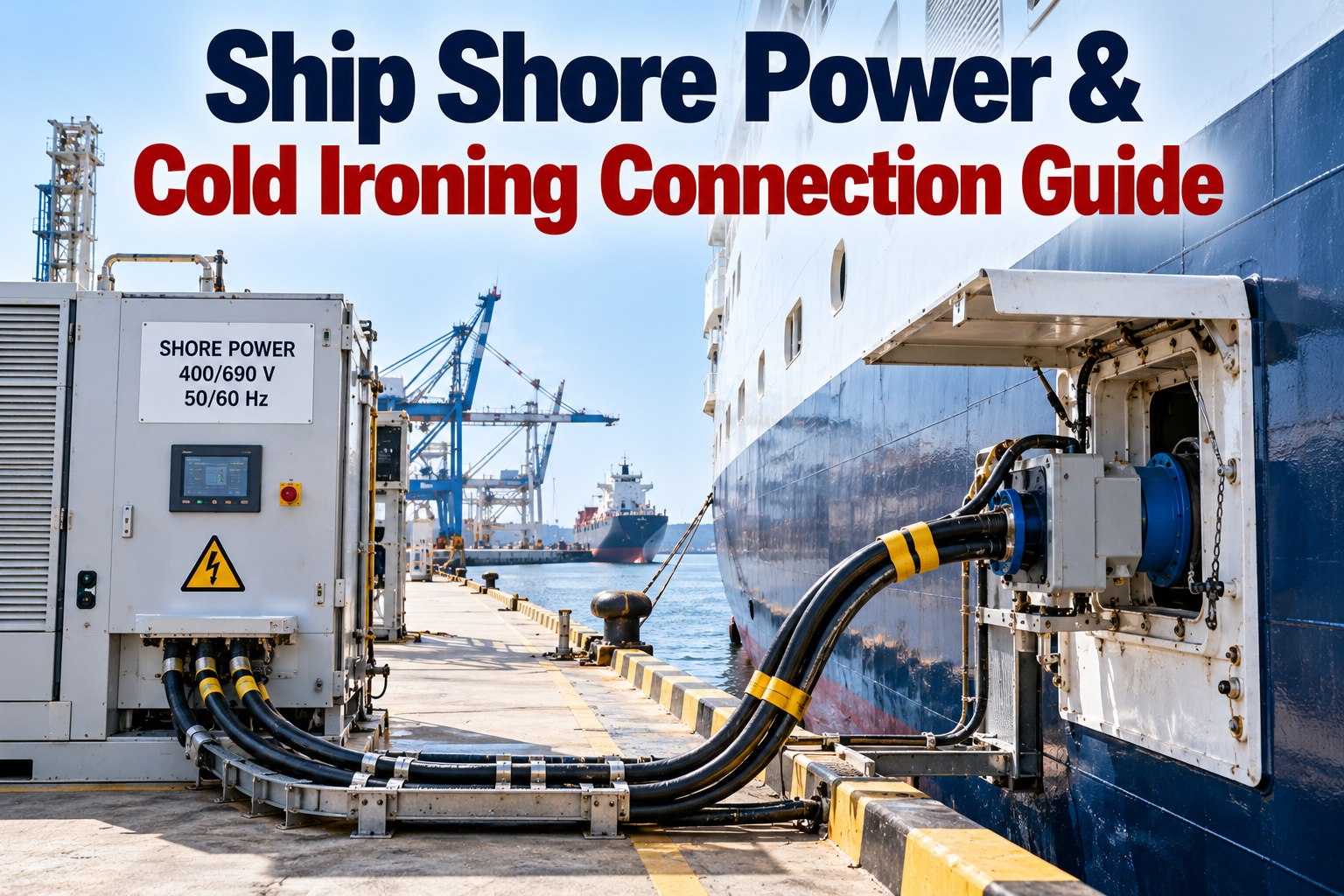
Shore power turns a berthed ship from a small power station into a customer of the grid. Done well, it silences the auxiliary engines and cuts emissions at the quay. Done badly, it brings a high voltage connection, an unfamiliar interlock system and a crew that has never plugged in. With an EU duty for container and passenger ships starting on 1 January 2030, many operators are preparing now. This guide covers the standards, the regulatory clock, the safety systems and the readiness checks.
How a Shore Power Connection Works: From the Grid to the Ship's Loads
What sits on shore, what sits on board and what links them together
IEC/IEEE 80005-1:2019 covers high voltage shore connection systems, both on the ship and on shore, and applies to their design, installation and testing. Its scope includes the shore distribution system, the shore-to-ship connection and interface equipment, transformers and reactors, frequency converters, the ship's distribution system, and the control, monitoring, interlocking and power management systems. It does not apply to power supplied during docking periods.
Why the standard says national and port authorities may add their own requirements
The ISO summary says national authorities, port authorities or shore system owners may impose additional or alternative requirements. For a ship, that means the standard is the base, not the whole answer. The port's own rules on connection, communications and emergency arrangements apply on top. For a wider look at connection requirements, see our shore power connection guide to cold ironing requirements and OPS installation.
Standards and Connectors: Low Voltage, High Voltage and Ship-Type Annexes
Where the line between low voltage and high voltage connections falls, and which standard follows
A standards summary from the Sustainable Ships community classes low voltage shore connection systems as below 1 MVA and high voltage systems as above 1 MVA. High voltage systems follow IEC/IEEE 80005-1 for operability and IEC 62613-2 for dimensions. Low voltage systems follow IEC/IEEE 80005-3 and IEC 60309-5. Both use IEC/IEEE 80005-2 for communication, and the summary says a frequency converter shall be used on shore and the system must be galvanically separated from the shore distribution system.
| Item | Low voltage (LVSC, below 1 MVA) | High voltage (HVSC, above 1 MVA) |
|---|---|---|
| Operability standard | IEC/IEEE 80005-3 | IEC/IEEE 80005-1 |
| Plug and socket dimensions | IEC 60309-5 | IEC 62613-2 |
| Communication | IEC/IEEE 80005-2 | IEC/IEEE 80005-2 |
| Ship types with normative annexes | Offshore supply, service and working ships (Annex B); container ships (Annex C) | Ro-Ro cargo and Ro-Ro passenger (B); cruise (C); container (D) |
| Ship types with informative annexes | Tankers (Annex D) | LNG carriers (E); tankers (F) |
Why the standard is being revised and what that means for new installations
The ISO record shows IEC/IEEE 80005-1:2019 as the second edition, with Amendment 1 (2022) and Amendment 2 (2023), and as an international standard to be revised, with a successor under development. If you are specifying a new installation, ask your supplier which edition and amendments the design follows and how they will handle the revision.
High-Voltage Safety: Safety Circuits, Interlocks and the People Who Connect
What the standard says about safety circuits and how quickly the breakers must open
The ISO summary of IEC/IEEE 80005-1 says safety circuits are mandatory in all annexes, the minimum current in safety circuits is 50 mA, and opening a safety loop must trigger automatic opening of the ship and shore circuit breakers within 200 ms. For earthing, it notes an earthing transformer with a resistor may be used on the secondary side, with a neutral earthing resistor rated at least 25 A for 5 seconds. These are design points for the installation, but a Chief Engineer or ETO should know them and test them.
Why a connection sequence needs an agreed procedure, trained people and a written record
High voltage connection work carries shock and arc hazards. The standard and the port's rules define the detail, and the ship's procedure should say who does what. The outline below is a generic planning aid, not a procedure. It shows the stages a crew should plan for and where records are generated.
The EU Clock: FuelEU Maritime, AFIR and Who Must Connect
Which ships and ports are covered from 2030 and what changes in 2035
Lloyd's Register says that from 1 January 2030, container and passenger ships above 5,000 GT moored at the quayside in TEN-T maritime ports under the jurisdiction of an EEA Member State must connect to shore power and use it for all electrical power demand at berth. From 1 January 2035 it extends to any port under EEA jurisdiction where shore power is available. A ship may instead use zero-emission technologies for all its electrical demand at berth.
Which exemptions apply, and why compatibility and certification decide whether you can use one
Lloyd's Register lists exemptions including stays of under two hours, unscheduled calls for safety, unavailable connection points, grid stability risk and incompatibility with onboard equipment where the onboard installation is certified to AFIR Annex II. From 2035, exemptions are capped. The incompatibility exemption depends on certification, so the ship's installation documents matter.
| Exemption | Detail |
|---|---|
| Short stay | Alongside for less than two hours |
| Safety calls | Unscheduled calls for safety or saving life at sea |
| No connection point | Shore power connection points not available at the port |
| Grid stability | Grid stability at risk because shore power is insufficient |
| Incompatibility | Shore installation incompatible with onboard equipment, if the onboard installation is certified to AFIR Annex II |
| Emergency | Emergencies or force majeure, for a limited period |
| Tests | Onboard generation for maintenance or functional tests requested by an authority or recognised organisation, while still connected |
| From 2035 | Exemptions capped at the lower of 10% of annual port calls (rounded up) or 10 port calls |
Emissions, Compliance and Cost Benefits: What the Sources Show and Do Not Show
How much at-berth energy and CO2 is at stake in EU ports, and what the current rules reach
The ICCT estimated that about 15,700 ships spent more than two hours at berth in 489 major EU ports in 2019, demanding nearly 5.9 TWh and emitting around 4.37 Mt of CO2 a year. Tankers, passenger ships and cruise ships made up 67% of that demand. It says current FuelEU Maritime and AFIR ambitions would cut at-berth CO2 by only 24%. For energy efficiency rules on existing ships, see our EEXI compliance guide to the energy efficiency existing ship index.
What shore power can do for compliance and cost, and where the evidence is thin
The benefits are real but uneven. The Maersk Mc-Kinney Moller Center explainer, which is non-regulatory, says shore power counts as zero GHG intensity under FuelEU Annex I. It also points to public funding and port incentives. The sources we read give no cost figures. So the honest advice is to build your own case from a quote, your port call pattern and your load at berth.
The Shore Power Readiness Checklist: Ship, Port and Crew
A checklist with a checkpoint type on each item for the ship and the superintendent
Use the checklist below as a base. It covers compatibility with the port, the ship's installation and documents, the safety systems and the crew. Adapt it to your equipment maker's instructions, the standard and the port's requirements.
| Item | What to check | Checkpoint type |
|---|---|---|
| Port compatibility | Port's voltage, frequency, connector and cable arrangement match the ship's installation | Record |
| Ship installation certificate | Installation certified, and documents on board (relevant if claiming an incompatibility exemption) | Record |
| Shore connection switchboard | Condition, labelling and protective settings | Visual |
| Safety loop and interlocks | Function test done and recorded | Test |
| Earthing and bonding | Arrangements checked per the standard and procedure | Test |
| Cable and coupler | Undamaged, clean and stored correctly | Visual |
| Crew competence | Connection team trained and drilled | Record |
| Energy and hours records | Energy taken and hours connected logged for each call | Record |
Mistakes That Turn a Shore Power Project Into a Berth-Side Problem
Six habits that leave a shore power installation unused or unsafe
Systems That Keep Shore Power Tests, Drills and Records Together
How a dated photo repository, task ownership and deadlines keep shore power evidence together
Shore power adds a new set of equipment to inspect, test and document. Marine Inspection supports a dated photo repository, observations turned into tasks with owners, deadlines and evidence, and certificate and equipment tracking. A dated photo of the shore connection switchboard and a log of each safety loop test show an inspector or charterer that the system is looked after.