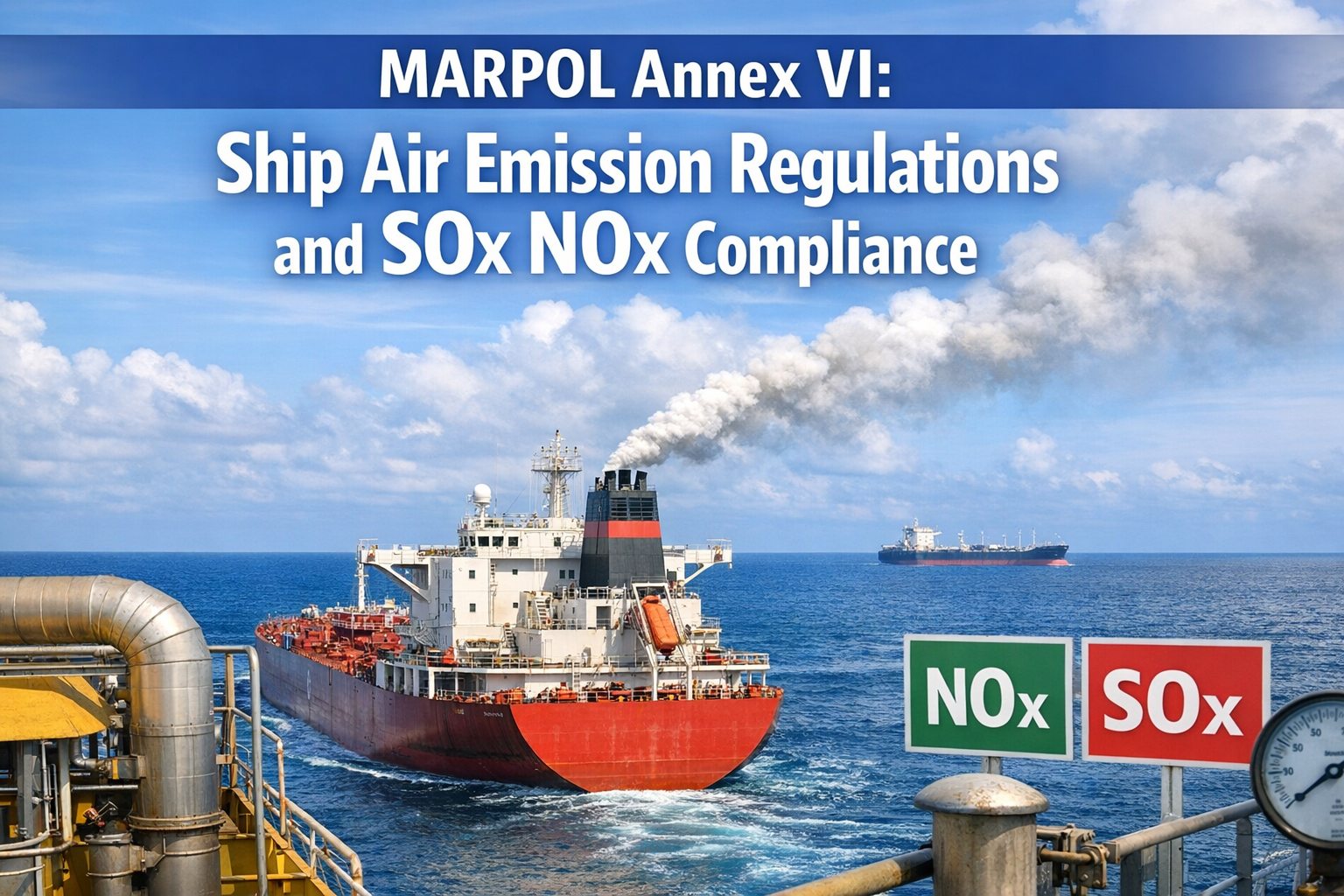
MARPOL Annex VI is the most actively amended regulation in international shipping — and the one that affects the largest operational cost line on every vessel's P&L. Since the landmark "IMO 2020" global sulphur cap cut permitted fuel sulphur from 3.50% to 0.50%, the annex has continued to tighten with EEXI and CII requirements for existing ships, expanded Emission Control Areas, and the emerging IMO Net-Zero Framework for greenhouse gas reduction. In 2026, two new ECAs in the Canadian Arctic and Norwegian Sea entered force, the NOx Technical Code was updated for engine retrofits, and enhanced SEEMP fuel data collection requirements took effect. For technical superintendents and fleet managers, Annex VI compliance now means managing fuel procurement across sulphur grades, tracking NOx Tier certification for every engine, calculating and reporting EEDI/EEXI/CII values, maintaining IAPP certificates, and preparing for a global carbon pricing mechanism that could arrive as early as 2027. This guide covers every Annex VI requirement in operational terms — from the sulphur cap and NOx tiers to the energy efficiency framework and upcoming decarbonization measures. Start a free trial of Marine Inspection to track fuel compliance, engine certifications, and SEEMP documentation across your fleet.
MARPOL Annex VI: Air Emissions Regulation by the Numbers
0.50%
Global Sulphur Cap
Max fuel sulphur content outside ECAs since 2020
0.10%
ECA Sulphur Limit
Required in all 7 Emission Control Areas
III
NOx Tiers
Tier III required in ECAs for new-build engines
A-E
CII Ratings
Annual operational carbon intensity rating for ships 5,000 GT+
Sulphur Oxides (SOx): The Fuel Compliance Framework
The SOx regulations are the most visible and operationally impactful part of Annex VI — they dictate what fuel every ship burns and where. Since January 1, 2020, no ship may use fuel with sulphur content exceeding 0.50% globally, or 0.10% inside ECAs, unless using an approved Exhaust Gas Cleaning System (scrubber).
0.50% S max
Applies to all ships worldwide since 1 Jan 2020. Down from 3.50% (pre-2020). Carriage ban: non-compliant fuel prohibited onboard unless EGCS fitted.
0.10% S max
Required in Baltic, North Sea, North American, US Caribbean, Mediterranean (May 2025), Canadian Arctic & Norwegian Sea (Mar 2027). Or equivalent EGCS.
SOx Compliance Options for Vessel Operators
1
Low-Sulphur Fuel (VLSFO/ULSFO/MGO)
Use compliant fuel — VLSFO (0.50% S) globally, ULSFO/MGO (0.10% S) in ECAs. Most common approach. Requires fuel changeover procedures for ECA entry/exit with logbook documentation.
2
Exhaust Gas Cleaning System (Scrubber)
Allows use of higher-sulphur HFO while achieving equivalent SOx emission levels. Open-loop, closed-loop, or hybrid configurations. SOx Emission Compliance Plan and Certificate required. Some ports restrict open-loop scrubber discharge.
3
Alternative Fuels (LNG, Methanol, etc.)
LNG, methanol, and other low-sulphur alternative fuels inherently comply with SOx limits. Requires IGF Code compliance for gas-fuelled ships. Growing option for new builds targeting decarbonization.
Nitrogen Oxides (NOx): The Three-Tier System
NOx emissions from marine diesel engines over 130 kW are regulated through a three-tier system based on the ship's construction date and operating area. Book a Marine Inspection demo to see how engine certification tracking works across mixed fleets with Tier I, II, and III engines.
Table 1: NOx Emission Limits by Tier (MARPOL Annex VI Reg. 13)
2026 NOx ECA UPDATES
Canadian Arctic ECA: NOx Tier III applies to ships with keels laid on/after 1 January 2025 — effective from March 1, 2026. Norwegian Sea ECA: Tier III applies to ships with building contracts on/after 1 March 2026, or keels laid on/after 1 September 2026, or delivery on/after 1 March 2030. NOx Technical Code: Updated engine certification procedures for retrofits, dual-fuel conversions, and power limitation measures — effective September 1, 2026.
Emission Control Areas: The 2026 Global Map
ECAs enforce stricter SOx (0.10% fuel) and/or NOx (Tier III) limits. Vessel routes through any ECA trigger fuel switching requirements, engine certification verification, and additional documentation. Sign up for Marine Inspection to track ECA transit documentation automatically.
Table 2: All Emission Control Areas — Status as of 2026
Track SOx, NOx & ECA Compliance Across Your Fleet
Fuel switching logs, BDN tracking, engine EIAPP certificates, scrubber compliance plans, ECA transit documentation — Marine Inspection manages every Annex VI fuel and emission requirement in one platform with automated alerts.
Energy Efficiency: EEDI, EEXI, CII & SEEMP
Annex VI Chapter 4 introduced mandatory energy efficiency measures — the regulatory framework driving maritime decarbonization. These requirements affect every ship of 400 GT and above, with data collection obligations starting at 5,000 GT.
New Ships
EEDI — Energy Efficiency Design Index
Mandatory for new ships — sets a minimum energy efficiency level per capacity-mile. Calculated at design stage. Progressively stricter in phases (Phase 0 → Phase 3). Ship designers choose technologies to meet the required EEDI value. IEE Certificate issued upon verification.
Existing Ships
EEXI — Energy Efficiency Existing Ship Index
One-time calculation for existing ships — must demonstrate attained EEXI meets the required value. Applied from first survey on/after 1 January 2023. Compliance options: engine power limitation (EPL/ShaPoLi), energy-saving devices, or alternative fuels. Under review in 2026.
All Ships 5,000 GT+
CII — Carbon Intensity Indicator
Annual operational rating from A (best) to E (worst) based on actual CO2 emissions per transport work. Ships rated D for 3 consecutive years or E in any year must submit a corrective action plan. Reduction targets tighten annually. Under review in 2026 for post-2026 reduction factors.
All Ships
SEEMP — Ship Energy Efficiency Management Plan
Part I: Energy efficiency management plan (all ships 400 GT+). Part II: Fuel oil data collection plan (ships 5,000 GT+) — enhanced data requirements from August 2025. Part III: CII management plan with 3-year improvement targets. Must be verified and kept onboard.
The Decarbonization Horizon: What's Coming Next
The IMO Net-Zero Framework — if adopted at the adjourned MEPC session expected in October 2026 — will add a new Chapter 5 to Annex VI introducing a global fuel standard with mandatory emissions intensity limits and economic measures (carbon pricing). Fleet managers should begin preparing now. Schedule a demo to see how Marine Inspection tracks decarbonization readiness alongside current compliance.
Oct 2026
IMO Net-Zero Framework — MEPC reconvenes to consider adoption of global fuel standard and carbon pricing mechanism as MARPOL Annex VI Chapter 5.
2027
CII reduction factors updated post-2026 review. SOx 0.10% enforced in Canadian Arctic & Norwegian Sea ECAs. North-East Atlantic ECA expected to enter force.
~2050
IMO net-zero target for GHG emissions from international shipping — driving transition to alternative fuels, wind-assist, and zero-carbon technologies.
Annex VI Compliance Checklist
Use before PSC, flag state surveys, and commercial vetting. These items cover the most common Annex VI deficiency findings. Sign up for Marine Inspection to run these checklists digitally across your fleet.
MARPOL Annex VI — Pre-Inspection Compliance Check
Fuel & SOx Compliance
Bunker Delivery Notes available for last 3 years — sulphur content documented per delivery
Fuel oil samples retained onboard until fuel consumed (sealed, labelled with BDN reference)
Fuel changeover procedure documented for ECA entry/exit — logbook entries with timing and tank levels
No non-compliant fuel carried onboard unless EGCS installed with valid SOx Compliance Certificate
NOx & Engine Certification
Engine EIAPP Certificate available for every diesel engine over 130 kW
Engine Technical File onboard with on-board NOx verification procedure
For ECA operations — Tier III compliance verified for applicable engines per construction date
Any engine modifications documented with updated EIAPP certification
Energy Efficiency & GHG
IAPP Certificate valid with survey endorsements current
IEE Certificate onboard — EEDI (new ships) or EEXI (existing ships) value documented
SEEMP Part I onboard (all ships). Part II verified for 5,000 GT+ with enhanced data collection
CII rating documented — corrective action plan submitted if rated D (3 years) or E (any year)
Other Annex VI Requirements
ODS Record Book maintained — no deliberate emissions of ozone depleting substances
Incinerator operating within Annex VI requirements — no incineration of prohibited substances
VOC Management Plan onboard if tanker carrying crude oil (applicable ports)
Crew can explain current fuel type in use and applicable sulphur limits for vessel's position
Frequently Asked Questions
What is the current global sulphur cap under MARPOL Annex VI?
The global sulphur cap is 0.50% m/m (mass by mass) since January 1, 2020. Inside Emission Control Areas, the limit is 0.10%. Ships can comply using low-sulphur fuel, Exhaust Gas Cleaning Systems (scrubbers), or alternative fuels like LNG. Carriage of non-compliant fuel is prohibited unless a scrubber is fitted.
What are NOx Tier I, II, and III?
Three progressively stricter emission standards for marine diesel engines over 130 kW. Tier I applies to engines on ships built 2000-2010. Tier II applies globally to engines on ships built from 2011. Tier III applies only inside NOx ECAs to new-build engines — reducing NOx by approximately 75-80% compared to Tier I. The applicable construction date varies by ECA.
What is the difference between EEDI, EEXI, and CII?
EEDI applies to new ships at the design stage — setting a minimum energy efficiency standard. EEXI is a one-time calculation for existing ships to demonstrate they meet an equivalent efficiency standard. CII is an annual operational rating (A-E) based on actual emissions per transport work — ships rated poorly must submit corrective action plans. All three are part of Annex VI Chapter 4.
What new ECAs entered force in 2026?
The Canadian Arctic and Norwegian Sea became Emission Control Areas on March 1, 2026. NOx Tier III requirements apply to new-build engines immediately (per construction date criteria). SOx compliance (0.10% fuel) is enforced from March 1, 2027 after a 12-month grace period. A North-East Atlantic ECA is expected to be adopted at MEPC 84.
What is the IMO Net-Zero Framework?
A proposed new Chapter 5 of MARPOL Annex VI establishing a global fuel standard with mandatory GHG intensity limits and economic measures (carbon pricing). The MEPC adjourned without consensus in October 2025 and is expected to reconvene in October 2026 to consider adoption. If adopted, this would introduce the shipping industry's first mandatory carbon pricing mechanism, targeting net-zero emissions by around 2050.
Future-Proof Your Fleet's Air Emission Compliance
From today's sulphur cap and NOx tiers to tomorrow's carbon pricing — Marine Inspection tracks fuel compliance, engine certifications, SEEMP documentation, CII ratings, and ECA transit records in one platform built for the decarbonization era.