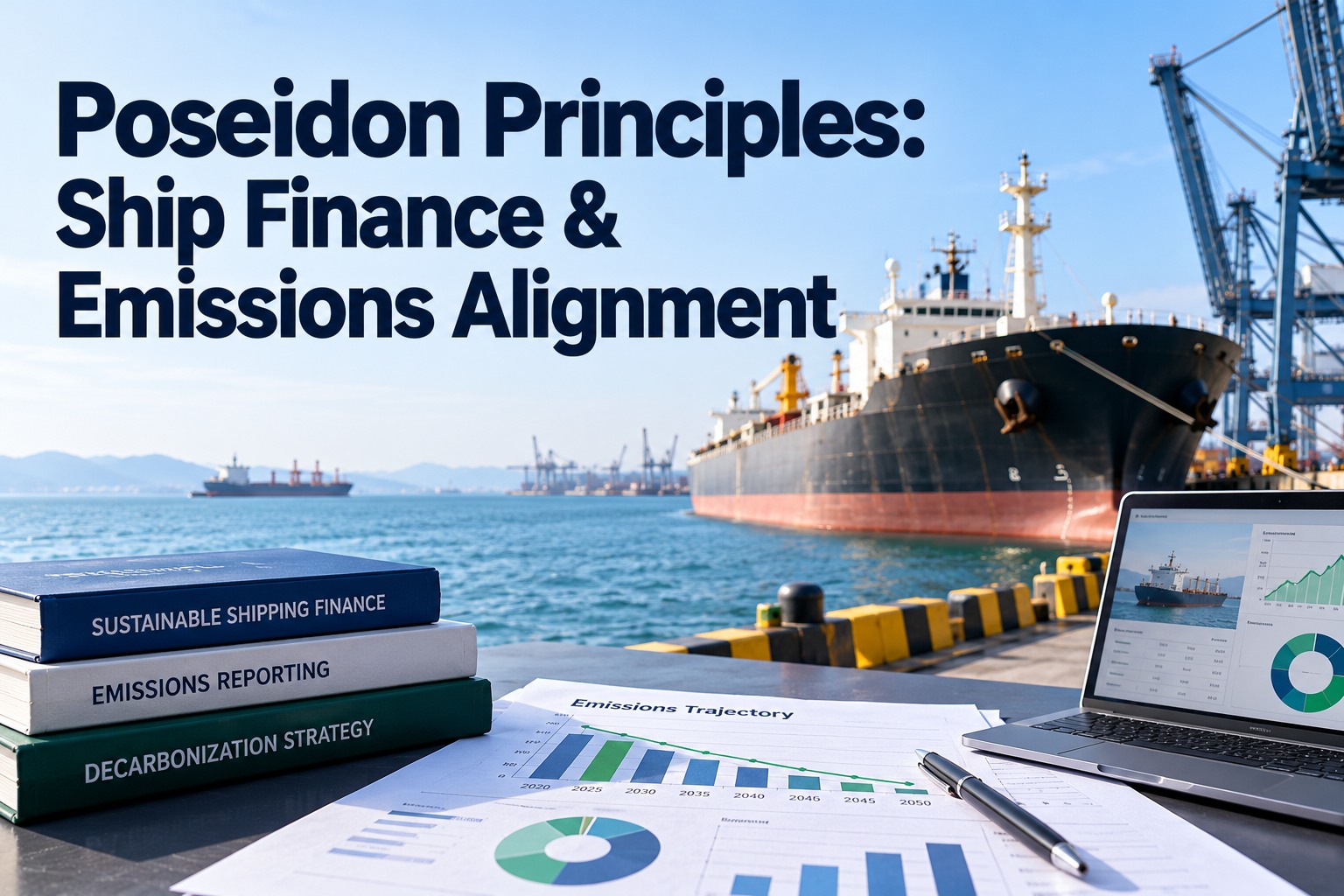
When a bank lends against a ship, it now also lends against that ship's emissions. A growing group of lenders score their ship loan books each year against a decarbonisation path, publish the result and write a data clause into new loan documents. What does that mean for the owner who has to supply the numbers? This guide, written for the Fleet Manager, explains how the Poseidon Principles work, how an alignment score is built, what lenders typically ask of borrowers and how to get the data in order before the lender's date. It covers only what public sources state, and marks the places where those sources disagree. For related regulation, see our carbon intensity indicator tracking software.
What the Poseidon Principles Are and Who Actually Signs Them
A lenders' framework, with four principles that reach the borrower through the loan
The Poseidon Principles Association describes the scope as any financial institution that provides products, underwrites or arranges transactions for international shipping, with signatories and associate members. The four principles are Assessment, Accountability, Enforcement and Transparency. Signatories assess alignment annually, rely on IMO standards and recognised organisations for unbiased data, include covenant clauses in new shipping business and publish their scores. The diagram sets out what each means for an owner. The owner column is our reading. The principles do not impose duties on shipowners themselves, only on the signing institutions.
Where the initiative stands in 2026
As of the April 2026 briefing there were 36 signatories from 14 countries, representing about three quarters of global ship finance, and 35 of them reported in the sixth report. The association says its methodology is recognised in the SBTi Financial Institutions Net-Zero Standard, that a Technical Committee is refining trajectories, including adjustments for vessel types such as cruise, and that a Future Principles Committee is exploring topics such as crew welfare, biodiversity and ship recycling, any of which would require signatory approval.
How an Alignment Score Is Built, From One Ship to a Whole Loan Book
The Annual Efficiency Ratio, the well-to-wake factor and the 2050 trajectory
The association states that vessel-level alignment is calculated first and then aggregated into a portfolio score. The metric is the Annual Efficiency Ratio, not the Energy Efficiency Operational Indicator, with inputs of fuel consumption, distance travelled and deadweight at maximum summer draught. A well-to-wake emission factor replaces a carbon emission factor. Trajectories are expressed in grams of CO2 equivalent per tonne-nautical mile, run to 2050 and are derived from the Fourth IMO GHG Study. The UK P&I Club article of 2020 adds that standard trajectories come from the secretariat for each ship type and size class, so every signatory calculates in the same way.
What follows from those inputs for a ship manager
Three points follow from the stated inputs, and they are our reading, not a quotation. Fuel type matters, because a well-to-wake factor is applied. Capacity matters, because deadweight, not cargo carried, sits in the denominator. And distance and consumption must reconcile, because they come from the same operating records you give the flag State. For the design-efficiency side of the same fleet, see our EEXI compliance guide for the Energy Efficiency Existing Ship Index.
What the 2025 Report Shows: Improvement, but Still Above the Line
Where lenders are now and which segments are moving
The sixth Annual Disclosure Report, published 15 December 2025, shows average misalignment falling from +19.4% to +11.7% against the minimum trajectory and from +25.0% to +18.4% against the striving trajectory. The Global Maritime Forum says cargo segment misalignment fell from 14% to 6% and passenger from 38% to 26%, and credits operational efficiency, retrofits and emerging fuel pathways, while noting that rerouting and supply chain disruption also affected scores. It adds that trajectories become more demanding each year, so staying aligned is harder over time.
What a Borrower Actually Provides: The Covenant, the Data and the Limits
The standardised covenant and what the 2020 and later sources say about it
Brodies explains that the Standardised Covenant is a clause requiring shipowners and operators to supply fuel and emissions-related data to financiers, with an optional Carbon Intensity and Climate Alignment Certificate for which a fee may apply. Signatory lenders are not required to include it but are strongly recommended to. The UK P&I Club article of 2020 says signatories use best efforts to include it, that the clause should not be more onerous than owners' other obligations such as supplying class and ISM documents, and that owners are otherwise not obliged to disclose ship data to any third party. Both articles are older than the 2026 briefing, so confirm the clause in your own agreement.
Why the data should reconcile to what you already give the IMO
Brodies describes the data as the same information owners must supply to the IMO Data Collection System, which applies to ships of 5,000 gross tonnage and above in international trade. Owners report to the flag State, which issues a Statement of Compliance when it confirms the data meets IMO requirements, and once data reaches the IMO it is anonymised. That anonymisation is why lenders want the covenant. The Poseidon page says covenant data requests match information already submitted to the IMO DCS, which reduces the burden on clients. The table maps the likely requests to their sources.
| Data point | Why the metric needs it | Usual source on board or in the office |
|---|---|---|
| Fuel consumption by fuel type | Input to the efficiency ratio. A well-to-wake factor is applied to each fuel | Noon reports, bunker delivery notes, flow meters, the IMO DCS submission |
| Distance travelled | Input to the efficiency ratio | Voyage records and the IMO DCS submission |
| Deadweight at maximum summer draught | Capacity input to the ratio, not cargo carried | Ship's particulars and class records |
| Flag State Statement of Compliance | Evidence that the IMO DCS data was accepted | Flag State or recognised organisation |
| Optional carbon intensity certificate | The standardised covenant offers it as an option, and a fee may apply | Arranged with a recognised organisation |
Dates differ between sources, so ask which one your lender uses
The current association page gives 15 November for the annual report to the secretariat, and a self-assessment within 5 months of joining. Older articles give 30 November, 31 December or a May start. The periods concern signatories, not borrowers, but your lender's internal deadline will fall before them. The table lists what each source says.
| Source and year | What it says | Treat as |
|---|---|---|
| Poseidon Principles Association, April 2026 | Signatories report to the secretariat no later than 15 November each year, starting the calendar year after joining. A self-assessment is due within 5 months of joining | Current, but a lender-side date |
| UK P&I Club article, May 2020 | Membership acknowledged by 30 November, alignment reports due 30 November of the year after joining, scores shared with other signatories by 31 December | Historic, likely superseded |
| Brodies article, undated | Reporting begins in May of the second calendar year after joining, scores by 30 November, publication by 31 December | Historic, check for updates |
Poseidon Data Readiness Checklist for the Fleet Manager
A checklist with a checkpoint type on each item for fleet audits and desk reviews
Use the checklist a few months before the lender's reporting date. It is our template, based on the covenant sources above, and not a lender form.
| Item | What to check | Checkpoint type |
|---|---|---|
| Loan agreement clause | Read the covenant: what data, how often, to whom, who pays for any certificate | Record |
| Fuel records by fuel type | Annual consumption by fuel type reconciles to bunker delivery notes and the IMO DCS submission | Record |
| Distance records | Annual distance reconciles to voyage records and the IMO DCS submission | Record |
| Deadweight and ship particulars | Deadweight at maximum summer draught matches class and registry records | Record |
| Statement of Compliance | Valid Statement of Compliance on file for each ship covered by the loan | Record |
| Data owner | One named person per vessel owns fuel and distance data, with a deadline before the lender's date | Record |
| Meter and sounding checks | Flow meters and tank soundings that feed consumption are calibrated and logged | Test |
| Efficiency measures evidence | Dated photos and records of hull cleaning, propeller polishing and retrofits that lower fuel use | Visual |
Six Mistakes Borrowers Make With Lender Emissions Requests
What the sources point to, in the order they usually surface
Systems That Keep Lender Reporting Evidence Together Across a Fleet
How a dated photo repository, task ownership and deadlines support lender reporting
Lender reporting is a records task that repeats every year, with a hard date. Marine Inspection supports a dated photo repository, observations turned into tasks with owners, deadlines and evidence, and certificate and equipment tracking. A named owner and a due date for each vessel's fuel and distance reconciliation, a tracked Statement of Compliance and dated photos of hull and propeller work give a Fleet Manager an evidence trail to hand a lender. It does not calculate an alignment score or replace your loan agreement. For the EU side of emissions reporting, see our FuelEU Maritime guide to EU shipping emissions compliance in 2026.