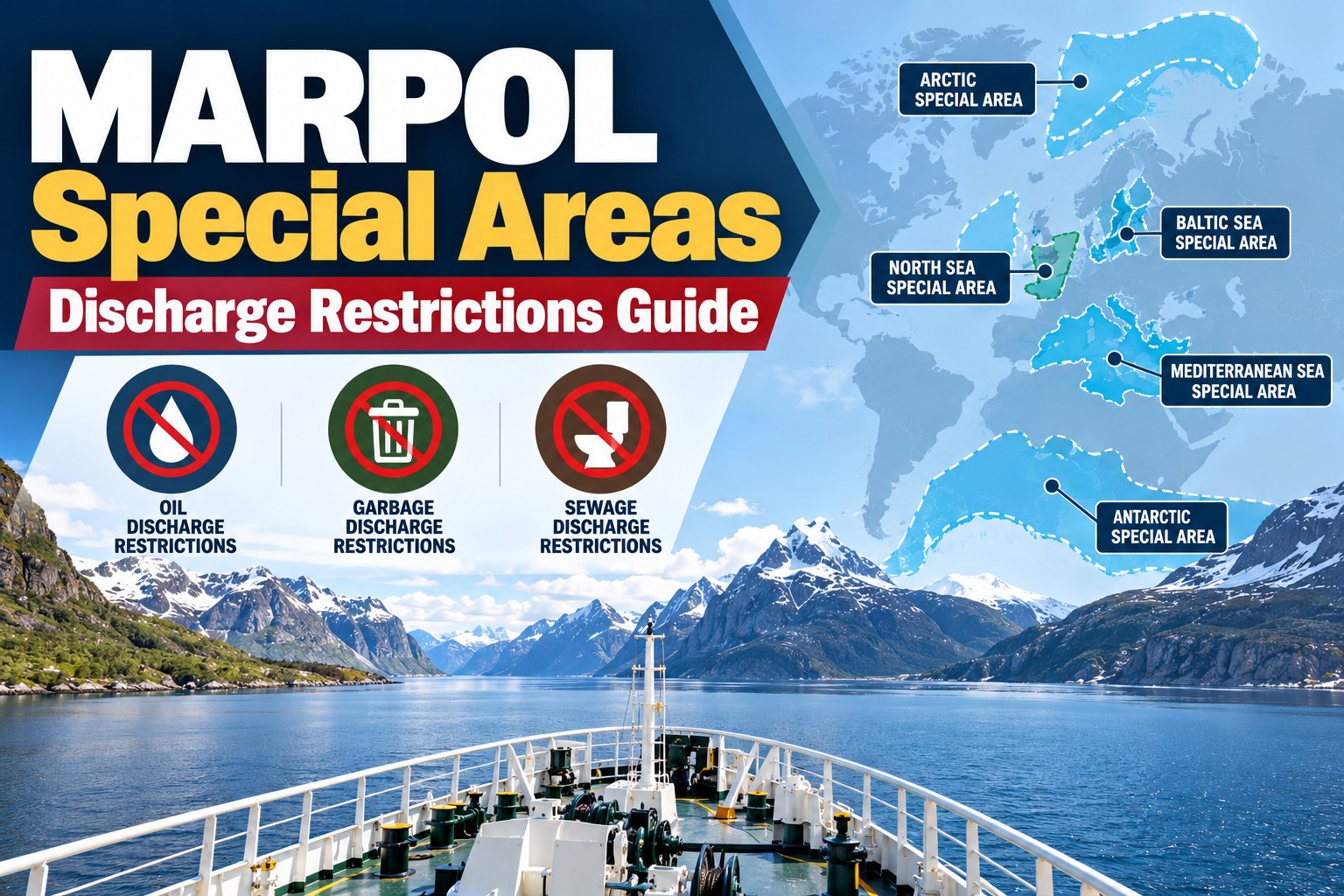
Special areas are the parts of the sea where MARPOL asks more of a ship than anywhere else. A discharge that is lawful in the open ocean can be a violation a few miles later, and the same ship can be inside one area under Annex I and a different area under Annex V on the same passage. For the Fleet Manager the risk is not that crews do not care, it is that the rules change by annex and by sea. This guide maps the areas, sets out the oil, garbage and sewage restrictions in plain terms, and lays out the records every special area transit should leave behind. Start a free trial of Marine Inspection to track discharge records and special area transits across the fleet.
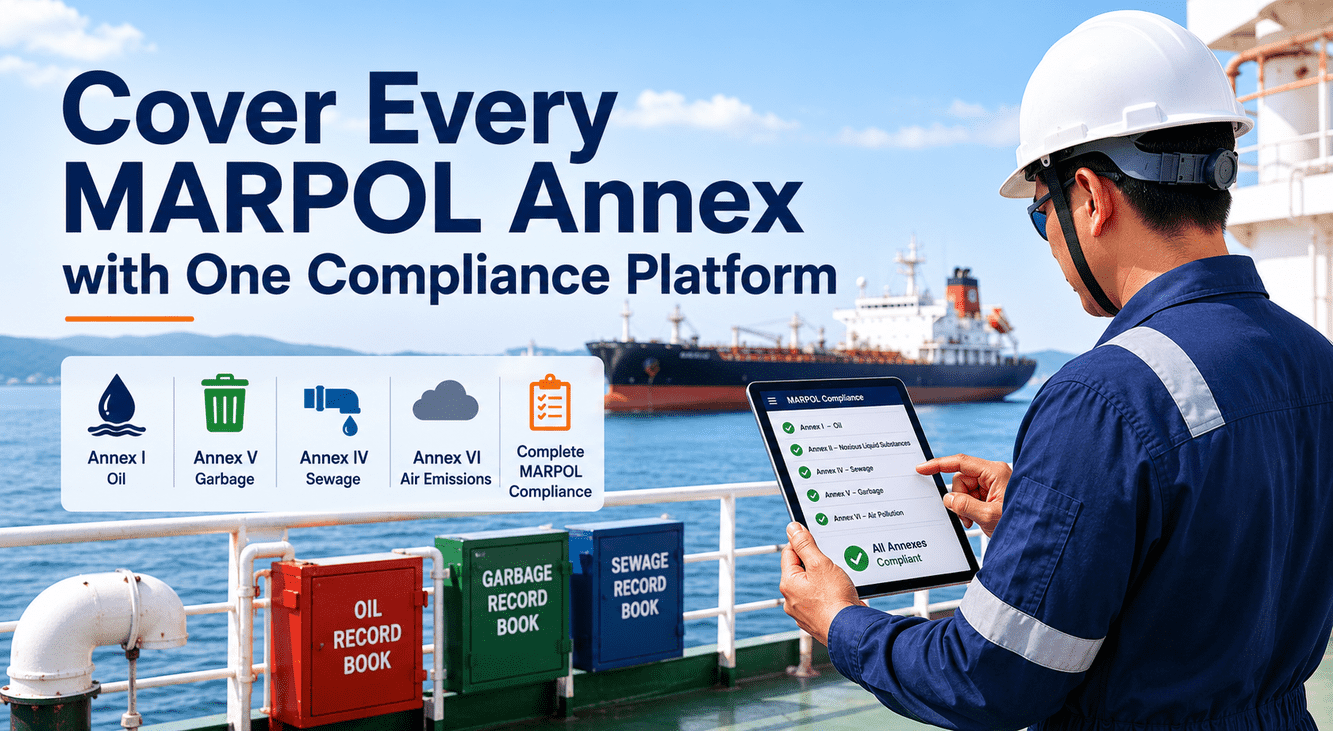
COVERAGE GRID
One Sea, Several Rulebooks: Know Which Annex Applies Where You Sail
Annex I is oil, II is noxious liquids, IV is sewage, V is garbage and VI is air emissions.
Special area or ECA applies under that annex
Free trial available. Or book a walkthrough built around your own fleet.
RECENT CHANGE
Under IMO Circular MEPC.1/Circ.778 Rev.5, the Red Sea and the Gulf of Aden special areas under Annex I took effect on 1 January 2025, and the Red Sea special area under Annex V took effect on the same date. If your fleet trades through Suez, update passage plans and crew briefings. The grid above shows the main areas. The full list is below.
Annex I (Oil): What Changes Inside a Special Area
MACHINERY SPACE BILGE
Outside special areas
En route, more than 12 nm from the nearest land, oil content not above 15 ppm, through approved oil filtering equipment.
MACHINERY SPACE BILGE
Inside special areas
Prohibited unless the ship is en route, the content is not above 15 ppm and approved equipment is used. In the Antarctic area any discharge of oil is prohibited.
TANKER CARGO AREA
Outside special areas
More than 50 nm from the nearest land, limited rate and a working discharge monitoring and control system.
TANKER CARGO AREA
Inside special areas
Any oily mixture or oil discharge from the cargo area into the sea is prohibited.
Summarised from Marine Insight's guide to Annex I. Applies to non-tankers of 400 GT and above and tankers of 150 GT and above. Always check the text of Annex I regulation 15 and your flag's guidance.
Annex V Distance Ladder: Minimum Distance From Land for Discharge
Ground food waste, outside special area
3 nm
Ground food waste, in special area
12 nm
Whole food waste, outside special area
12 nm
Whole (not comminuted) food waste may not be discharged inside a special area at all. All distances are from the nearest land, en route and as far as practicable.
Rules change by sea, so the passage plan is the first control. See how Marine Inspection links voyage plans, discharge records and checks across the fleet.
Annex V (Garbage): The Full Discharge Table
| Garbage type | Outside special areas | Inside special areas |
|---|
| Food waste, comminuted or ground (25 mm or less) | 3 nm or more from land, en route and as far as practicable | 12 nm or more from land, en route and as far as practicable |
| Food waste, not comminuted | 12 nm or more from land, en route and as far as practicable | Discharge prohibited |
| Cargo residues, not harmful to the marine environment | 12 nm or more from land, en route and as far as practicable | 12 nm or more, en route, with specific conditions |
| Cargo hold washwater cleaning agents | Same distance rules as cargo residues | Same distance rules as cargo residues, with conditions |
| Deck and external washing | Allowed if not harmful to the marine environment | Allowed if not harmful to the marine environment |
| Animal carcasses | En route, as far from land as possible, more than 100 nm, in deep water | En route, as far from land as possible, more than 100 nm, in deep water |
| Plastics and all other garbage | Prohibited | Prohibited |
Based on the Bahamas Maritime Authority notice on MARPOL Annex V. Cargo residue rules depend on whether the residue is harmful to the marine environment and on port reception facilities. Check the full text for polar and local rules.
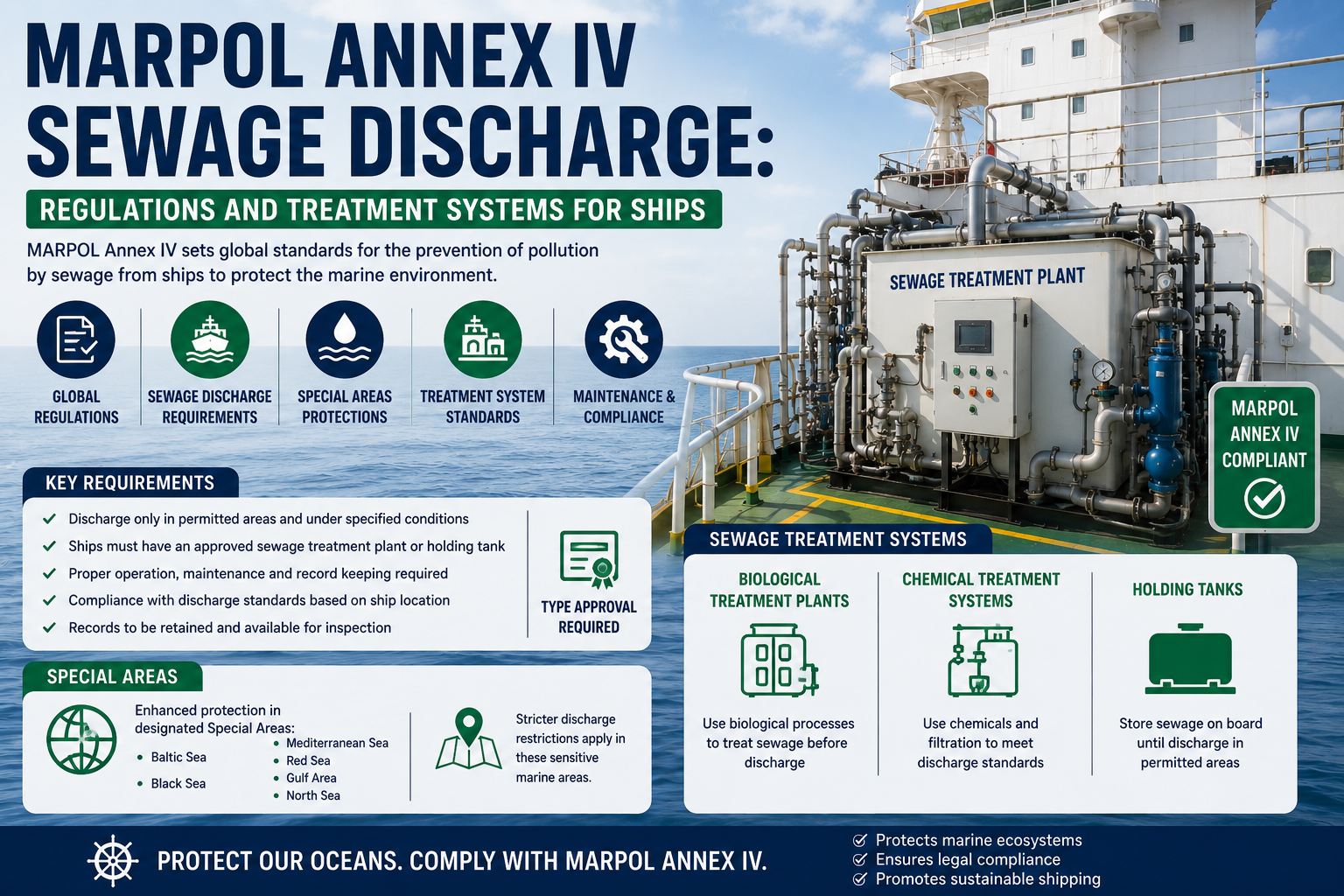
Annex IV (Sewage): The Baltic Special Area
Baltic Sea
The only Annex IV special area
The special area entered into force on 1 January 2013, with effect for passenger ships phased in from 2019, 2021 and 2023.
Treated only
Rule for passenger ships
Discharge is allowed only through an approved sewage treatment plant that meets the stricter standards for nitrogen and phosphorus removal.
Port facilities
Alternative
Hold the sewage on board and discharge it to port reception facilities.
Check the exact standards and dates in Annex IV and your flag's guidance. Other ships follow the general Annex IV rules.
Make Every Special Area Transit Leave a Record
Link passage plans, oil and garbage records and equipment checks, so a crossing is easy to prove and easy to audit.
Free trial available. Or book a walkthrough built around your own fleet.
Before Any Discharge: Four Questions for the Watch
1
Where are we?
Check the position against each special area, not only the nearest one.
2
Which annex?
Oil, garbage and sewage have different areas and different rules.
3
Is it allowed here?
Check distance from land, en route, and equipment working and in alarm range.
4
Is it recorded?
Make the entry in the right book at the time, with position and quantity.
A suggested drill for watchkeepers. Put it in the ship's procedures and brief crews before special area transits.
Fleet Manager's Record Discipline
| Record | What it should show | Fleet-level check |
|---|
| Oil Record Book Part I | Machinery space discharges and transfers, in order, signed | Entries match transit position and equipment records |
| Garbage Record Book | Date and time, position, category and estimated amount for each discharge. For cargo residues, start and stop positions | No discharges logged inside prohibited special areas |
| Oily water separator records | 15 ppm monitor calibration, alarm and automatic stop tests | Test dates inside the survey interval |
| Sewage plant records | Approval certificate, tank levels, discharge and reception facility receipts | Plant meets the Baltic standard where ships trade there |
| Passage plan | Special areas crossed, with notes on discharge restrictions | Plans updated for the new Red Sea and Gulf of Aden dates |
| Crew briefing | Who was briefed, when, on which areas | Briefings logged before each trade change |
Our suggested fleet check. The book formats and entry codes are set by MARPOL and your flag.
Special Areas Reference: Area by Annex
| Area | Annexes and notes |
|---|
| Mediterranean Sea | I, V, VI (sulphur ECA) |
| Baltic Sea | I, IV, V, VI (SOx and NOx) |
| Black Sea | I, V |
| Red Sea | I and V, effective 1 Jan 2025 |
| Gulfs area | I, V |
| Gulf of Aden | I, effective 1 Jan 2025 |
| Antarctic area | I, II, V |
| North West European waters | I |
| Oman area of the Arabian Sea | I |
| Southern South African waters | I |
| North Sea | V, VI |
| Wider Caribbean region | V |
| North American and US Caribbean Sea | VI (ECA) |
| Canadian Arctic and Norwegian Sea | VI (ECA), in force 1 Mar 2026 |
From IMO Circular MEPC.1/Circ.778 Rev.5 and Marine Insight. For the Antarctic, Annex II applies as well. Annex VI areas are emission control areas, not special areas in the strict sense.
What is a MARPOL special area?
A sea area that needs stricter discharge rules for recognised technical reasons, such as its ecology or heavy traffic. Each MARPOL annex lists its own special areas.
Can I discharge oily bilge water in a special area?
Only en route, at not more than 15 ppm and through approved filtering equipment. In the Antarctic area, any discharge of oil is prohibited.
Can food waste be discharged in a special area?
Which annex has sewage special areas?
Annex IV, which currently has one: the Baltic Sea, with stricter rules for passenger ships.
Are emission control areas special areas?
They are a separate designation under Annex VI, though the sea areas often overlap with the special areas. A ship must meet both sets of rules.
Sail Special Areas With Proof, Not Hope
One trail for passage plans, discharge records, equipment tests and crew briefings across every vessel in the fleet.
Free trial available. Or book a walkthrough built around your own fleet.