Sewage seems like one of the more mundane waste streams on a ship until an inspector asks to see the discharge records, and the rules turn out to be precise, distance-dependent, and unforgiving of guesswork. MARPOL Annex IV governs the prevention of pollution by sewage from ships, and it does not simply ban discharge — it sets out exactly when, where, and how sewage may go overboard, depending on whether it has been treated, how far the ship is from land, and whether it is in a special area. For an environmental officer or engineer, knowing those thresholds cold is the difference between a clean inspection and a deficiency, because the same discharge that is perfectly legal twelve miles out at four knots is an offence inside that line. Annex IV applies to ships of 400 gross tonnes and above on international voyages, or any ship certified to carry more than fifteen people, and it requires each to carry approved equipment, hold a valid certificate, and discharge only within the permitted conditions. This guide covers the discharge rules, the three equipment options and treatment plant types, the Baltic special-area requirements, the certification and survey regime, and the maintenance that keeps a treatment plant compliant. To manage sewage records, treatment-plant maintenance, and Annex IV compliance in one place, book a Marine Inspection demo.
Green shipping · MARPOL Annex IV
MARPOL Annex IV Sewage: Discharge Rules & Treatment Systems
A practical guide to sewage discharge regulations, treatment plant types, Baltic special-area requirements, and the maintenance that keeps a marine sewage treatment system compliant.
Treated
Certified STP — discharge permitted any distance
Over 3 nm
Comminuted & disinfected sewage
Over 12 nm
Untreated, en route at 4+ knots
Who Annex IV Applies To
The first question is scope. Annex IV does not apply to every vessel, but its thresholds are broad enough to capture most ships on international service. Knowing whether a vessel is in scope — and what equipment it must therefore carry — is the foundation of compliance. See compliance tracking in a demo.
Tonnage threshold
Ships of 400 gross tonnes and above engaged in international voyages fall within Annex IV.
Persons threshold
Any ship certified to carry more than 15 persons is also covered, regardless of tonnage.
Equipment required
An approved treatment plant, an approved comminuting-and-disinfecting system, or a holding tank — plus a standard discharge connection.
Certification
An International Sewage Pollution Prevention (ISPP) Certificate, issued after survey, is required for ships trading internationally.
The Three Discharge Methods
Annex IV permits three distinct ways to discharge sewage legally, each balancing the level of treatment against the distance from land. The principle is simple: the better the treatment, the closer to shore you may discharge.
Any distance
Treated by an approved STP
Discharge is permitted at all times where the ship operates a sewage treatment plant certified by the Administration to meet MEPC.227(64). The effluent must not produce visible floating solids or discolour the surrounding water.
Over 3 nm
Comminuted & disinfected
Sewage that has been comminuted and disinfected using an approved system may be discharged more than 3 nautical miles from the nearest land.
Over 12 nm
Untreated, en route
Sewage that is neither comminuted nor disinfected may be discharged more than 12 nautical miles from land, with the ship en route at not less than 4 knots and at a discharge rate approved per MEPC.157(55).
A critical operational point: sewage held in holding tanks must not be discharged instantaneously. Stored sewage, and sewage from spaces holding live animals, must be released at a moderate, approved rate while the ship is moving — a sudden dump of a full tank, even beyond 12 miles, breaches the rules.
The Three Equipment Options
Every ship in scope must carry one of three permitted systems, and the choice shapes where and how it can discharge. Each suits a different operating profile. See equipment record-keeping in a demo.
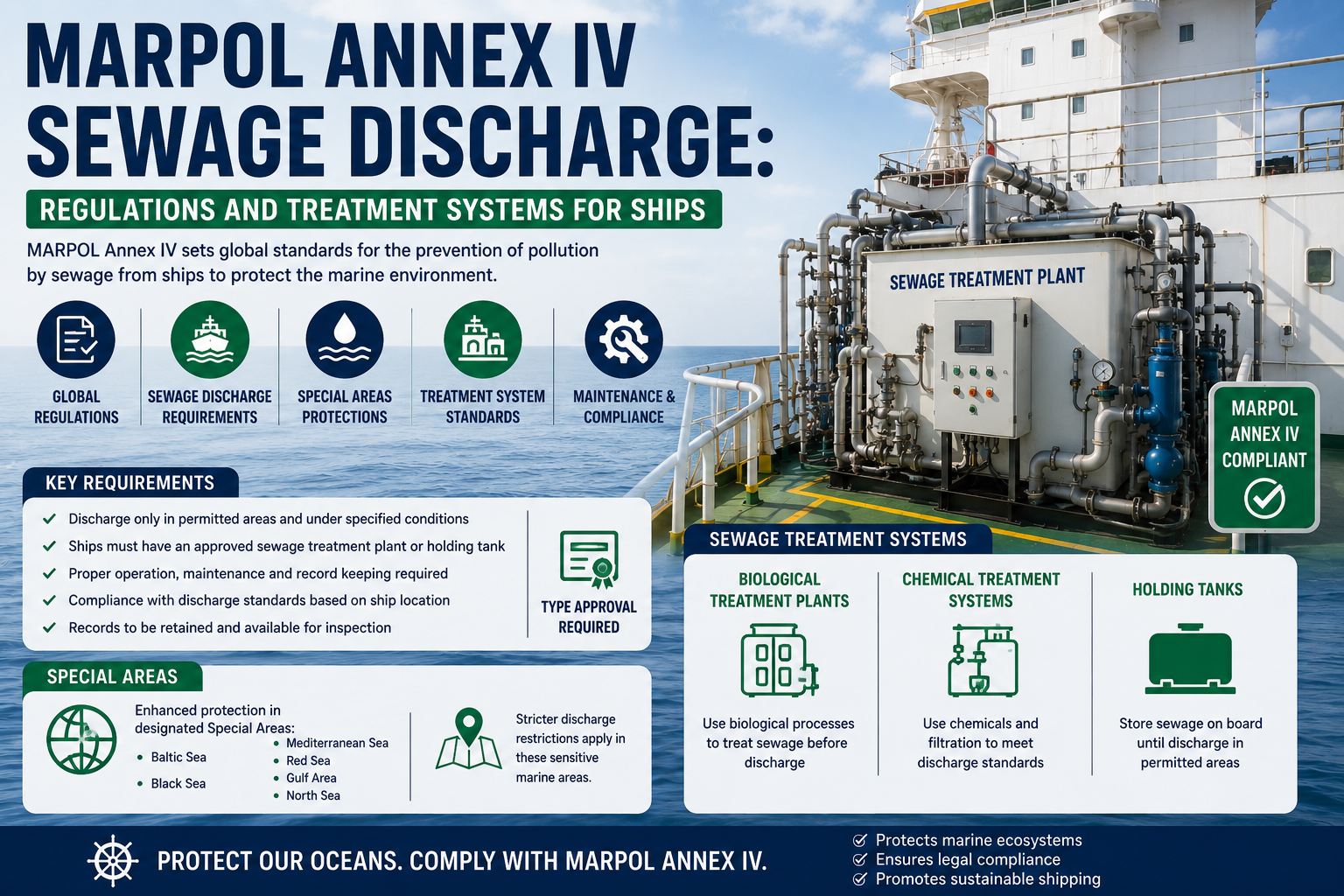
Sewage treatment plant (STP)
An approved plant that treats sewage to a certified effluent standard, giving the most operational freedom — discharge permitted at any distance when certified to MEPC.227(64).
Comminuting & disinfecting
An approved system that breaks down and disinfects sewage, permitting discharge beyond 3 nautical miles — a simpler option than a full treatment plant.
Holding tank
A tank to store sewage for later discharge beyond limits or to a reception facility, fitted with a means to show its contents level visually.
Sewage Treatment Plant Types
For ships choosing a treatment plant, the technology matters for both compliance and maintenance. Plants fall into recognisable types, each with its own demands. The approval standard depends on the installation date — plants fitted before 1 January 2010 follow the older MEPC.2(VI), while newer plants meet MEPC.227(64).
Biological (aerobic)
The most common type, using aerobic bacteria to break down sewage in aeration chambers, followed by settling and disinfection. Effective but dependent on a healthy, undisturbed biological culture.
Chemical / physical
Uses chemical dosing and physical separation rather than a biological culture, tolerating intermittent loads better but requiring a consistent chemical supply and dosing control.
Electrolytic
Treats sewage using electrolysis, often of seawater, to generate disinfecting agents in situ, reducing chemical storage but adding electrical and electrode maintenance.
Membrane bioreactor
Combines biological treatment with membrane filtration for high-quality effluent, increasingly used where nutrient-removal standards apply, but demanding membrane care.
Keep the records straight
Log Sewage Discharges and Plant Maintenance in One Place
Annex IV compliance rests on records — discharge positions and rates, treatment-plant maintenance, and certification status. Marine Inspection captures sewage discharge logs, schedules STP maintenance, and tracks ISPP certificate validity against each vessel, building the evidence an inspector expects. Book a 30-minute demo to see Annex IV record-keeping, or start a free trial today.
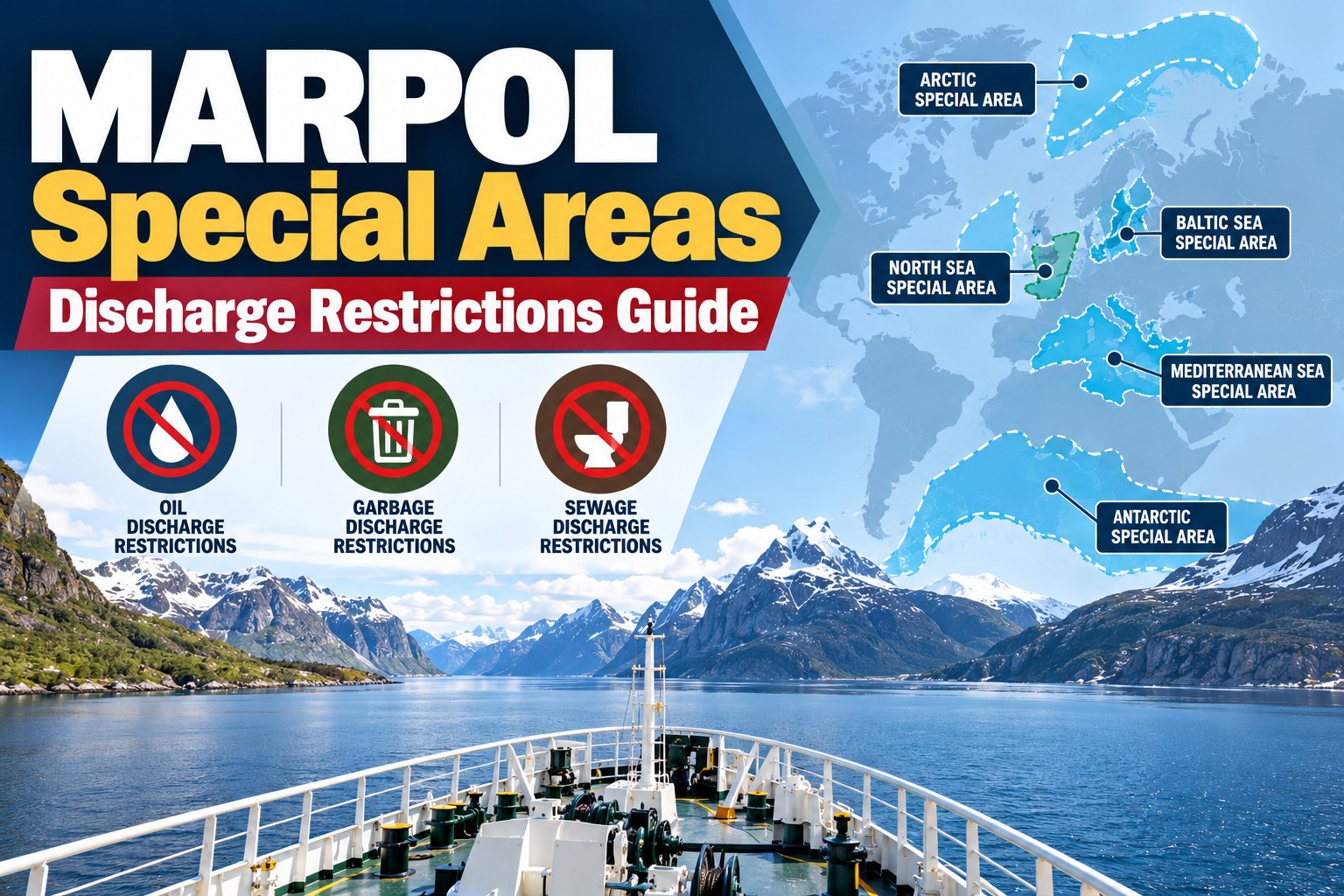
Special Areas: the Baltic Sea
Annex IV designates special areas with stricter rules, and currently the Baltic Sea is the only one in force. The requirements there are considerably tighter, and a vessel trading into the Baltic must plan its sewage management accordingly.
Who it applies to
The Baltic special-area discharge rules apply to passenger ships, which generate the largest sewage volumes per voyage.
The rule
Discharge of sewage is generally prohibited regardless of distance, unless the ship operates an approved treatment plant certified for the area.
Nutrient removal
A plant intended to discharge in the Baltic must additionally meet nitrogen and phosphorus removal standards under MEPC.227(64) section 4.2.
The alternative
Otherwise sewage must be held and discharged outside the special area or landed to a port reception facility.
The Baltic requirements phased in for passenger ships between 2019 and 2023 depending on ship age and route. Beyond Annex IV, the Polar Code adds its own stricter sewage limits in polar waters, prohibiting untreated discharge regardless of distance for the vessel categories it covers — so a ship's trading pattern dictates which regime bites hardest.
Certification and Surveys
Compliance is demonstrated through certification, and the certificate is only as valid as the surveys behind it. The ISPP regime defines a clear survey cycle that an environmental officer should track. See certificate tracking in a demo.
Initial survey
Carried out before the ship enters service or before the ISPP certificate is first issued, covering the treatment plant, holding tank, pipework, and discharge connection.
Periodical & renewal
Periodical and renewal surveys keep the certificate valid through the ship's life, confirming the equipment still meets the standard it was approved to.
The ISPP certificate
The International Sewage Pollution Prevention Certificate evidences compliance and must be valid and on board for ships trading internationally.
Standard connection
A standard discharge connection to a specified design must be fitted so sewage can be transferred to a port reception facility.
Keeping the Treatment Plant Compliant
A type-approved plant only stays compliant if it is maintained — and a poorly run plant can produce effluent that breaches the visible-solids and discoloration limits even while technically operating. Maintenance is where compliance is won or lost day to day.
Protect the biology
In biological plants, avoid shock loads, harsh chemicals down the drains, and disinfectant carryover that can kill the bacterial culture the plant depends on.
Maintain aeration
Keep blowers, diffusers, and air supply working so the aerobic process has the oxygen it needs; failing aeration is a common cause of poor effluent.
Manage disinfection
Maintain the disinfection stage and dosing so the discharged effluent meets the standard, without over-dosing that harms a downstream biological stage.
Check the effluent
Monitor the effluent for clarity and the absence of floating solids, the visible markers an inspector and the regulation both rely on.
Service pumps & sensors
Maintain transfer pumps, level sensors, and the holding-tank content indicator so the system operates and reports reliably.
Log everything
Record discharges, positions, rates, and maintenance, so compliance can be demonstrated rather than merely asserted at a survey.
The thread tying the whole regime together is the record. Annex IV compliance is proven by discharge logs showing position, treatment, and rate, by maintenance records demonstrating the plant is cared for, and by a valid certificate backed by survey. A vessel that operates its plant well but cannot show the evidence is exposed; one that captures it routinely turns a sewage inspection into a formality. Book a demo to see Annex IV compliance management.
Frequently Asked Questions
What is MARPOL Annex IV?
MARPOL Annex IV is the international regulation preventing pollution by sewage from ships. It applies to ships of 400 gross tonnes and above on international voyages, or any ship certified to carry more than 15 persons, and sets out the equipment they must carry and the conditions — treatment level and distance from land — under which sewage may legally be discharged.
How far from shore can a ship discharge sewage?
It depends on treatment. Sewage treated by an approved STP certified to MEPC.227(64) may be discharged at any distance, provided the effluent shows no visible solids or discoloration. Comminuted and disinfected sewage may be discharged beyond 3 nautical miles, and untreated sewage beyond 12 nautical miles with the ship en route at not less than 4 knots at an approved rate.
What equipment must a ship carry under Annex IV?
One of three options: an approved sewage treatment plant, an approved comminuting-and-disinfecting system, or a holding tank with a means to show its contents level. A standard discharge connection must also be fitted so sewage can be transferred to a port reception facility, and the ship needs a valid ISPP certificate.
What are the special area rules for the Baltic Sea?
The Baltic Sea is currently the only Annex IV special area. For passenger ships, sewage discharge is generally prohibited regardless of distance unless an approved treatment plant certified for the area is in operation, and that plant must additionally meet nitrogen and phosphorus removal standards under MEPC.227(64). Otherwise sewage must be held or landed ashore.
What types of sewage treatment plant are used on ships?
The main types are biological (aerobic) plants using bacterial cultures, chemical or physical plants using dosing and separation, electrolytic plants generating disinfectant in situ, and membrane bioreactors combining biological treatment with filtration. Biological plants are most common; membrane bioreactors are favoured where nutrient-removal standards apply, such as the Baltic.
How is sewage treatment plant compliance maintained?
By protecting the biological culture from shock loads and harsh chemicals, maintaining aeration and disinfection, monitoring effluent for clarity and absence of floating solids, servicing pumps and sensors, and logging discharges and maintenance. A type-approved plant can still produce non-compliant effluent if poorly maintained, so day-to-day care and record-keeping are essential.
Built for MARPOL compliance
Treat It, Log It, Prove It
Capture sewage discharge logs with position and rate, schedule and record treatment-plant maintenance, track ISPP certificate and survey status, and flag special-area requirements by route — all against each vessel and ready for inspection. Marine Inspection keeps the plant maintained and the Annex IV record complete. Book a tailored walkthrough or start a free trial today.