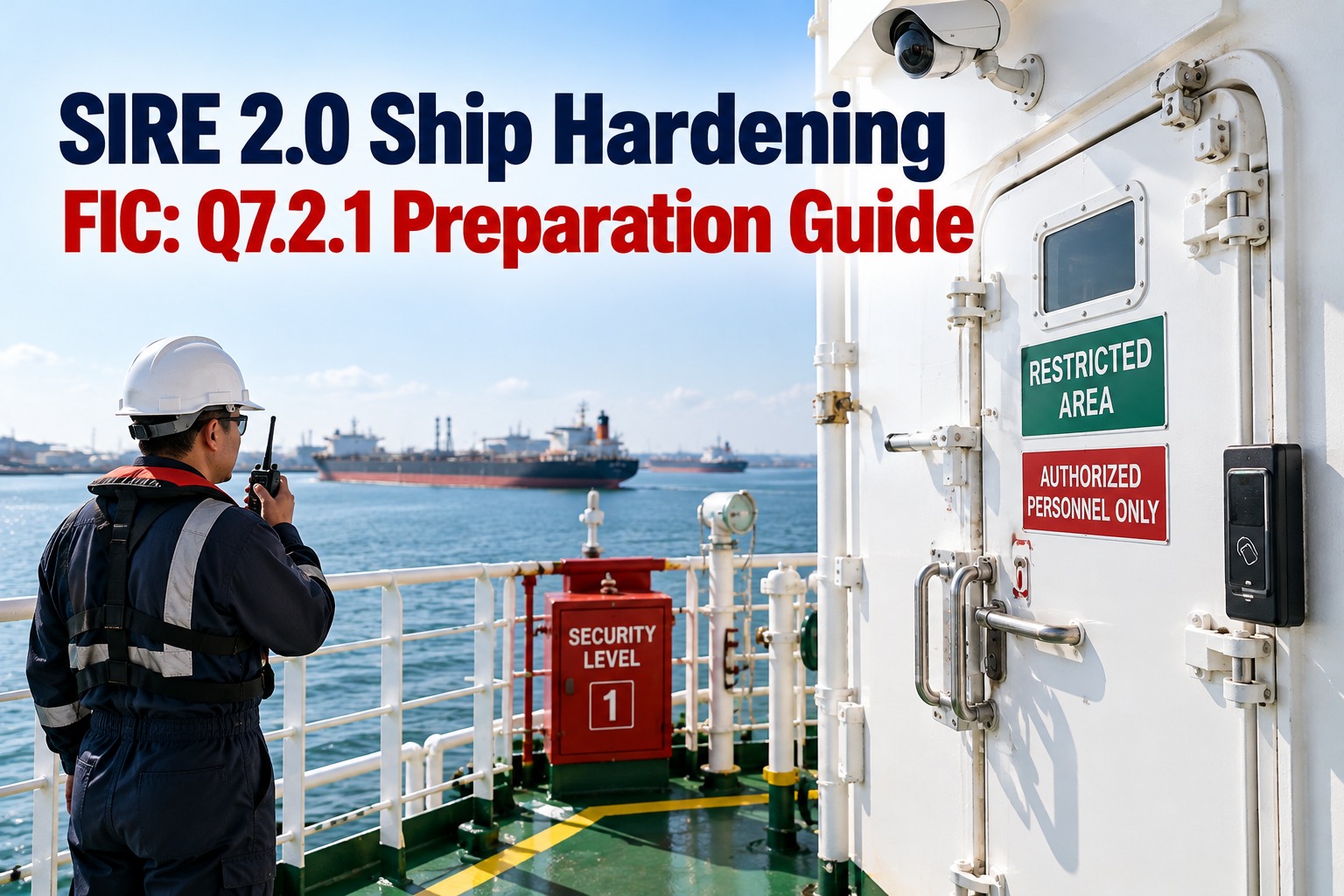
OCIMF’s Focused Inspection Campaign on ship hardening ran from 1 October 2025 to 31 March 2026, and for those six months question 7.2.1 was put to every vessel on every SIRE 2.0 inspection regardless of where she traded. That window has closed. The question has not: it remains in the set, inspectors have now asked it several hundred times each, and the campaign data went to OCIMF’s security committee. Preparing for 7.2.1 stopped being campaign work and became standing readiness, which is a harder discipline and a cheaper one.
SIRE 2.0 · Question 7.2.1
The campaign closed in March. The question stayed.
Ship hardening and access control is a two-part question: whether the master and officers know the company’s hardening procedures, and whether a Vessel Hardening Plan is actually on board. A vessel can satisfy one limb and fail the other, and most of the weakness sits in the first.
As quoted by operators preparing for the campaign, 7.2.1 asks whether the master and officers were familiar with the company procedures for hardening the vessel, and whether a Vessel Hardening Plan was available. The document half is a five-minute check. The familiarity half is where vessels come apart, because it cannot be arranged on the morning of the inspection.
Which categories of question appear on any given inspection is governed by the compiled set rather than by the inspector, and the mechanics are covered in our guide to core, rotational, campaign and conditional questions.
Inside the Vessel Hardening Plan
The plan is not a restatement of the security plan with wire added. It is a risk-assessed, vessel-specific document built on OCIMF hardening guidance and the Best Management Practices maritime security publications, and it carries operational content a ship can work from.
Element
What it has to contain
What proves it
Risk basis
A risk assessment behind the measures, reducing the hazard as low as reasonably practicable
The assessment itself, with the trades and threats it considered
Measures by threat level
What is rigged, closed or manned at each stage of hardening, in the order it is done
A sequence a deck officer can follow without interpretation
Equipment inventory
A detailed list of the hardening equipment and materials held, and where they are stowed
The list matching what is actually in the locker
Inspection and upkeep
Inspection and maintenance requirements for that equipment, with intervals
Completed routines against the items, not a general statement
Citadel arrangements
Where it is, and the equipment and systems that support it — where one is fitted
Position, access, communications and endurance described concretely
Duties by person
Who does what during hardening, named by rank rather than by department
Crew able to state their own duty without opening the plan
Review trigger
Reviewed during voyage preparation, particularly before entering areas of known maritime crime or piracy
A dated review tied to a specific passage, not an annual one
The inventory and upkeep rows are the ones most often thin. A plan that lists equipment without saying how often it is examined invites the obvious follow-up, and a locker that does not match its own list answers the third focus area before anyone asks.
Ownership, split three ways
Company Security Officer
Develops the plan and makes sure a hardening process exists at all. This is the shore-side half of the question, and a plan written once and inherited by three masters is where it starts to drift.
Master
Reviews the plan before transiting or operating in a known security risk area, and is the person an inspector will ask first. Familiarity here is not optional and cannot be delegated downwards.
Ship Security Officer
Ensures the crew are trained to carry out the procedures in the plan and in the ship security plan. The training is the deliverable, not the appointment.
Every crew member with a duty
Familiar with their own security duty under the plan. Dedicated sessions work better than folding this into a general security briefing, because the duties are specific and physical.
The familiarity half, and how it fails
Four patterns account for most weak answers, and none of them is about the ship being unprepared in a physical sense.
1
The plan exists and nobody has opened it
Written ashore, filed on board, never worked through. The master can produce it and cannot describe the sequence in it, which is a worse answer than not having read a document that does not exist.
2
Familiarity is assumed from the trade
Crews on routes with no recent incidents stop rehearsing. The campaign deliberately asked the question everywhere precisely because hardening knowledge decays fastest where it is never used.
3
It was briefed, not drilled
A toolbox talk produces recognition, not capability. Rigging a measure once, badly, teaches more than describing it correctly three times, and it also exposes the equipment problems.
4
The crew changed
Security duties attach to positions, and positions turn over. A plan last exercised two crews ago is a plan nobody currently aboard has carried out.
Familiarity you can evidence, not assume
Marine Inspection records who was taken through which plan and when, holds the hardening equipment on inspection routines, and keeps the drill evidence against the vessel — so the answer to the familiarity limb is a record rather than a hope.
The chain below is what an inspector is really tracing when they move from the plan to the locker to the logbook. A break anywhere in it shows up as a weak answer somewhere else.
Present is not the same as effective
The third thing inspectors were told to look at is whether the plans and equipment are effective and well maintained, which is a harder standard than whether they exist. Hardening materials live outdoors, get used rarely and degrade quietly, and a locker that was stocked three years ago is not the same as a locker that works.
Materials degrade where they are stowed
Wire rusts into a solid coil, fastenings seize, covers perish and timber warps. None of it announces itself, and all of it is discovered at the moment somebody is trying to rig in a hurry.
Fit is as important as quantity
Enough material to cover the rails is not the same as material cut and prepared for this vessel’s layout. The time a crew spends improvising at the rail is time the plan was supposed to remove.
Supporting systems are part of the measure
Lighting, alarms, communications and any water-based arrangement are part of hardening rather than separate equipment, and they need the same inspection interval as the physical barriers.
Citadel readiness is a system question
Where one is fitted, access, communications, power and endurance decide whether it is a refuge or a room. Each of those has an owner and a test, and none of them is proven by the plan describing it.
The practical move is to put every item named in the plan onto the same maintenance routine as any other shipboard equipment, with an interval and a record, rather than treating the hardening locker as stores. That single change answers the effectiveness question in advance and turns the inventory row of the plan into something that can be verified rather than asserted — and you can book a demo to see the hardening inventory held as assets on routines.
It also changes what a drill produces. Rigging measures with equipment that is known to be in condition tests the crew; rigging with equipment nobody has looked at tests the locker, and the crew learn the wrong lesson from a bad afternoon.
Evidence that hardening actually happened
Where a vessel has hardened for a transit, the record of it is ordinary operational material rather than a special file, and it is worth knowing in advance which items carry the weight.
Bridge logbook entries
When hardening began and finished, what state the vessel was in, and when it was stood down. Contemporaneous, dated and difficult to argue with.
Work planning records
The job as planned and resourced, which shows hardening was treated as work rather than improvised on the day.
Reports to the office
What was reported ashore and when, demonstrating that the shore side was engaged rather than informed afterwards.
Photographs
The measures as rigged, which answers the effectiveness question faster than any description and takes a minute to capture at the time.
Reviewing the plan before a transit
The review obligation is tied to voyage preparation rather than to the calendar, which is what makes it easy to miss on a fleet with mixed trades. A plan reviewed every January and never against a specific passage satisfies a filing requirement and not much else.
Trigger it from the passage plan
The moment a voyage takes the vessel toward an area of known maritime crime or piracy, the plan review becomes part of preparing that passage, alongside the other pre-departure work.
Check the inventory against the locker
Before the transit, not during it. Missing or degraded materials discovered on approach are a procurement problem at the worst possible moment.
Confirm who holds each duty now
Positions have probably changed since the last review. Reassigning duties on paper and telling the people concerned are two different actions.
Record the review against the voyage
Dated, naming the passage and the people involved. This is the entry that turns a standing document into evidence of active management.
PLThe plan and the equipment
A Vessel Hardening Plan is on board and specific to this vessel
It rests on a risk assessment, not on a template
The equipment inventory matches what is in the locker today
Every listed item sits on an inspection routine with an interval
Citadel arrangements, where fitted, are described with their supporting systems
PEThe people
The master can describe the hardening sequence without the document
Officers know the company procedure for entering a raised-threat area
Each crew member can state their own duty under the plan
Measures have been rigged in practice, not only briefed
A session was held after the last significant crew change
Anything unmarked in the second group is where an inspector will find the gap, because that is the group the campaign was designed to probe. The wider security arrangements these sit within are covered in our ISPS security audit guide, and you can book a demo to see familiarisation and equipment routines tracked against each vessel.
Marine Inspection modules for security readiness
The question splits cleanly into a document problem, an equipment problem and a people problem, and each lands in a different part of the system.
Holds the Vessel Hardening Plan at its current revision at the point of use, with superseded copies withdrawn, and records each review against the passage that triggered it rather than against a calendar date.
Carries the hardening equipment inventory as real assets with stowage locations, puts each item on an inspection interval, and raises a defect when something is degraded or missing — which closes the gap between what the plan lists and what the locker holds.
Crew & CompetenceFamiliarisation · Security Duties · Training Records
Tracks who has been taken through the plan and which security duty each position holds, flagging the gap automatically after a crew change so familiarity is managed rather than assumed between inspections.
Schedules hardening drills, runs the 7.2.1 checkpoints as an internal check before an external inspector does, and carries anything found through to verified closure across the fleet.
Evidence LibraryPhotographs · Logs · Reports
Stores the photographs of measures as rigged, the log entries and the reports ashore against the voyage they belong to, so the effectiveness question is answered by producing something rather than describing it.
Shows which vessels have overdue hardening routines, unexercised plans or familiarisation gaps after a crew change, which is where a QHSE manager acts across a fleet instead of vessel by vessel.
Ship hardening and 7.2.1: frequently asked questions
Is the ship hardening campaign still running?
The Focused Inspection Campaign ran from 1 October 2025 for a minimum of six months, to 31 March 2026, with an interim review in February 2026. The campaign window has closed, but question 7.2.1 remains part of the question set and the campaign findings were fed into OCIMF’s security work. Confirm current programme status with OCIMF before relying on dates.
What does question 7.2.1 ask?
As operators quoted it during the campaign, it covers whether the master and officers were familiar with the company procedures for hardening the vessel, and whether a Vessel Hardening Plan was available. Two limbs, one documentary and one about people.
What belongs in a Vessel Hardening Plan?
A risk assessment behind the measures aiming to reduce the hazard as low as reasonably practicable, the measures themselves in the order they are applied, a detailed equipment and materials inventory with stowage, the inspection and maintenance requirements for that equipment, citadel position and supporting systems where one is fitted, duties by position, and a review tied to voyage preparation.
Who is responsible for it?
The Company Security Officer develops the plan and ensures a hardening process exists. The master reviews it before transiting or operating in a known security risk area. The ship security officer ensures the crew are trained to carry out its procedures, and every crew member with a duty under it should know their own.
Does it only matter in piracy areas?
No. During the campaign the question was asked on every inspection whatever the vessel’s area of operation, which is the clearest possible signal that hardening readiness is not treated as a regional subject. Knowledge decays fastest on routes where it is never used.
What evidence should be kept when a vessel hardens?
Bridge logbook entries covering when hardening began, what state the vessel was in and when it was stood down; the work planning records behind it; reports made to the office; and photographs of the measures as rigged. All of it is ordinary operational material, captured at the time rather than assembled later.
Standing readiness
A plan nobody has rigged is a document, not a defence
Marine Inspection keeps the hardening plan current at the point of use, the equipment on inspection routines, familiarisation tracked by position and the drill evidence against the vessel — so both limbs of 7.2.1 are answered from records rather than recollection.