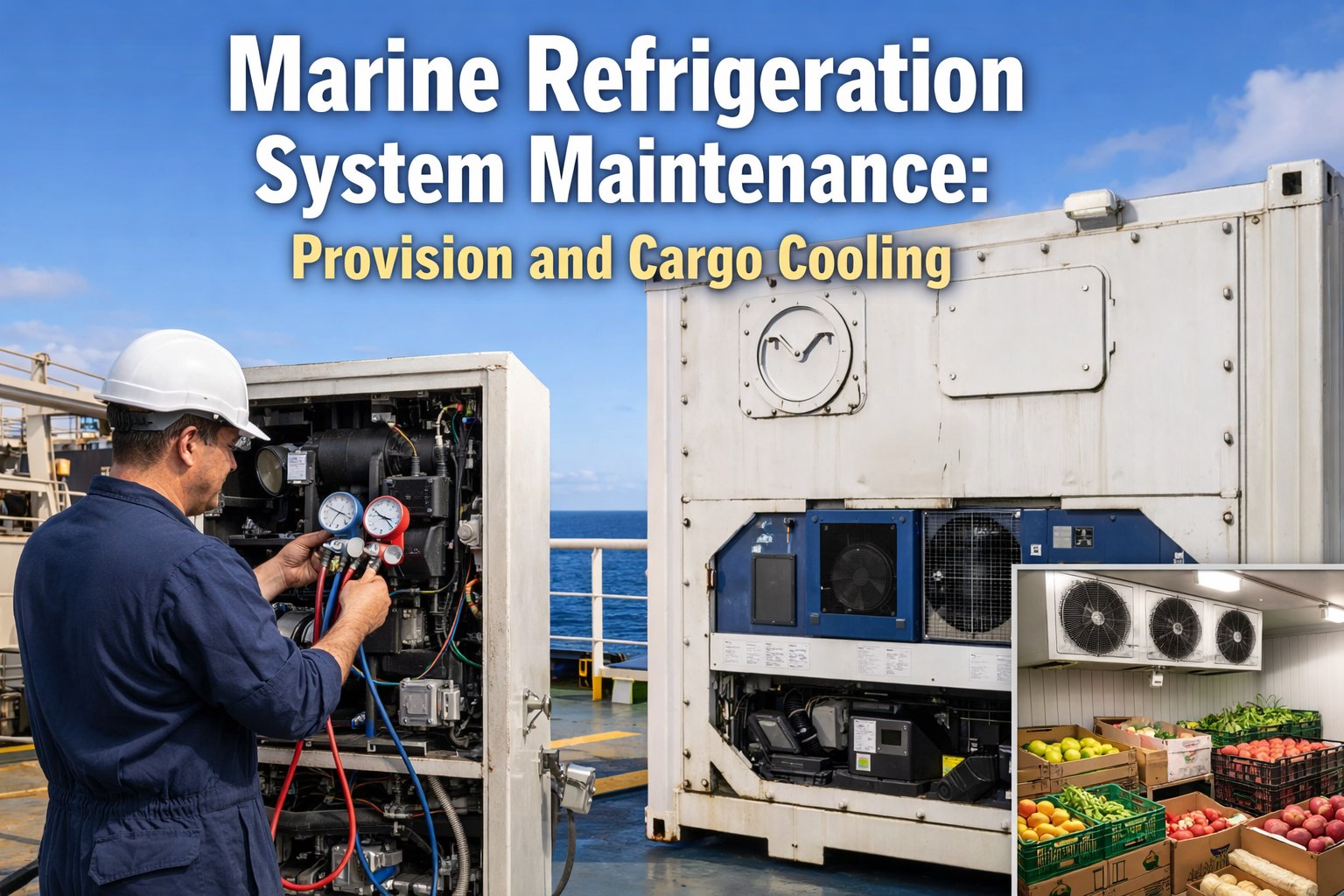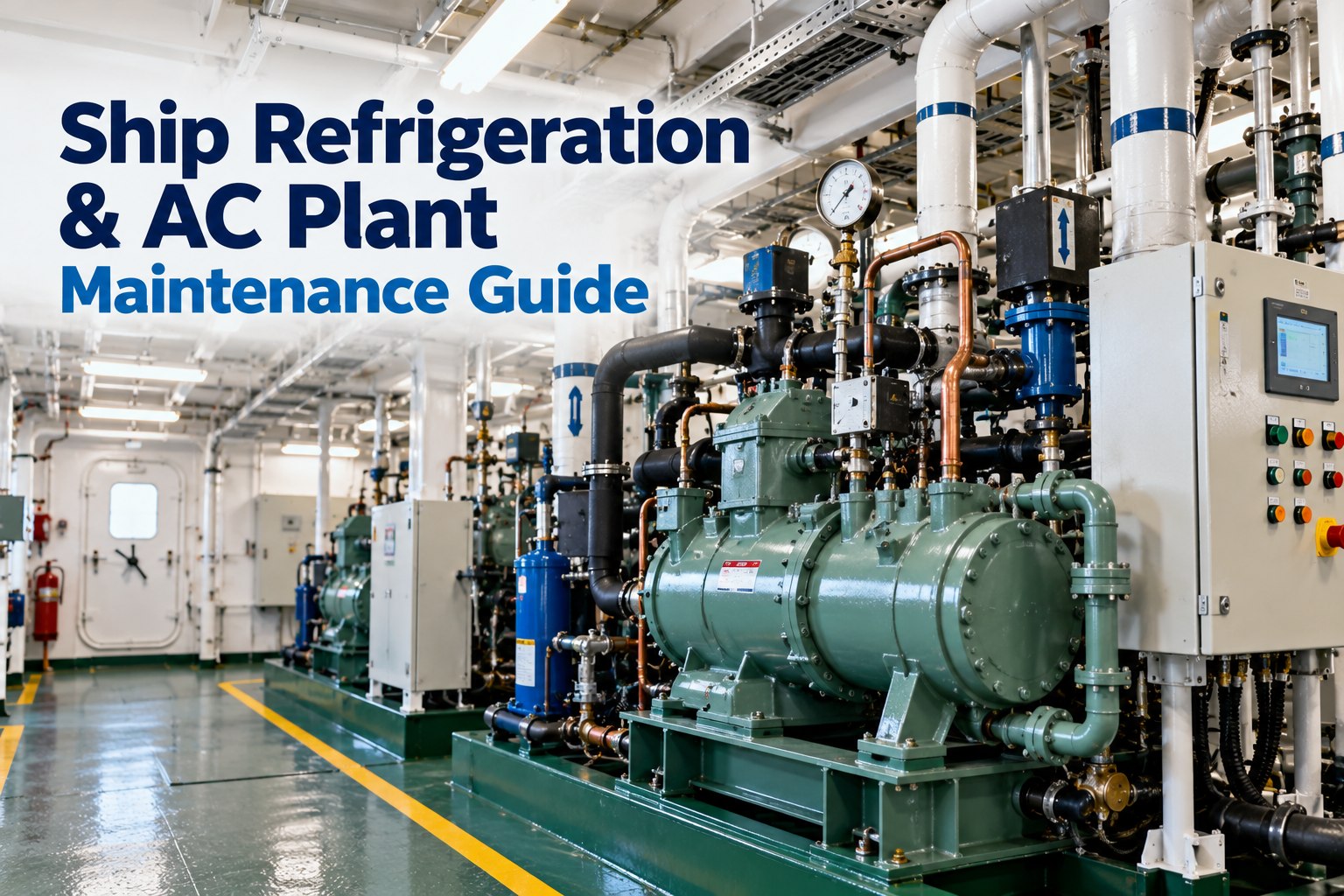
Ship refrigeration maintenance keeps the provision rooms cold, the accommodation air conditioning working and the refrigerant where it belongs: inside the system. It covers compressor checks, condenser and evaporator care, refrigerant leak tests and the ODS and F-gas records that MARPOL Annex VI and, for EU-flagged ships, the EU F-gas rules require. Get it wrong and the cost is spoiled provisions far from port, a hot accommodation in the tropics, refrigerant vented to atmosphere and a record book that fails an inspection.
Cold rooms, cool cabins, no lost gas: running a ship’s reefer and AC plant without surprises
Compressor rounds, leak tests and refrigerant records in one routine that survives every crew change.
Free sign-up · Offline checklists at sea · Signed PDF records
On most cargo ships the provision refrigeration plant is a small direct-expansion system with two compressors, a sea-water cooled condenser and evaporators in each cold room, sometimes sharing a condenser or compressor with the air conditioning. The AC plant is larger, running either direct expansion through an air handling unit or a chilled water loop. Both are usually looked after by the second or third engineer, and both are easy to neglect until something goes warm.
This guide follows the plant from the refrigeration cycle through the maintenance routine, compressor care, leak testing, records, troubleshooting and AC air handling. If you want the daily rounds and monthly leak checks on a phone checklist that works offline, you can start logging refrigeration tasks free.
How a ship refrigeration plant works, and where it fails
Every vapour-compression plant on board, from the provision rooms to the AC, runs the same four-stage cycle. Knowing where each stage fails makes fault-finding much faster.
Compressor
Raises refrigerant vapour to high pressure and temperature.
Condenser
Sea water or air removes heat; vapour condenses to liquid.
Expansion valve
Meters liquid into the evaporator and cuts its pressure.
Evaporator
Liquid boils off, taking heat out of the room or air.
Driers, sight glasses, solenoid valves, oil separators and pressure switches sit around this loop and cause many of the day-to-day faults.
Ship refrigeration maintenance routine: daily to annual tasks
Set the exact tasks from the maker’s manual and your planned maintenance system. A typical routine for provision and AC plants looks like this:
| Task | Daily | Weekly | Monthly | Yearly |
|---|---|---|---|---|
| Room temperatures and alarms checked | ||||
| Suction, discharge and oil pressures logged | ||||
| Sight glass: bubbles and moisture indicator | ||||
| Compressor oil level and running noise | ||||
| Evaporator ice and defrost operation | ||||
| Cold room doors, seals and curtains | ||||
| Leak check with electronic detector | ||||
| Condenser sea water side and filters | ||||
| AC filters, drains and fan belts | ||||
| Safety cut-outs (HP, LP, oil) tested | ||||
| Condenser tubes cleaned and inspected | ||||
| Compressor oil changed, valves inspected |
Typical practice, not a rule. Statutory leak-check intervals for EU-flagged ships depend on the charge size (see below). Plan the routine in a preventive maintenance schedule.
Reefer compressor maintenance: what to check and record
The compressor is the heart of the plant and the part most often blamed. Many compressor faults are really condenser, expansion valve or charge problems, so read the pressures before opening anything up. Each check below has a checkpoint type, so the record shows what was actually done.
Pressures and temperatures
Suction, discharge and oil pressures, discharge temperature and room temperature, logged at the same time each day so trends show.
Oil level and colour
Level in the sight glass with the compressor running. Dark or foaming oil points to overheating or refrigerant in the crankcase.
Safety cut-outs
High pressure, low pressure and oil pressure switches tripped at their set points and reset as the maker directs.
Superheat
Suction line temperature against saturation temperature. Too low risks liquid reaching the compressor; too high starves the evaporator.
Belts, couplings and mountings
Tension, wear and alignment on belt drives; vibration mountings and pipe supports for cracking.
Overhaul findings
Valve plate, piston and bearing condition with photographs and parts used, against running hours.
Log every reefer reading, leak check and refrigerant top-up in one place
Readings that drift raise a job, and every kilogram of refrigerant added goes straight into the record.
Free to start · Works offline on board · Export to signed PDF
Refrigerant leak test on ships: methods and how often
Refrigerant leaks are the most common reefer fault and the most expensive to ignore: the plant loses capacity, the compressor works harder, and every kilogram lost is a release that has to be recorded. Use more than one method, because each finds different leaks.
Electronic detector
Handheld sniffer moved slowly along joints, valves and flare nuts. The routine method for monthly checks.
Soap solution
Bubbles pinpoint a leak the detector has narrowed down. Cheap and reliable on accessible joints.
UV dye
Dye in the oil shows under a UV lamp. Useful for slow leaks in hard-to-reach places, if the maker allows dye.
Pressure hold test
Dry nitrogen pressure held after repairs, watching the gauge over time. Proves the repair before recharging.
EU F-gas leak-check intervals by charge size (without leak detection)
Intervals as summarised by Ireland’s EPA for the F-gas Regulation; a working leak detection system doubles each interval, and systems of 500 t CO2e or more need automatic leak detection. The regulation was replaced by Regulation (EU) 2024/573, so confirm current thresholds with your flag and refrigerant supplier.
F-gas record and ODS Record Book on ships: what the rules require
Two sets of rules decide what goes in the refrigerant records. MARPOL Annex VI applies worldwide; the EU F-gas rules apply to EU-flagged ships. For the wider Annex VI picture, see MARPOL compliance.
- Deliberate emissions of ozone-depleting substances prohibited
- New installations containing HCFCs prohibited on ships built on or after 1 January 2020
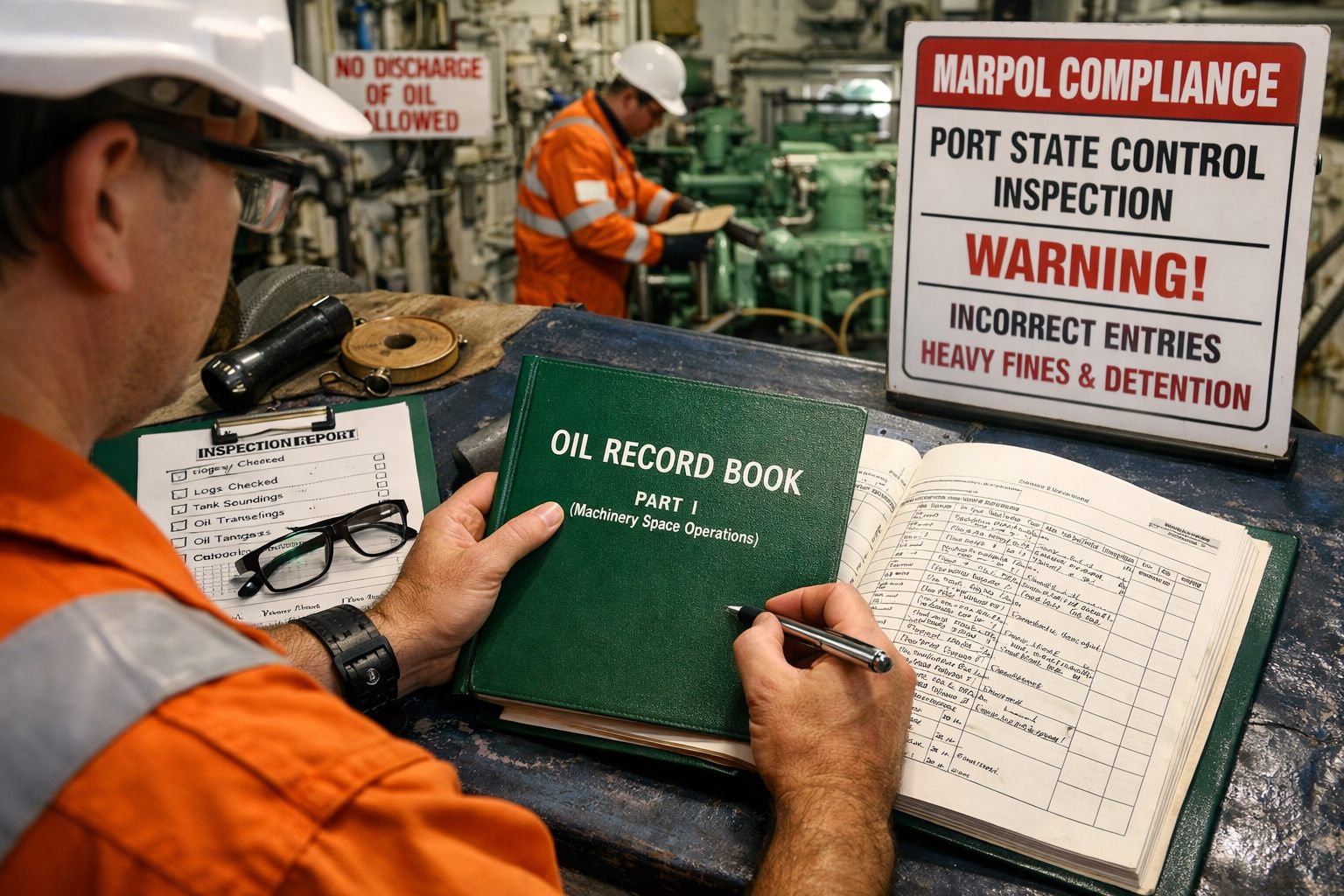
- Ships with rechargeable ODS systems keep an ODS Record Book, in a logbook or approved electronic system
- Entries in kg for recharges, repairs, releases, discharges ashore and ODS supplied to the ship
- Periodic leak checks on systems of 5 t CO2e or more
- Since 1 January 2020, no virgin refrigerant with GWP of 2,500 or more to service systems of 40 t CO2e or more; recovered gas allowed until 2030
- Records per system: gas type and quantity, leak-check dates, gas added, gas recovered
- Labelling with gas type, charge and CO2e
The ODS points follow the Bahamas Maritime Authority’s notice on HCFC refrigerants; the F-gas points follow West P&I’s 2020 summary of the earlier F-gas Regulation. Older ships still running R-22 should plan a refrigerant change: supplies are getting scarcer and dearer.
Marine refrigeration troubleshooting: symptom, cause and fix
Start every diagnosis with the pressures, the sight glass and the room temperature. Together they usually point to one stage of the cycle.
| Symptom | Likely cause | Check | Fix |
|---|---|---|---|
| Room warm, low suction pressure | Short of refrigerant, blocked drier or expansion valve | Sight glass bubbles, drier temperature difference, superheat | Find and repair leak, renew drier, recharge and record |
| High discharge pressure | Fouled condenser, low sea water flow, air in system | Sea water inlet and outlet temperatures, strainer, condenser | Clean condenser and strainer; purge non-condensables |
| Compressor short cycling | Low charge, LP switch set too close, iced evaporator | LP setting, evaporator, charge | Correct setting, defrost, repair leak |
| Evaporator iced up | Defrost heater or timer fault, door left open, fan fault | Defrost cycle, heater current, door seals | Repair defrost, manual defrost, fix seals |
| Moisture indicator shows wet | Moisture entered during repair or through a leak | Indicator colour after running | Renew drier; evacuate and recharge if severe |
| Compressor noisy, oil foaming | Liquid slugging, refrigerant in oil, worn parts | Superheat, crankcase heater, oil level | Correct superheat, check heater, overhaul if worn |
| Compressor will not start | Safety cut-out tripped, electrical fault | Which cut-out, motor and starter | Find the trip cause before resetting |
Marine AC plant maintenance: air handling, filters and drains
Marine air conditioning keeps accommodation liveable in the tropics, and the Maritime Labour Convention expects accommodation to be air conditioned except on ships regularly trading where the climate makes it unnecessary. Most AC complaints trace to a handful of problems on the air side.
Engine room AC and provision plants often share condensers and sea water pumps. For the wider engine room plan, see engine room maintenance.
How Marine Inspection supports ship refrigeration maintenance
Marine Inspection turns the refrigeration routine into checklists the crew complete on a phone, online or offline, with readings, photos and refrigerant quantities captured as they go.
Plans scale from one ship to a fleet; see Marine Inspection pricing.
Ship refrigeration maintenance: keep it cold, keep it sealed, keep it recorded
Ship refrigeration maintenance comes down to reading the plant every day, finding leaks early, keeping the condenser and evaporators clean and recording every kilogram of refrigerant that goes in or comes out. Do that and the provision rooms stay cold, the cabins stay cool and the ODS and F-gas records stand up to any inspection. Keep the daily readings in a digital engine room logbook so the trend is there when you need it.
Stop losing refrigerant you never recorded
Daily reefer rounds, leak checks and refrigerant entries, logged on board and ready for every inspection.
Free sign-up · Offline at sea · Signed PDF reports