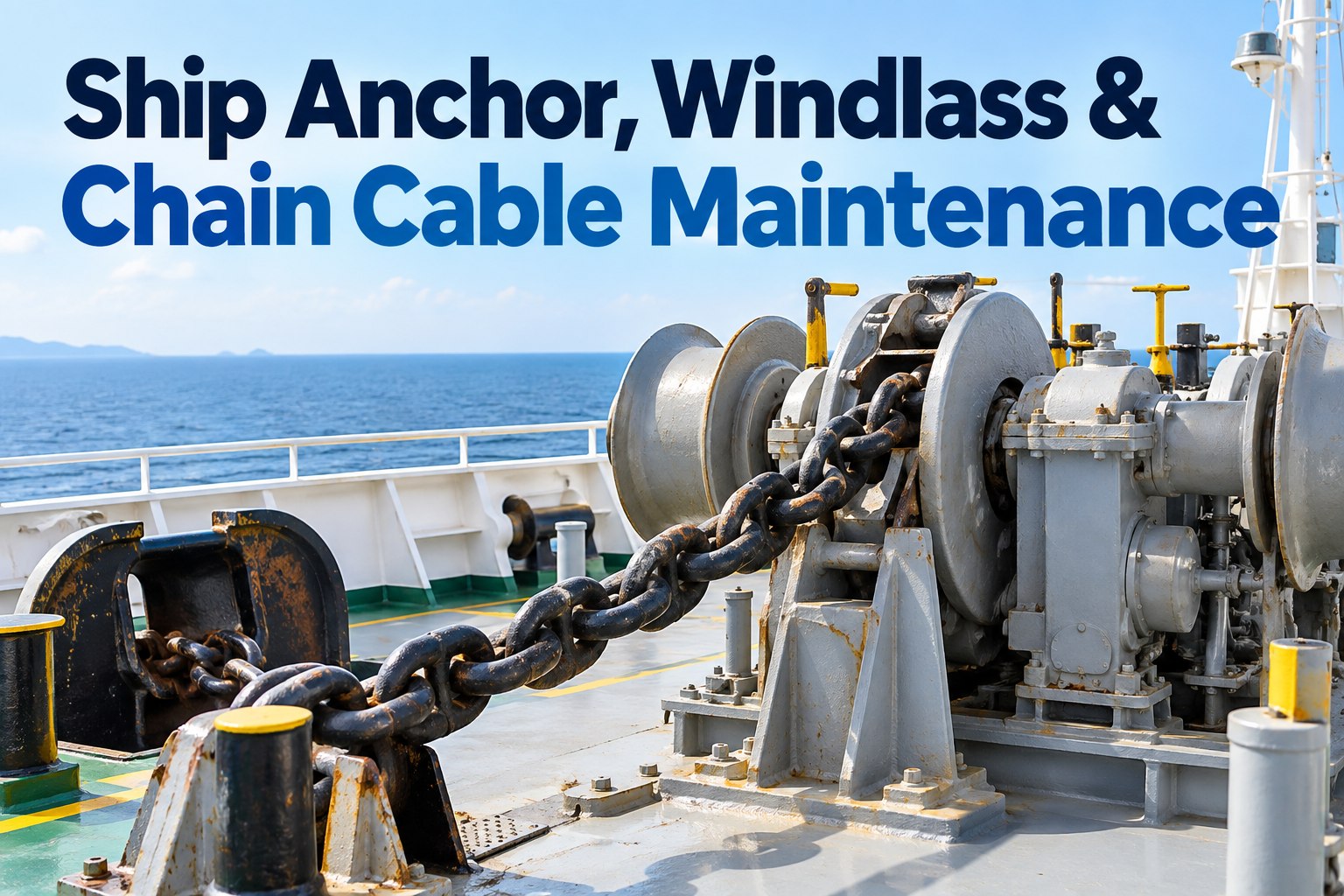
Anchoring equipment is designed around a deliberate order of failure, and almost nobody on deck could recite it. The chain is the strongest thing in the system. The windlass brake is set to hold a defined fraction of what the chain can take. The bitter end is secured by an arrangement engineered to let go before either of them is destroyed. Understood that way, most anchor losses stop looking like bad luck and start looking like a system doing exactly what it was built to do, in circumstances it was never built for — because the whole arrangement is designed for temporary mooring in a sheltered area, in good holding ground, against 25 m/s of wind and 2.5 m/s of current, with no waves assumed at all. This guide covers what the equipment is actually rated for, chain cable marking and construction, gauging and the 12 per cent rule, windlass brake capacity and testing, the bitter end, chain locker condition, why anchors get lost, and a maintenance and troubleshooting set for the whole forecastle. Start a free trial of Marine Inspection to keep gauging records, brake tests and anchoring equipment inspections in one place.
The designed order of failure
Every part of the anchoring system is rated against one number
That number is the chain’s specified minimum breaking strength. Brake capacity, stopper design load and the bitter end arrangement are all fractions of it, set so that the cheapest component surrenders first.
IACS unified requirements state the design intent plainly, and it is far narrower than most people assume. Anchoring equipment is for temporary mooring within a harbour or sheltered area while a ship awaits berth or tide — not for riding out weather.
25 m/s
Assumed wind speed
Roughly Beaufort 10. Above that the arrangement is outside its design basis, whatever the chain can take.
2.5 m/s
Assumed current
About five knots. Tidal streams beyond this load the system past what it was sized for.
No waves
The base condition assumes no wave action at all. An alternative case for larger vessels assumes 1.54 m/s current, 11 m/s wind and 2 m significant wave height.
Assumed sea state
Scope 6
Minimum chain scope
Six times the water depth, as a minimum. Short scope converts horizontal pull into vertical lift and breaks the anchor out.
Good ground
Assumed holding
Holding power falls sharply in poor ground. Rock, weed, soft mud and shale all reduce it well below the design figure.
82.5 m
Windlass hoisting test
Three shots of chain with the anchor submerged and hanging free, at a mean cable speed of at least 0.15 m/s.
The single most useful thing to know about your anchors
They are not storm equipment. The design assumptions above describe a ship waiting for a berth, not a ship trying to hold position in heavy weather. When forecast conditions exceed them, the correct decision is to weigh and go to sea early — while the windlass can still recover the cable, which it cannot reliably do once the ship is snatching at the chain. Anchor losses and dragging incidents cluster around masters who waited one forecast cycle too long, and in almost every case the equipment performed exactly as specified.
Chain cable, shackle by shackle
Chain is supplied and measured in shackle lengths — 15 fathoms, or 27.5 metres — joined by connecting links and marked so that the length out can be read from the deck in poor light. Marking conventions vary between fleets, but the principle does not: the marks must be legible, maintained, and understood identically by everyone on the forecastle. See how gauging and inspection records are held per shackle rather than as a single dry-dock certificate.
Common studded link
The stud is structural, not decorative — it stops the link collapsing under load and keeps the cable from knotting. A loose or missing stud is a defect, not cosmetic wear, and the allowances for movement before survey are measured in millimetres.
Joining shackles
Connect shackle lengths. They are gauged and assessed on the same basis as the chain itself, and the lead pellet and taper pin arrangement needs checking — a joining shackle that works loose in service takes the cable and anchor with it.
Swivel and anchor crown shackle
The swivel prevents turns building in the cable. Lateral movement in the eyelet is a renewal criterion in its own right, at around five per cent of the eyelet axle diameter.
Cable markings
Paint and wire turns at each shackle joint, repainted every docking and checked after any chain work. A mark nobody can read at night is the reason ships let go more cable than intended.
Gauging and the 12 per cent rule
Chain is ranged, gauged and examined at the special survey. Mean diameter is taken as the average of two measurements at right angles at the point of maximum wear, and the accepted criterion is straightforward: consideration for renewal once wear reaches 12 per cent of the original diameter, which is to say a remaining diameter of 0.88 times the original. The same 12 per cent figure applies to cable fittings, joining shackles and anchor pins.
Where the wear actually is — diameter loss by shackle, one cable
Illustrative distribution. Wear concentrates in the shackles that actually leave the hawse pipe, which is why turning the cable end for end at survey redistributes the remaining life instead of condemning a nearly new outboard half.
Measure at the point of maximum wear
Not at a convenient spot on the link. Wear concentrates where links bear on each other, so the measurement is taken there, twice, at right angles, and averaged.
Studs must be tight at survey
Limited movement is tolerated before the formal survey — axial movement within about 3 per cent of cable diameter, lateral within about 5 per cent, and a gap under 3 mm — but at survey there should be no looseness. Loose studs mean renewal or an approved weld repair.
Record every shackle, every time
A single worst-case figure tells you nothing about the trend. Shackle-by-shackle records across two or three surveys show the wear rate and let you plan renewal a docking ahead rather than discovering it in the yard.
Turn the cable end for end
The oldest and most effective chain economy there is. Moving the worn inboard-working shackles to the outboard end evens out wear across the whole cable and can defer renewal by years.
Gauging records that survive the next crew change
Shackle-by-shackle diameters, brake test results, bitter end inspections and cable work history — captured with photo evidence and held fleet-wide, so the wear trend is there the next time someone asks whether the cable will make another five years.
The brake is the component that decides whether an anchor is controlled or lost, and its required capacity depends on whether a chain stopper is fitted. With a stopper, the brake must hold 45 per cent of the chain’s specified minimum breaking strength without slipping. Without one, that rises to 80 per cent — and where a stopper is fitted, it and its attachments are themselves designed for 80 per cent without permanent deformation.
Test the brake, do not assume it. Holding capacity is tested to the ship’s specified figure, with the result recorded. A brake that has never been tested is an unknown quantity at exactly the moment you need certainty.
Lining condition and linkage travel. Worn linings, a stretched linkage or a handwheel that runs out of thread all reduce the force reaching the band. Check the remaining lining thickness and the adjustment range, not just that the brake feels tight.
Keep the band dry and the drum clean. Oil or grease on the brake path destroys holding capacity. Grease points near the band deserve particular care, and overfilled bearings are a common source.
The gypsy must match the chain. A worn gypsy or a mismatched pocket profile lets the cable ride and jump, which damages the chain, the whelps and anything nearby. Check snugging and pocket wear at every docking.
Exercise it before you need it. Windlasses sit idle for weeks then get asked for full duty in bad conditions. Running the gear briefly before arrival finds the seized control or the water in the hydraulics while there is still time to do something.
Guards, stops and communications. Rotating parts guarded, emergency stops proven, and a working communication link to the bridge. Forecastle injuries happen in the noise and spray where hand signals get misread.
The bitter end is meant to let go
The inboard end of the cable is secured by an arrangement designed to fail before the chain does — class rules commonly require it to withstand a proportion of the chain’s breaking strength in the region of 15 to 30 per cent — and, critically, to be releasable from outside the chain locker. The whole point is that a cable running out of control can be let go deliberately, by someone who is not standing in the locker.
Prove the release works
The release must operate from outside the locker, by one person, without entering. Seized pins, painted-over mechanisms and releases buried behind stores are all findings — and all common.
Inspect the attachment and its structure
Not just the link, but the bracket, the bolts and the plating it lands on. Corrosion in the locker attacks exactly this fitting, because it sits in the wettest, worst-ventilated part of the ship.
Know which mark warns you
The last shackle should be marked so the windlass operator knows the end is approaching. Running the bitter end out because nobody saw it coming is a preventable loss of both anchor and cable.
Locker entry is enclosed-space entry
Oxygen-deficient, unventilated, with mud and decomposing organic matter. It is entered under permit with gas testing and a standby person, never for a quick look during cable work.
Why anchors get lost
Dragging in conditions past the design basis. Wind or current beyond the assumed figures, in poor holding ground, with insufficient scope. The commonest cause by far.
Letting go instead of walking back in deep water. Free-falling a cable in deep water builds speed the brake cannot absorb; the brake overheats, the cable runs and the bitter end does its job.
Brake never tested. Holding capacity assumed rather than proven, with worn linings or a linkage out of adjustment.
Joining shackle failure. Taper pin or lead pellet missing or working loose after cable work that was never properly checked.
Chain jumping the gypsy. Worn pockets, worn chain, or a mismatch after a partial cable renewal with links of different wear.
Anchor not properly housed or secured. Lashings and devil’s claw not set for sea, so the anchor works in the hawse pipe until something gives.
Fouled anchor. Cables, pipelines and wrecks in the anchorage. Checking the chart for obstructions before letting go costs nothing.
Worn cable left in service. Wear past 12 per cent in the working shackles, carried forward because gauging was never trended between surveys.
Maintenance schedule
A practical baseline for anchoring equipment. Class survey requirements and the windlass maker’s manual take precedence, particularly for brake capacity testing and chain renewal decisions.
Interval
Task
What good looks like
Before arrival
Test-run the windlass, check hydraulic or steam supply, prove controls and brake operation
Gear proven working while there is still time to fix it, not at the pilot station
Before departure
Anchors housed and secured, lashings and devil’s claw set, hawse pipe covers fitted
Nothing able to move in a seaway; spurling pipe sealed against water ingress
Weekly
Grease the windlass, check oil levels, inspect brake band and linkage for free movement
Grease where it belongs and nowhere near the brake path
Weekly
Check chain locker for water; pump and confirm the drainage arrangement is clear
Locker dry, bilge suction working, no standing water over the cable
Monthly
Inspect visible cable, gypsy pockets, whelps, chain stopper and guillotine bar
No jumping or riding on the gypsy, stopper free to operate, pins present
Monthly
Verify the bitter end release operates from outside the locker
Mechanism free, accessible, and understood by the duty officers
Quarterly
Check brake lining thickness and adjustment range; record both
Lining within limits with adjustment still in hand, not at the end of the thread
Quarterly
Inspect anchor crown, shank, flukes and the securing arrangements
No cracks or distortion, shackle pins secured, swivel free
Annual
Windlass brake holding capacity test to the ship’s specified figure; record the result
Holds the required percentage of chain breaking strength without slipping
Annual
Overhaul cable lifter clutch and band brake as the manual requires; renew worn parts
Clutch engaging positively, no slip under load
Every docking
Range, gauge and examine the full cable; repaint shackle markings
Diameter recorded shackle by shackle, marks legible and correct afterwards
Every docking
Assess end-for-ending the cable; renew shackles at or near 12 per cent wear
Decision recorded with the gauging data that supports it
Every docking
Clean and inspect the chain locker internally, including the bitter end attachment
Mud removed, coatings and structure sound, attachment and bracket free of wastage
Troubleshooting matrix
Symptom
Likely causes, in order
What to do
Brake will not hold the cable
Linings worn or glazed; oil or grease on the band; linkage out of adjustment; band distorted
Stop paying out and take the weight on the stopper. Inspect and adjust before any further use — do not simply pull harder on the handwheel.
Brake smoking or overheating
Cable running too fast, usually from letting go in deep water rather than walking back
Take the weight on the stopper if it can be done safely, let the brake cool, and review the anchoring method for the depth.
Chain riding or jumping the gypsy
Worn pockets; chain worn out of profile; mismatched links after partial renewal; snugger worn
Stop heaving. Check gypsy and chain wear together — replacing one without the other repeats the fault.
Confirm the anchor is not fouled before blaming the machinery. Check pressure against the plate and test the relief valve setting.
Cable comes up with turns in it
Swivel seized; ship swung repeatedly at anchor; cable stowed with turns from previous work
Free or renew the swivel. Turns left in the cable make the next recovery worse and stress the anchor connection.
Loose studs found at gauging
Cable age and service; overload event; manufacturing or repair defect
Renew affected links or repair by an approved welding procedure. Loose studs at survey are not acceptable.
Joining shackle loose
Taper pin backed out; lead pellet missing; assembled incorrectly after cable work
Remake the shackle correctly with a new pin and pellet, and review who checks cable work afterwards.
Water in the chain locker
Spurling pipe seal missing or damaged; hawse pipe cover not fitted; locker drain blocked
Clear the drain, restore the seals. Standing water accelerates corrosion of the bitter end attachment more than anything else.
Bitter end release seized
Corrosion; painted over; obstructed by stores or structure
Free, service and prove the release. This is a safety device, and it is checked from outside the locker.
Anchor working in the hawse pipe at sea
Lashings slack; devil’s claw not set; brake relied on alone for sea-fastening
Set the mechanical securing properly. The brake is not a sea-fastening and was never intended as one.
Frequently asked questions
How much wear is allowed on anchor chain before renewal?
Renewal is considered once mean diameter has worn by 12 per cent of the original, giving a minimum acceptable diameter of 0.88 times the original. Mean diameter is the average of two measurements taken at right angles at the point of maximum wear. The same 12 per cent criterion is applied to cable fittings, joining shackles and anchor pins.
What holding capacity must a windlass brake have?
Where a chain stopper is fitted, the brake must hold 45 per cent of the chain’s specified minimum breaking strength without slipping. Where no stopper is fitted, the requirement rises to 80 per cent. A fitted chain stopper and its attachments are themselves designed to take 80 per cent without permanent deformation.
What conditions is anchoring equipment designed for?
Temporary mooring within a harbour or sheltered area, in good holding ground, with a minimum chain scope of six times the water depth, assuming a current of 2.5 m/s and wind of 25 m/s with no waves. An alternative case for larger vessels assumes 1.54 m/s current, 11 m/s wind and 2 m significant wave height. It is not designed to hold a ship in heavy weather.
How long is a shackle of chain?
15 fathoms, which is 27.5 metres or 90 feet. Chain is supplied and marked in these lengths, joined by connecting shackles, so that the amount of cable out can be read from the deck.
Why is the bitter end deliberately weaker than the chain?
So that a runaway cable parts at a known, cheap point rather than tearing out the locker structure. Class rules commonly require the inboard attachment to withstand a proportion of the chain’s breaking strength in the region of 15 to 30 per cent, and to be releasable from outside the chain locker so it can be let go deliberately without anyone entering.
What is the windlass hoisting requirement?
Testing is carried out over two shots of chain, starting with at least three shots — 82.5 metres, or 45 fathoms — out and the anchor submerged and hanging free, with a mean cable speed of at least 0.15 m/s during recovery.
What does end-for-ending the cable achieve?
It moves the heavily worn shackles, which are the ones that actually leave the hawse pipe, to the inboard end where they see little use, and brings the near-new inboard shackles into service. It evens wear across the whole cable and can defer renewal by years for the cost of the cable work.
What do inspectors check on the forecastle?
Windlass condition and brake test records, guards and emergency stops, chain markings, the chain stopper and its securing pins, anchor lashings and hawse pipe covers, the chain locker and its drainage, and whether the bitter end release is accessible and operable from outside the locker.
Keep the cable’s history where the next crew will find it
Shackle-by-shackle gauging, brake tests, bitter end checks and windlass maintenance in one record — captured on the forecastle with photo evidence, and trended across every vessel so renewal is planned rather than discovered.